Direct Proof
^25847a
- Used for proving an "if p then q" (conditional sentence) sentence is true.
- หรือถ้าได้เป็นประโยคมา ก็ลองแปลงให้เป็น Conditional sentence ก่อน
- Its application to prove that a “for all” statement is true.
- A “for all” statement can always be rewritten as an “if-then” statement.
Process of Direct Proof
- First line → Assume that p is true.
- (IN-BETWEEN) USE DEFINITIONS AND OUR BACKGROUND KNOWLEDGE
- Last line → q is true
Proof by Contradiction (Indirect Proof)
- Used for proving an "if p then q" (conditional sentence) sentence is true. — เหมือนกับ Direct Proof
Process of Indirect Proof
- To prove that “if p, then q” is true.
- Assume that “p is true” and “q is true (q is false)”
- and try to derive a “contradiction”
- Always start by 2 assumptions!!
Proof by Contrapositive
- (A special case of proof by contradiction)
- To prove that “if p, then q” is true.
- เวลาใช้อันนี้จะ Proof “if q, the p” instead.
- พอตั้งเสร็จก็ Proof ด้วย Direct Proof ต่อได้เลย
Warning
“Proof by Contradiction” is more powerful than “Proof by Contrapositive”
บางอัน Proof by Contradiction ได้ แต่ Contrapositive ไม่ได้ – แต่ถ้า Contrapositive ได้ Contradiction ได้ทุกอัน!!
Deductive Reasoning
- The process of drawing a conclusion from a sequence of propositions
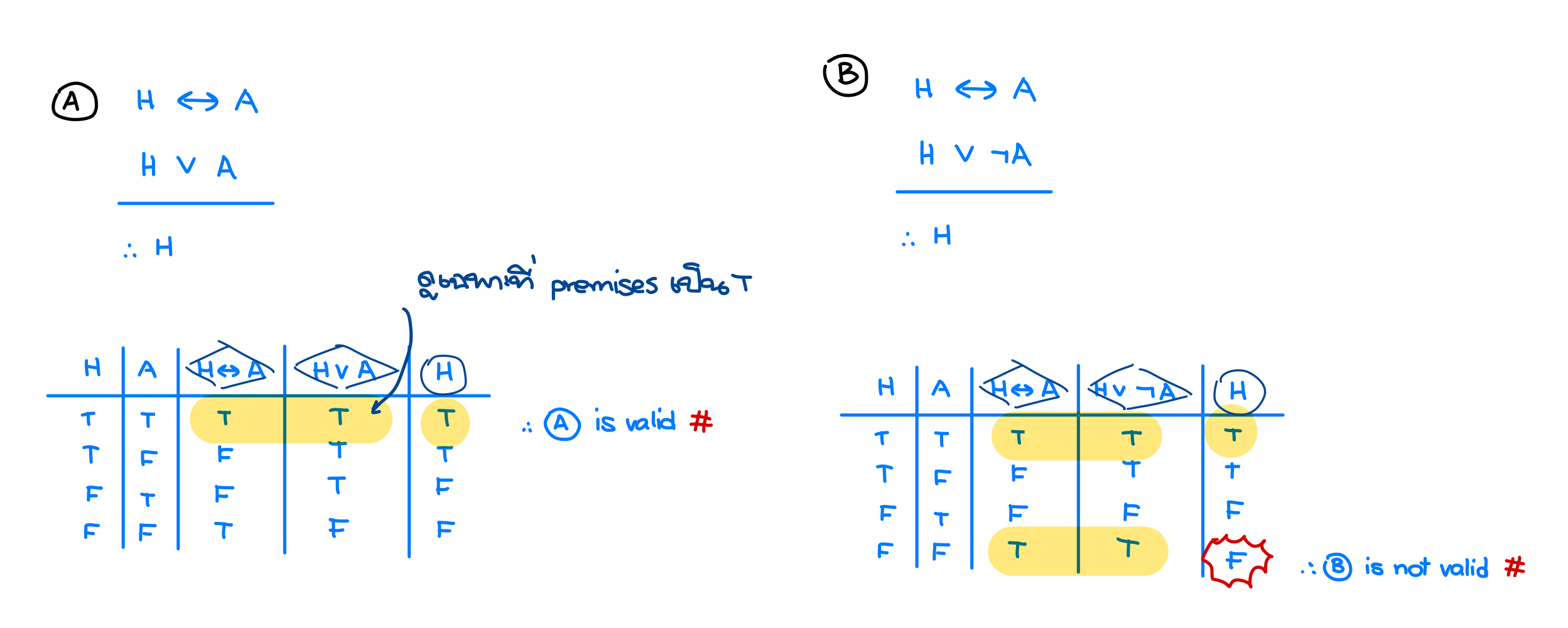
- The argument is valid if an only if:
- if all the premises are true, then the conclusion must be true;
otherwise, the argument is invalid.
- if all the premises are true, then the conclusion must be true;
วิธีทำง่าย ๆ เลยก็คือเอา Premises กับ Conclusion ที่ให้ มาเขียน Truth Table แล้วดูในช่องที่ Premises ทุกตัวเป็น True, แล้วเหมือนกันในทุกช่อง Conclusion ก็ต้องเป็น True ถ้ามีอันใดอันนึงเป็น False ขึ้นมา ถือว่า Invalid ทันที
- แต่ Method นี้จะทำงานได้ดีตอนเฉพาะ Variable น้อย ๆ คือถ้าเยอะ Size ของ Truth Table มันก็ grows exponentially ใช่มะ ๆ
Resolution Proofs
Terms
- Atom (Atomic Formula)
- No logical connective
- Ex: p, q, r
- Literal
- An atom or the negation of an atom
- Ex: p, p, q, q, r, r
- Clause
- A disjunction using OR only of one or more literals
- Ex: p q, p q r, p, p ✅
- Ex: p q ❌
The “resolution” rule works with “clauses” only!!
Process of Resolution Proof
^RPPS
- ทำให้ Premises & Conclusion ทุกตัวเป็น Clauses ก่อน
- If a given sentence is NOT in the form of a clause → Convert to a clause or;
- หรือเป็น A conjunction of clauses ก็ได้ ก็คือเชื่อมด้วย (and) แล้วมันจะแตกออกมาเป็น 2 premises ได้นะ
- ก็คือถ้าพูดจริง ๆ แล้วก็เหมือนว่า Premises ทุกตัว เชื่อมด้วย and อยู่แล้ว
- แล้วก็เอาแต่ละ premises มาจับรวมกัน พยายามให้ได้ Conclusion โดยสมมติว่า
- p จับกับ p q จะเหลือแค่ q ก็คือเหมือนถูกตัดออกไปนั่นเอง
- เราไม่จำเป็นต้องใช้ทุก Premises ขอให้ได้ Conclusion แค่นั้นก็พอแล้ว
Warning
ต้องระวังไว้ด้วย ง่าย ๆ ก็คือ ถ้า Form เป็น Conclusion ไม่ได้ ก็ไม่ได้จำเป็นว่าจะ Invalid ละ จะโชว์ได้ว่า Invalid ก็ต้องใช้ Truth Table (T, T, T – F)
Mathematical Induction
- Use to show that a statement is true;
Process
- มาวิธีการทำเลยดีกว่าจะได้ง่าย ๆ
- ต้องแบ่งออกเป็นสองฝั่ง
- Basis Step
- Induction Step
- โดยต้องทำ Basis Step ก่อนเป็นอย่างแรก เพราะง่ายที่สุด เหมือนได้คะแนนฟรี โดยการแทนตัวเลขลงไป โดยตัวเลขก็ต้องตรงกับ Domain ที่โจทย์กำหนดด้วยนะ
- ต่อมาก็เขียนใน Induction Step
- Assume that is true (induction hypothesis) – เราจะเปรียบเสมือนว่ามันคือ Tool (Helper)
- We want to prive that is true. – อันนี้คือ Task (สิ่งที่เราต้องทำ)
- ละเราก็เขียนลง Memo เล็ก ๆ โดยการแทนตรง ๆ ไปเลย ว่า ได้เป็นอะไร แล้วก็เก็บไว้
- เวลา Prove ก็เริ่มจาก แล้วก็ Prove อีกฝั่ง หรือพยายามจัดรูปอะไรก็แล้วแต่ ไม่มีวิธีตายตัว แต่พยายามจัดให้ได้รูปก่อน แล้วมันจะแทนอะไรบางอย่างได้