#NotOnTheExam
Semiconductor Memory
- While a register can store a limited number of information (dependent on its storage capacity), semiconductor memory is used for storing binary data in LARGE quantities.
- It is normally divided into arrays of elements (cells) that are generally either latches or capacitors.
- The basic units of binary data are: bits, nibble (4-bit), byte (8-bit), word (16-bit), doubleword (32-bit), and quadword (64-bit).
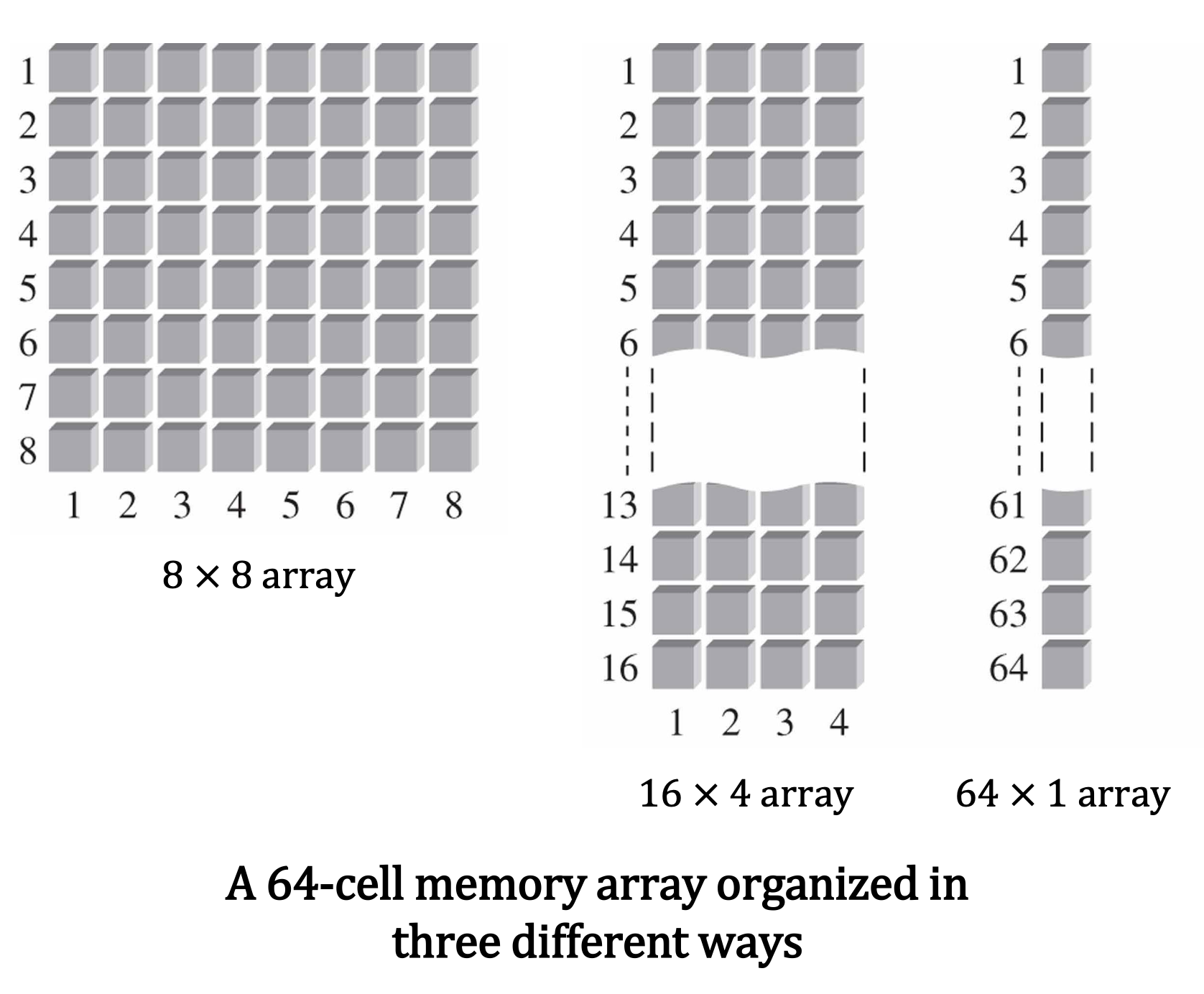
Memory Address and Capacity
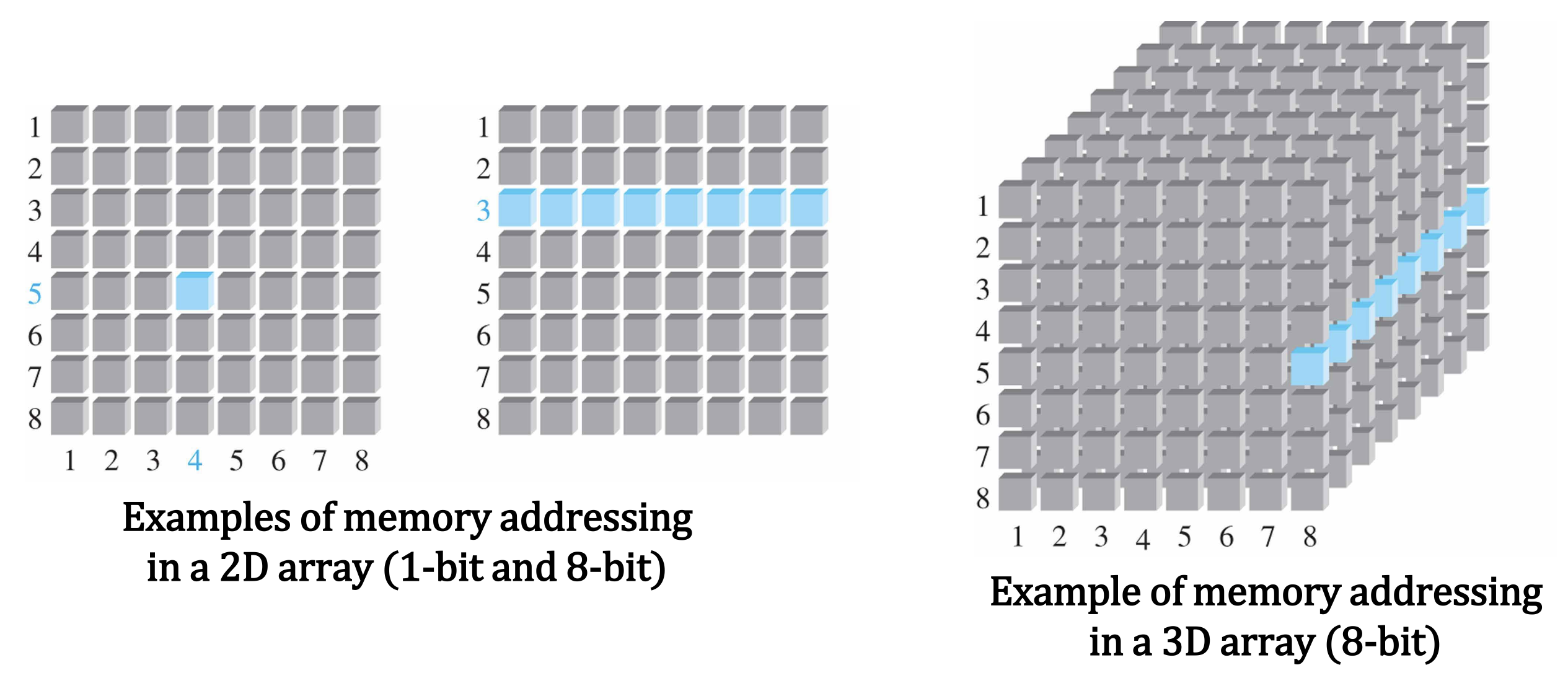
- The location of a unit of data in a memory array is called its address.
- The address will depend on how the memory is organized into units of data. Usually, personal computers have random-access memories organized in bytes. This means that the smallest group of bits that can be addressed is eight.
- The capacity of a memory is the total number of data units that can be stored.
Types of Memory
- Whether simple or complex, every microprocessor-based device has a memory system.
- The two main types of memory are:
- Read-only memory (ROM) → contains system software and permanent system data.
- Need special equipment to write
- Random access memory(RAM) or read/write memory → contains temporary data and application software.
- Read-only memory (ROM) → contains system software and permanent system data.
- Pin connections common to all memory devices are:
- address inputs.
- data outputs or input/outputs.
- selection input.
- control input.
Random Access Memory (RAM)
- Random-access memory (RAM) is one of two major categories of semiconductor memories. All addresses are accessible in an equal amount of time and can be selected in any order for a read or write operation.
- It is a ==volatile memory because it loses stored data when power is turned off.==
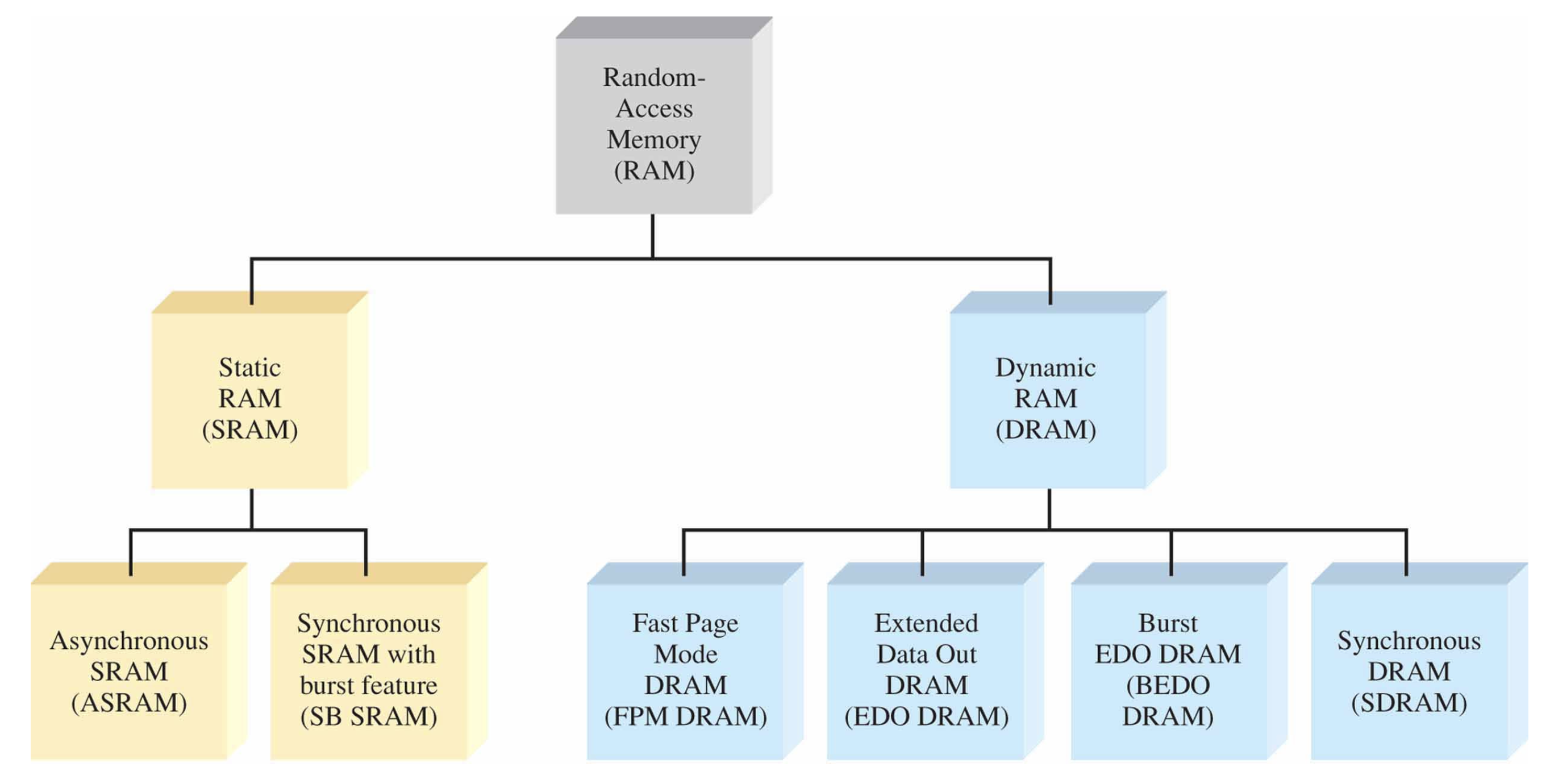
- There are two types of RAMs: static RAM (SRAM) and dynamic RAM (DRAM). SRAMs are faster, but DRAMs can store much more data at a lower cost.
Classifications of RAM memory
Static RAM (SRAM)
- Very fast!
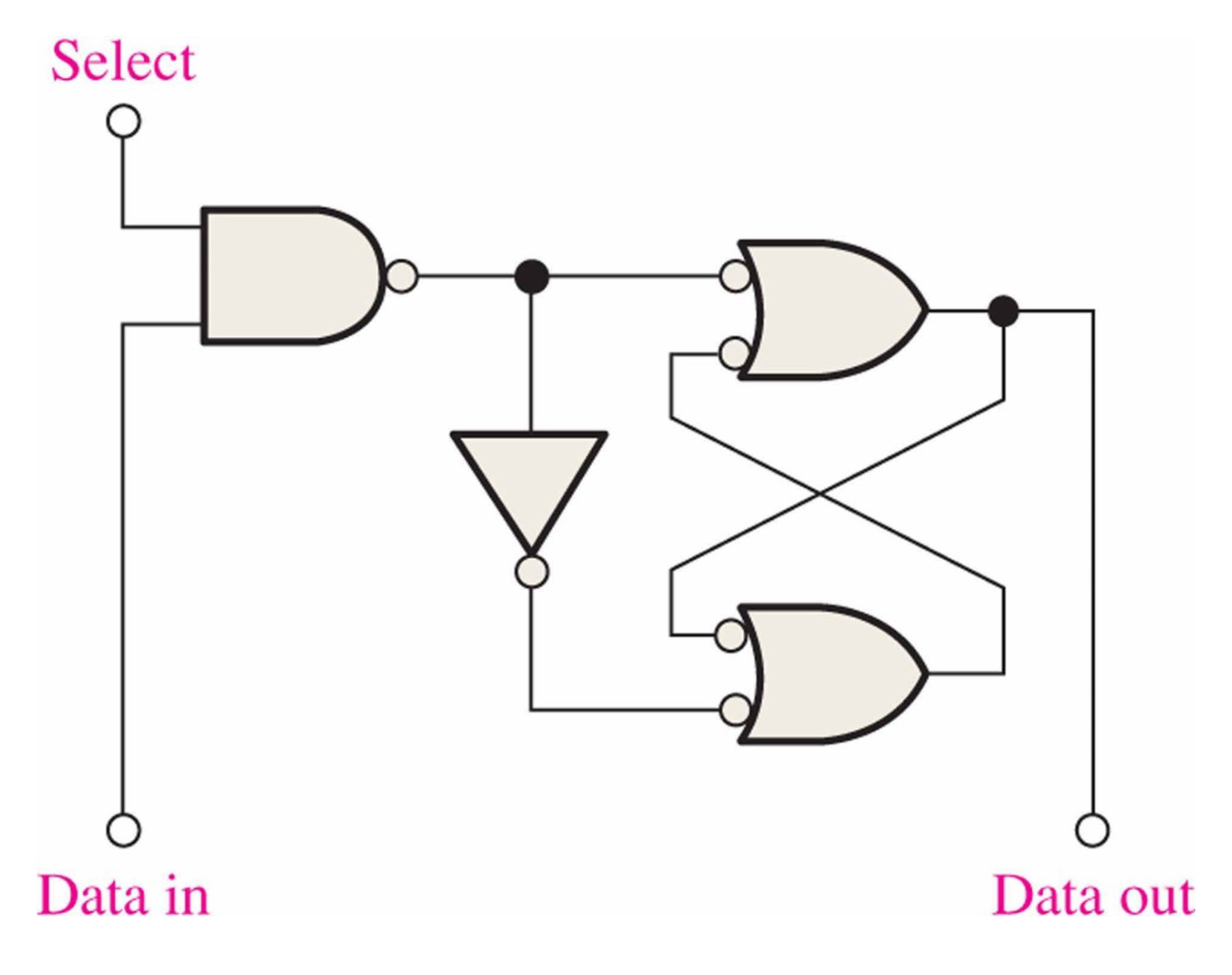
- All SRAMs are characterized by latch memory cells. As long as power is applied to a static memory cell, it can retain a 1 or 0 state indefinitely.
- The structure of a basic SRAM latch memory cell is show below. The cell is selected by an active level on the select line, and a data bit (1 or 0) is written into the cell by placing on the data in line. A data bit is read by taking it off the data out line.
Dynamic RAM (DRAM)
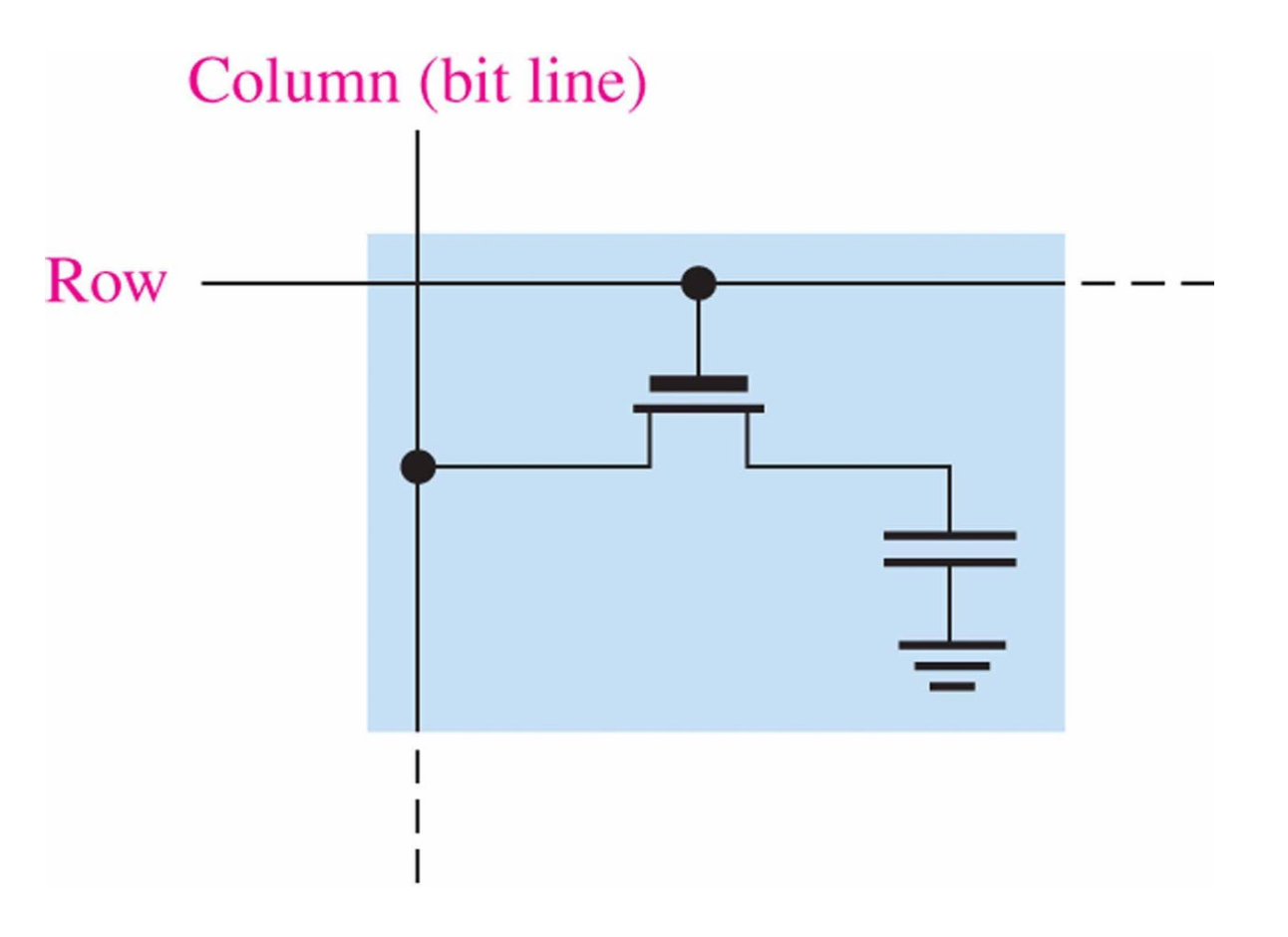
- Dynamic memory cells store a data bit in a small capacitor rather than a latch. It is very simple, thus allowing very large memory arrays to be constructed on a chip at a lower cost per bit.
- The disadvantage is that the storage capacitor cannot hold its charge over an extended period of time, and will lose the stored data unless its charge is refreshed periodically.
- The figure below shows a typical DRAM cell consisting of a MOSFET and a capacitor.
Memory Modules
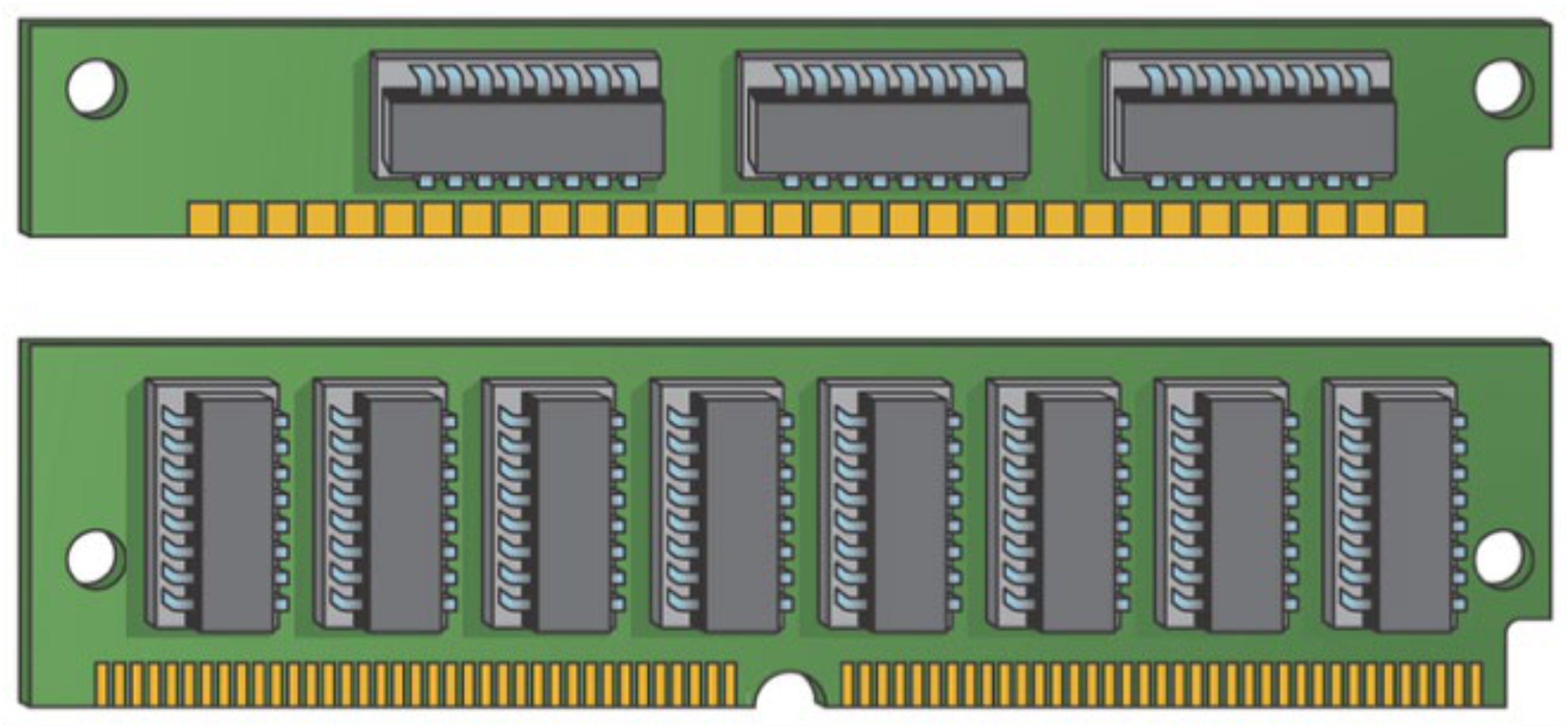
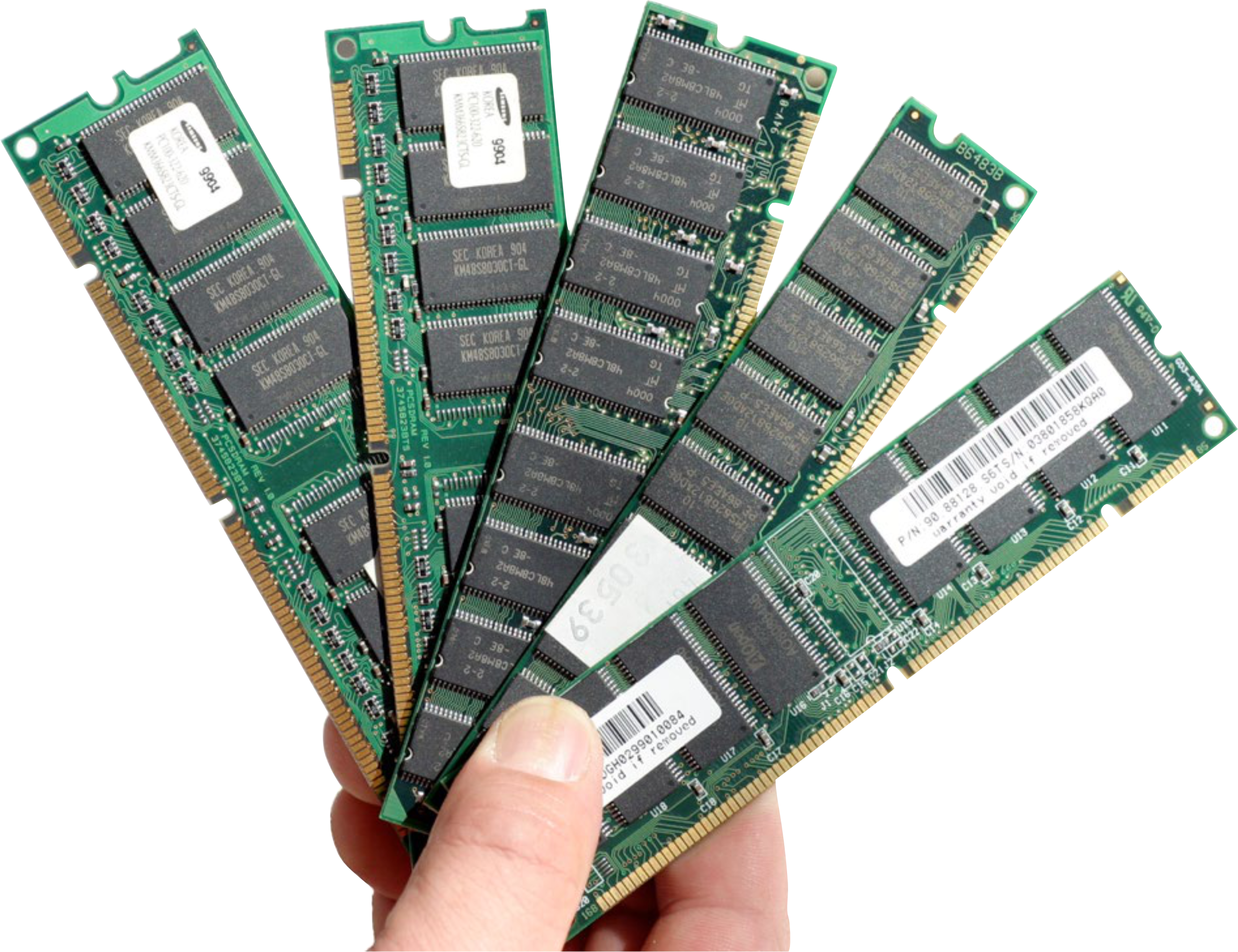
- RAMs are commonly supplied as single in-line memory modules (SIMMs) or as dual in- line memory modules (DIMMs). SIMMs and DIMMs are small circuit boards on which memory chips (ICs) are mounted with the inputs and outputs connected to an edge connector at the bottom of the board.
- SIMMs are available in 30-pin and 72-pin configurations. The main difference is the size of the data path (30-pin SIMMs are designed for 8-bit data buses, 72-pin can accommodate 32-bit data buses).
- DIMMs look similar to SIMMs but provide an increase in memory density with only a slight increase in physical size.
- The key difference is that DIMMs distribute the input and output pins on both sides of the PC board, whereas SIMMs use only one side.
- DIMMs are available in 72-pin, 100-pin, 144-pin, and 168-pin configurations (8-, 16-, 32- and 64-bit wide data buses).
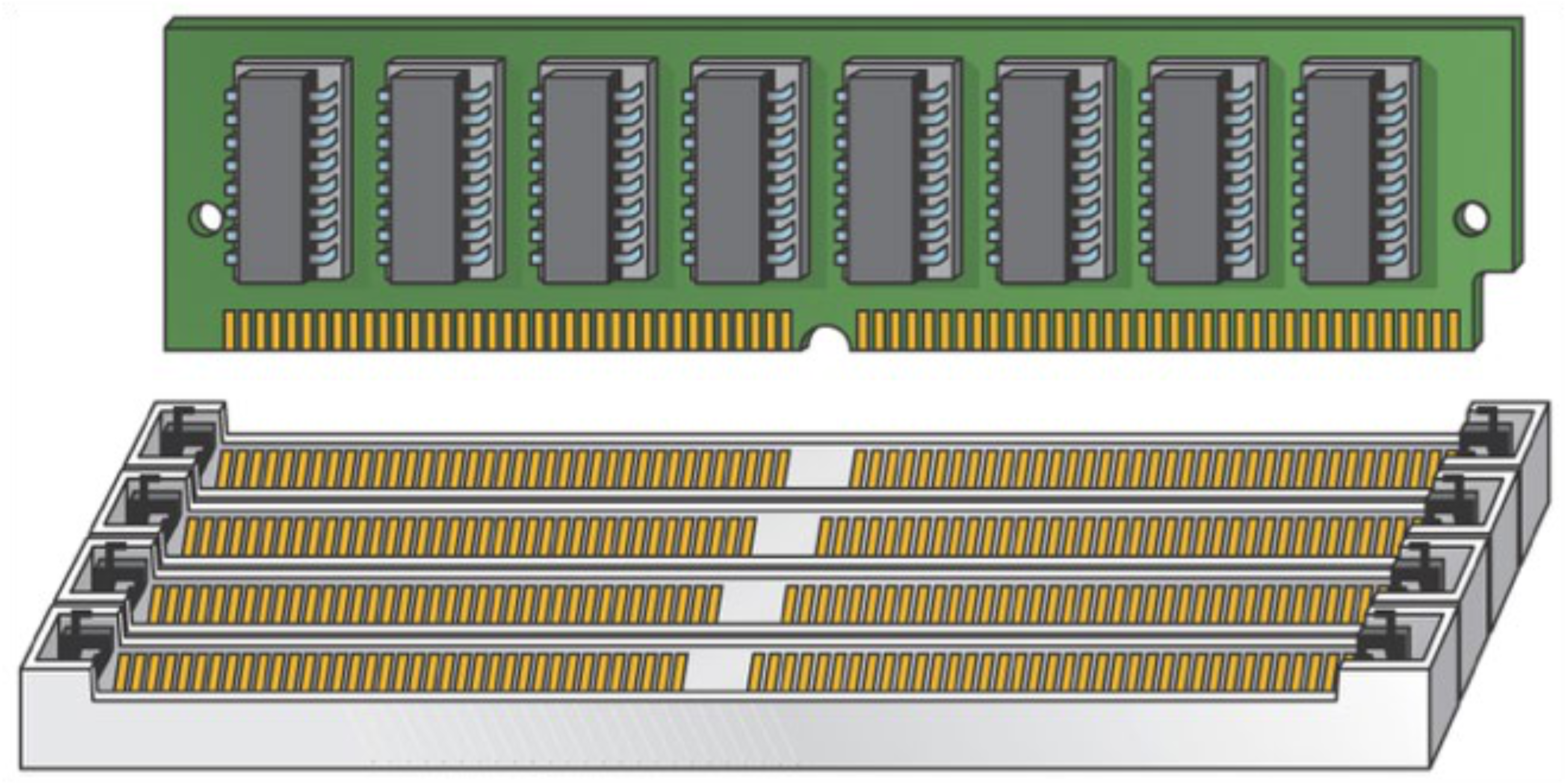
- SIMMs and DIMMs plug into sockets on a system board, as shown below.
Read Only Memory (ROM)
- In fact, you can write to ROM but not so easily
- Read-only memory (ROM) stores permanent or semipermanent data, which can be read from memory but either cannot be changed or cannot be changed without specialized equipment.
- It is especially suited for data that are used repeatedly by system applications and retains information even when the power is off (nonvolatile).
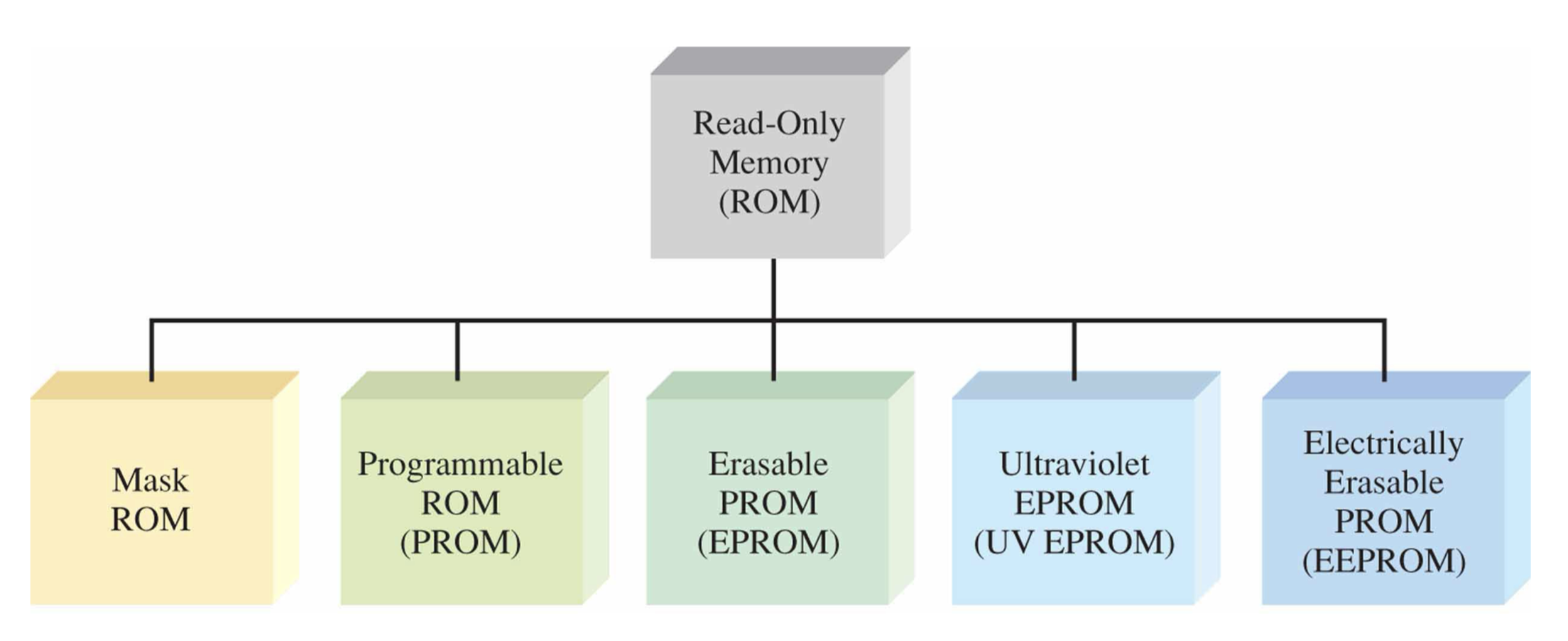
- The main categories of ROMs include:
- Mask ROM — permanently programmed during the manufacturing process to provide widely used standard functions or user-specified functions.
- Programmable ROM (PROM) — uses some type of fusing process to store bits, in which a memory link is burned open or left intact to represent a 0 or a 1.
- Erasable programmable ROM (EPROM) — can be reprogrammed using special equipment (existing program must be erased first).
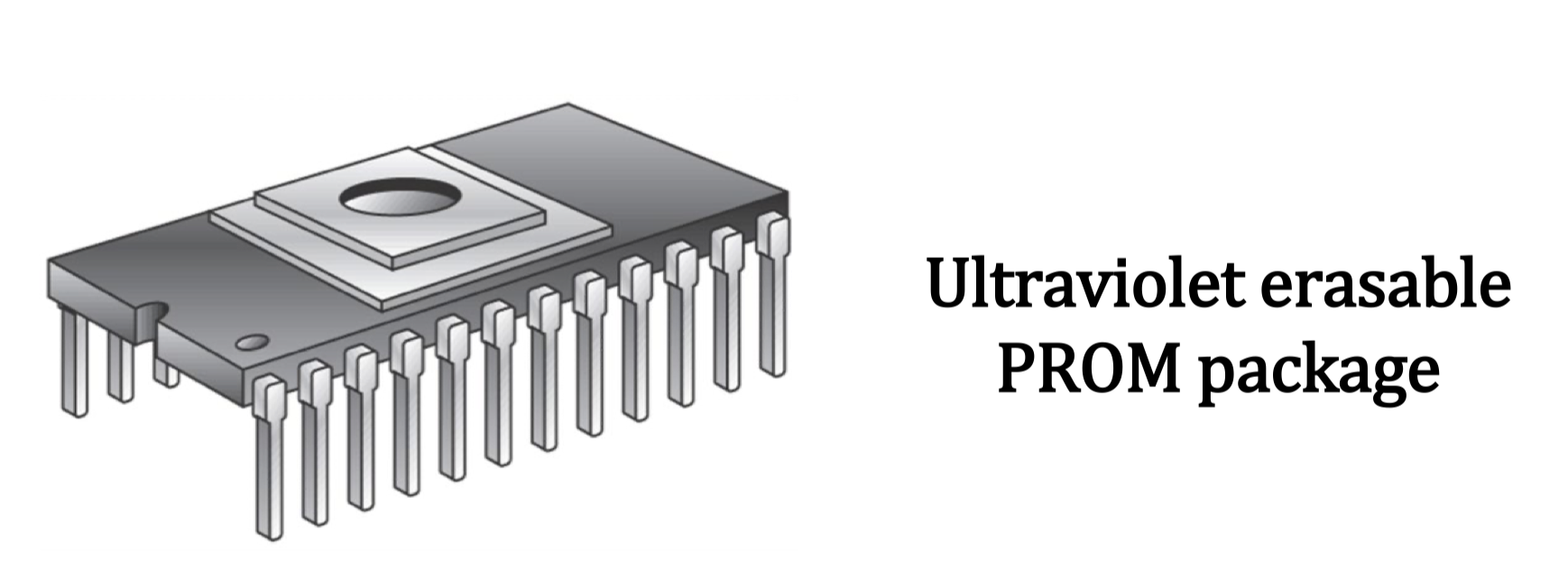
- Ultraviolet erasable programmable ROM (UV EPROM) — contains a transparent quartz lid on the package that allows exposure to high-intensity UV light. This neutralizes any positively stored charges.
- Electrically erasable programmable ROM (EEPROM) — can be erased and reprogrammed using electrical pulses (more rapid).
Mask ROM
- Cannot upgrade the program
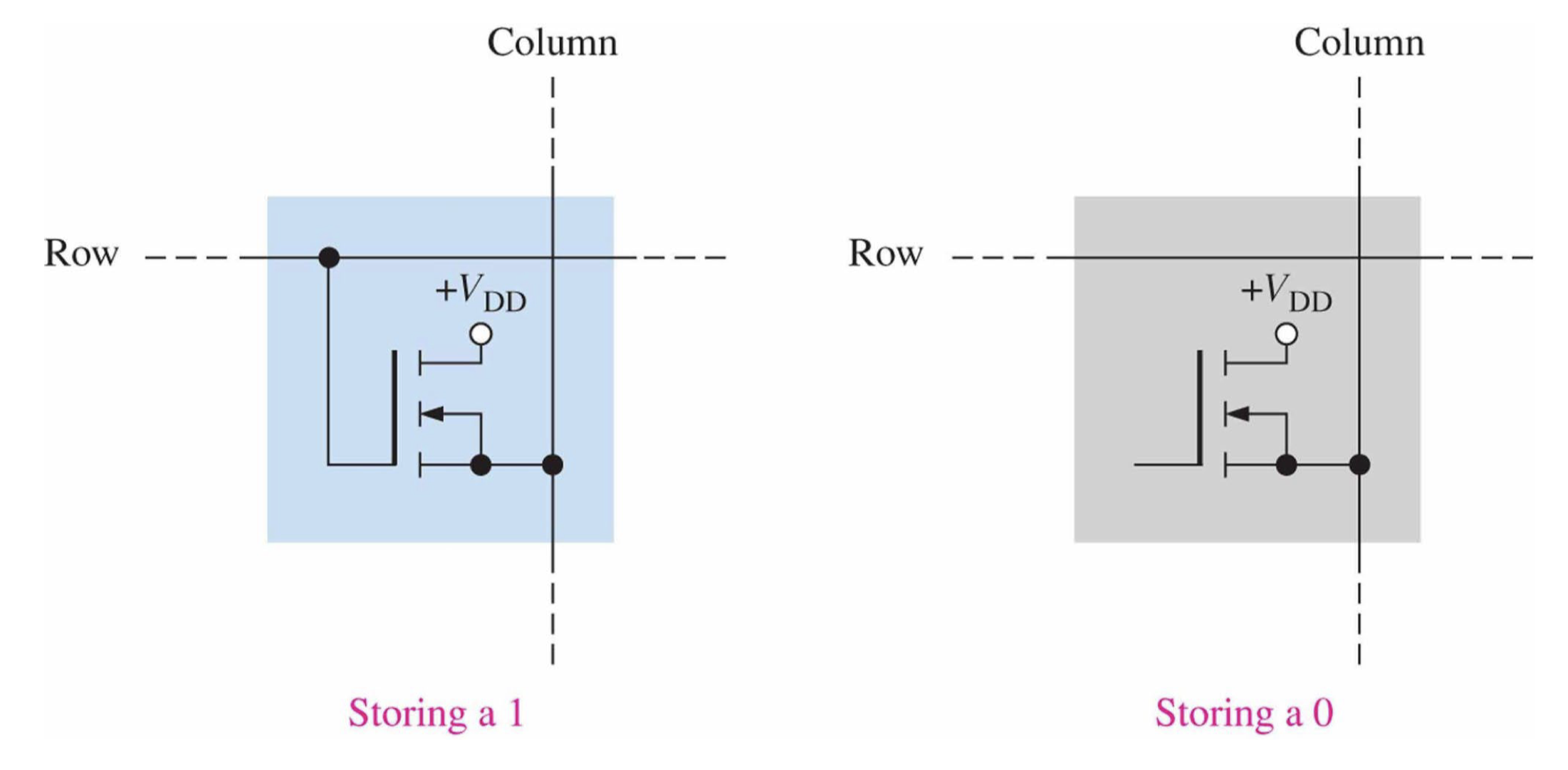
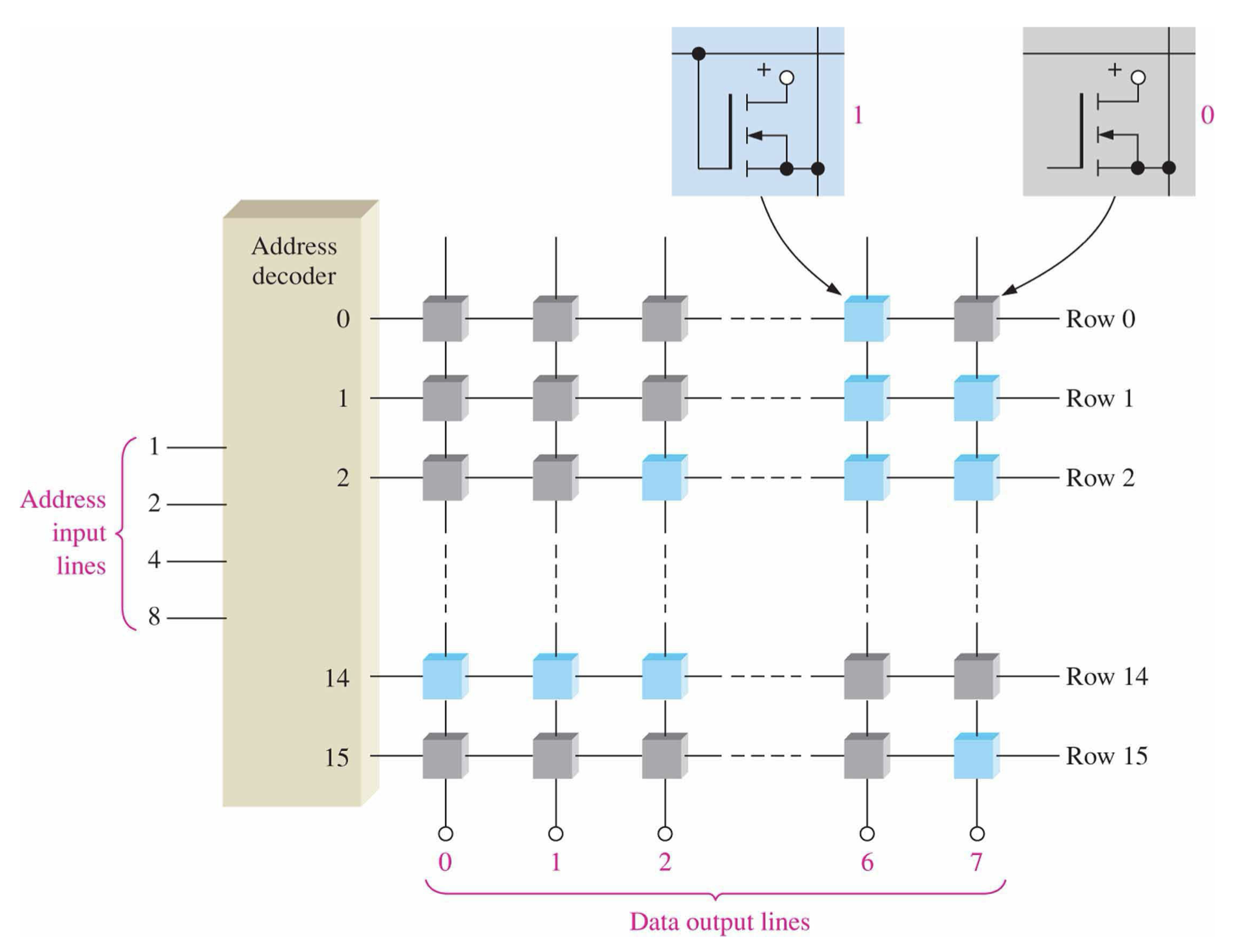
- The mask ROM is generally referred to as just ROM. It is permanently programmed during the manufacturing process to provide widely used standard functions or user-specified functions.
- Once the memory is programmed, it cannot be changed. Most ROMs utilize the presence or absence of a transistor connection at a row/column junction to represent a 1 or a 0.
- The presence of a connection from a row line to the gate of a transistor represents a 1, because when the row line is taken HIGH, all transistors with a gate connection to that row line turn on and connect the HIGH (1) to the associated column line. At row/column junctions where there are no gate connection, the column lines remain LOW (0) when the row is addressed.
Programmable ROM (PROM)
- A PROM uses some type of fusing process to store bits, in which a memory link is burned open or left intact to represent a 0 or a 1.
- The fusing process is irreversible (PROM cannot be reprogrammed). In the programming process, a sufficient current is injected through the fusible link to burn it open to create a stored 0.
- There are 3 fuse technologies used in PROMs:
- Metal links (ex. nichrome).
- Silicon links (ex. polycrystalline silicon).
- Shorted junctions or avalanche-induced
- migration (two pn junctions arranged
- back-to-back).
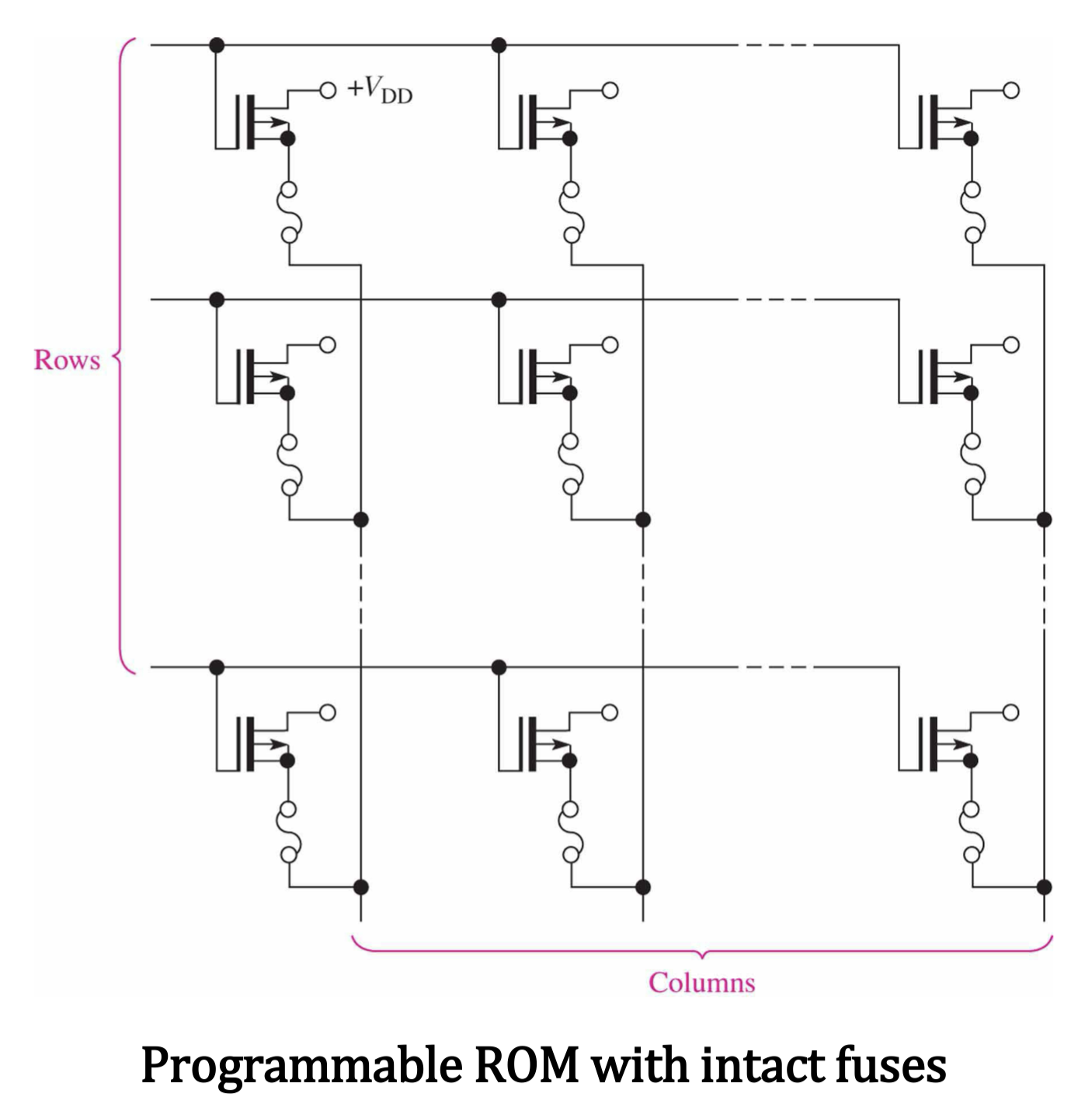
- You can program this! ใช้ Fuse เวลา Burn ไปแล้ว ไม่สามารถเอากลับมาได้แล้ว เรียกว่า One-time programmable
Erasable PROM (EPROM)
- An EPROM is an erasable PROM which can be reprogrammed (existing program must be erased first).
- It uses an NMOSFET array with isolated-gate structure which has no electrical connections and can store an electrical charge for indefinite periods of time.
- The data bits are represented by the presence or absence of a stored gate charge.
- The two basic types of EPROM are:
- UV EPROM — contains a transparent quartz lid on the package that allows exposure to high-intensity UV light for several minutes to an hour. This neutralizes any positively stored charges.
- EEPROM — can be erased and programmed using electrical pulses (more rapid).
Flash Memory
- The ideal memory has:
- High storage capacities.
- Nonvolatility.
- In-system read and write capability.
- Fast operations.
- Cost effectiveness.
- These properties are all provided by flash memories, which are high-density, read/write memories that are nonvolatile.
- It uses a single floating-gate MOS transistor to store a 0 or a 1.
- พวกนี้ก็พวก Thumb Drive, SD card, SSD
Memory Operations
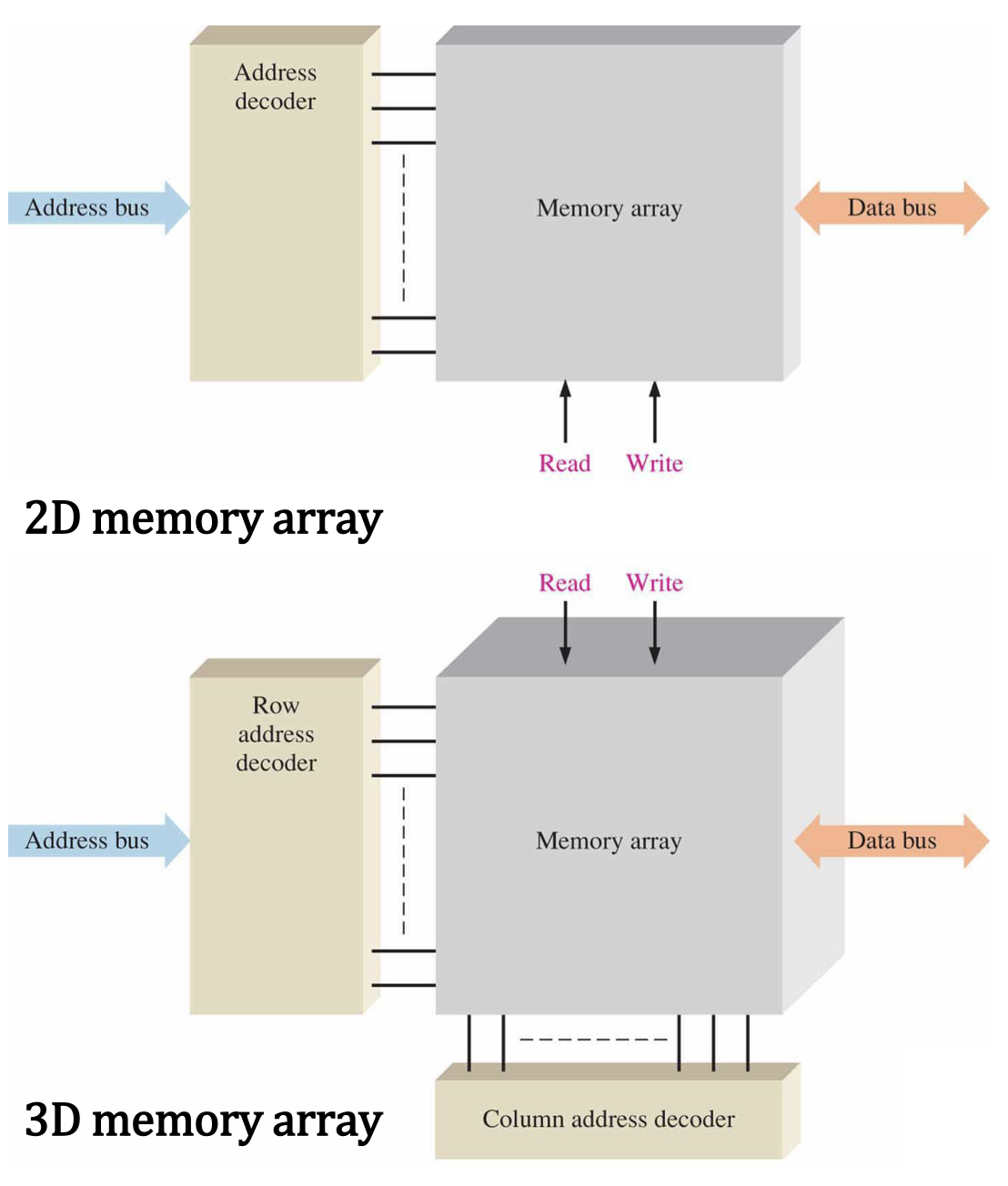
- The basic memory operations are read and write:
- The write operation puts data into a specified address in memory.
- The read operation copies data out of a specified address in the memory.
- The addressing operation, which is part of both read and write operations, selects the specified memory address using the address bus.
- Data is transmitted to and from the memory system using a set of lines call data bus, which are bidirectional.
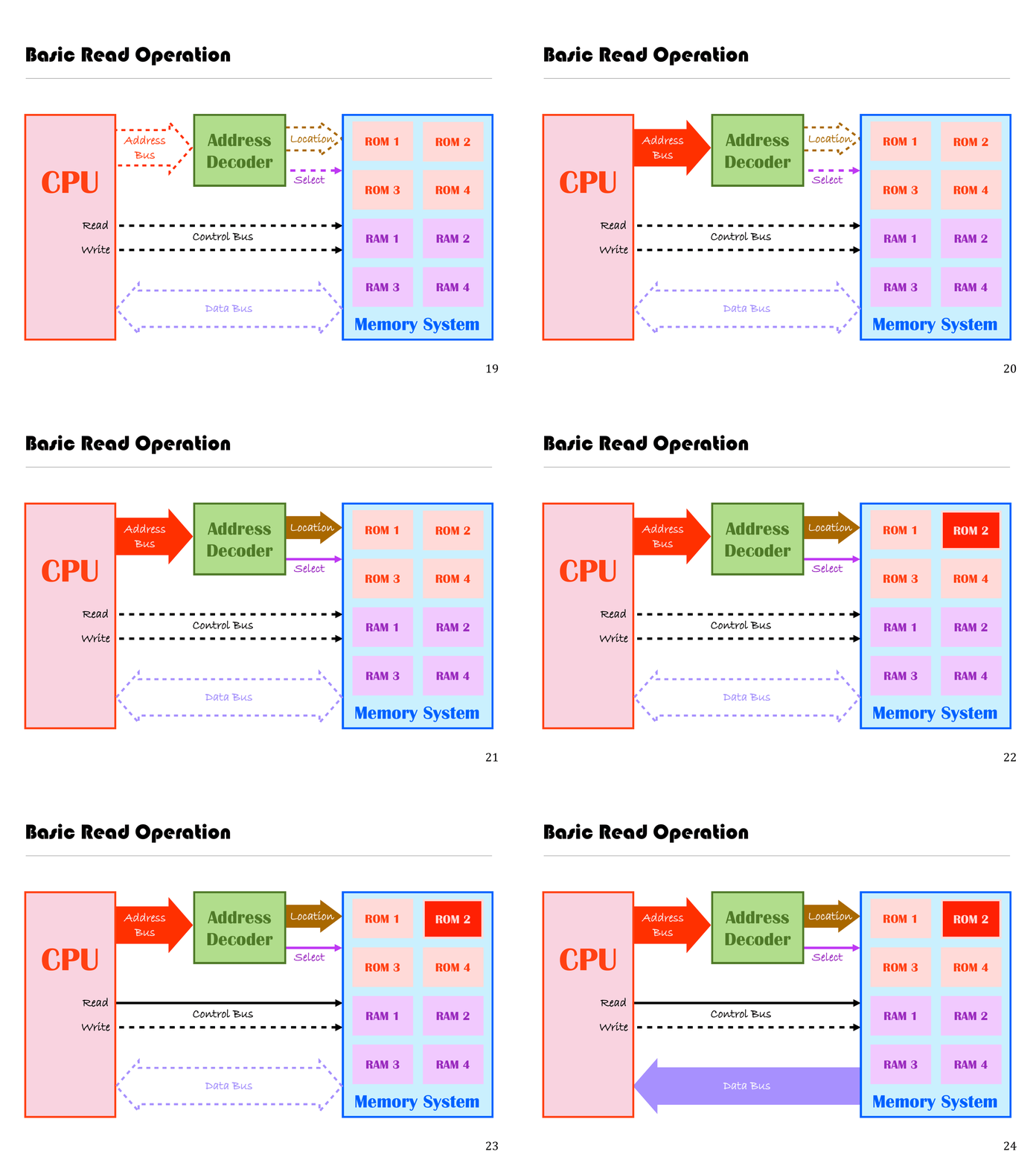
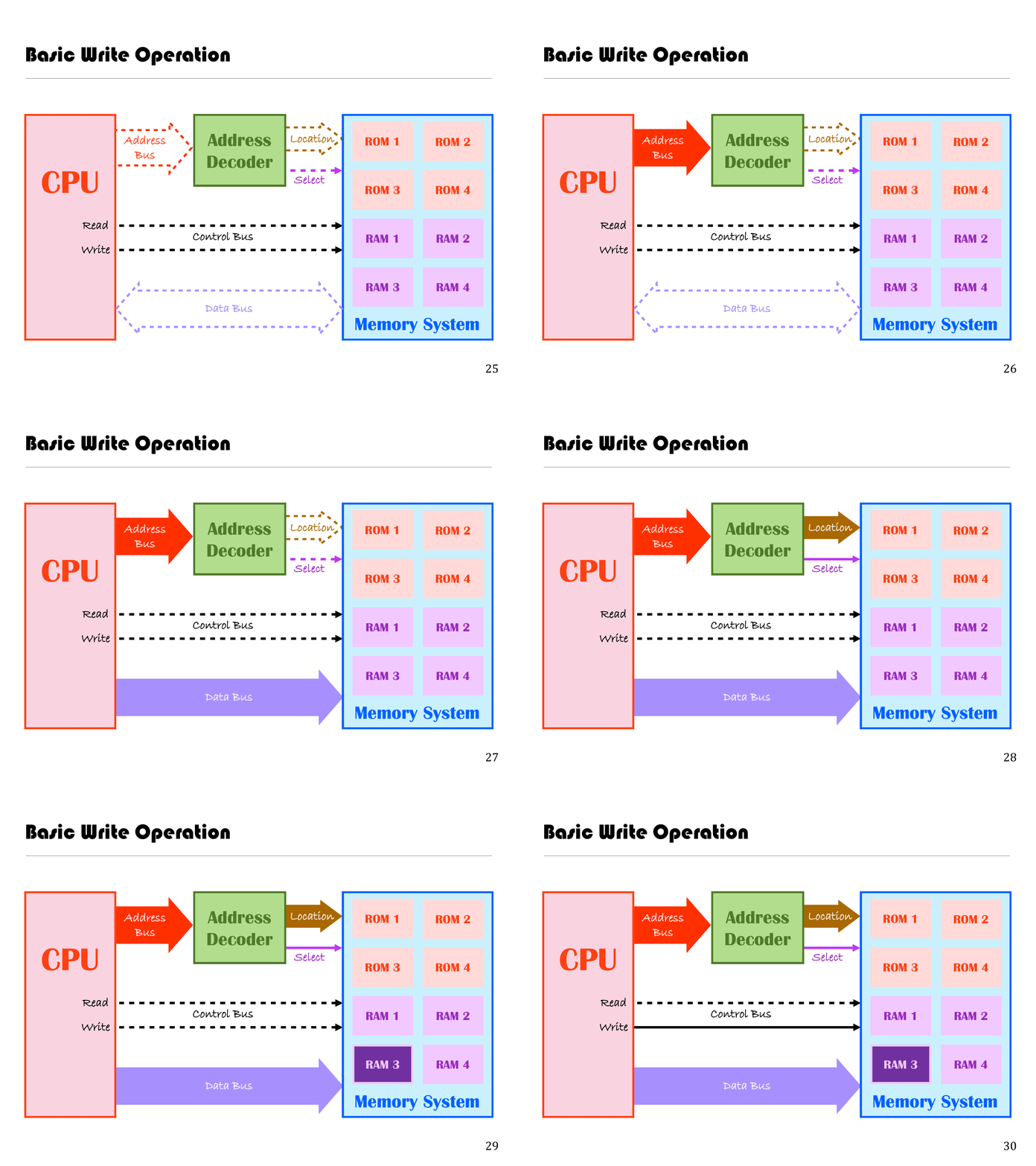
- Put address on Address Bus, Put Data on Data bus
- Address Decoder will decode the location somewhere in memory system
- ….
Hard Disk Drives
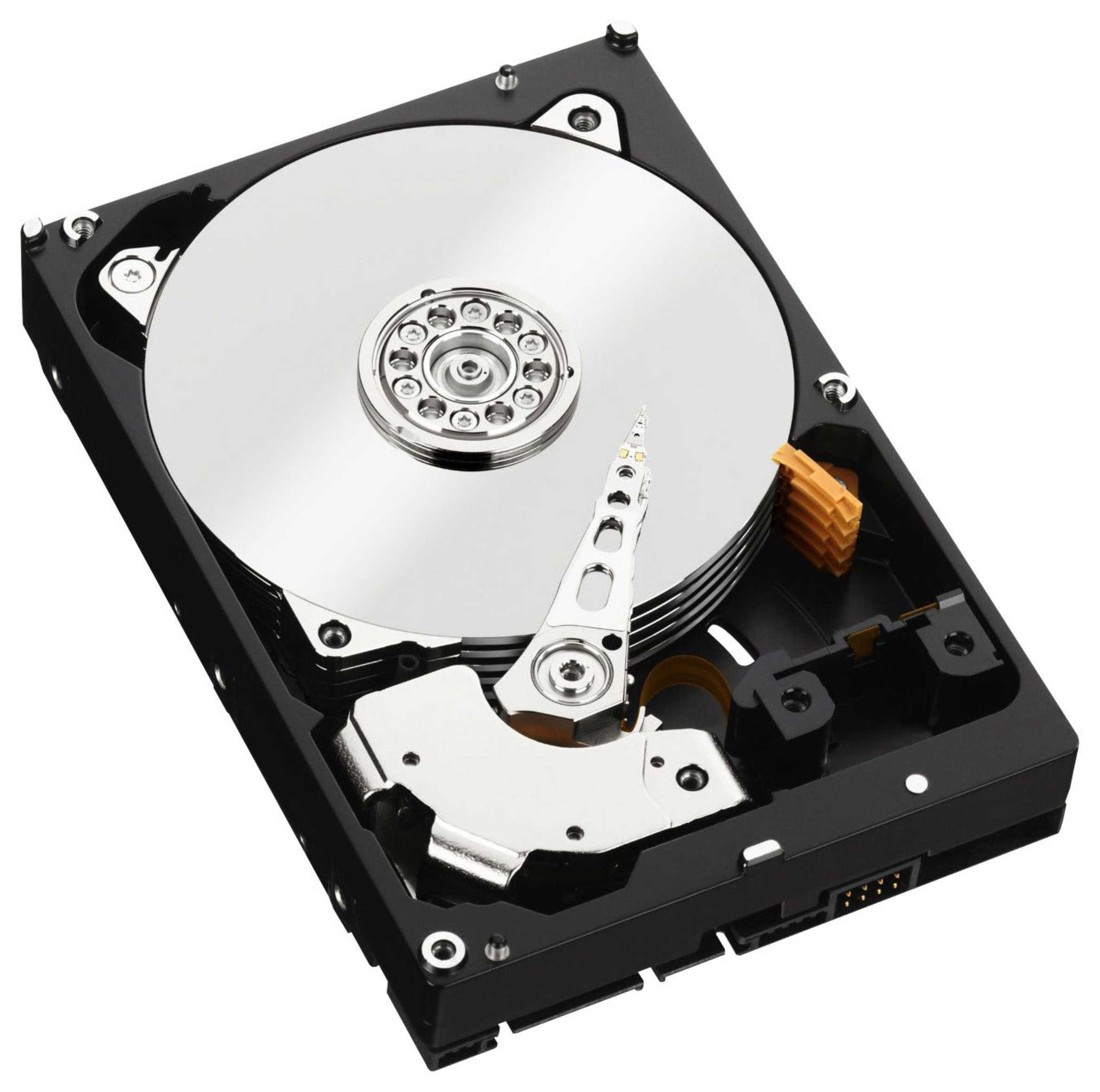
- Computers use hard disks as the internal mass storage media. Hard disks are rigid platters made of aluminum alloy or a mixture of glass and ceramic covered with a magnetic coating.
- Hard disk drives (HDDs) are available in 5.25, 3.5, 2.5, and 1.8 inch diameter sizes, and are hermetically sealed to keep the disks dust-free.
- Typically, two or more platters are stacked on top of each other on a common shaft (spindle) that turns the assembly at several thousand rpm (rotation per minute). A separation between each disk allows for a magnetic read/write head that is mounted on the end of an actuator arm.
- The separation between the read/write head and the platters is only a fraction of millimeter ... any small dust particle would cause the head to CRASH!
Read/Write Head Operation
- The HDD is a random-access device because it can retrieve stored data anywhere on the disk in any order.
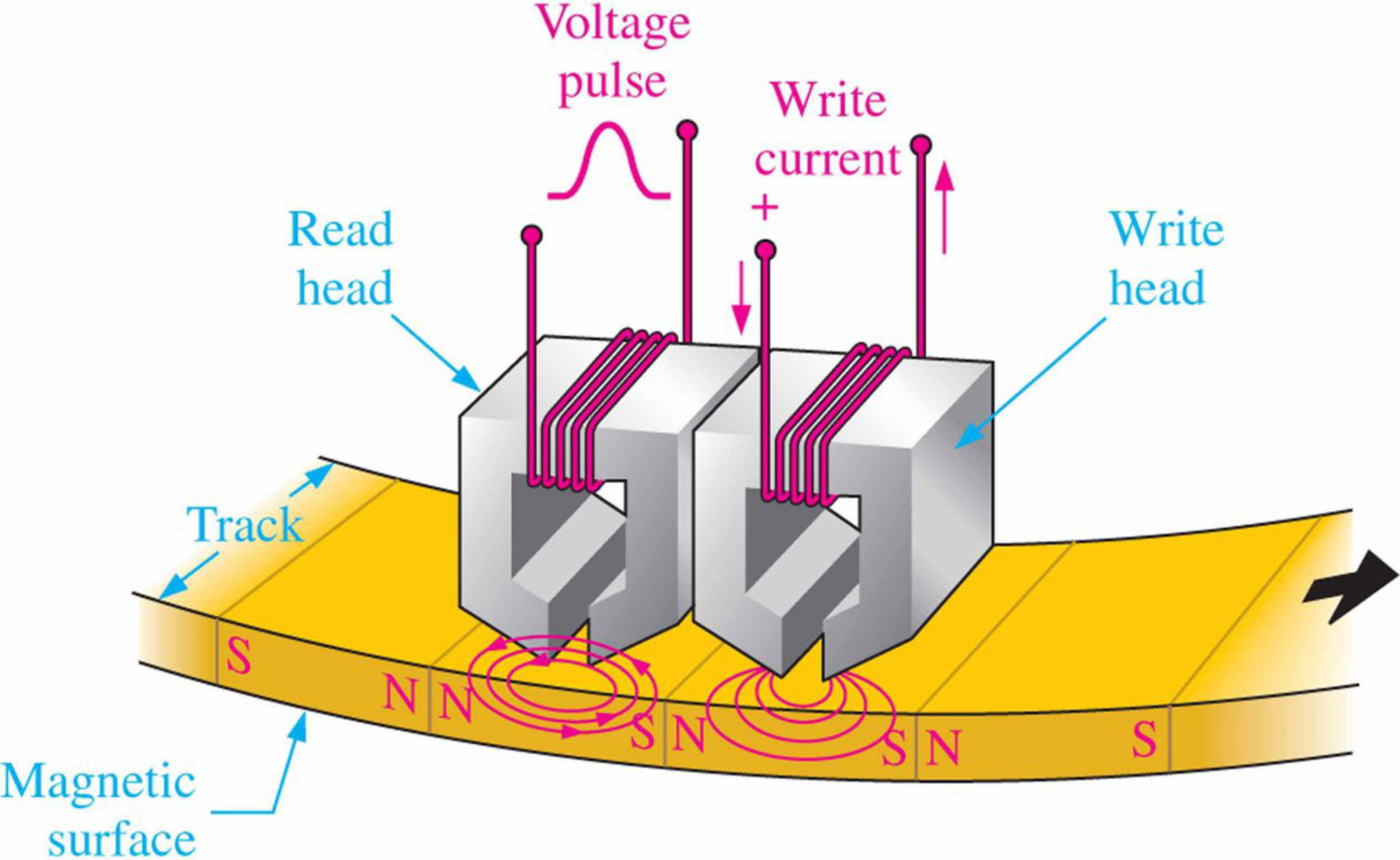
- The direction or polarization of the magnetic domains on the disk surface is controlled by the direction of the magnetic field (flux lines) produced by the write head according to the direction of a current pulse in the winding.
- This magnetic flux magnetizes a small spot on the disk surface in the direction of the magnetic field.
- When the magnetic surface passes a read head, the magnetized spots produce magnetic fields in the read head, which induce a voltage pulse.
- This is shown on the figure below.
Other Magnetic Storage Medias
- There are many other types of magnetic storage medias, such as:
- Floppy disks — made from a flexible polyester material with a magnetic coating on both sides, inclosed in a semi-flexible (5.25 inch) or rigid (3.5 inch) jacket.
- Zip — Zip drives also use flexible disk housed in a rigid case, but is capable of much higher storage capacity (250MB)
- Jaz — Jaz drives are similar to a hard disk, but contains two platters housed in a removable cartridge and has a storage capacity of 1-2GB.
- Magnetic tape — much slower than disks because data must be accessed serially. Comes in several types: QIC, DAT, 8mm, and DLT.
Optical Storage
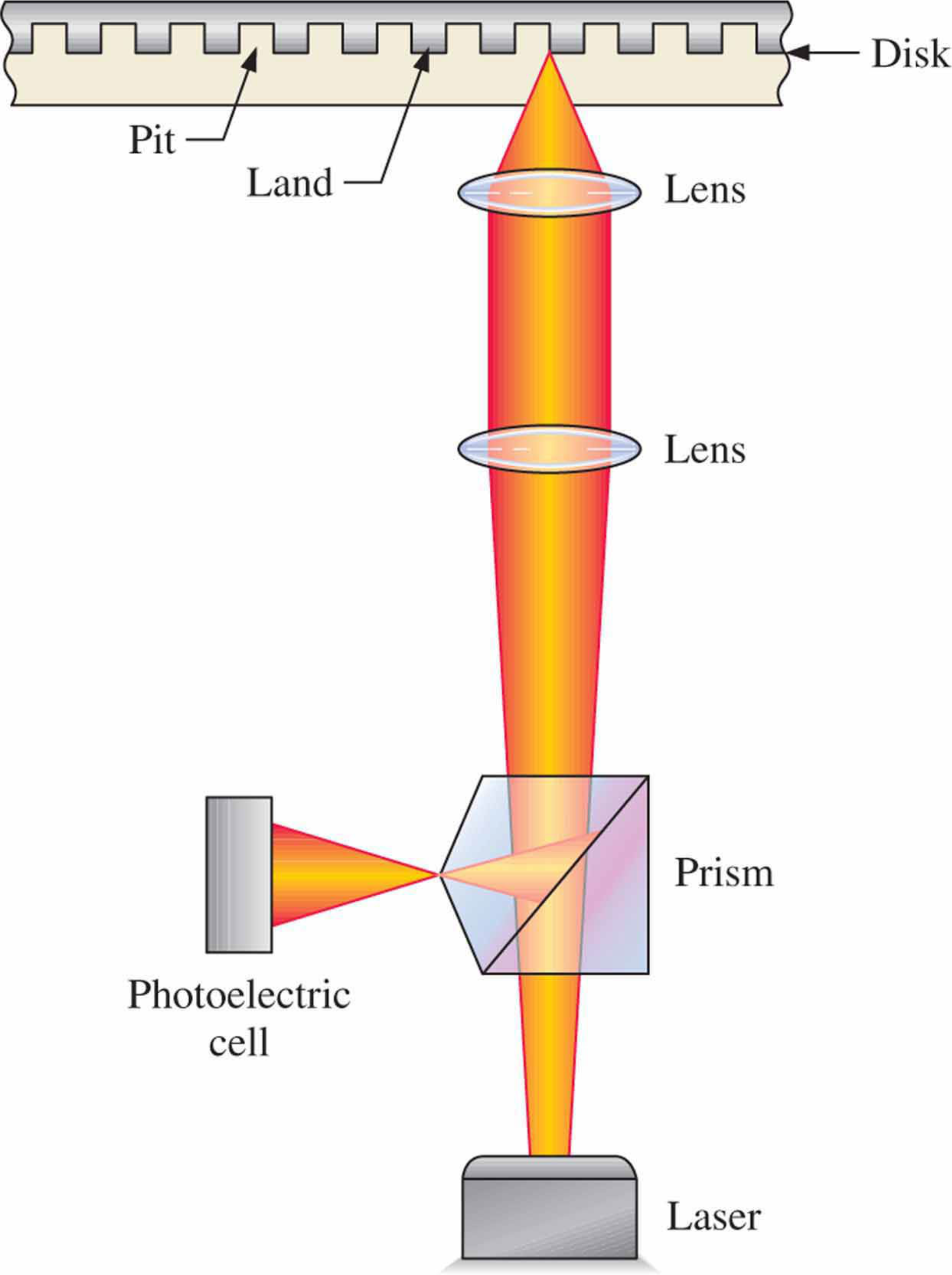
- The most common example of an optical storage media is the compact disk read-only memory (CD-ROM), which is a 120mm diameter disk with a sandwich of three coatings:
- A polycarbonate plastic at the bottom.
- A thin aluminum sheet for reflectivity.
- A top coating of lacquer for protection.
- The CD-ROM disk has a capacity of approx. 680MB, where data is recorded by mechanically pressing indentations (pits) and flat areas (lands) on the surface.
- They are read using a low-power infrared laser.
- The light reflected from a pit is 180 degrees out-of-phase with the flight reflected from the land. The reflected light is then detected by a photodiode to determine the stored information.
Other Optical Storage Medias

- There are many variations of optical storage medias:
- WORM (write-once, read-many) — can be written onto one time using a low-power laser to create burned and unburned areas, after which the data cannot be erased, but can be read many times.
- CD-R — essentially a WORM that allows multiple write sessions to different areas of a disk.
- CD-RW — a rewritable disk that can be used to read and write data. It uses a special compound that, when heated by a laser to a certain temperature, becomes crystalline when it cools. If it is heated to a higher temperature, it becomes amorphous when it cools. The amorphous and crystalline areas reflect light differently and can therefore be used to store 1s and 0s. Data can be rewritten by reheating the compound.
- DVD-ROM — short for digital versatile disk. It is similar to the CD-ROM, except the indentations are much smaller, allowing more data to be stored on a track. DVD-ROM are also double- sided. Some DVD-ROMs also have multiple layers.
- BLU-RAY — a high-density disk that uses blue lasers (wavelength is 405nm), allowing it to store data more compactly than CDs or DVDs, which use red laser technology (wavelength is 650nm).