เข้า Lecture 2 รอบ!
Overview
This chapter covers two main categories of investigative reports:
- Science Lab Reports #FinalExam แน่นอนละ อาจารย์บอก 100% (Writing part)
- Other Investigative Reports (Incident, Trip, and Forensic Reports) — NOT ON WRITING PART จะอยู่บนพวก INFORMATION PART
Science Lab Reports
Purpose & Audience
Why Science Lab Reports Exist
- Necessary for sharing knowledge in the scientific community
- Documents the scientific method and experimental process
Two Main Audiences
- Scientists/Professionals
- Interested in learning about latest research in their field
- Critique and evaluate research findings
- Educators
- Testing students' knowledge of concepts or processes
- Assessing understanding of scientific methodology
Scientific Reasoning
Inductive Reasoning
- Direction: Specific observations → General theory
- Process: Inference from evidence
- Certainty: NOT certain
- Example:
- Observation: "All the swans I've seen are white"
- Theory: "All swans are white"
- Limitation: Can be disproven (black swans exist!)
Deductive Reasoning
- Direction: General theory → Specific observation
- Process: Logical inference
- Certainty: IS certain
- Structure: IF-AND-THEN format
- IF: All swans are white (general theory)
- AND: This is a swan
- THEN: This swan must be white (specific prediction)
Summary of Scientific Method
- Scientists use inductive reasoning based on observations to arrive at a tentative hypothesis or theory
- They then use deductive reasoning in conjunction with experiments to test the validity of the hypothesis
- The science report is the written record of this process
- Requirements: Precision, accuracy, objectivity, and carefully drawn conclusions based on sufficient data
Structure of Science Lab Reports
Key Questions Answered
- What was the purpose of the experiment?
- What materials and equipment were used?
- What was the procedure?
- What were the results?
- What are the conclusions?

Primary Structure Sections
จำให้ได้ หา Mnemonic มาจำเลยยยย: TIMMRDC
- Title
- Introduction
- Materials and Equipment
- Method
- Results
- Discussion
- Conclusion
เวลาจะเขียนใน #FinalExam เขาก็ต้องให้ข้อมูลมาประมาณนึงแล้ว เพราะเราไม่ได้รู้จักสิ่งนั้นดีขนาดนั้น
Detailed Section Guidelines
1. Title
- Purpose: Clearly and briefly indicate what the report is about
- Format Rules:
- Never a complete sentence
- Articles (a, an, the) are usually omitted
- Use correct title case capitalization
- Examples:
- Science Lab: Testing a Single-Bevel-Groove Weld
- Ruler Drop Experiment
- Genetic Editing Test
ต้องเป็น Phrase (NOT a sentence) อย่าลืมใช้ Title case ด้วยตลอด - ตัวใหญ่หมด (ยกเว้น article, preposition)
2. Introduction
- Standard Format: "The purpose of this experiment is {infinitive verb}..."
- Grammar Structure:
- Subject + Verb + Object (infinitive verb)
- Use infinitive verb (to + verb) as the object
- Example:
- "The purpose of this experiment is to investigate the existence of harmful bacteria in pork products."
- Subject: The purpose of this experiment
- Main Verb: is
- Object (infinitive): to investigate... (something)
- "The purpose of this experiment is to investigate the existence of harmful bacteria in pork products."
Practice Exercise:
- Title
- ❌ Wrong: “Plant growth and development are significantly influenced by light.” (ใช้ไม่ได้เพราะ it’s a sentence)
- ✅ Correct: “The Influence of Light on Plant Growth and Development”
- จริง ๆ จะไม่ใส่ “The” ก็ได้นะ
- Introduction
- ❌ Wrong: "The experimenters will investigate the impact of varying light conditions on seed germination rates"
- ✅ Correct: "The purpose of this experiment is to investigate the impact of varying light conditions on seed germination rates"
3. Materials and Equipment
- Format: Write a list of items (noun phrases) used in the lab
- Guidelines:
- Be precise with measurements and specifications
- Use columns to save space if necessary
- List items as noun phrases, not complete sentences
- มันเป็น Bullet point สามารถ Indent เข้าไปได้นิดหน่อย
- Important Note: The word "equipment" NEVER has an "s" on the end
ถ้า 20 อันขึ้นไปถึงจะเขียนเป็นตัวเลข Numeral ไปเล้ยยย, ถ้าน้อยกว่าให้ spell out
Practice Exercise - Fix These Errors: (❌ Wrong:)
- Three identical pots have drainage holes in them
- Twenty-five bean seeds
- A potting mix
- Use a water spray bottle
- Label them properly with three labels
- The cardboard box
- Need a lamp too
Corrected version should be: (✅ Correct:)
- Three identical pots with drainage holes
- 25 bean seeds
- Potting mix (เพราะว่า Uncountable)
- 1 kg of potting mix ก็ได้
- Water spray bottle
- Three labels
- Cardboard box
- Lamp
4. Method Section
Tell what you already did; not tell them how to do it
Key Requirements:
- Include all information required for exact repetition of the work performed
- Do NOT write instructions to the reader
- Use past tense (lab reports are written after the lab has finished)
- Maintain objectivity by using passive voice verbs
- Do NOT use words like "I" or "we"
- Use precise measurements (e.g., "The tadpole measured 3.15 cm long")
Why Use Passive Voice?
- Maintains objectivity
- Focuses on the process, not the person
- Standard in scientific writing
Passive Voice Structure:
-
Formula: be + past participle
-
In past tense: was/were + past participle
-
❌ Incorrect (Past Active): "We performed the experiment over three weeks"
-
✅ Correct (Past Passive): "The experiment was performed over three weeks"
-
❌ Incorrect (Past Active): "We did the experiment over three weeks"
-
✅ Correct (Past Passive): "The experiment was done (V.3) over three weeks"
Practice Exercise - Convert to Past Passive:
Original (mixed tenses/voices):
- "Fill each pot with the potting mix"
- "Seven seeds were planted in each pot at an equal depth"
- "The pots can be labelled: 'Light,' 'Partial Shade,' and 'Darkness'"
- "You should place The 'Light' pot directly under a lamp providing twelve hours of light per day"
- "We can position the 'Partial Shade' pot further away from the lamp, receiving approximately six hours of indirect light daily"
- "The 'Darkness' pot is being placed inside a closed cardboard box to completely block out light"
- "Water all pots regularly to maintain consistent moisture"
- "The number of germinated seeds (emerging sprouts) would be recorded every two days for a period of two weeks"
✅ Corrected (all past passive):
- Each pot was filled with the potting mix
- Seven seeds were planted in each pot at an equal depth
- The pots were labelled: "Light," "Partial Shade," and "Darkness"
- The "Light" pot was placed directly under a lamp providing twelve hours of light per day
- The "Partial Shade" pot was positioned further away from the lamp, receiving approximately six hours of indirect light daily
- The "Darkness" pot was placed inside a closed cardboard box to completely block out light
- All pots were watered regularly to maintain consistent moisture
- The number of germinated seeds (emerging sprouts) was recorded every two days for a period of two weeks
5. Results Section
Important Distinction:
- Results ≠ Conclusions
- Results = Observable results (the FACTS you can see or measure)
- Conclusions = Interpretation of what the facts MEAN
Guidelines:
- Focus on observable data only
- Include graphics (tables, charts, diagrams) to visually show results
- Maintain objectivity - describe facts without bias or emotion
- NO interpretation in this section
Objectivity Example:
- Which is more objective?
- ✅ "A crack appeared along the surface of the plate" (objective - just facts)
- ❌ "The plate was very weak and so it broke" (subjective - interpretation/evaluation)
Practice Exercise - Remove Bias:
❌ Original (with bias and emotion):
- "Thankfully, the 'Light' group exhibited the highest germination rate, with all seven seeds sprouting within the first week. This was a great result!"
- "Unfortunately, the 'Partial Shade' group showed a slower germination rate. Only four seeds germinated within two weeks, very disappointing. :("
- "The 'Darkness' group was the absolute worst with not even one seed germinating throughout the observation period! Omg!"
✅ Corrected (objective):
- The "Light" group exhibited the highest germination rate, with all seven seeds sprouting within the first week
- The "Partial Shade" group showed a slower germination rate, with four seeds germinating within two weeks
- The "Darkness" group showed no seed germination throughout the observation period
6. Discussion Section
Purpose:
- Include comments, explanation, and ideas about the results
- Explain WHY you got the results
- Compare results to existing theories
- Comment on the suitability of the methods used
What to Include:
- Interpretation of data
- Explanations for unexpected results
- Connections to scientific knowledge/theories
- Analysis of methodology effectiveness
- Application of knowledge and reasoning to the evidence
Example Discussion:
"The results support the understanding that light plays a crucial role in seed germination. The seeds exposed to the most light ('Light' group) germinated the fastest and with the highest rate. This is likely because light triggers hormonal changes within the seeds, stimulating the growth process. The 'Partial Shade' group's slower germination suggests that while some light is present, it is insufficient for optimal seed development. The complete absence of light in the 'Darkness' group prevented germination entirely, highlighting the essential role of light in this initial stage of plant growth."
7. Conclusion Section
Purpose:
- Interpret the data and explain what the facts mean in relation to the initial purpose
- Comment on the success or lack of success of the experiment
- State what scientific discoveries were made, if any
- Explain what was learned
- Add closing thoughts or suggestions for further scientific study
- Consider your audience
Structure:
- Link back to the purpose/introduction
- State what the experiment showed
- Briefly explain your reasoning (like a summary of discussion)
- Suggest further experiments or applications
How It Relates to Introduction:
- Introduction states the purpose
- Conclusion answers whether that purpose was achieved
Results vs. Conclusions - Key Difference:
Example comparison:
- Result (observable fact): "The patient's temperature remained stable, ranging from 97.5 degrees to 98.1 degrees over the last 48 hours"
- Conclusion (interpretation): "The patient is no longer suffering from fever"
Practice Exercise:
Given this discussion:
"The results support the understanding that light plays a crucial role in seed germination. The seeds exposed to the most light ('Light' group) germinated the fastest and with the highest rate. This is likely because light triggers hormonal changes within the seeds, stimulating the growth process. The 'Partial Shade' group's slower germination suggests that while some light is present, it is insufficient for optimal seed development. The complete absence of light in the 'Darkness' group prevented germination entirely, highlighting the essential role of light in this initial stage of plant growth."
Write a conclusion that:
- Links to the purpose
- Explains what was shown and how you know
- Suggests further experiments
📄 TEACHER ANSWER KEY Investigative Reports Supplement.pdf
Other Types of Investigative Reports
1. Incident Reports
Definition
- Also called accident reports (doesn’t have to be an accident)
- Describe an unusual incident or occurrence
Importance
- Must be carefully written to reflect what really happened
- Can become legal evidence used in court
- Accuracy is critical
Key Components (from example - Hospital Incident Report)
Structure:
- Summary
- Brief overview of the incident
- Key dates and actions taken
- Resolution status
- Description
- Detailed account of what happened
- Chronological order
- Specific details (dates, times, people involved)
- Outcomes
- Impact of the incident
- Consequences
- Follow-up actions taken
- Conclusion
- Final resolution
- Preventive measures implemented
- Classification of incident
Example Summary Format:
"On Wednesday, July 7, 20—, a technician improperly installed the sampling probe on the Olympus Chemistry Analyzer, causing the probe to bend and rendering the machine inoperable. After the vice president granted approval for the $1,206 replacement probe, it was purchased and installed on Friday, July 9, 20—. The technician has been cleared through drug testing, and the incident was declared Operator Error Without Prejudice (according to the Hope Hospital Employee Policy Manual). Clinical Laboratory managers designed in-service training and proper installation posters to prevent this incident from recurring."
2. Trip Reports
Definition
- Tell management and coworkers what was gained from a business trip
- Document essential details only
- Cover the parts of the trip most useful to the organization
Key Features
- Pre-planning is essential: Know the purpose before the trip
- Understand what the organization needs to learn
- Focus on critical information, not every detail
Structure (Memo Format)
Header:
- MEMO TO: {Recipient}
- FROM: {Your name and title}
- DATE: {Date}
- SUBJECT: {Brief description of trip}
Body Sections:
- Purpose Statement
- Mission/objective of the trip
- What you were trying to accomplish
- Preview/Overview
- Brief summary of what the report will cover
- Detailed Findings
- Specific visits, meetings, or observations
- Organized by date, location, or topic
- Key information from each activity
- Conclusion
- Assessment of trip success
- What was learned
- Overall value
- Recommendation
- Suggested actions based on trip findings
- Next steps for the organization
Example Trip Report Structure:
Purpose: "My mission in China was to visit potential fabric suppliers to determine their capability to provide fabrics for our company's hammocks and outdoor furniture."
Body: Organized by supplier visited (with dates), including:
- Meeting details
- Facility observations
- Capabilities discovered
- Pricing and terms
- Pros and cons
Conclusion: "The trip was successful. After meeting with potential fabric vendors, I learned a great deal about the complicated network of fabric customers and vendors. I also learned that many who represent themselves as factory owners or direct sellers are agents who would only increase our costs without adding value."
Recommendation: "I recommend that we negotiate a contract with Hongyue Textiles directly rather than use Mr. Guo as an intermediary."
3. Forensic Reports
Definition
- Analyze evidence for legal purposes
- Specialized type of science lab report
- Usually written by experts
Key Characteristics
- Used in legal proceedings
- Must be extremely accurate
- Written by credentialed experts (forensic scientists, anthropologists, etc.)
- Follow strict scientific methodology
Structure & Special Features
Typical Components:
- Header/Identification
- Case numbers
- Evidence identification
- Date of report
- Laboratory information
- Purpose/Basis of Report
- Why the analysis was conducted
- What questions need to be answered
- Description of Evidence
- Objective, precise description
- Physical characteristics
- Condition of evidence
- Methods/Analysis
- Techniques used
- Standards followed
- Equipment employed
- Observations
- Findings from analysis
- Data collected
- Parenthetical documentation used throughout to cite sources
- Tables/Data Compilation
- Used to compile results for easy reference
- Organized presentation of findings
- Conclusions
- Evidence-based conclusions only
- Based on scientific analysis
- No speculation
- Compiled By
- Credentials of forensic expert
- Professional title
- Organization
- References Cited
- APA style used to cite references in forensic science
- All sources properly documented
Special Writing Features
Objectivity and Precision:
- Extremely objective descriptions
- No personal bias
- Precise measurements and terminology
Documentation:
- Numbers used to identify evidence
- Parenthetical citations throughout
- Comprehensive reference list
Example Format (Forensic Anthropology Report):
RHUML 2009-135-I-00 Red Haven University Medical Laboratory
The basis of this report is to clarify the sex of skeletal remains #2008-114-I-05.
Description of Remains: The remains exhibit variations in erosion and completeness. Remains #2008-114-I-05 are relatively complete. There is noticeable macro-porosity (large pores) on the auricular surface where the two hips connect to the tail bone (Buikstra and Ubelaker 1994)...
[Continues with detailed analysis, observations, tables, and conclusions]
Compiled by
Ian Peters, PhD, Anthropologist
Red Haven University Medical Laboratories
Practice Questions
Oral Quiz Questions
- What do incident reports describe?
- Unusual incidents or occurrences (Basic)
- Require official explanation by a public or private organization (Specific)
- Can become legal evidence
- Give an example of one detail that might be included and one excluded from a trip report.
- Included: Key meetings with vendors, important findings, relevant costs, route taken
- แต่เป็นไปได้ว่าอาจจะมี Personal opinion อะไรประมาณนั้น
- Excluded: Personal activities, non-business meals, irrelevant travel details
- Included: Key meetings with vendors, important findings, relevant costs, route taken
- What state agency would be regularly involved in producing forensic reports?
- The police
- State crime laboratories
- Medical examiner's offices
- State police forensic units
- Give an example of forensic evidence.
- Skeletal remains
- DNA samples
- Hair
- Blood
- Fingerprints
- Ballistics evidence
- Chemical analysis results
- Accident reconstruction data
- Where might a forensic report be used and why is it so important it is accurate?
- Used in: Court proceedings, legal cases, criminal investigations
- Why accuracy matters:
- Determines guilt or innocence
- Can be challenged in court
- Impacts people's lives and freedom
- Must withstand legal scrutiny
- Expert testimony relies on it
Summary: Complete Lab Report Example Flow
Scenario: Testing a Single-Bevel Groove Weld
Introduction (Purpose)
"The purpose of this lab is to test the quality of a single-bevel groove weld (horizontal)."
Materials and Equipment
- Protective clothing, gloves, and helmet
- Electrode: E71 T-11, 5/64" (2mm) diameter
- Single-bevel groove weld using 1" (25.4mm) mild steel plates and 3/8" (9.5mm) mild steel backing strip
- CNG Cleaner
- SKL-SP1 Penetrant
Method
"Two plates were prepared with single-bevel groove welds in the horizontal position using self-shielded tubular electrode wires as presented in previous labs. The plate was heated and torch-cut into a 2" x 6" segment. The weld was then visually inspected using a dipenitive test (using CNG Cleaner) and a penetrant test (using SKL-SP1 Penetrant) to look for discontinuities as established by the American Welding Society."
Results
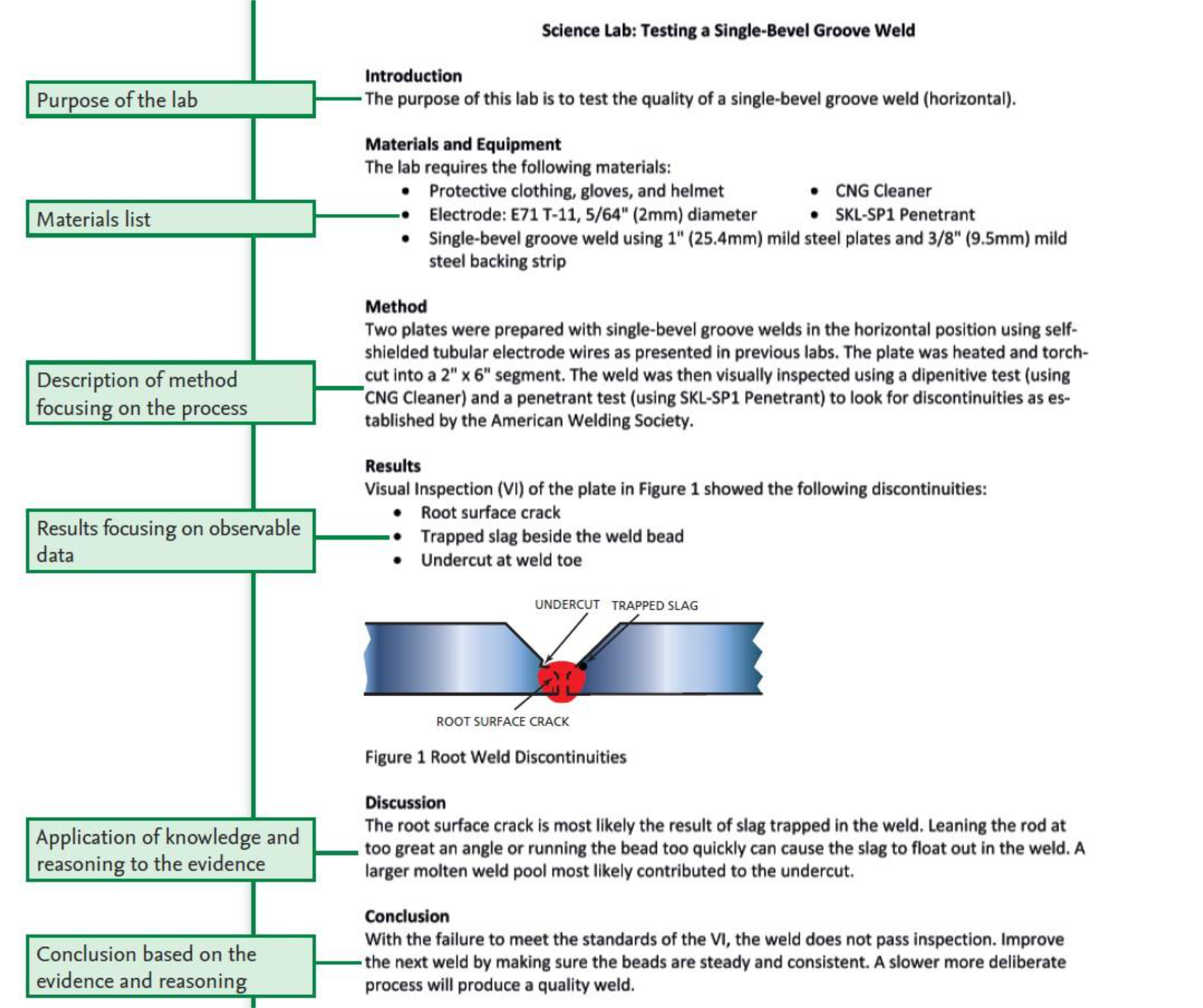
"Visual Inspection (VI) of the plate in Figure 1 showed the following discontinuities:
- Root surface crack
- Trapped slag beside the weld bead
- Undercut at weld toe"
[Figure included showing the discontinuities]
Discussion
"The root surface crack is most likely the result of slag trapped in the weld. Leaning the rod at too great an angle or running the bead too quickly can cause the slag to float out in the weld. A larger molten weld pool most likely contributed to the undercut."
Conclusion
"With the failure to meet the standards of the VI, the weld does not pass inspection. Improve the next weld by making sure the beads are steady and consistent. A slower more deliberate process will produce a quality weld."
Key Takeaways
Science Lab Reports
- Follow the scientific method structure
- Use past tense and passive voice in methods
- Separate observable results from interpretations
- Maintain objectivity throughout
- Link conclusion back to introduction/purpose
Other Investigative Reports
- Incident Reports: Legal documents requiring accuracy
- Trip Reports: Focus on business value and recommendations
- Forensic Reports: Expert analysis with extensive documentation
Universal Principles
- Clarity and precision
- Objectivity
- Proper documentation
- Appropriate audience consideration
- Evidence-based conclusions