Introduction
- In electrical engineering, we interest in communicating or transferring energy from one point to another. To do this requires an interconnection of electrical devices. Such interconnection is referred to as an electric circuit, and each component of the circuit is known as an element.
- ==Circuit analysis is the process of determining voltages across (or the currents through) the element of the circuit.==
- ก็เหมือนเป็นการหา Voltage/Current คร่อมบางจุดใน Circuit
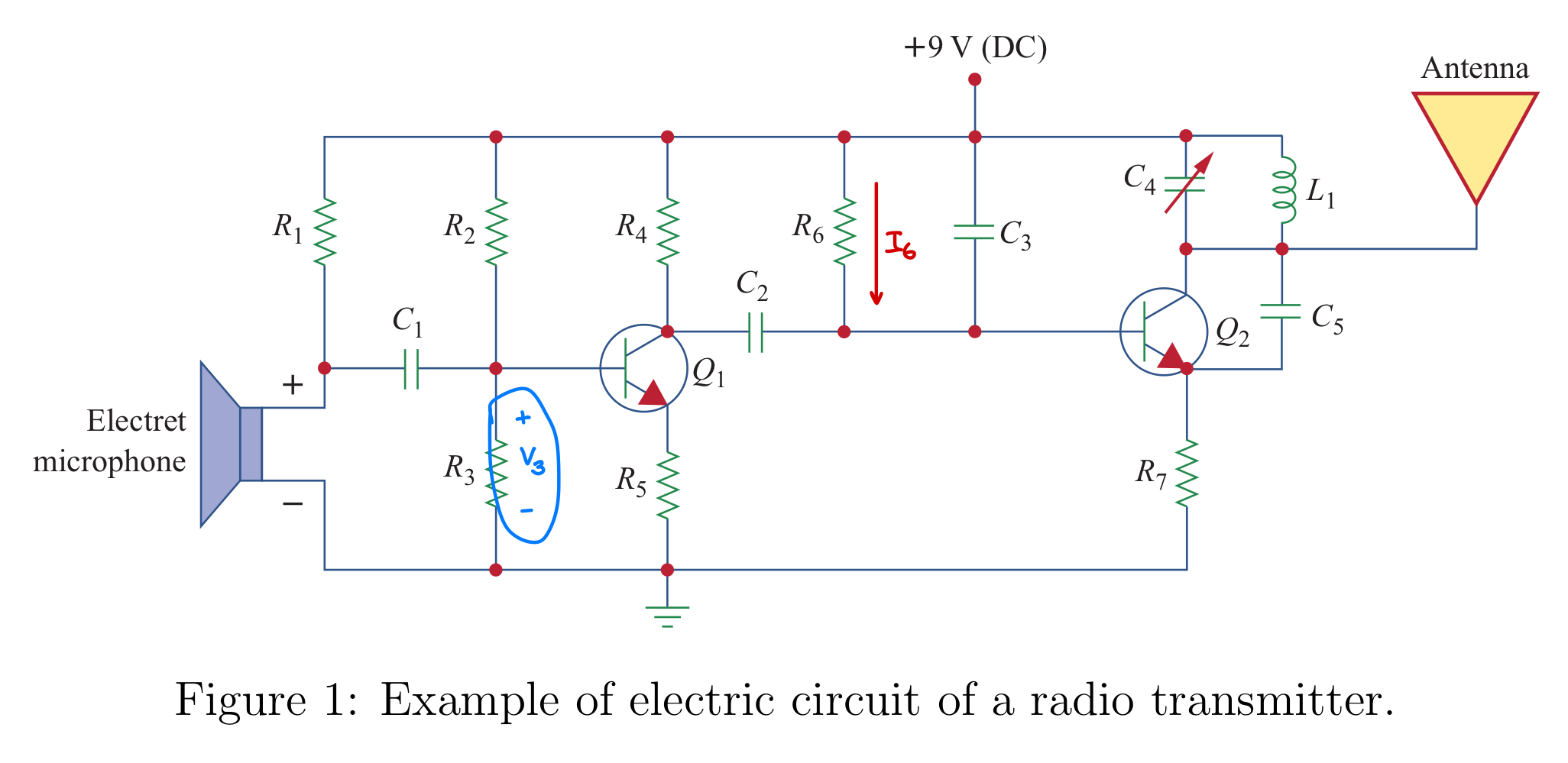
- ก็เหมือนเป็นการหา Voltage/Current คร่อมบางจุดใน Circuit
Systems of Units
- As engineers, we work with measurable quantities. However, to communicate with other engineers about these quantities, the standard system of units must be used.
- This standard system of measurement is the international system of units, the Système International des Unités, which is normally referred to as the SI standard system
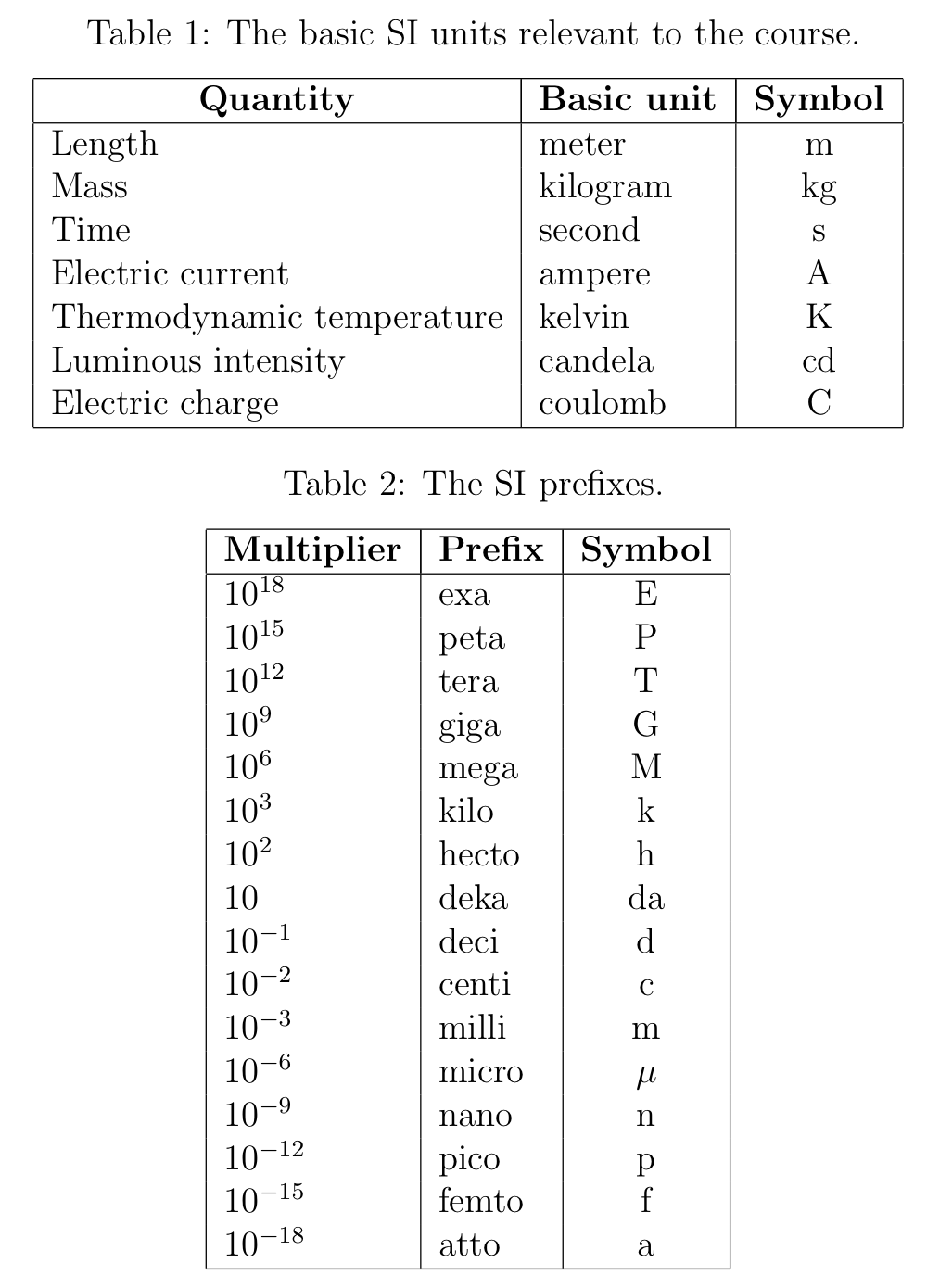
[1, 2]. The basic SI units that are related to this course is shown in Table 1. - All of the SI units in the table are the SI base units except the electric charge which is the SI derived unit.
- Derived unit ก็คือเกิดจากการเอาหน่วยฐานมา คูณ/หาร กัน!
- The SI unit uses prefixes based on the power of 10 to relate larger and smaller units to the basic unit.
Warning
ครูบอกให้ระวังว่าเป็น Symbol ตัวใหญ่ ตัวเล็ก ความหมายก็ไม่เหมือนกันแล้ว ไม่รู้ว่าจะเล่นใน Quiz หรือว่า Exam รึเปล่า!
Electric Charge and Electric Current
Electric Charge (ประจุไฟฟ้า)
- Electric charge (ประจุไฟฟ้า) is an electrical property of the atomic particles of which matter consists, measured in SI unit of coulombs (C). Charge on an electron is negative and equal to C, while a proton carries a positive charge of the same magnitude as the electron
- C
- C
- In 1 C of charge, there are electrons.
- The electric charge that occur in nature are integral multiples of the electronic charge C
- An electric circuit is essentially a pipeline that facilitates that. transfer of charge from one point to another.
Electric Current (กระแสไฟฟ้า)
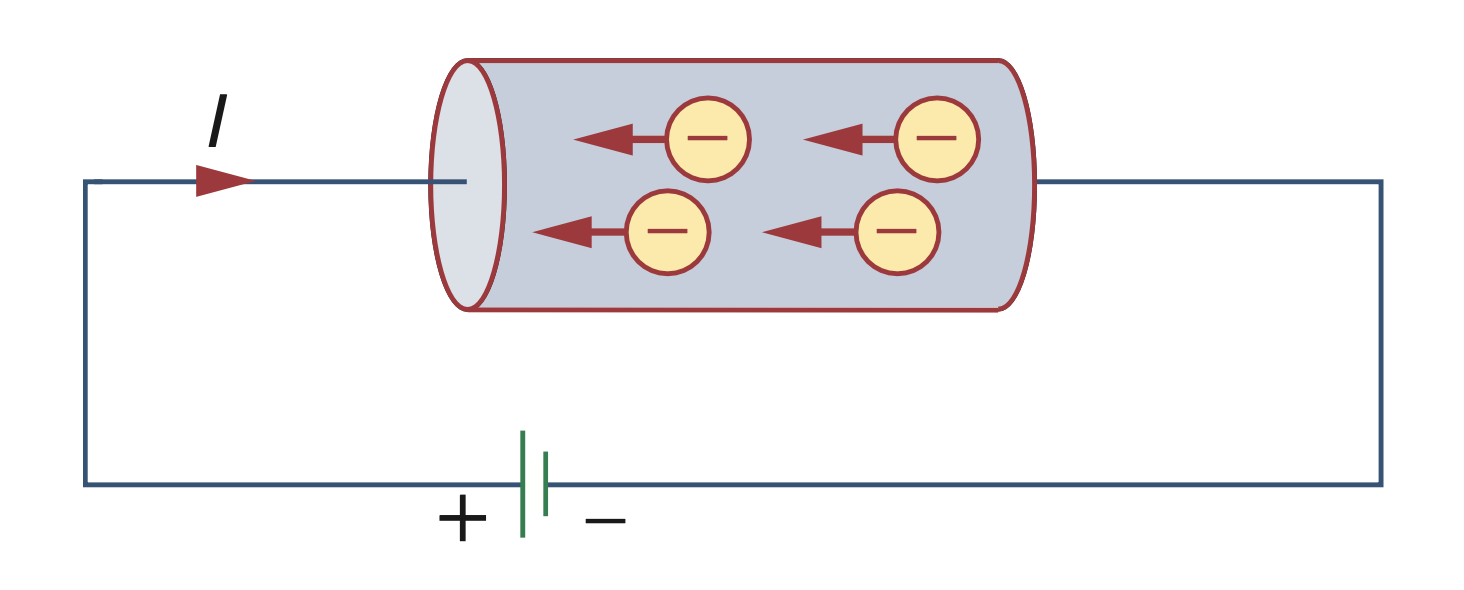
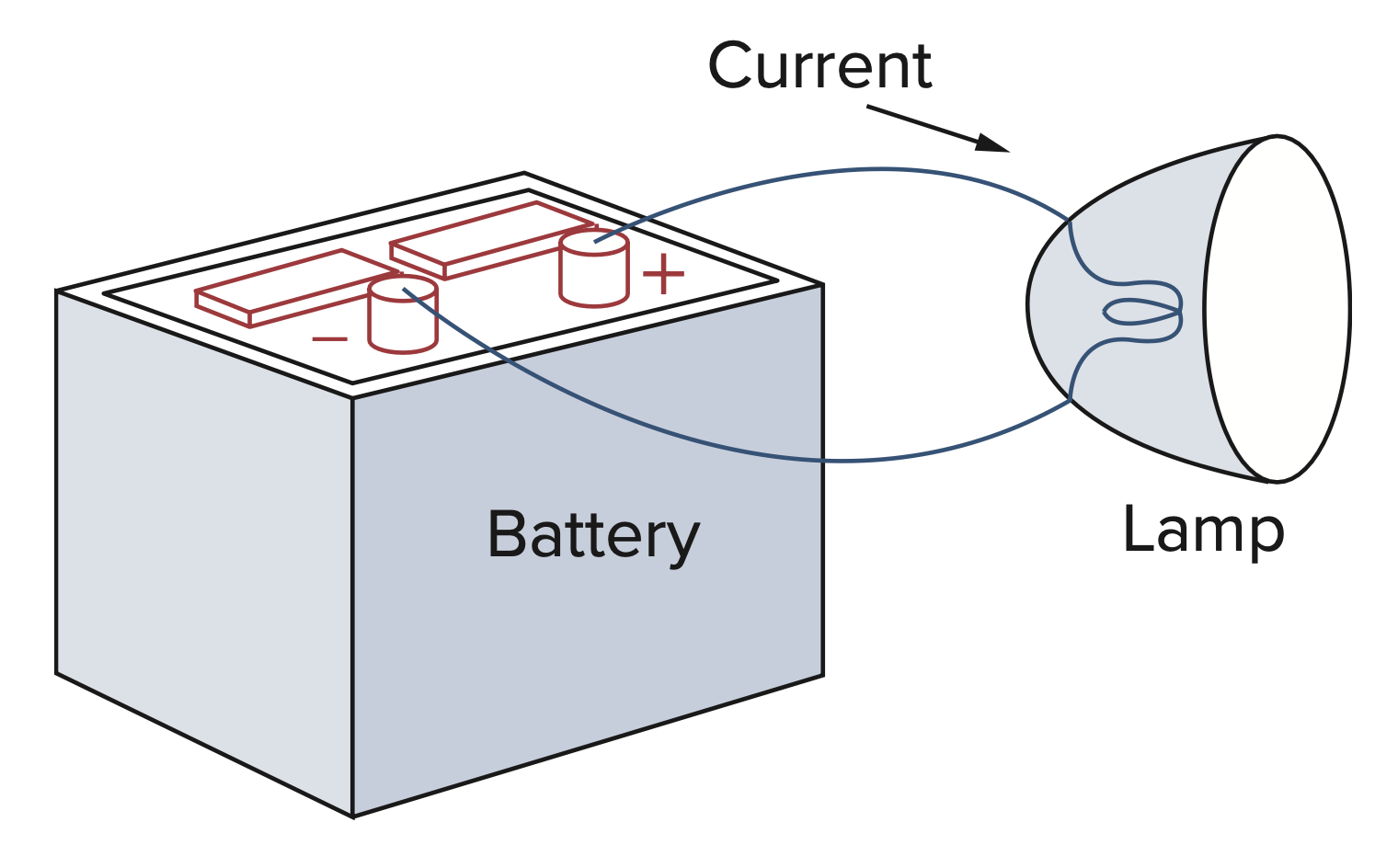
- When a conducting wire (consisting of several atoms) is connected to a source of electromotive force (e.g., a battery), the charges are compelled to move; positive charges move in one direction while negative charges move in the opposite direction. This motion of charges creates electric current.
- พอมันมีแรงเคลื่อนไฟฟ้าเกิดขึ้น (Battery) ทำให้ Electron หลุดและเคลื่อนที่ แล้วถ้าปลายทั้งสองข้างของโลหะมีความต่างศักย์ไฟฟ้า จะเกิดสนามไฟฟ้าภายในแท่งโลหะทำให้ Electron เคลื่อนที่อย่างเป็นระเบียบด้วย Drift Velocity ทำให้เกิด กระแสไฟฟ้า (Electric Current)
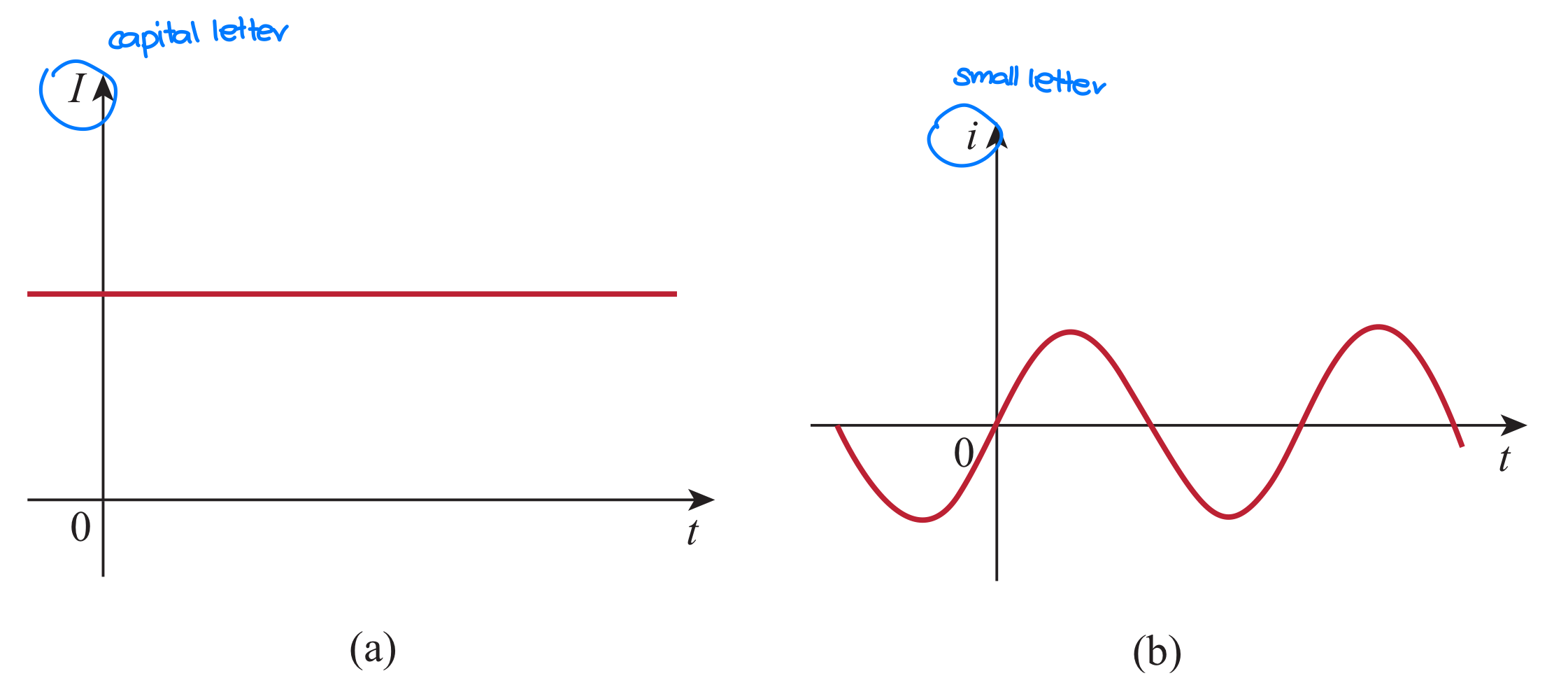
- By convention, capital letters are reserved for constant quantities, and lower case letters represent time dependency quantities.
- ==Electric current is the time rate of change of charge, measured in amperes (A).== Mathematically, the relationship between current i, charge q, and time t is as follows. where q is charge in coulombs (C) and t is time with the unit of second (s).
คิดให้ดีเวลาให้มาเป็นทั้งสมการ สมมติให้มาทั้งสมการของ จะหา ที่เวลาต่าง ๆ ก็แค่ Take Derivative
- The charge transferred between time and is obtained by integrating both sides of previous equation.
- กลับกัน ถ้าสมมติให้สมการ มา ก็หา ได้เช่นกัน แค่เอาไป Integrate
- ก็คือถ้าเจอเป็นกราฟมาก็เท่ากับหาพื้นที่นั่นแหละ!
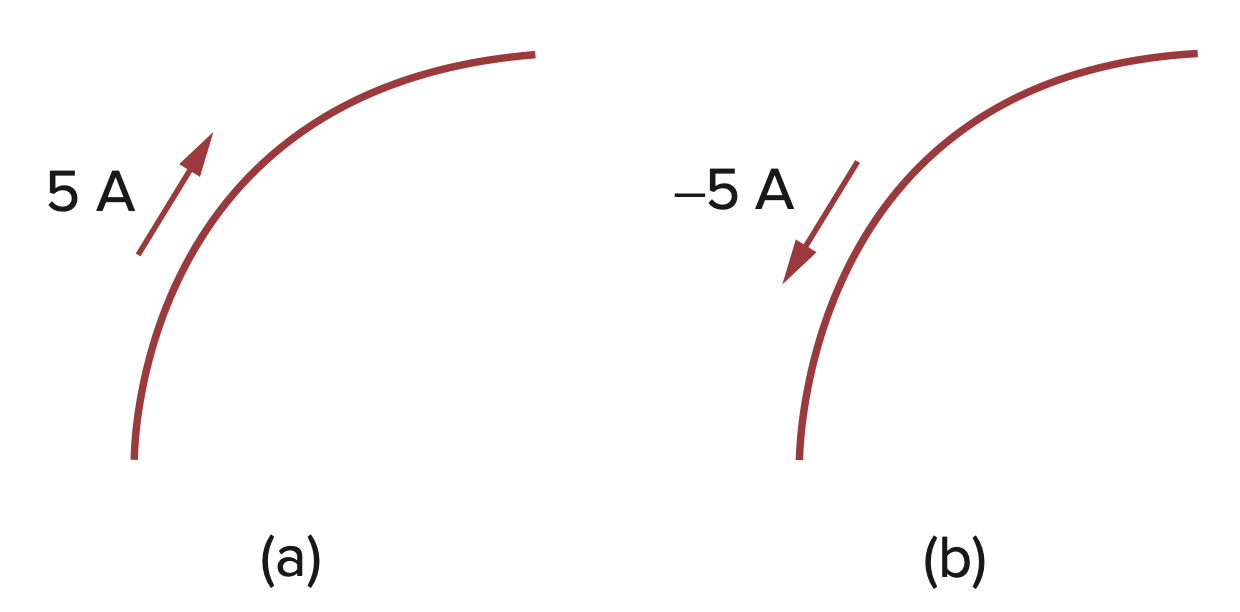
- ข้อตกลงของการไหลของกระแส: แม้ว่า Current จะเกิดจากการเคลื่อนที่ของ Negatively charged electrons แต่ปกติเราจะเขียน Current Flow ไปในทางที่ Positive Charge เคลื่อนตัวไป ดังนั้นถ้าเรากำหนดทิศที่สวนทางกับการไหลของกระแสก็ต้องคำนึงถึง + - ด้วย
- There are two common types of electric current.
- A direct current (DC) is a current that remains constant with time.
- An alternating current (AC) is a current that varies sinusoidally with time.
- The symbol is used to represent a constant current while a time-varying current is represented by the symbol .
Voltage
- To move the electron requires some work or energy transfer. This is done by an external electromotive force (EMF) known as voltage or potential difference.
- The voltage between two points and in electric circuit is the energy (or work) needed to move a unit charge from to . It is mathematically represented as follows. where is energy in joules (J) and is charge in coulombs (C), the voltage or is measured in volts (V).
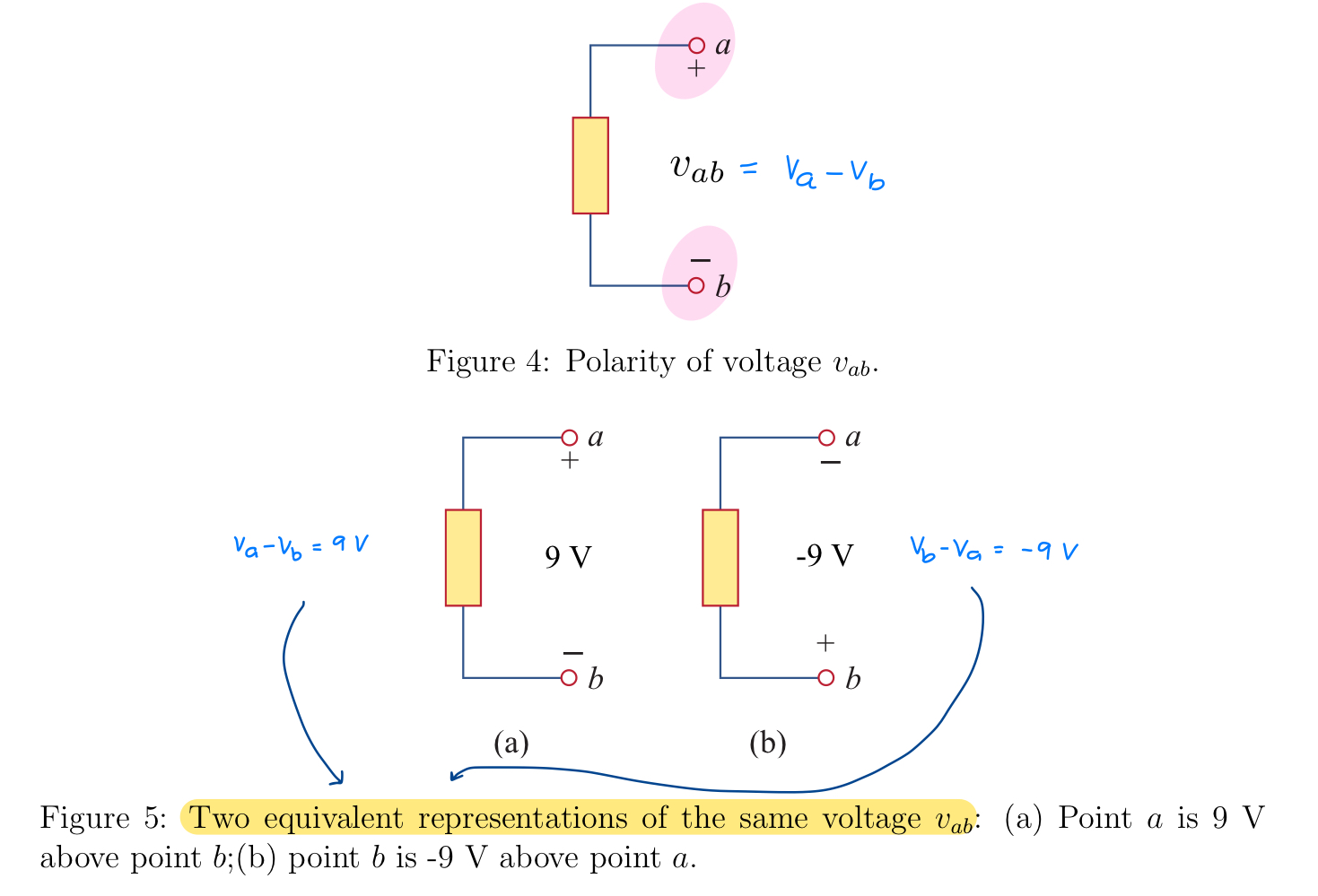
- The voltage across an element connected to points a and b is shown in Figure 4. The plus (+) and minus (−) signs are used to define reference direction or voltage polarity.
- Similar to electric current, a constant voltage is called a dc voltage and is represented by , while a sinusoidal time-varying voltage is called an ac voltage and is represented by .
Power and Energy
- ==Power or instantaneous power is the time rate of expanding or absorbing energy, measured in watts (W).==
- By the passive sign convention, when current enters through the positive polarity of the voltage, power has a (+) sign ().
- If current enters through the negative polarity, power has a (-) sign ().
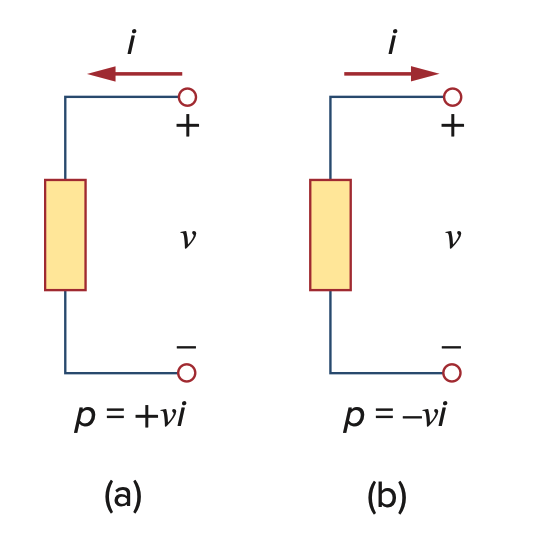
- If current enters through the negative polarity, power has a (-) sign ().
- When the power has a (+) sign, power is being delivered to or absorbed by the element. On the other hand, when power has a (−) sign, power is being supplied by the element.
- Based on law of conservation of energy, the algebraic sum of power in a circuit, at any instant of time, must be zero.
- The energy absorbed or supplied by an element from time to time is as follows.
Circuit Elements
- แหล่งจ่ายอิสระ (Independent Source) → แรงดัน, กระแส
- A source is a voltage or current generator capable of supply energy to a circuit.
- Dependent source
- A dependent source provides a circuit (or a voltage) that is dependent on another variable (ขึ้นอยู่กับ กระแส, แรงดัน ของตัวอื่น) elsewhere in the circuit.
- There are two types of circuit elements: active and passive elements.
- The most important active elements are voltage or currents sources that deliver power to the circuit connected to them. There are two kinds of sources: independent and dependent sources.
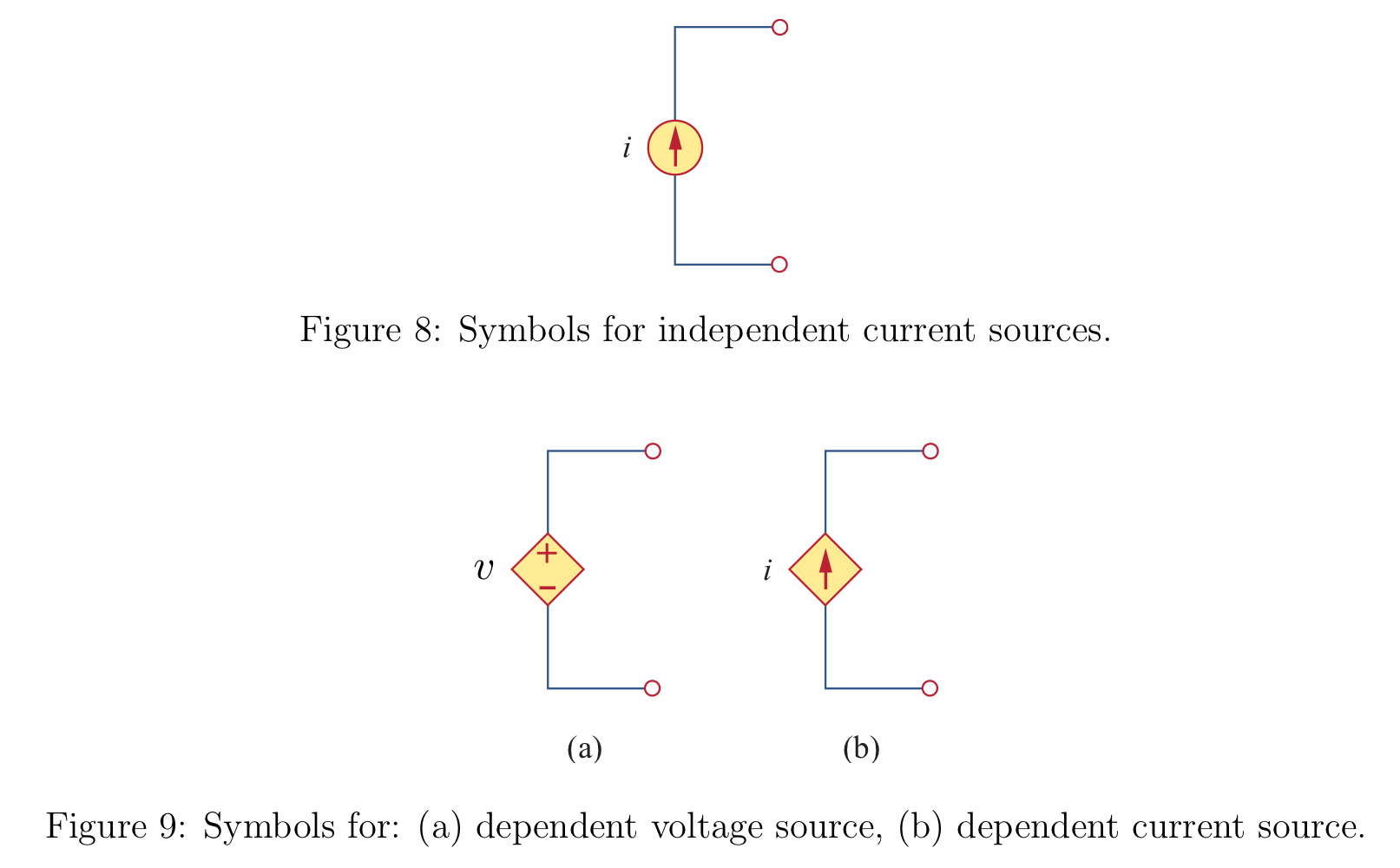
- An ideal independent source is an active element that provides a specified voltage/current that is completely independent of other circuit elements. The general symbol for an independent source is a circle.
- An ideal dependent (or controlled source) is an active element in which the source voltage/current is controlled by another voltage or current. Dependent sources are commonly represented by diamond-shaped symbols. There are four possible types of dependent sources as follows.
- A voltage-controlled voltage source (VCVS).
- A current-controlled voltage source (CCVS).
- A voltage-controlled current source (VCCS).
- A current-controlled current source (CCCS).