Lecture 1 - Linear Systems, Determinants, Vectors and Matrices
Lines in 2D
General equation
- General equation of a line in 2D is given by
- ถ้าเจอให้สมการแบบนี้มาแล้วให้เปลี่ยนเป็น Parametric → จัด ก่อน แล้วจัดซักตัวเป็น
y-y_0=m(x-x_0)
$$
- ต้องรู้ จุดที่ผ่าน และ Slope ()
Parametric equation
- คือจุดที่เส้นตรงนี้ผ่าน
- คือ Vector ที่ขนานกับเส้นตรง
- อย่าลืมว่าหาจากได้จากเอา
Lines and Planes in 3D
General equation of a Plane in 3D
- โดย สามารถ หาได้จาก ถ้าเรารู้ Three points in space
- แทนด้วย 1 ตามนี้เลย
- Normal Vector คือ
- แล้วก็มี Unit Normal Vector ด้วย— ก็แค่เอาไปหารด้วย Norm
- Plane 1 และ Plane 2 จะ Parallel ก็ต่อเมื่อ หรือ จะดูจาก Unit Normal Vector ก็ได้ หรือว่ามองว่ามันคูณด้วยอะไรเพื่อได้อีกตัวรึเปล่า
Lines in 3D
-
A line in 3D can be defined as an intersection of 2 non-parallel planes
ก็ถูกต้องใช่มั้ย 2 Planes ตัดกัน ทำให้เกิดเป็นเส้นตรง
-
ส่วน Parametric ก็คล้าย ๆ 2D แค่เพิ่มมาอีกตัวแปรไงง
Relative position of lines and planes in 3D
Planes vs Planes
- Intersecting planes (ถ้าเท่ากัน มันก็ขนานดิ)
- Parallel planes (นี่ไง เท่ากันคือขนาน) → แต่อันนี้ต้องดู ด้วย ต้องต่างกัน
- Equal planes (อันนี้ เท่ากัน มันก็คือ Plane เดียวกันไงง)
- Perpendicular planes (Dot product ของ และ ต้องเท่ากับ 0)
Lines vs Planes
- เวลาเปรียบเทียบ เปรียบ Normal Vector of the plane VS Direction Vector of a line ()
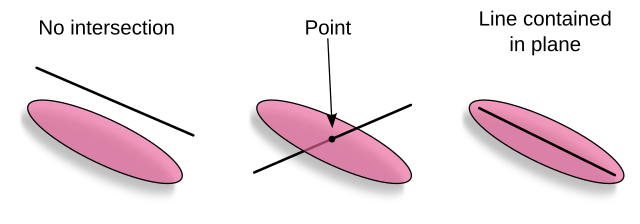
- Line intersects the plane (Dot product ของ และ ต้องไม่เท่ากับ )
- The line is perpendicular to the plane ( = ) จะเช็คโดยการแปลงให้เป็น Unit vector ก่อนก็ได้ หรือว่าจะดูว่าเป็น Scalar คูณรึเปล่า
- The line is parallel to the plane (Dot product ของ และ ต้องเท่ากับ )
- The line is lies in the plane (Dot product ของ และ ต้องเท่ากับ )
- To confirm that the line lies in the plane, substitute a point from the line into the plane's equation. If the point satisfies the equation, the line lies in the plane; otherwise, it's merely parallel to it.
Lines vs Lines
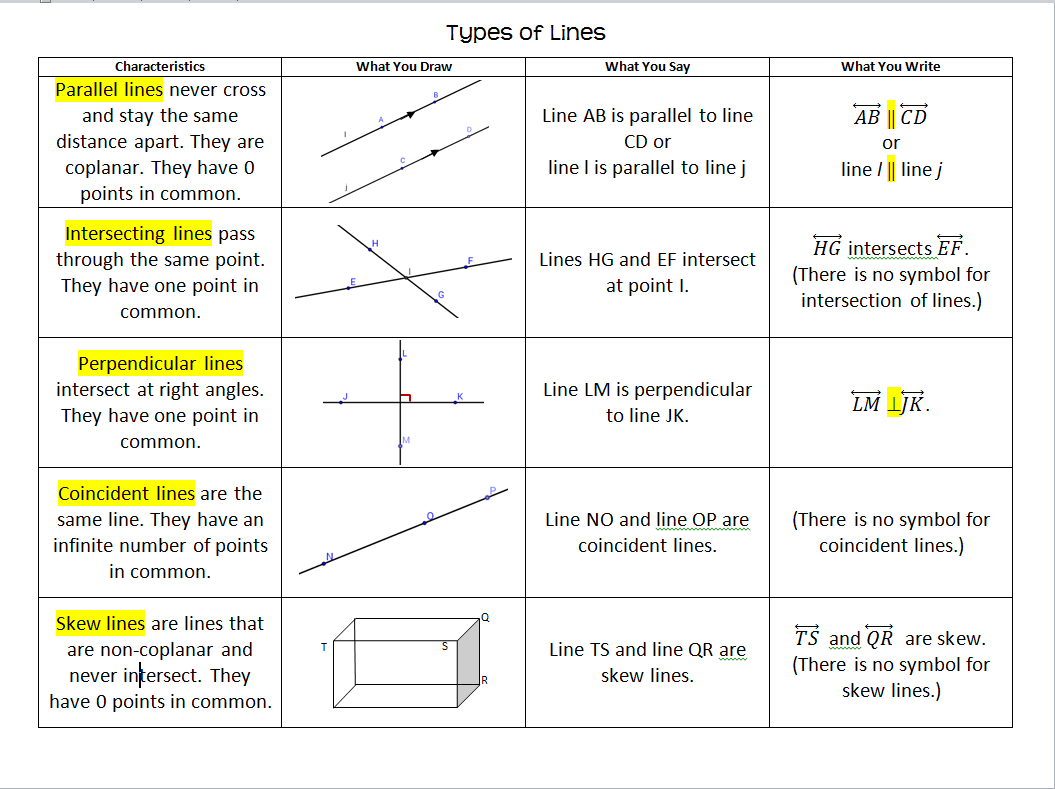
- Parallel lines
- , but a point on one line does not satisfy the equation of the other.
- Coinciding line เหมือนกันแต่
- , and a point on one line also satisfies the equation of the other line.
- Skew, and intersecting lines,
- Skew: Direction vectors are not scalar multiples, and the lines do not intersect (no solution to the system of equations).
- Intersection: Direction vectors are not scalar multiples, but there exists a point where both lines meet (the system of equations has a solution).