What is Enterprise Architecture?
Three Definitions of EA
- Definition 1: Architecture of the Enterprise
- Just like building a house requires building plans, floor plans, electricity plans, and plumbing plans...
- Building a business requires:
- Processes
- Organizations (Employees)
- Location
- Data
- Applications
- Technology
Think of EA like a blueprint — a house needs structural, electrical, and plumbing plans; a business needs its own equivalent set of "plans" across people, data, and tech.
- Definition 2: Mapping of Present and Future States
- EA is the plan of transition from the current state of the business to the desired future state
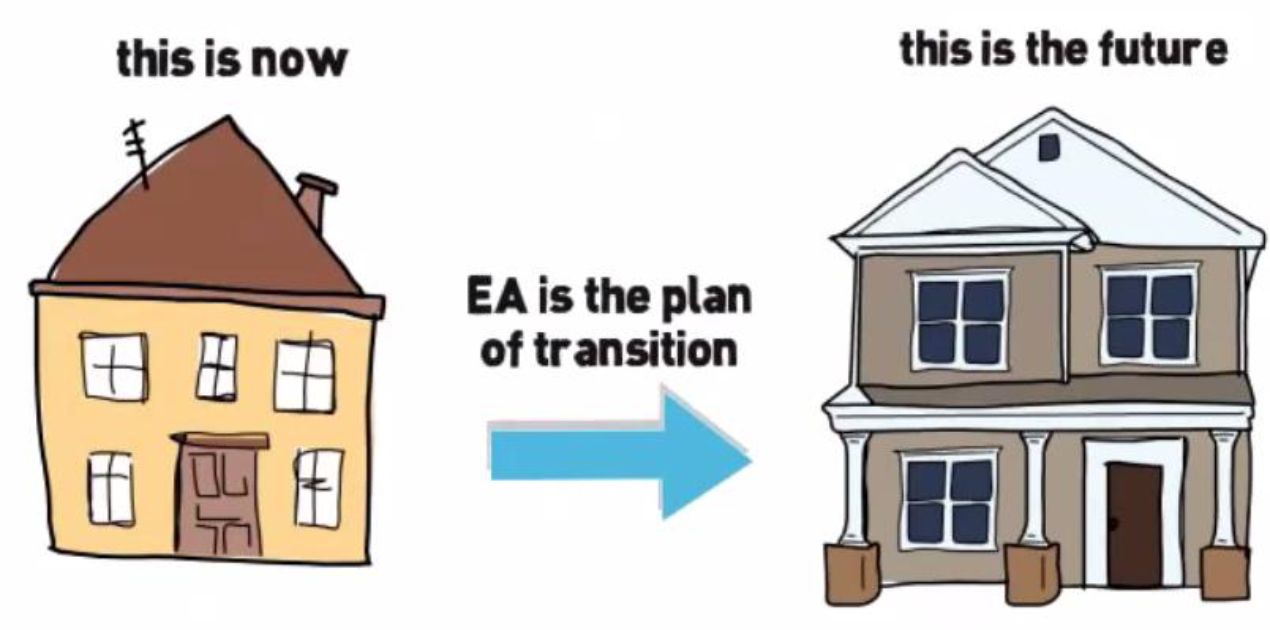
Like renovating a house — EA is the renovation plan that tells you how to get from your current rundown house to the dream house you want.
- Definition 3: A Management Method
- EA aims to bridge the gap between:
- Management decision stakeholders
- Operational teams
- EA aims to bridge the gap between:
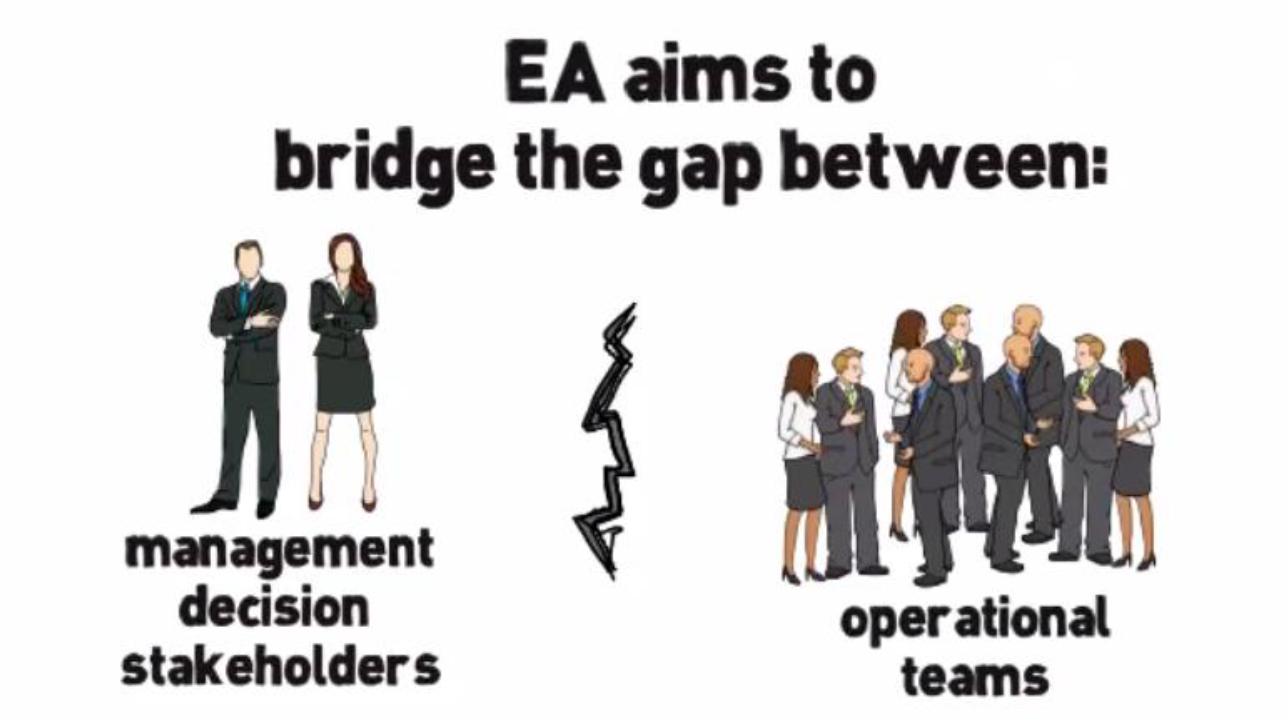
EA is like a translator between the "big picture" executives and the "hands-on" teams — making sure everyone is working toward the same goal.
Simple Answer
EA = Strategic Planning that relates and aligns information technology (IT) with the business functions that it supports.
Why EA Exists — Two Problems It Addresses
- System Complexity — Organizations were spending more and more money building IT systems
- Poor Business Alignment — Organizations found it increasingly difficult to keep expensive IT systems aligned with business needs
EA Validates Across Three Levels
- Strategic Level — Confirms and validates strategies
- Operations Level — Validates requirements
- Implementation Level — Validates implementations
Common Misconception
- ❌ EA is a function of IT
- ✅ EA must get Business & IT people to design together
EA Framework
A disciplines/guidelines for defining and maintaining the architecture models, governance and transition initiatives needed to effectively co-ordinate disparate groups towards common business and IT goals.
EA Framework Pyramid (Business-Driven → Technology-Driven)
- Business (top) — drives
- Information — prescribes
- Data — supported by
- Applications — supported by
- Technical Infrastructure (bottom)
Cross-cutting concerns: Strategy, Security
Architecture Relationships
Components within Enterprise Architecture
| Component | Description |
|---|---|
| Business Architecture | Result of defining business strategies, processes, and functional requirements |
| Information Architecture | Describes data's physical and logical aspects; manages data resources for business processes |
| Application Architecture | Focuses on developing/implementing applications to fulfill business requirements and meet business goals |
| Technical Architecture | Identifies and plans computing services forming the technical infrastructure |
| Product Architecture | Identifies standards and configurations for enabling technologies and products within Technical Architecture |
Hierarchy
Enterprise Architecture
├── Business Architecture
├── Information Systems Architecture
│   ├── Information Architecture
│   └── Application Architecture
└── Technical Architecture
    └── Product Architecture
Architecture Levels
| Level | Scope | Detail | Impact | Audience |
|---|---|---|---|---|
| Enterprise Architecture | Agency/Organization | Low | Strategic Outcomes | All Stakeholders |
| Segment Architecture | Line of Business | Medium | Business Outcomes | Business Owners |
| Solution Architecture | Function/Process | High | Operational Outcomes | Users and Developers |
Like zoom levels on a map — Enterprise is the country view (low detail, big impact), Solution is the street view (high detail, specific outcomes).
EA Frameworks
- Many EA frameworks have been published:
- Zachman Framework
- TOGAF (The Open Group Architecture Framework)
- Each framework has its own Methods, Techniques, Tools, Strengths & Weaknesses
The Zachman Framework
Overview
- An intersection between two classical schemas:
- Primitive Interrogatives: What, How, When, Who, Where, Why
- Integration of answers to these questions enables comprehensive description of complex ideas
- Reification (transformation of abstract → instantiation):
- Identification → Definition → Representation → Specification → Configuration → Instantiation
- Primitive Interrogatives: What, How, When, Who, Where, Why
Like journalism's "5 W's + H" meets a multi-level blueprint — you answer the same key questions from different perspectives/roles.
Six Perspectives (Rows)
| Perspective | Role | Description |
|---|---|---|
| Scope | Planner | Concerned with positioning the product in context; specifying scope |
| Enterprise Model | Owner | Interested in business deliverable and how it will be used |
| System Model | Designer | Works with specs to ensure product fulfills owner's expectations |
| Technology Model | Builder | Manages process of assembling and fabricating components |
| Detailed Representations | Subcontractor | Fabricates out-of-context components meeting builder's specs |
| Functional Representations | Operator | Validates usability and performance of the product |
Six Dimensions (Columns)
| Dimension | Question | Description |
|---|---|---|
| Data | What? | Understanding and dealing with enterprise data across all rows |
| Function | How? | Translating mission into successively detailed operational definitions |
| Network | Where? | Geographical distribution of enterprise activities |
| People | Who? | Who is involved in business and technology introduction |
| Time | When? | Effects of time on the enterprise |
| Motivation | Why? | Translation of business goals/strategies into specific ends and means |
Overview of the Zachman Framework (Matrix)
| DATA (What) | FUNCTION (How) | NETWORK (Where) | PEOPLE (Who) | TIME (When) | MOTIVATION (Why) | Stakeholder | |
|---|---|---|---|---|---|---|---|
| Objective/Scope (Planner) | List of things important in the business | List of Business Processes | List of Business Locations | List of important Organizations | List of Events | List of Business Goals & Strategies | Management Level |
| Enterprise Model (Owner) | Conceptual Data / Object Model | Business Process Model | Business Logistics System | Work Flow Model | Master Schedule | Business Plan | System Owner / Product Owner Level |
| System Model (Designer) | Logical Data Model | System Architecture Model | Distributed Systems Architecture | Human Interface Architecture | Processing Structure | Business Rule Model | System Designer Level |
| Technology Model (Builder) | Physical Data/Class Model | Technology Design Model | Technology Architecture | Presentation Architecture | Control Structure | Rule Design | Developer Level |
| Detailed Representations (Programmer) | Data Definition | Program | Network Architecture | Security Architecture | Timing Definition | Rule Speculation | Developer Level |
| Functioning Enterprise (User) | Usable Data | Working Function | Usable Network | Functioning Organization | Implemented Schedule | Working Strategy | User Level |
Framework Rules
- Rule 1: Columns have no order
- Rule 2: Each column has a simple, basic model
- Basic Model = Entities and Relationships:
Entity — Relationship — Entity
- Basic Model = Entities and Relationships:
- Rule 3: Basic model of each column is unique
- Rule 4: Each row represents a distinct view
- Rule 5: Each cell is unique
- Rule 6: Combining the cells in one row forms a complete description from that view
Tools for Zachman
TOGAF (The Open Group Architecture Framework)
By the Open Group Standard
TOGAF Architecture Framework — Structure
Top Layer: Architecture Principles, Vision, and Requirements
Preliminary:
- Architecture Principles
- Business Strategy
- Technology Strategy
- Business Principles, Objectives, and Drivers
- Architecture Vision
- Stakeholders
Architecture Requirements:
- Requirements | Constraints | Assumptions | Gaps
Middle Layer: Core Architecture Domains
| Business Architecture | Information Systems Architecture | Technology Architecture |
|---|---|---|
| Motivation: Drivers, Goals, Objectives, Measures | Data: Data Entities → Logical Data Components → Physical Data Components | Platform Services |
| Organization: Organization Units, Locations, Actors/Roles | Application: Information System Services → Logical Application Components → Physical Application Components | Logical Technology Components |
| Function: Business Services, Processes, Events, Controls, Products, Functions | Physical Technology Components |
Bottom Layer: Architecture Realization
- Opportunities, Solutions, and Migration Planning: Capabilities, Work Packages, Architecture Contracts
- Implementation Governance: Standards, Guidelines, Specifications
ADM — Architecture Development Method
ADM provides a tested and repeatable process for developing architectures. Activities are carried out within an iterative cycle of continuous architecture definition and realization.
ADM Basic Principles
- Iterative method — over the whole process, between phases AND within phases
- Each iteration involves new decisions about:
- Enterprise coverage
- Level of detail
- Time horizon
- Architecture asset re-use (previous ADM iterations, other frameworks, system models, industry models)
- Decisions based on:
- Competence / resource availability
- Value accruing to the enterprise
- Every phase is validated against and validates the current requirements of the business
Like Agile sprints but for architecture — each loop through the cycle refines and confirms the design against real business needs.
ADM Phases
Preliminary Phase: Frameworks & Principles
- Prepares the organization for undertaking EA successfully
- Activities:
- Understand business environment
- Commitment of key stakeholders
- Agreement on scope
- Establish principles
- Establish governance structure
- Agree on methods to be adopted
Phase A: Architecture Vision
- Initiates one iteration of the architecture process
- Sets scope, constraints, expectations
- Required at the start of every architecture cycle
- Validates business context
Phase B: Business Architecture — Contents
- Organization structure
- Business goals and objectives
- Business functions
- Business Services
- Business processes
- Business roles
- Correlation of organization and functions
Phase C: Information Systems Architectures
- The fundamental organization of an IT system, embodied in:
- Relationships to each other and the environment
- Principles governing its design and evolution
- Shows how the IT systems meet the business goals of the enterprise
Phase D: Technology Architecture
- The fundamental organization of an IT system, embodied in:
- Its hardware, software and communications technology
- Their relationships to each other and the environment
- The principles governing its design and evolution
Phase E: Opportunities and Solutions
- Identify the major implementation projects
- Decide on approach:
- Make vs Buy vs Re-Use
- Outsource
- COTS (Commercial Off-The-Shelf)
- Open Source
- Assess priorities
- Identify dependencies
Phase F: Migration Planning
- For projects identified in Phase E, perform:
- Cost/benefit analysis
- Risk assessment
- Produce an implementation road-map
Phase G: Implementation Governance
- Defines architecture constraints on implementation projects
- Architecture contract
- Monitors implementation work for conformance
Phase H: Architecture Change Management
- Ensures that changes to the architecture are managed in a cohesive and architected way
- Establishes and supports the Enterprise Architecture to provide flexibility to evolve rapidly in response to changes in the technology or business environment
ADM — 4 Iteration Cycles
| Cycle | Phases Involved |
|---|---|
| Architecture Context | Prelim + Phase A |
| Architecture Delivery | Phase A → B → C → D → E |
| Transition Planning | Phase E → F |
| Architecture Governance | Phase G → H |
Example Work Products per Phase
| Phase | Key Artifacts |
|---|---|
| Preliminary | Principles Catalog, Stakeholder Map Matrix, Value Chain Diagram, Solution Concept Diagram |
| A. Architecture Vision | Requirement Catalog |
| B. Business Architecture | Org/Actor Catalog, Role Catalog, Business Service Catalog, Location Catalog, Business Capability Catalog, Value Stream Catalog, Value Stream Map, Business Capability Map, Organization Map, Business Footprint Diagram, Business Model Diagram, Product Lifecycle Diagram, Business Service/Information Diagram, Functional Decomposition Diagram |
| C. Information Systems Architectures | Data Entity Catalog, Application Portfolio Catalog, Conceptual Data Diagram, Interface Catalog, Logical Data Diagram, Application Communication Diagram, Data Dissemination Diagram, Application and User Location Diagram, Application Use Case Catalog |
| D. Technology Architecture | Technology Standard Catalog, Technology Portfolio Catalog, Environments and Locations Diagram, Platform Decomposition Diagram |
| E. Opportunities and Solutions | Project Context Diagram, Benefit Diagram |
TOGAF + Zachman
- Zachman can be applied to TOGAF Phases A through D
- Phase A (Architecture Vision) ↔ Zachman Scope/Planner perspective
- Phase B (Business Architecture) ↔ Zachman Enterprise Model/Owner perspective
- Phase C (Information Systems) ↔ Zachman System Model/Designer perspective
- Phase D (Technology Architecture) ↔ Zachman Technology Model/Builder perspective
TOGAF gives you the process (what to do and when), while Zachman gives you the classification schema (how to organize what you know). Together they complement each other.
TOGAF ADM + Agile Mapping
- Architecture Backlog → fed from Architecture Vision (Phase A)
- Iteration Backlog → from Business Architecture (Phase B)
- Architecture Development Iteration → Phases B → C → D → E (showcase + retrospective)
- Defined Architecture → output of Phase E
- Solution Backlog → feeds into Solution Release Planning
- Solution → from Implementation (Phase G/H)
- New Architecture Backlog Items → fed back into Preliminary
TOGAF ADM maps cleanly onto Agile: Architecture Vision = Product Vision, ADM iterations = Sprints, Requirements Management Backlog = Product Backlog.
Further Reading
- TOGAF: http://www.opengroup.org/togaf/
- Zachman: http://www.zachmaninternational.com