Agenda
- What is a fallacy
- Fallacies of Ambiguity
- Fallacies of Relevance
- Fallacies Involving Unwarranted Assumption
1. What is a Fallacy?
Definition of Argument
- An argument is a way of supporting a claim using reasons or evidence (called premises)
- Arguments can still be weak or incorrect if:
- The reasons are wrong, OR
- The reasons don't really support the conclusion
Definition of Fallacy
- Fallacy: A mistake in reasoning
- An argument with a fallacy might look correct at first—but when we check more closely, it turns out to be wrong
Types of Fallacies
- Formal fallacy: Something wrong with the structure of the argument
- Informal fallacy: Argument feels convincing but is not logical; might play with emotions or use unclear ideas
2. Fallacies of Ambiguity
Characteristics
- These fallacies happen when:
- a) A word or phrase means more than one thing
- b) A sentence is grammatically confusing
- c) Two ideas that look similar are mixed up
Types of Fallacies of Ambiguity
Equivocation
- Occurs when a key term in an argument is ambiguous—when it has more than one meaning
”Feathers are light. What is light cannot be dark. So, feathers cannot be dark.”
Amphiboly
- Occurs when an argument has a sentence with bad or weak grammatical structure, making the meaning unclear
“I saw the man with the telescope.” (Unclear: Did I use the telescope, or did the man have it?)
Fallacies of Division
- Making an erroneous inference that what is true for the group is true for each member
”The basketball team is the best in the league, so every player must be the best in the league.”
Fallacies of Composition
- Inferring that what is true for a member is true for the whole group, misrepresenting the components of the group
“Each player on this team is excellent, so the team must be the best in the league.”
3. Fallacies of Relevance
Definition
- In a fallacy of relevance, one or more of the reasons (premises) in the argument don't really support the conclusion
- These reasons may seem convincing, but they are not logically connected to the conclusion
- They only seem relevant because they affect us emotionally or psychologically
Types of Fallacies of Relevance
1. Personal Attacks (Ad Hominem)
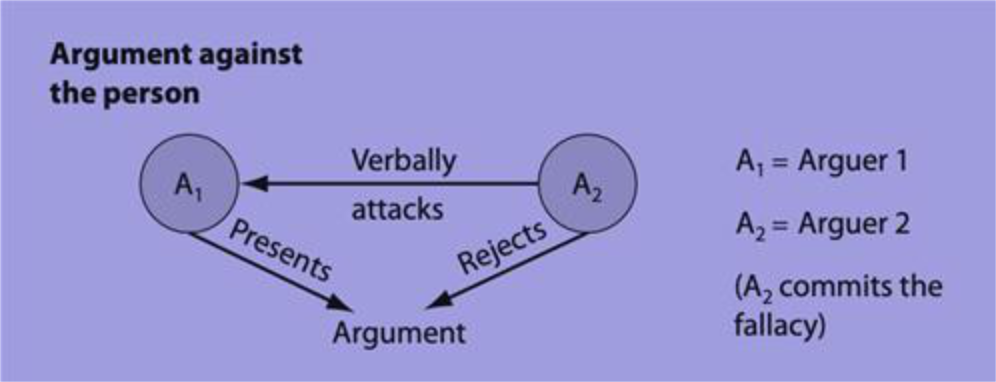
- Definition: The fallacy happens when we attack the person instead of responding to the argument
- Subtypes:
- ✗ Abusive
- ✗ Circumstantial
- ✗ Tu Quoque (You Too)
- Examples:
- Customer: "The product stopped working less than a month after we bought it."
- Product Owner: "Of course you would want a refund because you look like you ran out of money for mindlessly buying stuff you cannot actually pay."
2. Appeals to Force/Scare Tactics
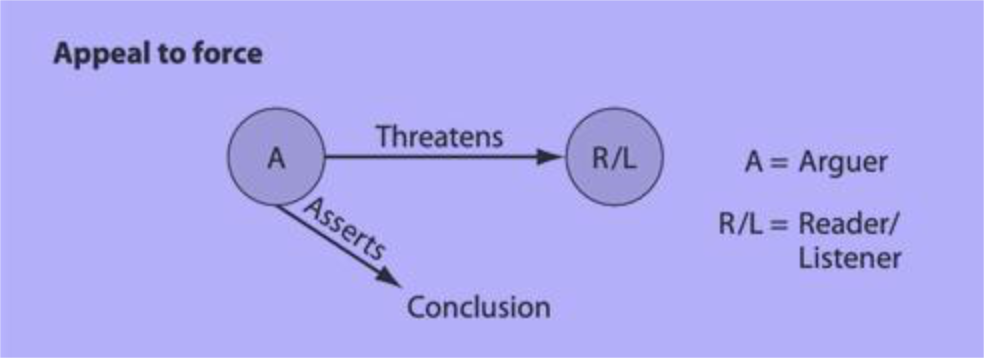
- Definition: Uses threats—physical, emotional, or social—to pressure someone into agreeing
- Examples:
- "Before you say a word, remember that I pay for your house, food, and clothes."
- "Well, my fist doesn't really talk a lot. But if I told you this is the best option, then it is the best option."
3. Appeals to Pity
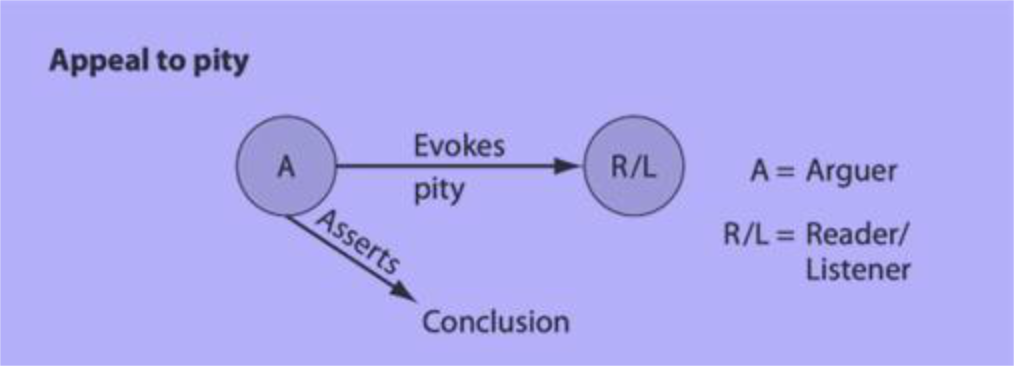
- Definition: Appeals to emotions—especially pity—even when those feelings have nothing to do with the logic of the argument
- Example:
- Student: "My total grade is below the passing grade, but if you give me an F my family will be disappointed in me. It will hurt me to disappoint my parents who worked hard. I want to have a better future, but an F on my record will ruin my chances of a scholarship. Surely, I should not be given an F."
4. Popular Appeals Fallacy (Appeal to the people/ad populum)
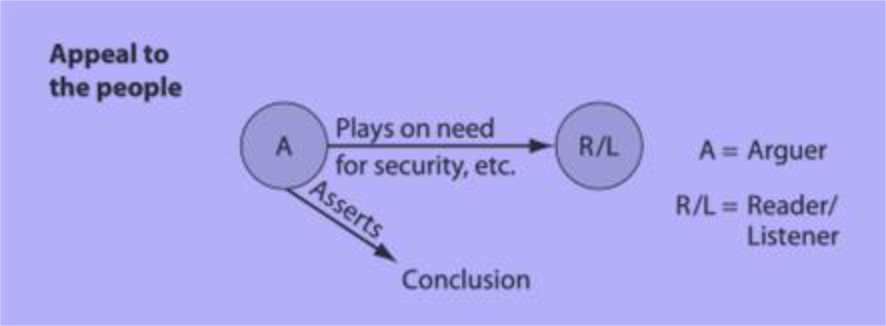
- Definition: Tries to win agreement by using popularity or popular sentiments instead of real reasons
- Subtypes:
- Bandwagon argument
- Appeal to vanity
- Appeal to snobbery
- Appeal to tradition
- Examples:
- "Of course you want to be as hot as Ryan Gosling. This means you will want to wear a Tag Heuer watch like his."
- "Everybody believes in gravity. You should too."
5. Appeal to Ignorance
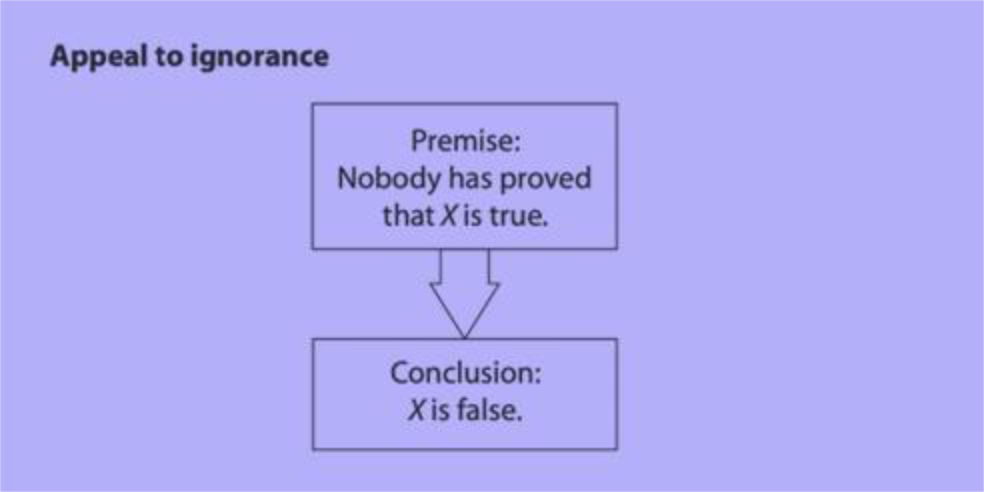
- Definition: Says something is true just because no one has proven it false—or false because no one has proven it true
- Examples:
- "You cannot prove that it wasn't destiny that led us to each other, so it is true that destiny brought us together."
- "Every platform and app cannot prove that I cheated in my virtual chess matches. We must conclude that I did not cheat."
6. Hasty Generalization
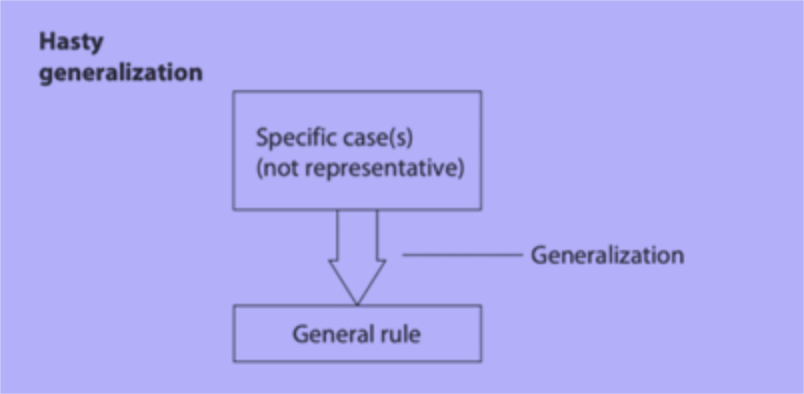
- Definition: A conclusion about a group based on too small or biased a sample
- Characteristics:
- It's an inductive fallacy, meaning it jumps from examples to general rules
- The fallacy occurs when the sample is not likely representative of the whole
- Example:
- "Dr. Kob Fitzwilliam, Prof. Nook Demarchy and Mrs. Look-orn van der Berg are from the same province, and the three of them went to study in Europe. The women in that province have European college degrees."
7. Strawman Fallacy
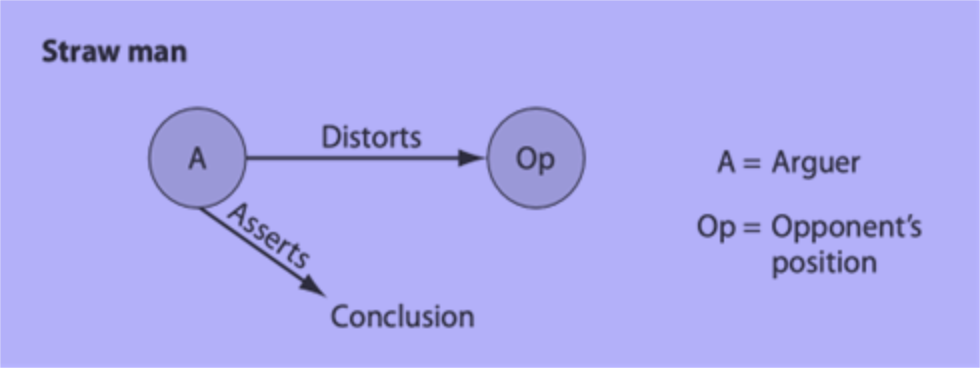
- Definition: Occurs when someone distorts the original argument to create a weak version, then attacks that version instead
- Examples:
- "My siblings want the contribution for the household expense according to our income. What they really want is to bleed out the ones who work hard and earn more."
- "My adviser said my research did not include enough relevant articles about AI. Does she expect me to include the whole library about AI in my paper? Her advice is rubbish."
8. Red Herring
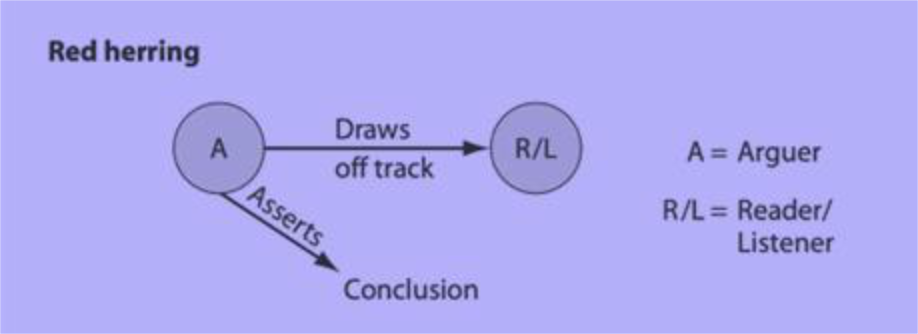
- Definition: The response changes the topic to distract from the real issue
- Process:
- The speaker subtly shifts the topic
- The speaker draws a conclusion on the new topic instead of the original one
- Example:
- A: "The students are outraged by the new rules charging them 1,000.00 for parking their cars on campus overnight."
- B: "These are outrageous times. It is outrageous that small crimes are on the rise on campus..."
- A: Nuclear power plants are dangerous.
- B: Electricity is dangerous no matter where it comes from. Many die from electrocution, mostly from carelessness. Therefore we need to teach people the safe use of electricity. If we want to be far from harm, we need everyone to have the knowledge and skills to deal with electric connections.
4. Fallacies of Unwarranted Assumptions
Definition
- A fallacious argument that contains an assumption that is not supported by evidence
Types of Fallacies of Unwarranted Assumptions
1. Begging the Question
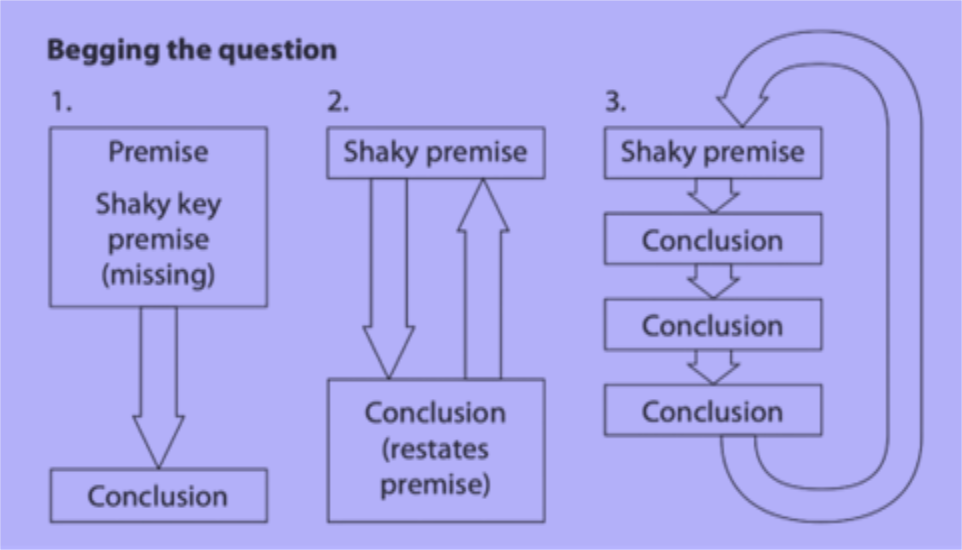
- Definition: This fallacy happens when the conclusion just repeats the same idea as the premise—nothing new is really proven
- Examples:
- "Robbery is morally wrong. This is the same. Therefore, the lottery is morally wrong."
- "Punishing plagiarism is right because it is correct to give a penalty for such behavior."
- "Group Y's project is the best. After all, it is the finest work. Therefore, this means that their submission is number one."
2. Inappropriate Appeal to Authority (Unqualified Authority)
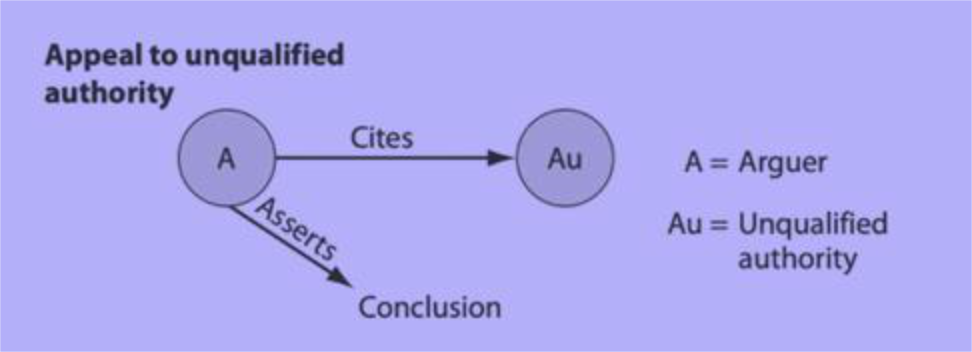
- Definition: Occurs when someone uses an unreliable or unqualified source to support their argument
- Problems with authority:
- ✗ Lack of expertise
- ✗ Bias
- ✗ Motivation to lie
- Examples:
- "Our religious leader declared that genetic engineering is unsafe. Therefore, all experiments on genetic engineering must be stopped."
- "The CEO of the tobacco company swore that cigarettes are addictive. He knows so much about cigarettes. So, cigarettes do not cause addiction."
3. Loaded Question (Complex Questions)
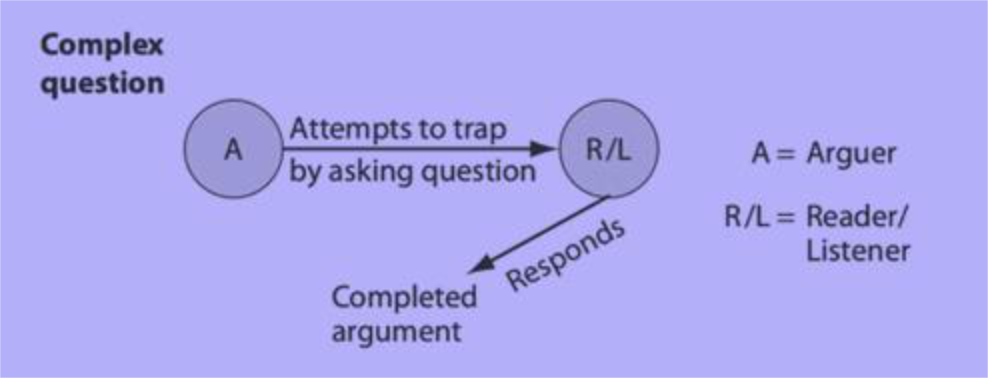
- Definition: Two or more questions are asked in the guise of a single question. Acting as a trap, it asks a question that already assumes something controversial or unproven
- Examples:
- "Have you stopped cheating on exams?"
- "Where did you hide the marijuana you were smoking?"
4. False Dilemma (False Dichotomy)
- Definition: This fallacy limits complex issues to only two options, even when more exist
- Examples:
- "Either you love this country, or you hate it. You adopt our culture or go back to where you came from."
- "Either we stop using petrol, or we burn our planet. Surely you don't want to set this world in flame. We have to stop using petrol now."
5. Slippery Slope
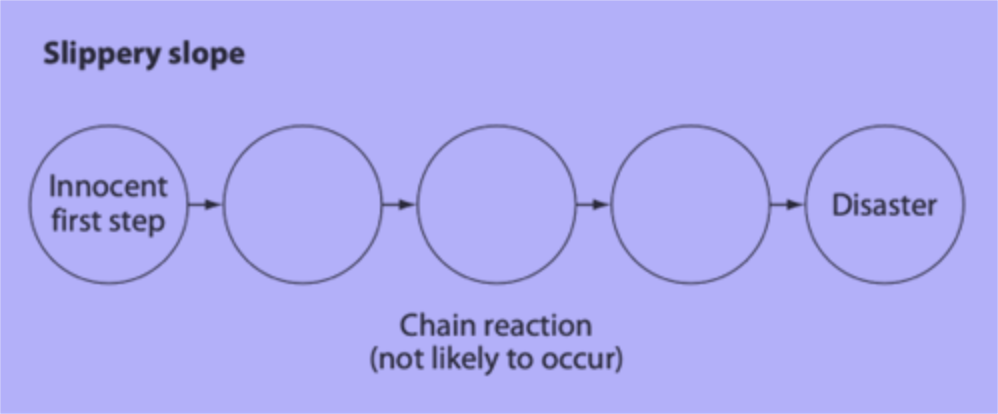
- Definition: This fallacy exaggerates: if one thing happens, it'll trigger a chain of bad events—even without real proof
- Example:
- "If we allow students to wear what they want, they will demand to do what they want. This will lead to a loss of respect for rules and regulations. Soon, there will be no more respect for each other's rights, and there will be no more rules to follow. The school system will disintegrate. There will be anarchy instead of education."
6. Naturalistic Fallacy
- Definition: This fallacy assumes that because something is natural, it is good or acceptable
- Examples:
- "These cigarettes are made from natural tobacco."
- "Homosexual encounters do not lead to children, which is the natural end of sexual relations. This is what nature intends. Therefore, homosexuality is immoral."
- "Animals hunt and kill. We are born hunters. It is immoral to outlaw hunting."
Detecting Fallacy in Ordinary Language
Important Points
- Fallacies in everyday language are often hard to spot
- They are not always clear or obvious
- Sometimes they are hidden in ordinary ways of speaking or writing
- There are many ways to make reasoning mistakes
- A single argument can contain multiple fallacies
- Fallacies can be mixed with valid reasoning, so we need to carefully separate the parts
- Detecting fallacies requires practice in spotting flawed patterns within everyday language