05 Hash Map
Updated 4 Oct 2026
Searching in an Array
- Consider a fully load array of size n
- How do we search for a specific item in it?
- What is the worst-case scenario?
- What is the Big-O for this searching method at the worst case?
What is a Hash Map?
- Designed for improving the search efficiency in the array.
- It’s a technique to map a data to a unique address so that it can be retrieved quickly.
- It requires a key-to-address mapping process to map an input key to an address index in the array.
- It requires special way to insert and delete the key to the array.
Technical Terms
- Data to be stored to an array → Keys
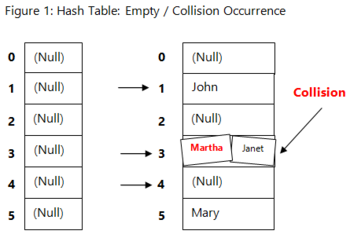
- Array to store data → Hash table
- The size of the array → Hash size
- Normally chosen to be a prime number to reduce the chance of collision.
- Formula to store data to the array → Hash function
- The location of data in the array → Address
- Using the hash function, multiple data are assigned to the same location in a hash table → Collision
Hashing Functions
- Given a key, a hash function tells its location
Division
H(key) = key % hashSize
Folding
H(key, C) = (floor(key/C) + key % C) % hashSize
- ง่าย ๆ ก็เหมือนเอาเลขส่วนข้างหน้ามา + กับเลขส่วนข้างหลัง แต่ก็ต้องดู C อีกที
How to Handle Collisions
Separate chaining
- Separate chaining: use a list for each collided address to extend capacity of each address
- อันนี้ไม่ค่อยได้เรียนเท่าไหร่ เหมือนว่าถ้าเจอ Collision ก็เก็บไว้ตรงนั้นแหละ
Open address
- Open address: find a new address for the new key
- Reallocate a new cell when there’s a collision: เราต้องหาช่องใหม่ให้มัน ห้ามซ้ำ
- Alternative cells are tried in succession (i=1,2,3,…) until the empty cell is found
H(key, i) = (H(key) +f(i))% hashSize
- Linear probing: f(i)=i
- Quadratic probing: f(i)=i2
Load Factor
- Tell how full of your hash table
Load Factor (λ)=Hash sizeSize of data
- We prefer λ<1, when it’s approaching 1, there’s a high chance of a collision
- We should keep λ<0.5 for the open addressing and λ<0.9 for separate chaining