What is E-Commerce?
- E-commerce, or Electronic Commerce, involves conducting business transactions through the Internet, World Wide Web, and mobile applications.
- The formal definition emphasizes digitally-enabled commercial transactions among organizations and individuals. Also known as "digital commerce"
- Began in 1995 (The availability of internet)
Traditional Commerce
- Consumers are viewed as passive targets of advertising campaigns
- Consumers cannot search for the best prices and quality beyond local areas. (Can only buy whatever is sold in nearby areas)
- Information about prices, costs, and fees could be hidden from the consumers
- E-commerce provides transparency in information about prices, costs, and fees, distinguishing it from traditional commerce.
Key component of E-commerce: Availability of internet to connect customers
- Connecting with individual or community isn’t E-commerce
- To connect outside some business, have data base to count stock of goods isn’t E-commerce
Unique Features of E-commerce Technology
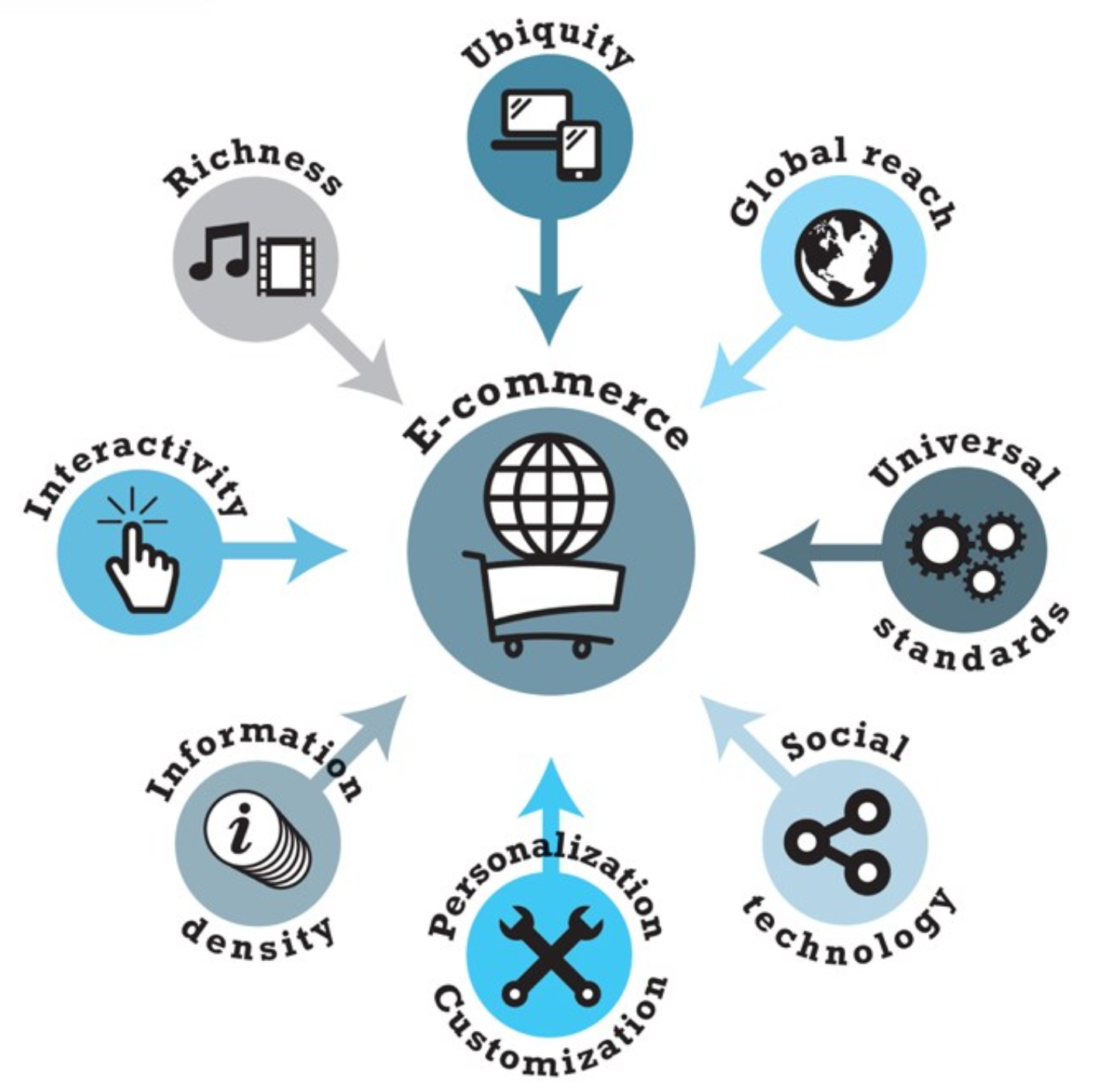
Technological Building Blocks Underlying E-commerce
- Internet: A global network of computer networks following common standards.
- World Wide Web (the Web): An information system on the Internet infrastructure, offering access to billions of web pages.
- Mobile Platform: Enables Internet access from various mobile devices such as smartphones, tablets, and lightweight laptops.
Types of E-Commerce:
- E-commerce types classified by the nature of the market relationship:
- Business-to-Consumer (B2C): Involves transactions between businesses and individual consumers.
Main type in terms of number of sales
- Example: Online retail, where a consumer purchases products from an online store.
- Business-to-Business (B2B): Encompasses transactions between businesses.
In terms of generating huge revenue, huge amount of goods, business transactions
- Example: A company procuring raw materials from another business through an online platform.
- อย่าง Apple ก็ไม่ได้ผลิตทุกอย่างเอง ให้อีกบริษัทนึงมาผลิตให้
- Consumer-to-Consumer (C2C): Involves transactions between individual consumers.
- Example: Online platforms facilitating individuals to sell used items to other consumers.
- ซื้อรองเท้ามาผิด Size, แล้วเราเข้า Facebook Marketplace ไปขาย แบบนี้เรียกว่า C2C
- Business-to-Consumer (B2C): Involves transactions between businesses and individual consumers.
- E-commerce types classified by marketing campaign:
- Social E-commerce: Transactions facilitated through social media platforms.
- Example: Purchasing products directly through a social media app.
- Mobile E-commerce: Involves transactions conducted through mobile devices.
- Example: Making purchases using a mobile shopping app.
- Local E-commerce: Focuses on transactions within local markets.
- Example: A local online marketplace where businesses sell products or services to nearby
- Social E-commerce: Transactions facilitated through social media platforms.
Question
How can we be sure we are protected when doing business online?
Question
How do we contract online?
Question
How do we make (secure) payments?
Question
How do we sign an agreement? are there require signature?
Contract: Definition and Elements
A contract is a legally enforceable agreement between two or more parties, creating an obligation to do (or not to do) certain things.
The term "party" can refer to an individual natural person or a legal person.
Elements of a Contract:
- Two Parties, at Least: Involving a mutual agreement between the parties.
- Contractual Capacity: Parties must be sui juris (legally competent) to enter into a contract.
- Purpose of the Contract: Each party either promises to perform an act not legally required or promises to abstain from performing a legally entitled act.
- Formation of Contract: Involves offer and acceptance
- Form of the Contract:
- ex. Formal/Informal Contract
Once the contract is formed, it becomes impossible for anybody to argue between the parties that come to contract
Form of the Contract
1. Formal Contract:
Definition: A formal contract is a legally binding agreement that has a specific and structured format, often involving written documentation and adherence to legal formalities.
- Characteristics:
- Typically in writing, explicitly stating the terms and conditions.
- Often requires signatures or seals from the parties involved.
- May involve specific legal formalities and procedures.
- Common in significant transactions and legal agreements.
2. Informal Contract:
- Every day people may enter into dozens of legally binding contracts without thinking (realizing) about it! Example:
- Contracts of sale with shops, supermarkets, etc.
- Contracts for the supply of services with hairdressers, dentists, etc.
- Contracts of carriage with public transport operators
- These agreements, known as informal contracts, are unique in that they can be formed without the exchange of written or even oral terms.
- Informal contracts have no legally defined form and are established simply through a meeting of the minds.
Definition: An informal contract, also known as a simple contract, is a less structured agreement that may not necessarily involve written documentation. It is still legally binding based on mutual assent and the exchange of something of value (consideration).
- Characteristics:
- Can be oral or written, without strict formalities.
- Relies on the understanding and agreement of the parties.
- Valid as long as essential contract elements (offer, acceptance, consideration) are present.
- Common in everyday transactions and agreements.
Both formal and informal contracts are legally enforceable, but the level of formality varies. The choice between them depends on the nature of the agreement, the preferences of the parties, and legal requirements.
Example
Kiera is travelling from home to university for class. 🚌
- She decides to take the bus. She gets on the bus and pays her fare and then takes a seat on the bus.
- She does not say anything to the driver; the driver does not say anything to her yet.
- A contract has been formed where the customer agrees to pay the fare for the journey undertaken and to comply with the bus company’s general conditions of carriage and the driver (as agent for the bus company) agrees to carry the customer in accordance with the same general conditions of carriage.
This example illustrates how informal contracts can be established through implied consent and mutual understanding.
Contract Formation: Key Points for Informal Contracts:
To establish an informal contract, all parties involved must mutually agree on the terms and express a commitment to be bound by those terms. Key considerations include:
- Offer and Acceptance with Consideration: Typically, a contract is presumed to be formed when an offer is accepted, and consideration (something of value exchanged) is present.
- Impact of Contract Formation Rules: The rules governing contract formation often influence the timing and even the location where the contract comes into existence.
- Relevance in Electronic and Online Contracts: Even in the realm of informal contracts, certain conditions are outlined for the formation of a concluded contract. These conditions become particularly crucial when dealing with electronic and online contracts.
Offer and Acceptance
-
Offer: An offer is the expression of one person's willingness to agree to specific terms without further negotiations.
-
Contract Formation: A contract is formed when there is either express or implied agreement resulting from the offer.
-
This agreement is solidified when the offeree communicates the acceptance of the offer to the offeror. The effective communication of acceptance marks the establishment of the contract.
- Offeror: The offeror is the party who makes or presents the offer to another person. This individual expresses the willingness to enter into a contract by specifying certain terms.
- Offeree: The offeree is the party to whom the offer is made. This individual receives the offer and can choose to accept or reject it. If the offeree agrees to the terms of the offer, a contract is formed.
คือคนเรามันก็เดินได้เนอะ การจะเกิดสัญญาก็ต้อง 2 ฝ่ายเห็นพ้องกัน ดังนั้น มันก็จะมีเรื่องระยะทางมาเกี่ยวด้วย จุดไหนจะทำให้เกิดสัญญา?!
The Civil and Commercial Law Code of Thailand #LawCode (อยู่ห่างกัน)
Section 355: A person who, without specifying a period for acceptance, makes an offer to another at a distance cannot withdraw his offer within a time within which notice of acceptance might reasonably be expected.
มาตรา 355: บุคคลทำคำเสนอไปยังผู้อื่นซึ่งอยู่ห่างกันโดยระยะทาง และมิได้บ่งระยะเวลาให้ทำคำสนอง จะถอนคำเสนอของตนเสียภายในเวลาอันควรคาดหมายว่าจะได้รับคำบอกกล่าวสนองนั้น ท่านว่าหาอาจจะถอนได้ไม่
สมมติว่า ส่งจดหมายไปละ (อยู่กับไปรษณีย์เลย กำลังขนส่ง) แล้วเกิดโลเลเปลี่ยนใจขึ้นมา กฎหมายข้อนี้ก็บอกว่า จะเปลี่ยนใจได้มั้ย? ตอบเลยว่า ไม่ได้ สัญญาต้องเป็นสัญญา
The Civil and Commercial Law Code of Thailand #LawCode (อยู่ตรงหน้า)
Section 356: An offer made to a person, who is present without specifying a period for acceptance, may be accepted only there and then. This applies also to an offer made by one person to another on the telephone.
มาตรา 356: คำเสนอทำแก่บุคคลผู้อยู่เฉพาะหน้า โดยมิได้บ่งระยะเวลาให้ทำคำสนองนั้น เสนอ ณ ที่ใดเวลาใดก็ย่อมจะสนองรับได้แต่ ณ ที่นั้นเวลานั้น ความข้อนี้ท่านให้ใช้ตลอดถึงการที่บุคคลคนหนึ่งทำคำเสนอไปยังบุคคลอีกคนหนึ่งทางโทรศัพท์ด้วย
ขายมั้ย? (อยู่ตรงหน้ามันก็ต้องตอบเลยอะ) (ต้องการให้ตอบเลยทันที) คนตอบก็ต้องตอบที่นั้น เวลานั้น ถ้าเราไม่ได้ให้ไปมีเวลาคิด
Formal Contracts & Contract Forms:
- Some Contracts Do Not Required Written Documents: Some contracts do not necessitate a written document, as previously explained.
- Some Contracts Require Written Document : However, certain types of contracts, such as the sale of immovable property (e.g., house, land), require a written document in a form prescribed by law.
- Form as Proof: In Thai law, a form serves as proof of the existence of a specific contract, and it can take various forms:
- Evidence in Writing: A contract supported by written evidence.
- Contract Made in Writing: A contract created in writing.
- Contract Made in Writing and Registered: A contract made in writing and registered by the competent official.
Importance of Electronic Contracts
The foundation of modern societies relies on the ability to trade and make payments, and the information society is no exception.
- In the information society, entrepreneurs have found numerous commercial opportunities.
- Examples include
- Bill Gates, known for Microsoft software packages
- Steve Jobs, renowned for hardware and software development at Apple
- Jeff Bezos, the founder of Amazon, which operates as a platform for selling goods and services in the information society
Application
Thai Electronic Transactions Act B.E. 2544 #LawCode
Section 3 (MODIFIED):
- This Act applies to all civil and commercial transactions performed using a data message, except those transactions prescribed by a Royal Decree to be excluded wholly or partly.
- The provisions of paragraph one do not prejudice any law or rule enacted for consumer protection.
- This Act applies to transactions connected with the carrying out of the affairs of the State as prescribed in Chapter 4.
มาตรา 3:
- พระราชบัญญัตินี้ให้ใช้บังคับแก่ธุรกรรมในทางแพ่งและพาณิชย์ที่ดำเนินการโดยใช้ข้อมูลอิเล็กทรอนิกส์ เว้นแต่ธุรกรรมที่มีพระราชกฤษฎีกากำหนดมิให้นำพระราชบัญญัตินี้ทั้งหมดหรือแต่บางส่วนมาใช้บังคับ
- ความในวรรคหนึ่งไม่มีผลกระทบกระเทือนถึงกฎหมายหรือกฎใดที่กำหนดขึ้นเพื่อคุ้มครองผู้บริโภค
- พระราชบัญญัตินี้ให้ใช้บังคับแก่ธุรกรรมในการดำเนินงานของรัฐตามที่กำหนดในหมวด ๔
Chapter 4: Electronic Transactions in the Public Sector
Definitions
Thai Electronic Transactions Act B.E. 2544 #LawCode
Section 4 (MODIFIED):
- Transaction: Any act relating to civil and commercial activity or the carrying out of the affairs of the State as prescribed in Chapter 4.
- Electronics: Application of an electron means, electrical means, electromagnetic means, or any other means of a similar nature, including an application of an optical means, a magnetic means, or a device in connection with an application of any of the aforesaid means.
- Electronic Transaction: A transaction in which an electronic means is used in whole or in part.
- Information: An incident or fact, regardless of whether expressed in the form of a letter, number, sound, image, or any other form capable of connotation by itself or through any means.
- Data Message: Information generated, sent, received, stored, or processed by electronic means, such as electronic data interchange (EDI), electronic mail, telegram, telex, or facsimile.
มาตรา 4:
- “ธุรกรรม” หมายความว่า การกระทำใด ๆ ที่เกี่ยวกับกิจกรรมในทางแพ่งและพาณิชย์ หรือในการดำเนินงานของรัฐตามที่กำหนดในหมวด ๔
- “อิเล็กทรอนิกส์” หมายความว่า การประยุกต์ใช้วิธีการทางอิเล็กตรอน ไฟฟ้า คลื่นแม่เหล็กไฟฟ้า หรือวิธีอื่นใดในลักษณะคล้ายกัน และให้หมายความรวมถึงการประยุกต์ใช้วิธีการทางแสง วิธีการทางแม่เหล็ก หรืออุปกรณ์ที่เกี่ยวข้องกับการประยุกต์ใช้วิธีต่าง ๆ เช่นว่านั้น
- “ธุรกรรมทางอิเล็กทรอนิกส์” หมายความว่า ธุรกรรมที่กระทำขึ้นโดยใช้วิธีการทางอิเล็กทรอนิกส์ทั้งหมดหรือแต่บางส่วน
- “ข้อความ” หมายความว่า เรื่องราว หรือข้อเท็จจริง ไม่ว่าจะปรากฏในรูปแบบของตัวอักษร ตัวเลข เสียง ภาพ หรือรูปแบบอื่นใดที่สื่อความหมายได้โดยสภาพของสิ่งนั้นเองหรือโดยผ่านวิธีการใด ๆ
- “ข้อมูลอิเล็กทรอนิกส์” หมายความว่า ข้อความที่ได้สร้าง ส่ง รับ เก็บรักษา หรือประมวลผลด้วยวิธีการทางอิเล็กทรอนิกส์ เช่น วิธีการแลกเปลี่ยนข้อมูลทางอิเล็กทรอนิกส์ จดหมายอิเล็กทรอนิกส์ โทรเลข โทรพิมพ์ หรือโทรสาร