-
What fallacy is in A2's argument?
A1: We should ban social media in schools. Social media takes away the students' ability to focus.
A2: Well, if it's focus that matters, then we should focus on the fact that food in the canteen is getting more expensive. You should focus on the fact that there is no parking space anymore.A2 is changing the topic from social media in schools to food prices and parking spaces, which is exactly what a red herring fallacy does - "The response changes the topic to distract from the real issue."
- Hasty generalization
- Popular appeals
- Red herring
- Loaded question
-
What fallacy did A2 make?
A1: We should ban social media in schools. Social media takes away the students' ability to focus.
A2: So, you are saying students should just study every second. What you mean is that students should have no way to take care of their own mental health when they are stressed out. No, there should be no ban on social media here.- Hasty generalization
- Appeal to pity
- Straw man fallacy
- Loaded question
A2 is distorting A1's argument by claiming they want students to "study every second" and have "no way to take care of their mental health," which is not what A1 said. This matches the lecture definition: "distorts the original argument to create a weak version, then attacks that version instead."
-
==What fallacy is contained in A2's argument?==
A1: We should ban social media in schools. Social media takes away the students' ability to focus.
A2: We should not ban social media in school because that ought not to be done.- Appeal to pity
- Appeal to ignorance
- Popular appeals
- Begging the question
A2's argument "We should not ban social media in school because that ought not to be done" simply restates the conclusion without providing new evidence, which is the definition of begging the question.
-
==What fallacy is in A2's argument?==
A1: We should ban social media in schools. Social media takes away the students' ability to focus.
A2: How am I supposed to believe you when you teach a course on social media app development? We should not ban social media in schools.- Begging the question
- Appeal to ignorance
- Personal attack
- Inappropriate appeal to authority
A2 attacks A1's credibility by questioning their qualifications rather than addressing the argument itself, which fits the personal attack fallacy definition.
-
==What fallacy is in A2's argument?==
A1: We should ban social media in schools. Social media takes away the students' ability to focus.
A2: We should not ban social media in schools. All schools allow social media use on their campuses.- Appeal to pity
- Begging the question
- Red herring
- Staw man fallacy
-
Which is true about the attached graphic?
A1: So many people would like you to believe that online gambling will ruin people's finances and endanger our economy. How do they know? Do they have some proof that is what is going to happen to us when we make it legal? They cannot know that. It will not ruin our finances. Our economy will not be in danger. We should legalize online gambling.- A2's statement contains appeal to ignorance.
- A2's statement uses the "begging the question" fallacy.
- A2 does not have an argument.
- A2's statement lacks a reason supporting his conclusion.
A1 argues that since critics "cannot prove" online gambling will cause harm, therefore it won't cause harm. The lecture defines appeal to ignorance as "says something is true just because no one has proven it false."
-
What fallacy is in A1's argument?
A1: Do I think that online gambling should be legal? A recent national survey showed that people are not against online gambling, so we should legalize it.- Loaded question
- Begging the question
- Popular appeal
- Red herring
A1 bases the argument on a survey showing people are "not against online gambling." This uses popular sentiment rather than logical reasoning, which the lecture identifies as popular appeals fallacy.
-
In the attached example, the personal attack fallacy is done through the use of another fallacy. What was this other fallacy?
A1: You said that our government could benefit from taxes from online gambling. I am very curious. Have gambling mafias kidnapped someone you love so you say these things? We should not legalize online gambling.- Loaded question
- False dilemma
- Appeal to force
- Hasty generalization
The question "Have gambling mafias kidnapped someone you love so you say these things?" assumes something unproven (that A1 has been kidnapped/threatened). The lecture defines loaded questions as asking "a question that already assumes something controversial or unproven."
-
What fallacy is contained in A1's statement?
- A1: When people are not allowed to gamble online legally, people will find ways to do it still. Either we legalize online gambling, or we make everyone a criminal.
- Appeal to ignorance
- Appeal to force
- False dilemma
- Loaded question
A1 presents only two options: "Either we legalize online gambling, or we make everyone a criminal." The lecture defines false dilemma as limiting "complex issues to only two options, even when more exist."
-
What fallacy is contained in A1's argument?
- A1: Why can't we legalize gambling? We are born this way. We seek out excitement. We have evolved and developed because we have always dared and taken risks. It is a very human characteristic. We ought to legalize online gambling.
- Straw man fallacy
- Naturalistic fallacy
- Inapproriate appeal to authority
- Begging the question
A1 argues that gambling should be legal because risk-taking is natural ("We are born this way... It is a very human characteristic"). The lecture defines naturalistic fallacy as assuming "that because something is natural, it is good or acceptable."
-
What fallacy is in A1's argument?
If we allow our government to require women to train in the military too, what is the next thing that the government will require us to do? They will soon require us to work in jobs we never want to do. Soon they will take away our independence. Women's bodies will be totally owned by the government.- Appeal to force
- Slippery slope
- Begging the question
- Appeal to pity
The argument claims that requiring women to train in the military will lead to a chain of increasingly bad consequences ending with government ownership of women's bodies. The lecture defines slippery slope as exaggerating "if one thing happens, it'll trigger a chain of bad events—even without real proof."
-
What fallacy is in A1's argument?
We cannot make military training a requirement for everyone. You say that this is every citizen's duty especially that our population is older and smaller. However, I do not deserve to be away from my family and loved ones. It will be too unbearable for them and for me.- False dilemma
- Inappropriate appeal to authority
- Hasty generalization
- Appeal to pity
A1 argues against military training by focusing on the emotional suffering it would cause ("too unbearable for them and for me"). The lecture defines appeals to pity as appealing "to emotions—especially pity—even when those feelings have nothing to do with the logic of the argument.
-
What fallacy is in A1's argument?
If you support the idea that everyone must go through military training, then I will have to hit you in the head. I don't think you want that. You should not support the idea that we all have to do it.- Slippery slope
- Appeal to force
- Popular appeals
- Personal attack
A1 threatens physical violence ("I will have to hit you in the head") to pressure agreement. The lecture defines appeals to force as using "threats—physical, emotional, or social—to pressure someone into agreeing."
-
What fallacy is contained in A1's argument?
As women, we have unique challenges that we experience. Throughout history, we have not been given access to opportunities and power. Requiring us to do military training will take us farther from our goals. I have a few friends who did the training and never reached their professional goals. We should not require everyone to do it.- Slippery slope
- Hasty generalization
- Appeal to ignorance
- False dilemma
A1 concludes that military training prevents women from reaching professional goals based on "a few friends" as examples. The lecture defines hasty generalization as "a conclusion about a group based on too small or biased a sample."
-
What fallacy is in A1's argument?
The famous painter, Mr. Grant Pintor, said that a woman's greatest strength is to build peace. I greatly admire the award-winning works of this great artist. We should not require women to do military training.- Straw man fallcy
- Hasty generalization
- Naturalistic fallacy
- Inappropriate appeal to authority
A1 cites a painter's opinion on military policy, but being a good artist doesn't make someone an expert on military or gender policy. The lecture defines this as using "an unreliable or unqualified source to support their argument."
-
Which of these statements is not an example of the illustrated fallacy?
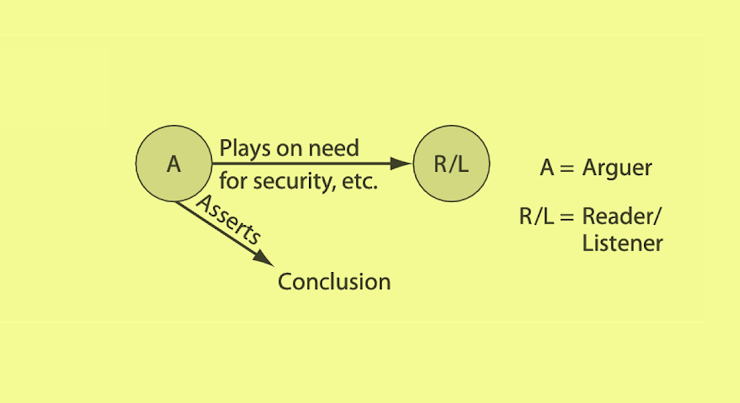
- Chris Hemsworth drives this car. That makes this car the best choice.
- A person with very good taste will only want to drive a car like this.
- This car is the most liked on Instagram. That makes it the best car for you.
- Of course, you think that this car has the best efficiency. Look at you, you are a social climbing noob.
Looking at this diagram, it shows Appeal to Pity - where the arguer (A) "Plays on need for security, etc." to influence the reader/listener (R/L), then asserts a conclusion. This illustrates how appeal to pity works by targeting emotional needs rather than logical reasoning.
-
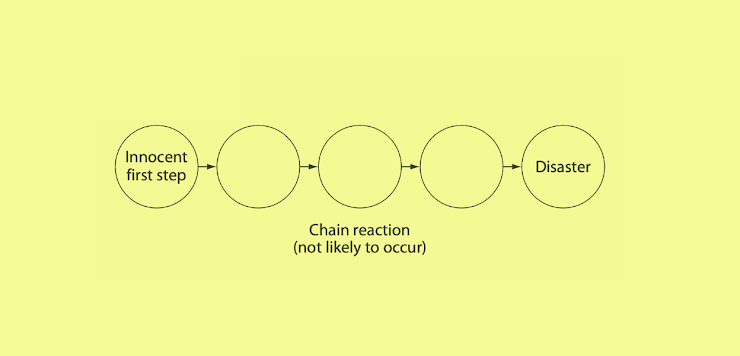
Which is an example of the illustrated fallacy?
- Mr Z is the best leader. That's what everyone in my school thinks. This makes him the best.
- If I lend you money now for your iced coffee, you will soon learn to forget to bring enough money with you. This will teach you to be irresponsible. You will soon fail in everything in your life.
- There are several reasons why we should not vote for him. First, there are so many reason's why we should not vote for him.
- When he became the leader, there was a pandemic. Voting for him again would cause another pandemic.
This clearly illustrates the Slippery Slope fallacy - showing how an "innocent first step" supposedly leads through a chain reaction to "disaster," even though this chain reaction is "not likely to occur."
-
Which is correct?
A: You are a loser because you are not a winner.
B: Ha! When you say something bad about me, something good happens to me.- A and B committed a fallacy.
- Only A committed a fallacy.
- Only B committed a fallacy.
- A and B did not commit a fallacy.
Statement A ("You are a loser because you are not a winner") is begging the question - it restates the conclusion without new evidence. Statement B, while odd, doesn't clearly fit a fallacy pattern from the lecture.
-
Which diagram correctly illustrates the fallacy in use in the argument that B made?
A: Do you think your essay will be good enough to get you a B?
B: Good enough? Do you think the instructor is doing good enough when he doesn't discuss the topics and uses random TedTalk clips instead? | don't think there will be anything that is good enough.- Chart X
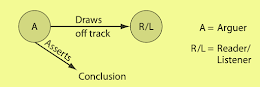
- Chart Y
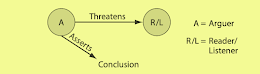
- Chart Z

- Chart W
- Chart X: Shows "Draws off track" - This matches Red Herring perfectly, where the arguer draws the reader/listener off track from the original topic.
- Chart Y: Shows "Threatens" - This represents Appeal to Force, which is not what B is doing.
- Chart Z: Shows Appeal to Ignorance (premise: nobody proved X is true, conclusion: X is false) - This doesn't match B's argument.
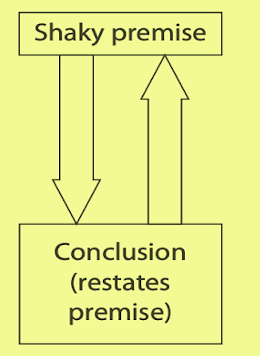
- Chart W: Shows "Shaky premise" leading to "Conclusion (restates premise)" - This represents Begging the Question, which is not B's fallacy.
- Chart X
-
Which argument is an example of the illustrated fallacy?
- Three students from Thammasat came to my village and helped us. If you are a Thammasat student, you are kind.
- You are Thai. You must like to smile.
- Please change the rule on cheating. If you don't you will ruin my chances of passing this course, and that will hurt me so much.
- We can generalize that TikTok changed Thai politics. You cannot prove that it did not.
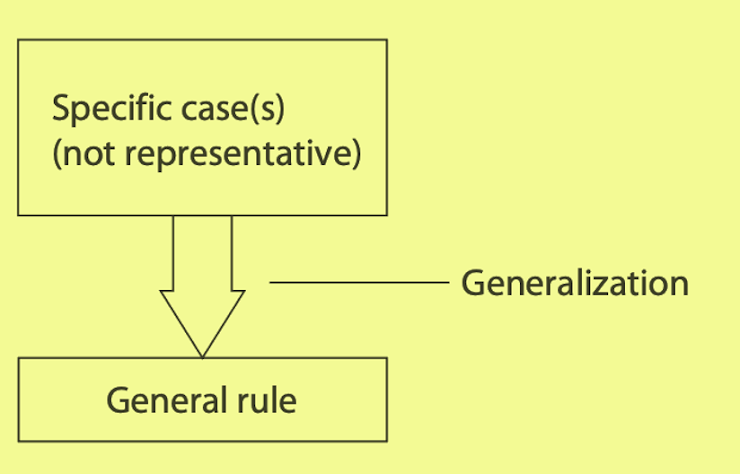
This perfectly matches the diagram. It starts with specific cases (3 students who helped), which are not representative of the entire population of Thammasat students, then makes a generalization to create a general rule that all Thammasat students are kind. This follows the exact pattern shown in the diagram: Specific case(s) (not representative) → Generalization → General rule.