Small shop
- Balance Sheet
- Income Statement
- Capital Statement
References:
- UoPeople Economic Principles Blog
- Accounting: CMMU
10 Economic Principles
1. People Face Trade-offs
- Everyone faces decisions that put one option above the other
- Most decisions involve trading off one thing for another
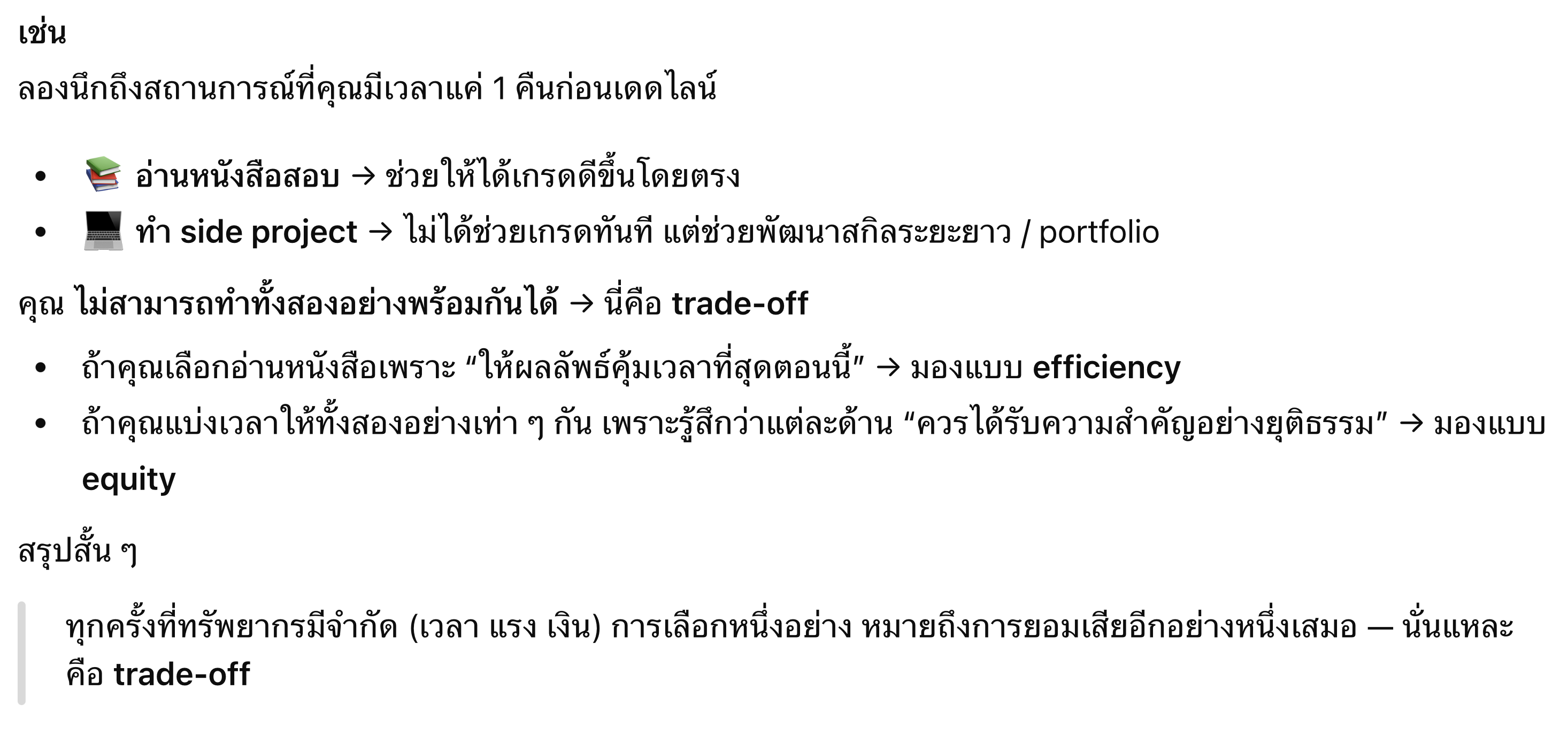
- Main societal trade-off: Efficiency (ประสิทธิภาพ) vs. Equity (ความเสมอภาค)
- Efficiency: Getting the most out of something, especially if the resource is scarce (insufficient)
- ถ้าเปิดธุรกิจก็อยากจะ maximize profit นี่แหละ efficiency
- Equity: All members of society benefit equally from a resource
- Efficiency: Getting the most out of something, especially if the resource is scarce (insufficient)
- Theory: People will make good decisions if they thoroughly understand both options
- However, usually either efficiency or equity is chosen above the other
นโยบายภาษีที่ช่วยลดความเหลื่อมล้ำ (Equity) อาจทำให้แรงจูงใจในการทำงานของคนรวยลดลง (Efficiency ลดลง)
Examples:
- How students decide to spend their time
- ไปเที่ยว Countdown ก็ได้ความสุขมา แต่ trade-off ก็คือเงินที่จะต้องเสียไปนั่นเอง
- How governments allocate budgets
- the government give คนละครึ่ง to people, trade-off ก็ต้องกันเงินส่วนา่กดเวา่หวสฟเก่า
Analogy: Think of choosing between studying for an exam vs. working on a side project. You can't do both at the same time (trade-off). If you choose based on what gives you the best outcome with limited time (efficiency) vs. what feels fair to all your commitments (equity), that's the trade-off in action.
2. The Cost of Something is What You Give Up to Get It
- Since people face trade-offs, decisions require comparing costs against benefits of alternative courses of action
- Each item has an opportunity cost = what you're giving up to get it
- When facing a decision, people should understand the opportunity cost involved
Example:
- Cooking dinner at home is cheaper than ordering from a restaurant, BUT it takes up a lot more time than calling to place an order (Opportunity cost = time ที่ต้องเสียไปไง)
- Some people consider only the monetary cost but not the time cost
- จริง อย่าคิดถึงแต่เรื่องเงิน เวลาเป็นทรัพย์สินที่มีค่าเหมือนกัน
- MUST CONSIDER BOTH MONEY AND TIME COST!
Analogy: Like choosing between coding a feature from scratch vs. using a library. The library might cost money (or dependencies), but coding from scratch costs your time. The opportunity cost is what you sacrifice by choosing one option.
3. Rational People Think at the Margin
- Economists assume people are rational thinkers
- They look at marginal changes = small adjustments to a plan of action
- People make decisions when they think "at the margin" (around the edge of a plan of action)
- Marginal changes describe small incremental adjustments
Example:
- Deciding whether to take an extra class in your semester
- This is an incremental decision comparing marginal costs and benefits
Consumer Behavior:
- Consumers look for maximum satisfaction on purchases within budget and income constraints
- Decisions are influenced by marginal changes and rational thinking
- Goal: Achieve maximum satisfaction within constraints of what we're willing to pay
Analogy: Like deciding whether to add one more feature to your app before release. You're not reconsidering the entire app, just thinking about the additional benefit vs. additional effort of that one more feature (marginal analysis).
Think at the Margin (คิดที่ส่วนเพิ่ม): คือการพิจารณาถึงการเปลี่ยนแปลงเล็กๆ น้อยๆ หรือ "การเพิ่มขึ้นอีกหนึ่งหน่วย" ของสิ่งใดสิ่งหนึ่ง (เช่น ซื้อเพิ่มอีก 1 แก้ว, ทำงานเพิ่มอีก 1 ชั่วโมง) และประเมินว่าการเพิ่มนั้นคุ้มค่าหรือไม่.
4. People Respond to Incentives (คนตอบสนองต่อแรงจูงใจ)
- Incentives inspire consumers to act by offering an extra reward to those who change their behavior
- Incentives can be positive or negative
- You can incentivize people TO DO something
- You can incentivize people NOT TO DO something
Examples:
- Positive incentive: Offering employees a bonus if they work extra hours
- Negative incentive: Extra taxes on fuel to encourage people to use it less
Analogy: Like gamification in apps. Positive incentives = rewards for daily logins. Negative incentives = losing streaks if you don't engage. Both change user behavior.
Example นะ
- Gas Prices: When gas prices rise, people drive less, use public transport, or buy fuel-efficient cars; when prices fall, they may drive more.
- Apple Market: A higher apple price makes consumers buy fewer apples and more substitutes (like oranges), while incentivizing farmers to grow more apples.
5. Trade Can Make Everyone Better Off (การค้า ทำให้ทุกคนมีทางเลือกที่ดีขึ้น)
- In trade, all parties can win by focusing on what they're best at
- Countries benefit from trading with each other
Why Countries Trade:
- Most countries don't have all the resources they need to function effectively
- They turn to other countries for more or cheaper resources
- Allows for a wider variety of goods to become available
- Increases competition on a global scale
Analogy: Like in software development teams - if you're great at backend and your teammate excels at UI/UX, you both benefit by focusing on your strengths and collaborating, rather than each doing everything alone.
6. Markets Are Usually a Good Way to Organize Economic Activity
ตลาดเป็นสื่อกลางของระบบเศรษฐกิจ เป็นแหล่งรวมของผู้ซื้อและผู้ขาย
Market Economy Characteristics:
- Decisions are made collectively by millions of households and firms
- Households decide where they'll work
- Firms decide who to hire and what to produce
- Both parties' decisions are guided by self-interest
Price Mechanism:
- Households and firms consider prices when deciding what to buy and sell
- Both look at costs and social benefits
- Ultimately increases society's welfare
Analogy: Think of the open-source software ecosystem. Individual developers (households) decide which projects to contribute to, companies (firms) decide what to sponsor. Everyone acts in self-interest, but the ecosystem as a whole benefits from this distributed decision-making.
Acts ของแต่ละคนก็เป็นของตัวเองกันหมด ถ้ามองในมุมทั้ง คนทั่วไป และ Company — แต่การกระทำนั้น ๆ ก็ benefit ทั้ง ecosystem
7. Government Can Sometimes Improve Market Outcomes
รัฐบาลเข้ามาแทรกแทรงตลาดได้ เพื่อปรับปรุงความล้มเหลวของตลาด
- Government may intervene in the market through policy creation
- Purpose: Protection to promote both efficiency and equity
Example: Environmental Protection
- Pollution and the well-being of the environment
- Without government intervention, the market could have a negative impact on the environment
Analogy: Like moderation in online communities. The "market" (users) might naturally trend toward chaos or toxic behavior. Moderators (government) intervene with rules to improve outcomes for everyone.
8. A Country's Standard of Living Depends on Country Production
รัฐบาลอาจจะ ลดดอกเบี้ย = กระตุ้นเศรษฐกิจ
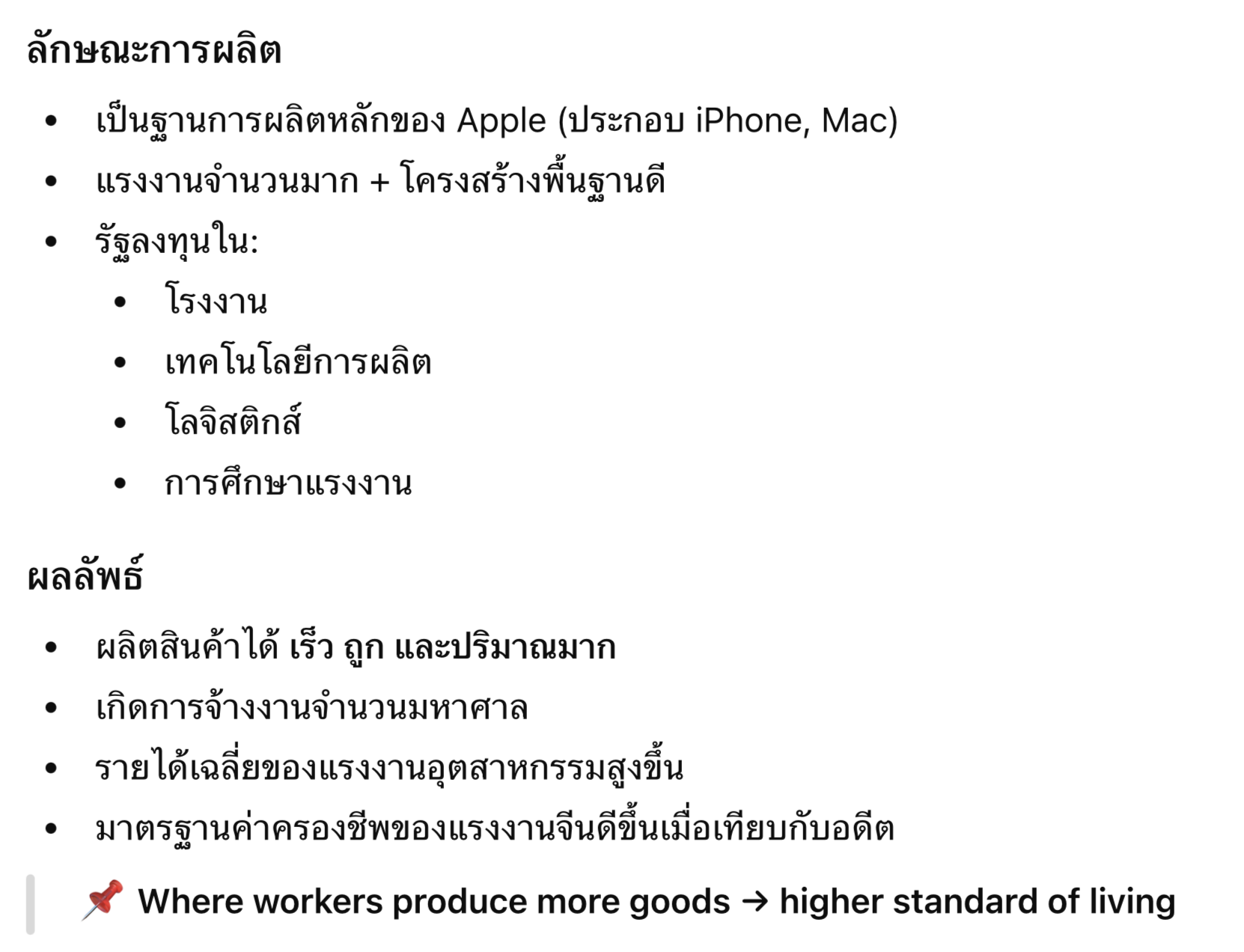
- Growth of standard of living traces back to goods and services produced in each country
- Higher productivity → Higher standard of living
- Where workers produce more goods → higher standard of living (and vice versa)
How to Increase Living Standards:
- Public policies that affect standard of living WITHOUT negatively impacting productivity
- Methods:
- Increasing education
- Providing better access to tools and technology
Analogy: A country's economy is like a software company's output. If developers have better tools (IDEs, frameworks, automation), education (training, documentation), they produce more and better software, leading to company growth and better compensation.
9. Prices Rise When the Government Prints Too Much Money
ราคาสิ่งของขึ้นราคา เมื่อรัฐบาลพิมพ์ธนบัตรมากเกินไป (เงินเฟ้อ)
- Prices follow inflation
- High rate of inflation increases costs
- Economic policymakers aim for lower inflation to keep the market moving
Cause of High Inflation:
- Usually because there's too much money in circulation
- When governments print more money and there's more available, its value decreases
Analogy: Like diluting ownership in a startup. If you have 1000 shares and the company issues 9000 more, your percentage ownership drops. Similarly, printing more money dilutes the value of existing money.
10. Society Faces a Short-Run Trade-off Between Inflation and Unemployment
สังคมเผชิญกับปัญหาในเรื่องของการว่างงานกับเงินเฟ้อ (เงินเฟ้อสูง อัตราการว่างงานต่ำ)
- Economists use the Phillips Curve to show the relationship
- When inflation increases → unemployment decreases (and vice versa)
Policy Impacts:
- Policymakers can impact inflation and unemployment by:
- Altering how much money is printed
- Changing the amount of government taxes
- Government policies directly impact market, economy, and rates of inflation/unemployment
Analogy: Like balancing performance vs. resource usage in software. Want faster execution (lower unemployment)? You might use more memory (higher inflation). Optimize memory (lower inflation)? Might sacrifice some speed (higher unemployment).
Basic Financial Statements
1. Balance Sheet (งบดุล)
โชว์ Financial Position of a business ก็เหมือนข้างล่างเลย
Balance Sheet หรือจะเรียก Statement of Financial …
Purpose: To show financial position of a business at a particular date
Accounting Equation
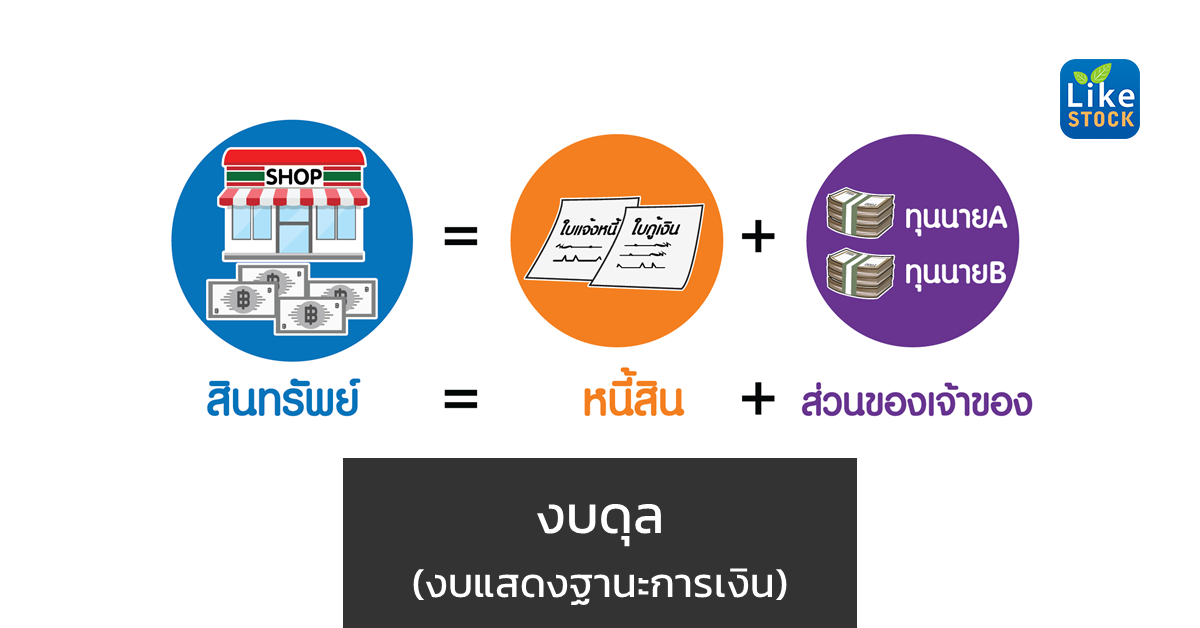
Or using abbreviations:
Key Definitions:
- Assets: Economic resources (things of value) owned by a business
- Liabilities: Debts or obligations of a business
- Owner's Equity: Amount of an owner's net investment in a business PLUS profit from successful operations which have been retained in the business
Analogy: Think of a balance sheet like your computer's specifications:
- Assets = Your hardware and software (what you OWN)
- Liabilities = Outstanding subscriptions or payments due (what you OWE)
- Owner's Equity = Your actual net value in the system (what you OWN - what you OWE)
Two Forms of Balance Sheet
- คือ 2 วิธี “จัดหน้ากระดาษ” (presentation format) ไม่ใช่ 2 วิธีคำนวณ และ ไม่ใช่การย้ายข้างสมการ
- เป็น presentation choice
- ข้อมูลเดียวกัน ตัวเลขเดียวกัน
- เปลี่ยนแค่ “วางยังไงให้คนอ่านเข้าใจง่าย”
A. Reporting Form (Vertical)
- Assets above
- Liabilities + Owner's equity below
B. Accounting Form (Horizontal)
- Assets on the left
- Liabilities + Owner's equity on the right
2. Income Statement
Purpose: To measure operating result of business during a given period of time
- เวลาเราเปิดธุรกิจ อาจจะได้ กำไร หรือ ขาดทุน ก็ได้ถูกมะ — เพราะว่าเราต้อง Pay Tax ให้กับ Government เราเลยต้องรู้ว่า ในแต่ละเดือน เราได้กำไร ขาดทุน เท่าไหร่ นั่นเองง!!!
Income Statement Formula
Key Definitions:
- Revenue (รายได้): Prices of goods sold and services rendered to customers
- Expense (ค่าใช้จ่าย): Cost of goods and services used up in the process of obtaining revenue
- Net Income: Excess of revenue over expense
Analogy: Like analyzing your app's performance for a month:
- Revenue = Total users × subscription fees
- Expenses = Server costs, developer salaries, marketing
- Net Income = Profit (or loss if negative)
Balance Sheet Accounts
Asset Accounts
Assets are divided into:
- Current Assets
- Non-Current Assets
Current Assets (สินทรัพย์หมุนเวียน)
Definition: Cash and other assets which can be turned into cash within one year by normal operations of business
Current assets ranking by liquidity
สภาพคล่อง (Liquidity) คือ Ability to turn in to cash — ความสามารถในการเปลี่ยนสินทรัพย์ต่าง ๆ ให้กลายเป็นเงินสดได้อย่างรวดเร็วและง่ายดาย โดยไม่ทำให้มูลค่าของสินทรัพย์นั้นลดลงมากนัก
สินทรัพย์ที่มีสภาพคล่องสูง เช่น เงินสด เงินฝากธนาคาร หรือกองทุนตลาดเงิน สามารถแปลงเป็นเงินสดได้ทันที
Types of Current Assets:
1. Cash
- Currency, checks, bank drafts, and money orders
- Includes: Cash in hand & at bank
2. Marketable Securities
- Stocks or bonds which can be easily bought or sold in market
3. Notes Receivable (N/R)
- Promissory notes from debtors to pay certain amount of money
- Usually with interest (ดอกเบี้ย)
- At the end of a specified period
ตั๋วเงินรับ คือสัญญาที่ยืนยันสิทธิในการได้รับเงินคืนในอนาคต มีความน่าเชื่อถือสูงกว่าลูกหนี้ปกติ และเป็นสินทรัพย์สำคัญของกิจการที่ต้องมีการบันทึกบัญชีอย่างถูกต้องตามหลักการบัญชี
4. Accounts Receivable (A/R)
- Debtors arising out of credit sales
- No interest (unlike Notes Receivable)
ลูกหนี้การค้า (Trade Receivable) คือ เงินที่ลูกค้าติดค้างธุรกิจจากการซื้อสินค้าหรือบริการแบบเครดิต (เชื่อ) ซึ่งผู้ขายส่งมอบไปแล้วแต่ยังไม่ได้รับเงินทันที
5. Inventory
- Merchandise
- Raw materials
- Materials in the process of production
สินค้าคงเหลือ (Inventory) คือ สินทรัพย์ที่ธุรกิจมีไว้เพื่อขาย สร้าง หรือใช้ในการผลิตสินค้าบริการ ซึ่งแบ่งเป็น 3 ประเภทหลัก: วัตถุดิบ (Raw Materials), งานระหว่างทำ (Work in Process), และสินค้าสำเร็จรูป (Finished Goods) โดยมี การบันทึกบัญชี โดยใช้วิธีการตีราคาตามต้นทุนหรือมูลค่าสุทธิที่คาดว่าจะได้รับที่ต่ำกว่า เพื่อสะท้อนฐานะทางการเงินที่แท้จริงของกิจกา
6. Office Supplies
- Materials acquired for use in office
- Papers & stationery
วัสดุสิ้นเปลืองสำนักงาน คือ สิ่งของที่ใช้แล้วหมดไป มีอายุสั้นไม่เกิน 1 ปี เช่น ปากกา ดินสอ กระดาษ หมึกพิมพ์ เทปกาว ลวดเย็บกระดาษ แฟ้ม และวัสดุทำความสะอาด เพื่อใช้ในกิจกรรมประจำวันของสำนักงาน โดยจัดเป็นสินทรัพย์หมุนเวียนและเมื่อใช้ไปจะบันทึกเป็นค่าใช้จ่าย
7. Prepaid Expenses
- Advance payment for expenses such as:
- Insurance
- Rent
ค่าใช้จ่ายล่วงหน้า (Prepaid Expenses) คือ การชำระเงินสำหรับสินค้าหรือบริการที่ธุรกิจจ่ายไปก่อน แต่จะได้รับประโยชน์หรือใช้บริการจริงในอนาคต โดยจะถูกบันทึกเป็น สินทรัพย์หมุนเวียน ในงบดุล (Balance Sheet) ก่อน แล้วจึงค่อยๆ ปรับปรุงเป็น ค่าใช้จ่าย เมื่อได้รับประโยชน์หรือใช้บริการนั้นจริง เช่น ค่าเช่าล่วงหน้า, ค่าเบี้ยประกันภัยล่วงหน้า, หรือค่าโฆษณาที่จ่ายไปก่อนได้รับผล
ตัวอย่างนะ
- ค่าเช่าล่วงหน้า (Prepaid Rent): จ่ายค่าเช่าสำนักงานสำหรับ 3-6 เดือนข้างหน้า.
- ค่าประกันภัยล่วงหน้า (Prepaid Insurance): จ่ายเบี้ยประกันรถยนต์รายปีล่วงหน้า.
- ค่าบริการรายปี: จ่ายค่าซอฟต์แวร์หรือบริการรายปีล่วงหน้า
Analogy: Current assets are like the resources you can quickly convert to cash, similar to:
- Cash = Money in your wallet
- Accounts Receivable = Money friends owe you (no formal contract)
- Notes Receivable = Money with a formal IOU
- Inventory = Items you can sell quickly
- Prepaid Expenses = Subscriptions you paid for but haven't fully used
Non-Current Assets (สินทรัพย์ไม่หมุนเวียน)
สินทรัพย์ที่มีสภาพคล่องต่ำ เช่น อสังหาริมทรัพย์ (ที่ดิน, บ้าน) หรือเครื่องจักร จะใช้เวลานานกว่าในการเปลี่ยนเป็นเงินสด
We rank according to “longest life”
Definition: Can be used for more than one year, NOT (intend) for resale
Types of Non-Current Assets:
- Land
- Special note: NO depreciation (ไม่มีค่าเสื่อมราคา, CAN BE USE FOREVER)
- ที่ดิน: โดยธรรมชาติของที่ดินนั้นมีอายุการใช้งานไม่จำกัดและไม่เสื่อมสภาพ แต่ถ้าเป็นการใช้ประโยชน์ที่จำกัด เช่น เพื่อฝังกลบขยะ จะต้องคิดค่าเสื่อมราคาตามอายุการใช้งานนั้น.
- Building
- Used by business for its normal operations
- Equipment (decreases in value over time)
- Machines
- Factory equipment
- Store equipment
- Office equipment
- Office furniture & fixtures
- Delivery equipment
Analogy: Non-current assets are like your long-term tools:
- Land = Domain name (doesn't lose value over time)
- Building = Server infrastructure
- Equipment = Development tools, computers, software licenses
All used for operations, not meant to be sold quickly
Liability Accounts (หนี้สิน)
Liabilities are divided into:
- Current Liabilities (หนี้สินหมุนเวียน)
- Non-Current Liabilities (หนี้สินไม่หมุนเวียน)
Current Liabilities
Definition: Debts owed by business to be paid within one year
Types of Current Liabilities:
1. Notes Payable (N/P) (ตั๋วเงินจ่าย)
- Promissory notes made and signed by business for creditors
- With interest
- Interest Expense ด้วยนะ not
Interest Revenue
- Interest Expense ด้วยนะ not
แล้วมันต่างกับ ตั๋วเงินรับ (Notes Receivable (N/R) ยังไงนะ แค่เป็นมุมมองของสองฝ่ายหรอ
Contents
2. Accounts Payable (A/P) (เจ้าหนี้การค้า)
- Creditors from credit purchases of business
- No formal note
3. Unearned Revenue
- Advances received from customers for:
- Goods to be delivered in future
- Services to be performed in future
รายได้รับล่วงหน้า (Deferred Revenue) คือ เงินที่ธุรกิจได้รับจากลูกค้าก่อนที่จะส่งมอบสินค้าหรือบริการจริง ๆ ทำให้บริษัทมีภาระผูกพันต้องทำตามสัญญาในอนาคต
Unearned revenue is deferred revenue; they are two names for the same thing
4. Other Payables
- Expenses which are already due but not yet paid during accounting period
- Examples:
- Salaries payable
- Interest payable
- Utilities payable (ค่าน้ำ ค่าไฟ ค่าโทรศัพท์)
Analogy: Current liabilities are like your short-term debts:
- Accounts Payable = Bills you haven't paid yet (informal)
- Notes Payable = Formal loans with contracts
- Unearned Revenue = Pre-orders customers paid for but you haven't delivered
- Other Payables = Accrued expenses (work done, payment pending)
Non-Current Liabilities
Definition: Debts to be paid for more than one year
Types of Non-Current Liabilities:
1. Mortgage Payable
- Usually made for long period
- Creditor has right to claim against specific asset of business in case of default
เจ้าหนี้จำนอง คือ ผู้ให้กู้เงินโดยมีทรัพย์สินของลูกหนี้ (เช่น ที่ดิน, บ้าน) เป็นหลักประกัน และมีสิทธิได้รับการชำระหนี้จากทรัพย์สินนั้นก่อนเจ้าหนี้รายอื่นหากลูกหนี้ผิดนัดชำระหนี้
โดยเจ้าหนี้สามารถเลือกที่จะฟ้องคดีแบบธรรมดา (ยึดทรัพย์สินอื่น ๆ ได้) หรือฟ้องบังคับจำนอง (บังคับเอาจากทรัพย์ที่จำนองโดยเฉพาะ) ก็ได้
2. Bank Loan
- Provided to finance a particular project
- Bank takes general assets of project as security
สินเชื่อธนาคาร คือ การที่ธนาคารหรือสถาบันการเงินให้เรายืมเงินไปใช้ตามวัตถุประสงค์ต่างๆ (เช่น ซื้อบ้าน รถ ลงทุน หรือใช้จ่ายส่วนตัว) โดยเราต้องทำสัญญาคืนเงินต้นพร้อมดอกเบี้ยตามเงื่อนไขที่ตกลงกันไว้
Analogy: Long-term debts like:
- Mortgage = Taking a loan for server hardware (specific collateral)
- Bank Loan = Business loan for expansion (general collateral)
Owner's Equity Accounts (บัญชีเจ้าของกิจการ)
Owner's Equity consists of:
- Owner's Capital
- Owner's Withdrawal
Owner's Capital
- Opened with owner's initial investment in business
- Balance at beginning of period shows result of:
- Additional investment
- Net income or loss
- Owner's withdrawal
Owner's Withdrawal
- Payment of cash or other assets for owner's personal expenses
- Important: Owner's withdrawal REDUCES owner's equity
Analogy:
- Owner's Capital = Your initial investment + accumulated profits in your startup
- Owner's Withdrawal = Taking money out for personal use (like paying yourself a salary)
Income Statement Accounts
Revenue Accounts
Revenue increases owner's equity
Types of Revenue:
1. Sales Revenue
- Sale of merchandise
- Either cash sales or credit sales
2. Service Fee Revenue
- Performance of services to clients
- Examples: medical, accounting services
3. Commission Revenue
- Performance of service based on successful completion of business transactions
- Examples: brokers, agents
4. Interest Revenue
- From notes receivable or loans
Analogy: Different revenue streams like:
- Sales Revenue = Selling software licenses
- Service Fee Revenue = Consulting fees
- Commission Revenue = Affiliate marketing income
- Interest Revenue = Returns on company investments
Expense Accounts
Expenses decrease owner's equity
Common Types of Expenses:
- Salary Expense
- Utilities Expense
- Office Supplies Expense
- Advertising Expense
- Insurance Expense
- Commission Expense
- Rent Expense
- Depreciation Expense
- Interest Expense
Analogy: Like your monthly operating costs:
- Salary = Team compensation
- Utilities = Internet, electricity, cloud services
- Advertising = Marketing campaigns
- Rent = Office space
- Depreciation = Gradual loss of equipment value
3. Capital Statement
- 1 ใน 3 basic statements
- อันนี้สำหรับ Small shop นะ
Formula:
Beginning Capital (5,000,000)
+ Additional investment
+ Net income for the period (- for net loss)
- Withdrawal
= Ending Capital
let beginningCapital = 5_000_000
let additionalInvestment = 2_000_000
let netIncome = -1_000_000 // Loss
let widrawal = 500_000

let endingCapital = (beginningCapital + additionalInvestment + netIncome - widrawal)
print(endingCapital)Analogy: Like tracking your startup equity over time:
- Start with initial investment
- Add any new money you put in
- Add profits from operations
- Subtract personal withdrawals
- End with current equity value
Chart of Accounts
Definition: List of account titles and their respective account numbers used by business
Account Number System:
- Assets - start with no. 1
- 111 112 คือไรว่า
- Liabilities - start with no. 2
- Owner's Equity - start with no. 3
- Revenue - start with no. 4
- Expense - start with no. 5
Effects of Business Transactions on Accounting Equation
Example Transactions (November 2023):
Nov. 1 (Aj explain): Michael McBryan started business by depositing $80,000 in a company bank account
- Effect: Cash +80,000
Nov. 3. (Our group): Purchased land for $52,000 cash
- Effect: Land +52,000
Nov. 5: Purchased a building for 6,000 in cash and issuing a note payable for the remaining $30,000
- Effect: Building +6,000; Notes Payable +$30,000
Nov. 17: Purchased tools and equipment on account, $13,800
- Effect: Tools and Equipment +13,800
Nov. 20: Sold some tools at a price equal to their cost, $1,800, collectible within 45 days
- Effect: Tools and Equipment -1,800
Nov. 25: Received $600 in partial collection of account receivable from sale of tools
- Effect: Cash +600
Nov. 30: Paid $6,800 in partial payment of an account payable
- Effect: Cash -6,800
Key Insight: Every transaction affects at least TWO accounts, and the accounting equation ALWAYS stays in balance:
Practice Problem Solutions
Problem 105
Total Assets =
Components: Building + A/R + Cash + Equipment + Land
Answer: a) $360,000
Problem 106
Total Liabilities = ?
Answer: d) $580,000
Problem 107
Owner's Equity = ?
Answer: b) $574,000
Problem 108
Answer: a) $400,000
Problem 109
Answer: c) $420,000
Problem 110
Given: Assets = 180,000
Answer: d) Liabilities are $90,000
Problem 121: Transaction Effects
Effect on: A (Assets), L (Liabilities), O (Owner's Equity)
| Transaction | A | L | O |
|---|---|---|---|
| a | + | NC | + |
| b | + | + | NC |
| c | NC | NC | NC |
| d | NC | NC | NC |
| e | + | + | NC |
| f | + | + | NC |
| g | - | - | NC |
| h | NC | NC | NC |
| i | + | NC | + |
| j | - | NC | - |
Legend:
- + = Increase
- - = Decrease
- NC = No Change
Problem 122: Specific Transaction Effects
| Transaction | A | L | O |
|---|---|---|---|
| a | +$40,000 | NC | +$40,000 |
| b | NC | NC | NC |
| c | +$5,000 | +$5,000 | NC |
| d | +$2,000 | +$2,000 | NC |
| e | -$1,000 | -$1,000 | NC |
| f | +$25 | NC | +$25 |
| g | NC | NC | NC |
| h | NC | NC | NC |
Key Takeaways for Computer Engineering Students
-
Think Systematically: Accounting is like programming - it follows strict logical rules (the accounting equation must always balance)
-
Double-Entry System: Every transaction affects at least two accounts (like changing two variables that must maintain a relationship)
-
State Management: Balance sheets are like snapshots of system state at a point in time; income statements are like logs of changes over a period
-
Economic Principles: Similar to optimization problems - balancing trade-offs, thinking at the margin, responding to incentives
-
Financial Statements: Like different views of the same database - balance sheet (current state), income statement (changes over time), capital statement (equity changes)
Quick Reference Formulas
Current vs. Non-Current:
- Current = Convertible to/from cash within 1 year
- Non-Current = Used for more than 1 year
Account Numbering:
- 1XX = Assets
- 2XX = Liabilities
- 3XX = Owner's Equity
- 4XX = Revenue
- 5XX = Expenses