Agenda
- Quick review: key terms
- Quick review: Modern square and Venn diagrams
- Standard Categorical Syllogism
- Mood & Figure of Valid SCSs
- Rules of Validity
- Proving SCS with Venn Diagrams
Review of Terms
Key Concepts to Remember
- Inductive (weak-moderate-strong) and deductive argument
- Synonym, connotation, metaphor, analogy
- Causal argument
- Necessary and sufficient conditions
- Mill's method of agreement and difference
- Proposition & Premise
- Valid (vs true/sound)
- Standard categorical proposition (vs natural language)
- Quantity, quality, distribution
Review of Testing Categorical Propositions
Five-Step Process
- If necessary, reformulate propositions to standard form
- Identify form (A, E, I, O)
- Use square of opposition to identify contradictory relationship
- Test immediate inference
- Draw Venn diagrams
Review Practice: Categorical Proposition
Converting to Standard Form
- Example: "Dogs like to bark"
- Standard Form: All dogs are animals that like to bark (A)
Strategy for Putting Propositions in Standard Form
To put a categorical proposition in standard form:
- Identify the subject and predicate terms
- Remember that the subject does not always come first in ordinary language
- If necessary, reformulate the subject and predicate terms so that they refer to classes
- Identify the quantity of the proposition:
- Singular propositions about an individual thing are treated as universal
- Nonstandard quantifiers like "every," "few," and "any" must be translated into the standard quantifiers: "all," "some," and "no"
Exercise 1: Converting to Standard Form
Reformulate these propositions into standard form. Ensure each proposition has: quantity, quality, copula, and two nouns. Then indicate the form (A, E, I, O).
- Most voters distrust politicians
- SCP: Some voters are not people who trust politicians.
- Form: O
- No liberals oppose free speech
- SCP: No liberals are people who oppose free speech.
- Form: E
- A couple of my friends do not believe in climate change
- SCP: Some of my friends are not believers in climate change.
- Form: O
- It isn't true that I did not eat the last slice of pizza
- SCP: I am a person who ate the last slice of pizza.
- Form: I
- It isn't the case that some politicians are honest leaders
- SCP: No politicians are honest leaders.
- Form: E
- It is not true that all students dislike exams
- SCP: Some students are not people who dislike exams.
- Form: O
- It's untrue that any scientists ignore evidence; actually, none do
- SCP: No scientists are people who ignore evidence.
- Form: E
Modern Square of Opposition
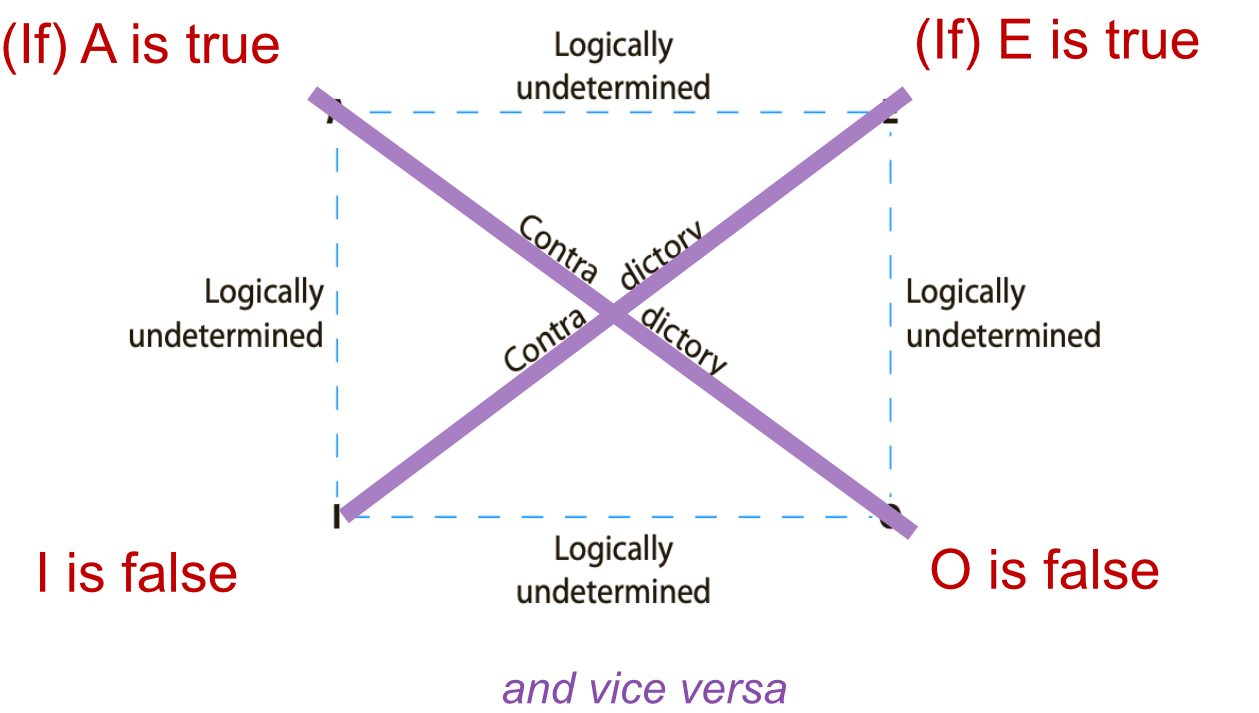
Step 3: Using the Square to Check Logical Validity
The modern square helps check validity of arguments with one premise.
Key Contradictory Relationships
- If A is true → O is false (and vice versa)
- If E is true → I is false (and vice versa)
Applied Example
Proposition A: "All politicians are corrupt!"
Response B: "I have a friend who is a politician and he is not corrupt. So, your proposition is false."
Key Point: If someone claims both an A and its O form are true (all politicians are corrupt, but some are not corrupt), you can point out the logical contradiction: "Those two statements cannot both be true at the same time according to the rules of logic."
If someone consistently affirms A and denies O (or vice versa), their argument passes the modern square's validity check.
Exercise 2: Finding Contradictories
Use the modern square to write the contradictory for each of the remaining six sentences from Exercise 1.
- Some voters are people who distrust politicians → No voters are people who distrust politicians
- No liberals are people who oppose free speech. → Some liberals are people who oppose free speech.
- Some of my friends are not believers in climate change. → All of my friends are believers in climate change.
- I am a person who ate the last slice of pizza. → I am not a person who ate the last slice of pizza.
- No politicians are honest leaders. → Some politicians are honest leaders.
Modern Square and Venn Diagrams
Visual Representation of Contradictions
The modern square of opposition and Venn diagrams help illustrate the relationship between different proposition types (A, E, I, O)—especially how contradictories cannot both be true at the same time.
Contradictories establish the truth value of propositions: "If this is true, then that must be false" etc.
Example
Proposition I: Some voters are people who distrust politicians
Proposition E: No voters are people who distrust politicians
These two Venn diagrams are contradictory (they should overlap), showing the argument is invalid.
Exercise 3: Drawing Venn Diagrams
Reformulate the proposition pairs from Ex 1 and 2 into standard categorical proposition forms: All S are P, No S are P, etc. Then, draw the Venn diagrams for each pair of propositions.
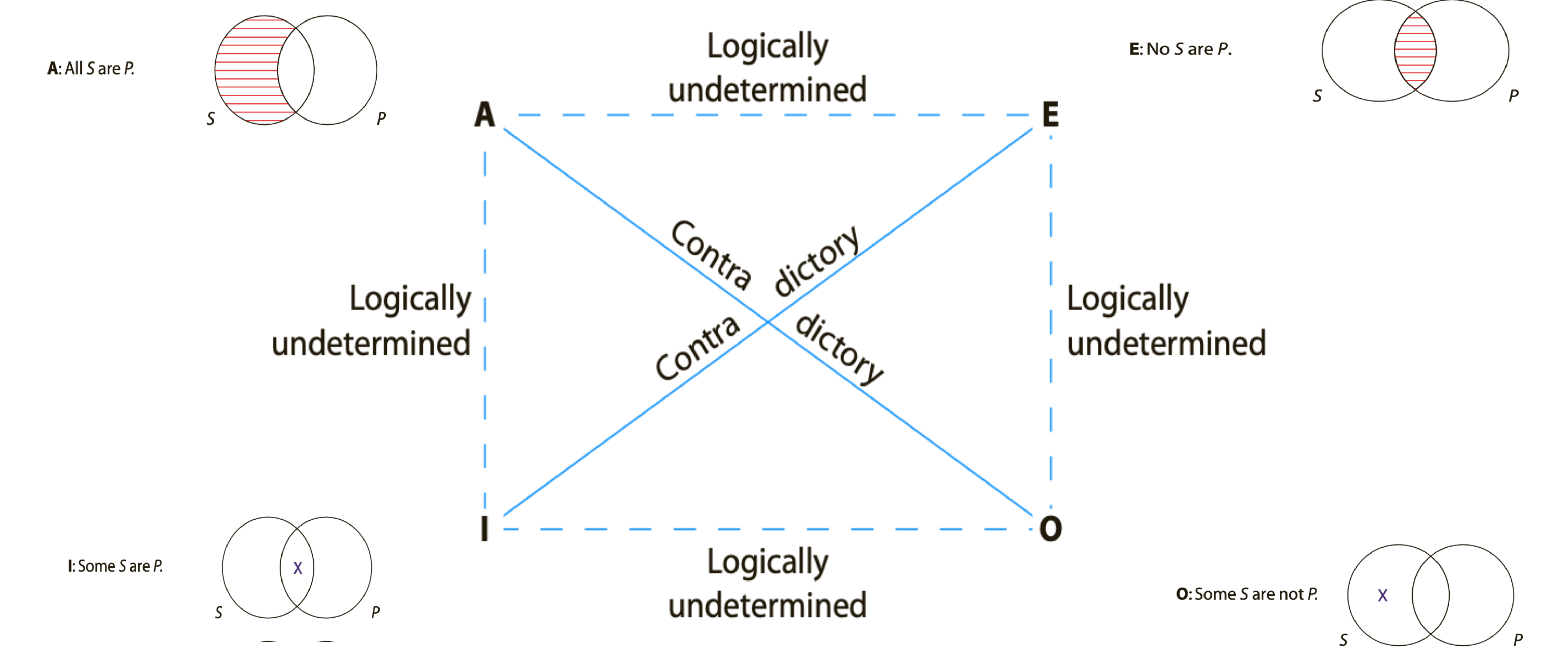
Reference: The Four Forms
- A: All S are P
- E: No S are P
- I: Some S are P
- O: Some S are not P
Immediate Inference
Definition
Immediate inference is a separate logical process from using the square of opposition.
How It Works
- In immediate inference, you create a new proposition by transforming the premise
- Use rules like conversion, obversion, or contraposition
- Test validity by checking if the transformation preserves truth for that form: "Is X therefore Y valid?"
Using Venn Diagrams for Immediate Inference
The Venn diagram is a visual tool that lets you see the validity of an immediate inference:
- After you convert/obvert, diagram both the original and transformed statements
- If the conclusion's diagram does not add any new information, the inference is valid
Example
Original (I form): Some voters are people who distrust politicians
- Contradictory (E form): No voters are people who distrust politicians
- Obversion: Some voters are not people who do not distrust politicians
- Conversion (Valid for I): Some people who distrust politicians are voters
Exercise 4: Drawing Venn Diagrams for Inferences
Draw the Venn diagrams for these inferences:
-
Some of my friends are people who do not believe in climate change. Therefore, some people who do not believe in climate change are my friends.
-
I am a person who ate the last slice of pizza. I am not a person who did not eat the last slice of pizza.
Important Note
Venn diagrams are not usually used for immediate inference but are used to illustrate propositions and transformation. Venn diagrams are more formally used with syllogisms.
Part 1: What is a Standard Categorical Syllogism?
Prerequisites
At this point, you need to have mastered these concepts:
Column 1:
- Argument
- Proposition
- Premise
- Conclusion
- Deductive argument
- Standard categorical proposition
Column 2:
- Subject
- Predicate
- Quality
- Quantity
- Distribution
- Venn Diagram for SCPs
Syllogism Definition
A deductive argument that has 2 premises and 1 conclusion.
Standard Categorical Syllogism Structure
Example 1: Basic Structure
All soldiers are patriots.        → Major Premise (P)
No traitors are patriots.         → Minor Premise (S)
─────────────────────────────────
No traitors are soldiers.         → Conclusion
Note: The standard form is always the same, although the order of terms in a proposition can be reversed.
SCS Elements: Major Term & Major Premise
Major Term (P)
The major term is the PREDICATE of the conclusion, and must appear somewhere in the major premise.
Symbol: P
Example from "Soldiers & Patriots"
- Major Premise: All soldiers are patriots
- Conclusion: No traitors are soldiers ← Major Term (P)
SCS Elements: Minor Term & Minor Premise
Minor Term (S)
The minor term is the SUBJECT of the conclusion, and must appear somewhere in the minor premise.
Symbol: S
Example from "Soldiers & Patriots"
- Minor Premise: No traitors are patriots
- Conclusion: No traitors are soldiers ← Minor Term (S)
SCS Elements: Middle Term
Middle Term (M)
Middle Term: Occurs once in each premise but does NOT occur in the conclusion.
The middle term provides the middle ground or link between the two premises.
Symbol: M
Example from "Soldiers & Patriots"
- Major Premise: All soldiers are patriots
- Minor Premise: No traitors are patriots
- Conclusion: No traitors are soldiers
The term "patriots" appears in both premises but not in the conclusion.
Summary: The SCS Structure
Three Terms, Each Appearing Twice
A categorical syllogism contains three terms, each appearing two times:
- Major term in conclusion and first premise
- Minor term in conclusion and second premise
- Middle term in both premises, not conclusion
Standard Form of a Syllogism
1. Quantifier _______ copula _______ { Major premise
                                       (contains major term)
2. Quantifier _______ copula _______ { Minor premise
                                       (contains minor term)
3. Quantifier _______ copula _______ { Conclusion
        Minor              Major
        term               term
Quick Annotation Abbreviations
- Major Term = P
- Minor Term = S
- Middle Term = M
Example 2: Identifying Parts
Marvel Movies Syllogism
Some Marvel movies are not popular titles.
All Marvel movies are expensive productions.
──────────────────────────────────────────
Some expensive productions are not popular titles.
Identifying the Terms:
- P (Major Term): popular titles
- S (Minor Term): Marvel movies
- M (Middle Term): expensive productions
Labeled:
- Major Premise: Some Marvel movies (M) are not popular titles (P)
- Minor Premise: All Marvel movies (M) are expensive productions (S)
- Conclusion: Some expensive productions (S) are not popular titles (P)
Part 2: What is the SCS's Mood? What are the Figures?
Mood
Definition
Mood simply refers to the order of the standard categorical propositions that comprise the premises and conclusion.
The premises and the conclusion are any of the (A), (E), (I), or (O) forms.
When you label each proposition, you will have a mood:
- AIA
- AAA
- etc.
SCS Mood Examples
Example 3
Some Marvel movies are not popular titles.           O
All Marvel movies are expensive productions.         A
──────────────────────────────────────────
Some expensive productions are not popular titles.   O
Mood: OAO
Example 4
All MCU heroes are characters with great abilities.              A
No characters with great abilities are unremarkable entities.    E
───────────────────────────────────────────────────────
No unremarkable entities are MCU heroes.                         E
Mood: AEE
Figure
Definition
FIGURE: The position of the middle term in the two premises.
The middle term can be in the subject position or the predicate position.
So there are four possible figures.
Figures of SCS
The Four Figures
| 1st | 2nd | 3rd | 4th | |
|---|---|---|---|---|
| Major | M — P | P — M | M — P | P — M |
| Minor | S — M | S — M | M — S | M — S |
| Conclusion | S — P | S — P | S — P | S — P |
Visual Pattern (Shirt Collar Mnemonic)
[Image of shirt collar pattern showing the four figures]
Just think of a shirt collar to help you remember the 4 figures.
Mood and Figure
Complete Coding System
A standard categorical syllogism is coded using mood and figure.
Example
Some mammals are animals that have four legs.    I  (M–P)
All cats are mammals.                            A  (S–M)
Some cats are animals that have four legs.       I  (S–P)
- Mood: IAI
- Figure: 1 (M–P, S–M pattern)
- Complete Code: IAI-1
Key Point: Once you have identified the S, P, M in a syllogism, you can use mood and figure to test the validity of an argument.
Remember: We should also put this into SCP form:
- Some mammals are animals that have four legs
- All cats are mammals
- Some cats are animals that have four legs
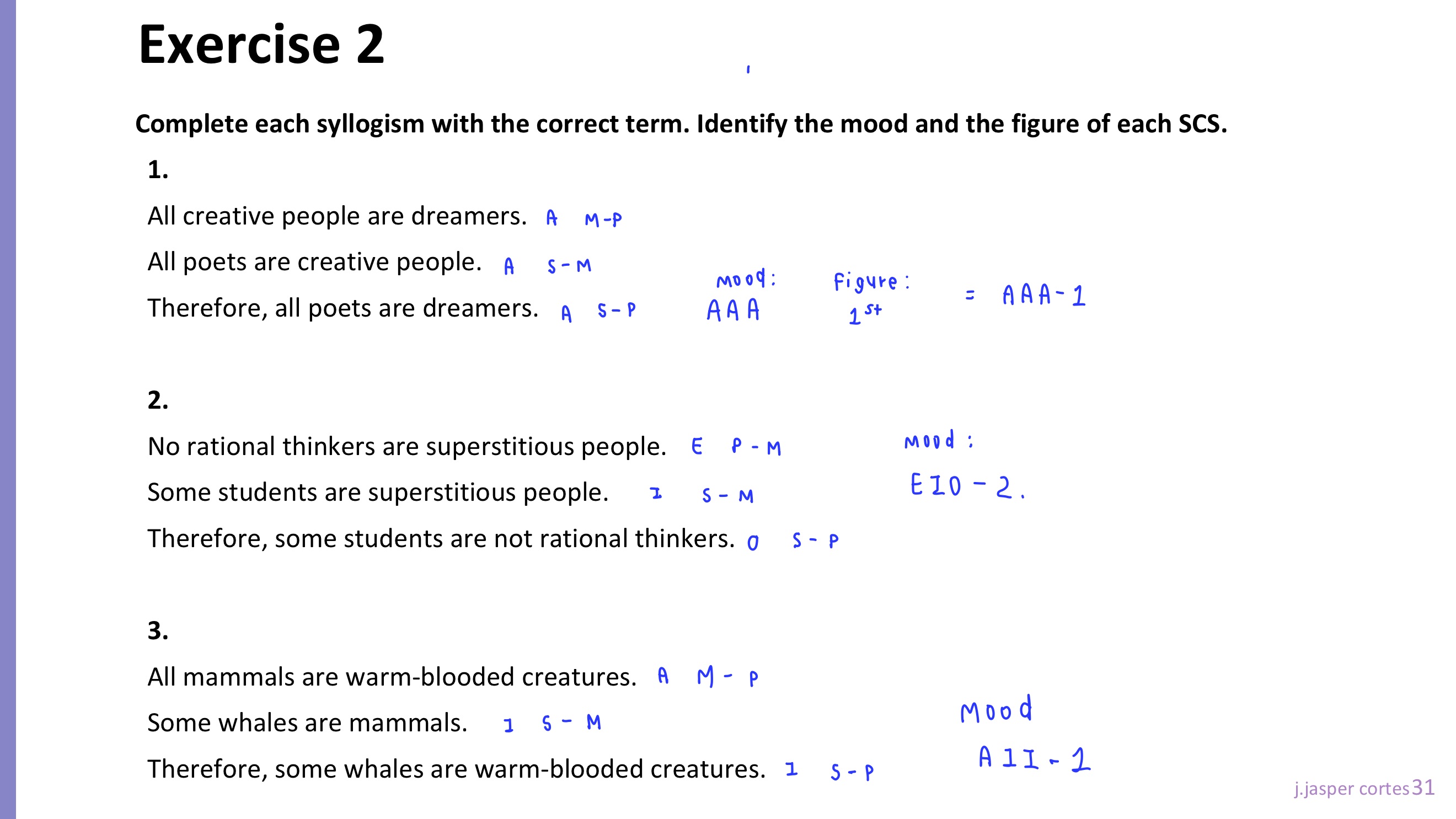
Exercise 2: Identifying Mood and Figure
Complete each syllogism with the correct term. Identify the mood and the figure of each SCS.
-
All creative people are dreamers. (M)
All poets are creative people. (A)
Therefore, all poets are dreamers. -
No rational thinkers are superstitious people.
Some students are superstitious people.
Therefore, some students are not rational thinkers. -
All mammals are warm-blooded creatures.
Some whales are mammals.
Therefore, some whales are warm-blooded creatures.
Part 3: Validity in Standard Categorical Syllogism
What are the Rules of Validity?
Rules of Validity
Actually, the 1st rule is there must be exactly three terms: major, minor, and middle.
Distribution Rules
| Category | Rule | Violation |
|---|---|---|
| Distribution | 1. The middle term must be distributed in at least one of the premises. | Undistributed middle term |
| Distribution | 2. If either the major or the minor term in the conclusion is distributed, it must be distributed in the premise in which it occurs. | Illicit major term, illicit minor term |
Negation Rules
| Category | Rule | Violation |
|---|---|---|
| Negation | 3. The premises cannot both be negative. | Two negative premises |
| Negation | 4. If either premise is negative, the conclusion must be negative; and if the conclusion is negative, one premise must be negative. | Negative premise, affirmative conclusion OR Affirmative premises, negative conclusion |
Quantity Rule
| Category | Rule | Violation |
|---|---|---|
| Quantity | 5. If the conclusion is particular, one premise must be particular. [Required only on the modern view of existential import.] | Universal premises, particular conclusion |
Distribution Reminder: OR ELSE
Two Mnemonic Devices for Distribution
"Unprepared Students Never Pass"
- Universals distribute Subjects
- Negatives distribute Predicates
"Any Student Earning B's Is Not On Probation"
- A distributes Subject
- E distributes Both
- I distributes Neither
- O distributes Predicate
Applying the Rules of Validity
Example 5
                                M                      P
(-)  No disqualified players are people who could win the tournament.
                  S                M
(+)  All rule-breakers are disqualified players.
     ───────────────────────────────────────────────
                 S                      P
(-)  No rule-breakers are people who could win the tournament.
Analysis
- Rule 1: ✓ (M is distributed in first premise)
- Rule 2: ✓ (S and P distributed properly)
- Rule 3: ✓ (Not two negative premises)
- Rule 4: ✓ (Negative premise → negative conclusion)
- Rule 5: ✓ (All universal propositions)
The syllogism followed all 5 rules. It is VALID.
Aj. Jasper's Hacks for Easy Checking
Step-by-Step Process
-
Circle the copulas
-
Label the terms (If you get confused, remember: the predicate of the conclusion is the major term [P]; the term that appears twice above the line is the middle term, leaving you the minor [S])
-
Double underline distributed terms
-
Check if M is distributed at least once
-
The term that is distributed in the conclusion MUST be distributed in the premise it appears in (but not the other way around)
-
Label the qualities - There CANNOT be two negative premises
-
A negative premise requires a negative conclusion. A negative conclusion requires a negative premise. This one goes both ways.
-
If the conclusion is particular, one premise MUST be particular. If one premise is particular, the conclusion must be particular as well.
Example 6: Applying the Rules
                 M                           P              S
Some online shoppers today are loyal customers.
                 M                                 S
All online shoppers today are people with an internet connection.
──────────────────────────────────────────────────────
               S                                P
Some people with an internet connection are not loyal customers.
Your Task
Apply the 5 rules to determine if this syllogism is valid or invalid.
Exercise 3: Assessing SCS
For each argument:
- Identify the mood & figure of each argument
- Double-underline the distributed terms
- List the rule number that is followed. When there is a violation, identify the specific violation. Refer to the table on the Rules of Validity
- Decide if the argument is valid or invalid
Rules Reference Table
| Category | Rule | Violation |
|---|---|---|
| Distribution | 1. The middle term must be distributed in at least one of the premises. | Undistributed middle term |
| Distribution | 2. If either the major or the minor term in the conclusion is distributed, it must be distributed in the premise in which it occurs. | Illicit major term, illicit minor term |
| Negation | 3. The premises cannot both be negative. | Two negative premises |
| Negation | 4. If either premise is negative, the conclusion must be negative; and if the conclusion is negative, one premise must be negative. | Negative premise, affirmative conclusion OR Affirmative premises, negative conclusion |
| Quantity | 5. If the conclusion is particular, one premise must be particular. [Required only on the modern view of existential import.] | Universal premises, particular conclusion |
The Fork in the Instruction
Two Options
Option A: End the lesson here and do Part 4 and A4 during Lesson 14
Option B: Finish Part 4 and do A4 now
Notes Section
Additional Practice Problems
[Leave space for handwritten notes and additional examples]
Summary Checklist
- Understand the structure of Standard Categorical Syllogisms
- Identify Major, Minor, and Middle terms
- Determine Mood (A, E, I, O sequence)
- Determine Figure (1, 2, 3, or 4)
- Apply the 5 Rules of Validity
- Use distribution rules correctly (OR ELSE mnemonics)
- Check for negative premise/conclusion relationships
- Verify quantity requirements
Key Reminders
- Three terms only: Major (P), Minor (S), Middle (M)
- Middle term appears in both premises but NOT in conclusion
- Mood = sequence of A, E, I, O forms
- Figure = position of middle term in premises
- Distribution matters for validity
- Venn diagrams help visualize relationships
- All valid syllogisms must follow all 5 rules