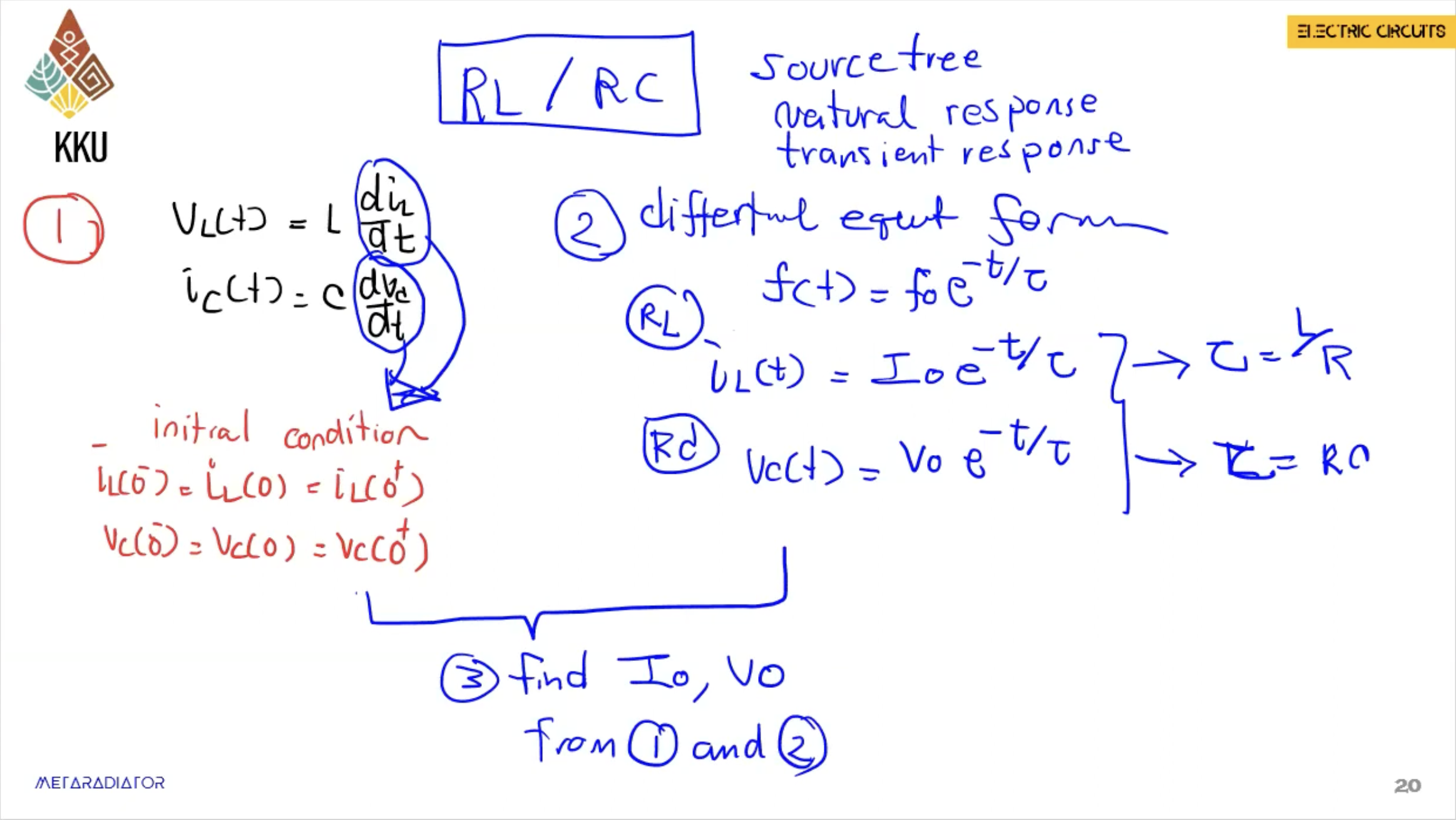
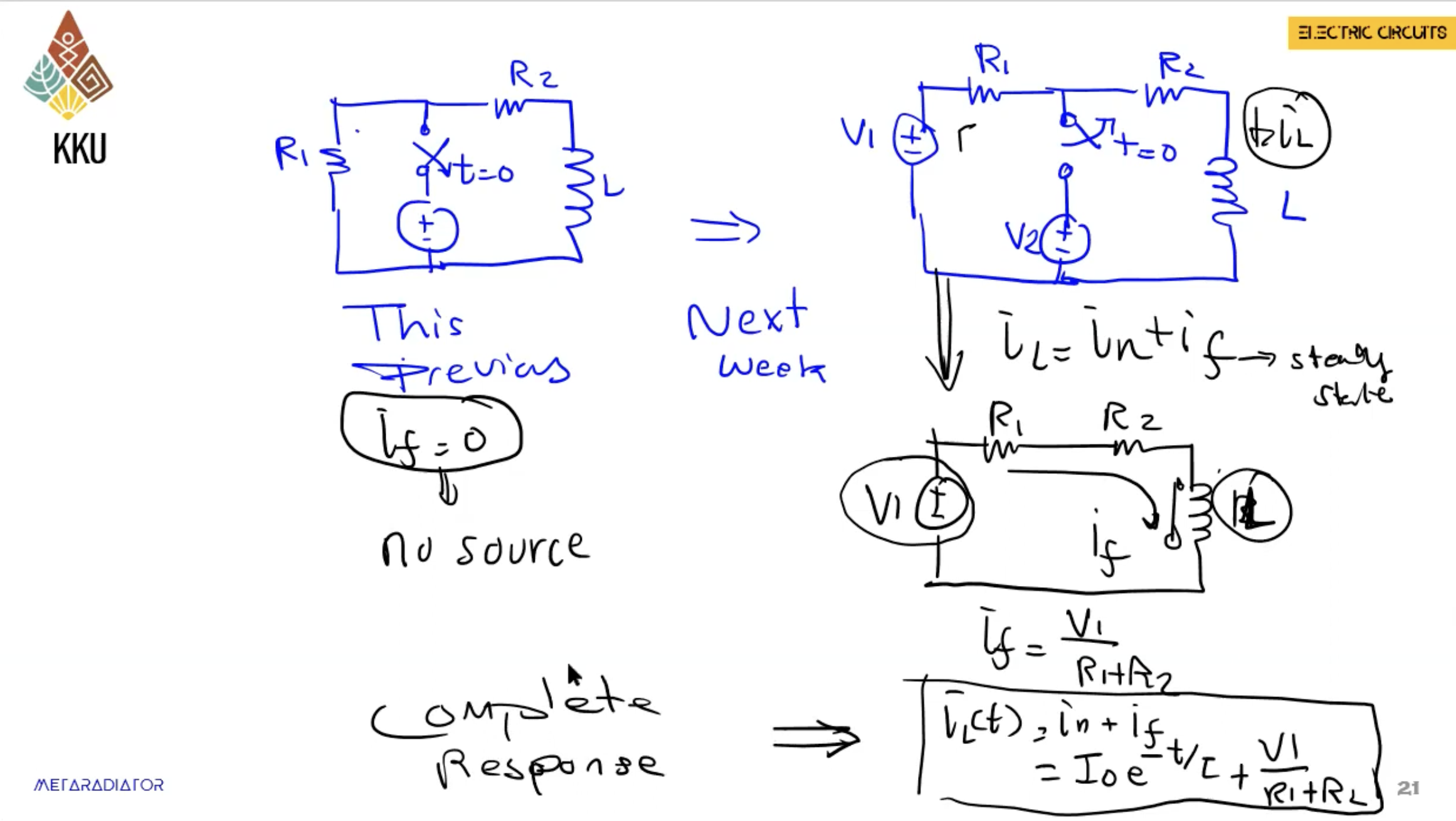
- Complete Response = Natural Response + Forced Response
- หรือว่า Complete Response = Transient Response + Steady State Response
- The Natural Response is the general solution of the differential equation representing the first-order circuit, when the input is set to zero
- The Forced Response is a particular solution of the differential equation representing the circuit
- รูปแบบคำตอบมันเหมือนเดิมตลอด ดังนั้นสามารถจำรูปแบบคำตอบไปได้เลย
Initial Conditions of Switched Circuits
-
All of the circuit inputs, that is, the independent voltage source voltages and independent current sources current, are constant functions of time.
-
The circuit includes one or more switches that open or close at time
- Time immediately before the switch →
- Time immediately after the switch →
-
Consider these three condition
- At initially, , switch doesn’t change for some time.
- At initial, , switch doesn’t change for some time.
- At final condition, , switch doesn’t change for some time
(1, 2) ก็คือเปลี่ยนแปลงเลยทันทีไม่ได้
Open switches act like open circuits, closed switches act like short circuits
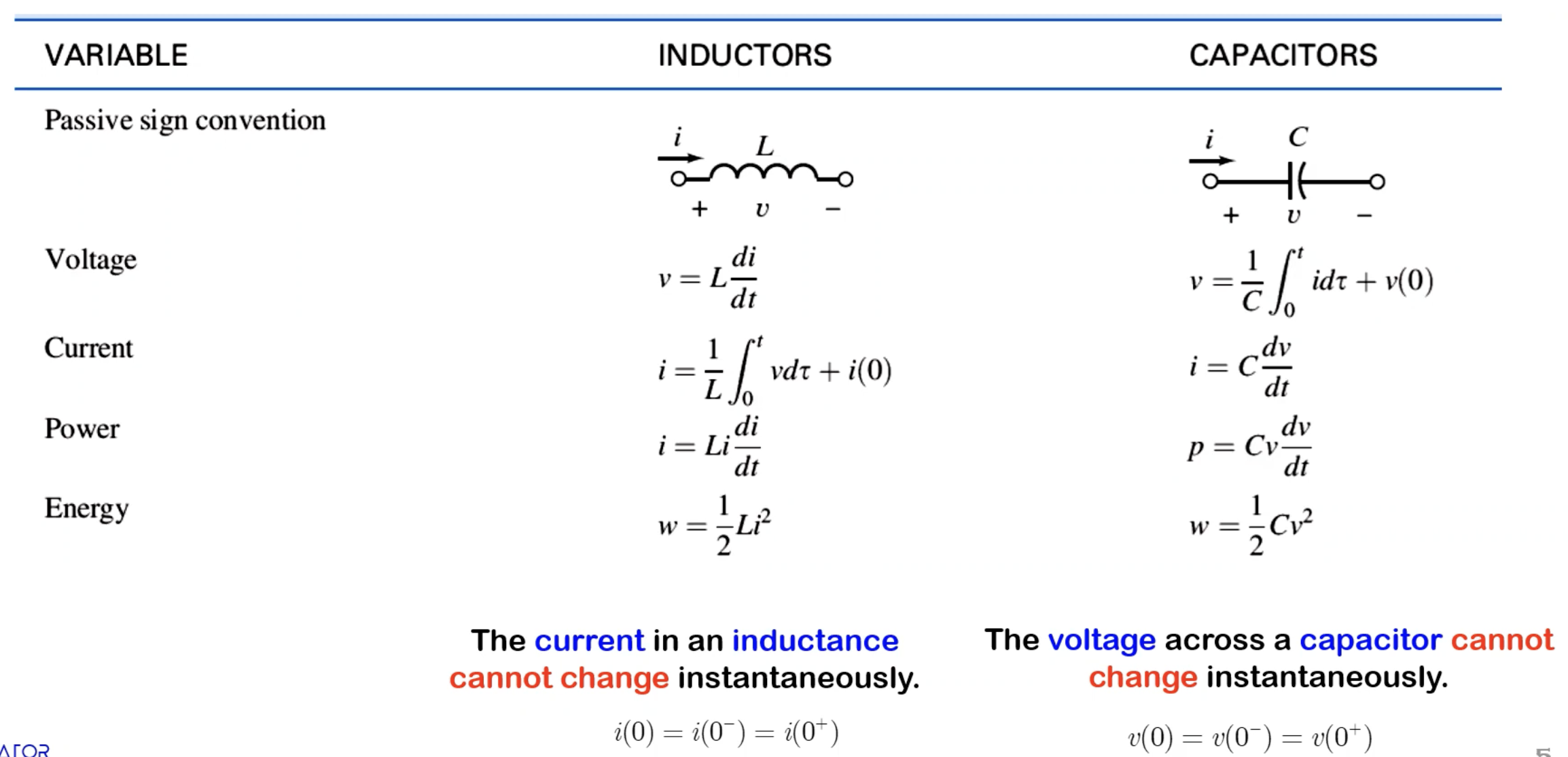
Characteristics of Energy Storage Elements
The Source-Free RL and RC circuits
- ก็คือทั้งวงจรมีอยู่แค่นี้นะ— Source-Free ก็คือไม่มีแหล่งจ่ายอะไรเลย
- คือไม่สามารถมี Independent Source ได้ แต่จริง ๆ ก็สามารถมี Dependent ได้นะ!
RC Circuit
-
เอาจริง Source-Free เอาจริง มันก็ต้องมี Source มาก่อนนะ เอามา Charge C ไม่งั้นมันจะไปเอาพลังงานมาจากไหน
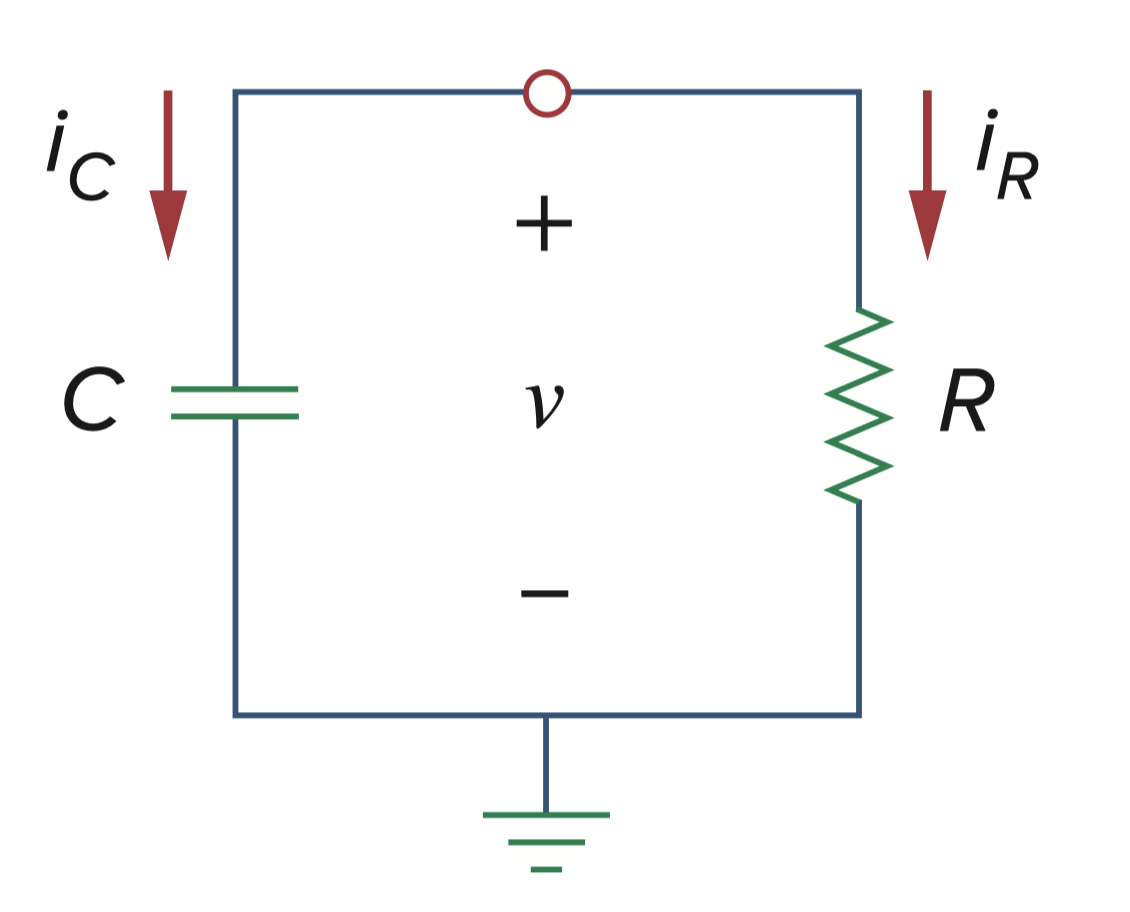
-
Since the capacitor is initially charged, we can assume that at time , the initial voltage is
- The energy stored
- Applying KCL:
- But and
-
From initial conditions,
-
Hence,
-
Since the response is due to the initial energy stored and the physical characteristics of the circuit and not due to some external voltage or current source, ==it is called the natural response of the circuit.==
The natural response depends on the nature of the circuit alone with no external sources
-
แต่ไม่ได้เหมือน Transient 100% นะ → Transient คือจะมี Source ก็ได้ แค่ temporary (เกิดขึ้นแปปเดียว)
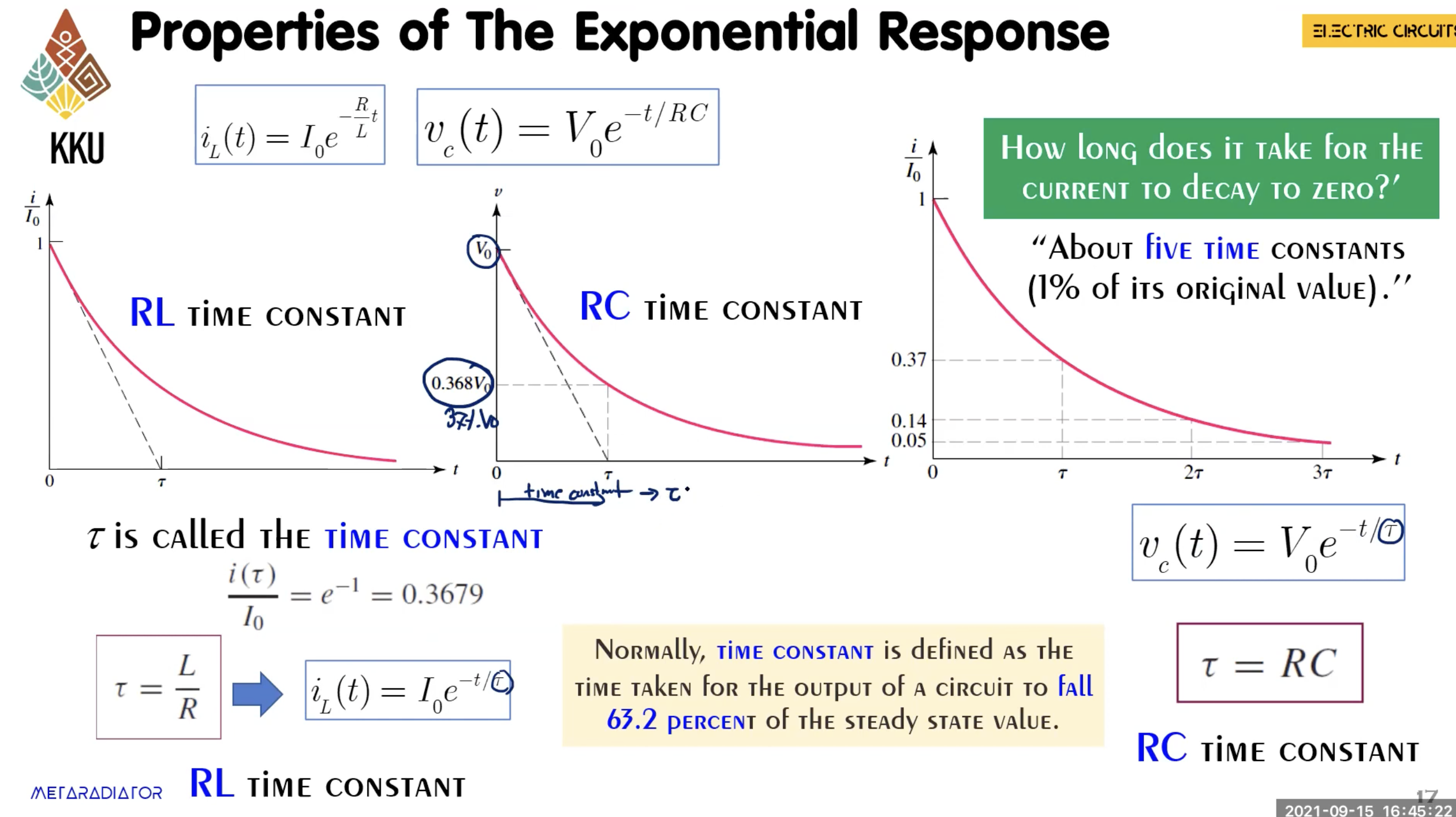
Time Constant
Question
How long does it take for the current/votage? รึเปล่า to decay to zero?
About five time constant (1% of its original value)
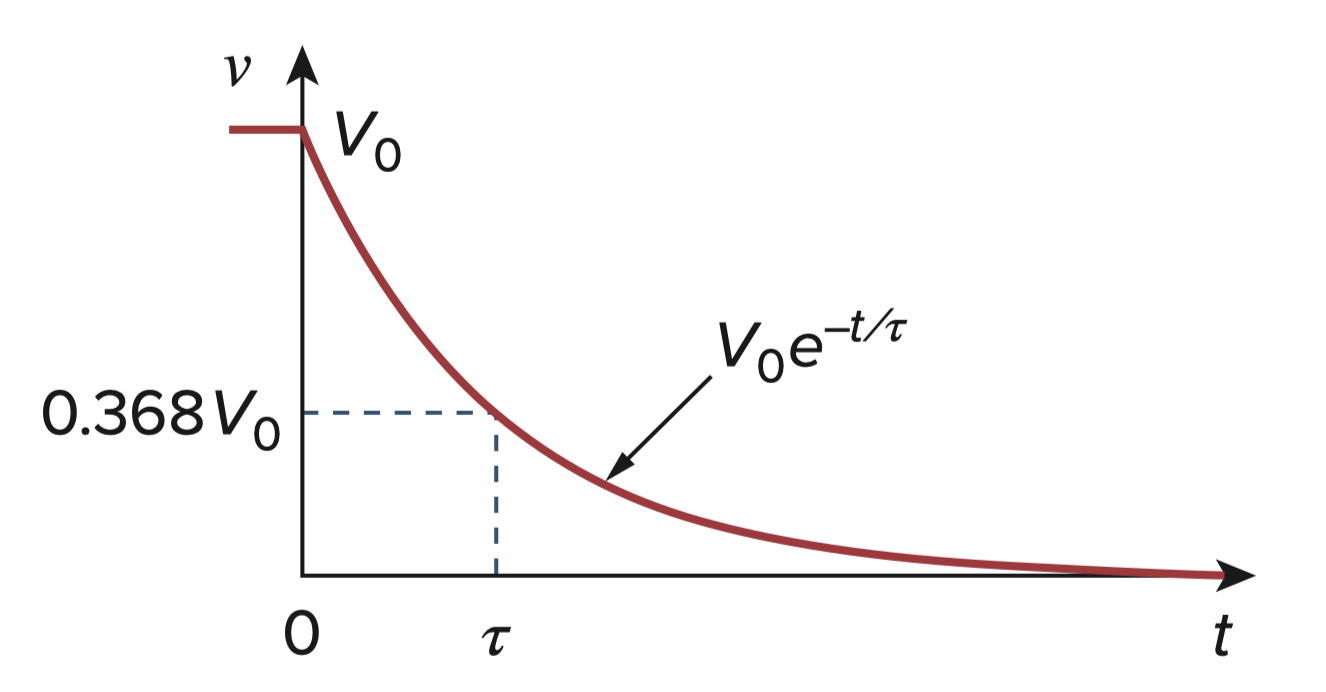
- The time constant () of a circuit is the time required for the response to decay to a factor of or 36.8% of its initial value.
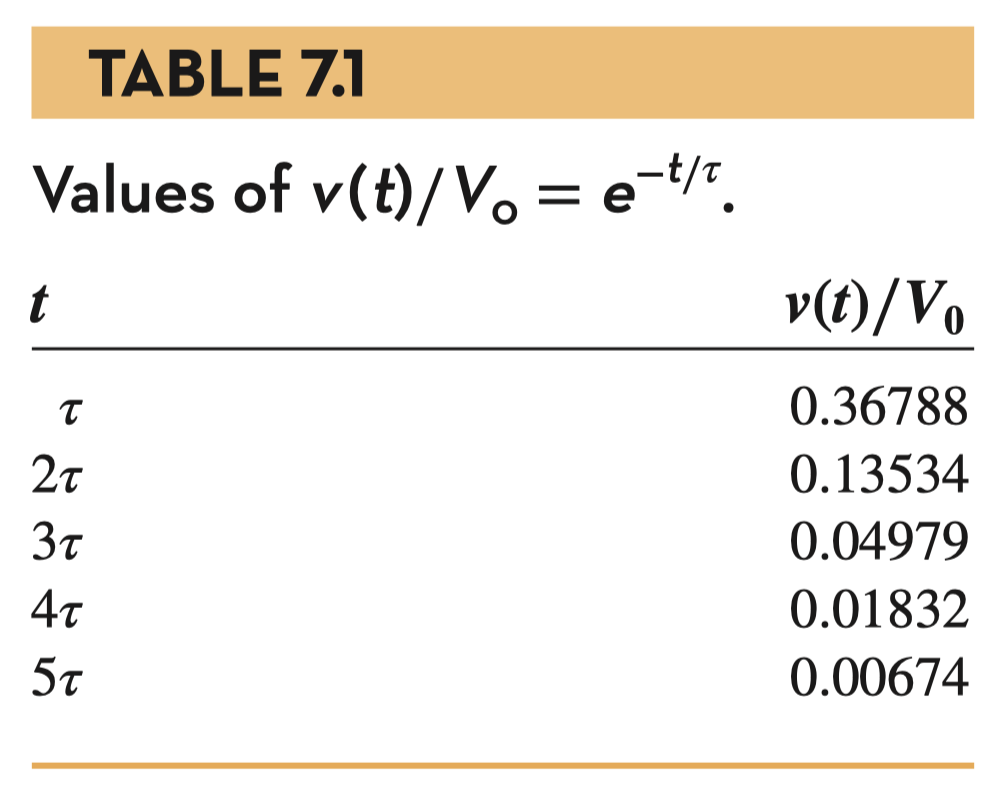
- It is evident from the table that voltage is less than 1% of after (five time constants).
- At any rate, whether the time constant is small or large, the circuit reaches steady state in five time constants
- ก็คือจุดสิ้นสุด Transient Response ละ
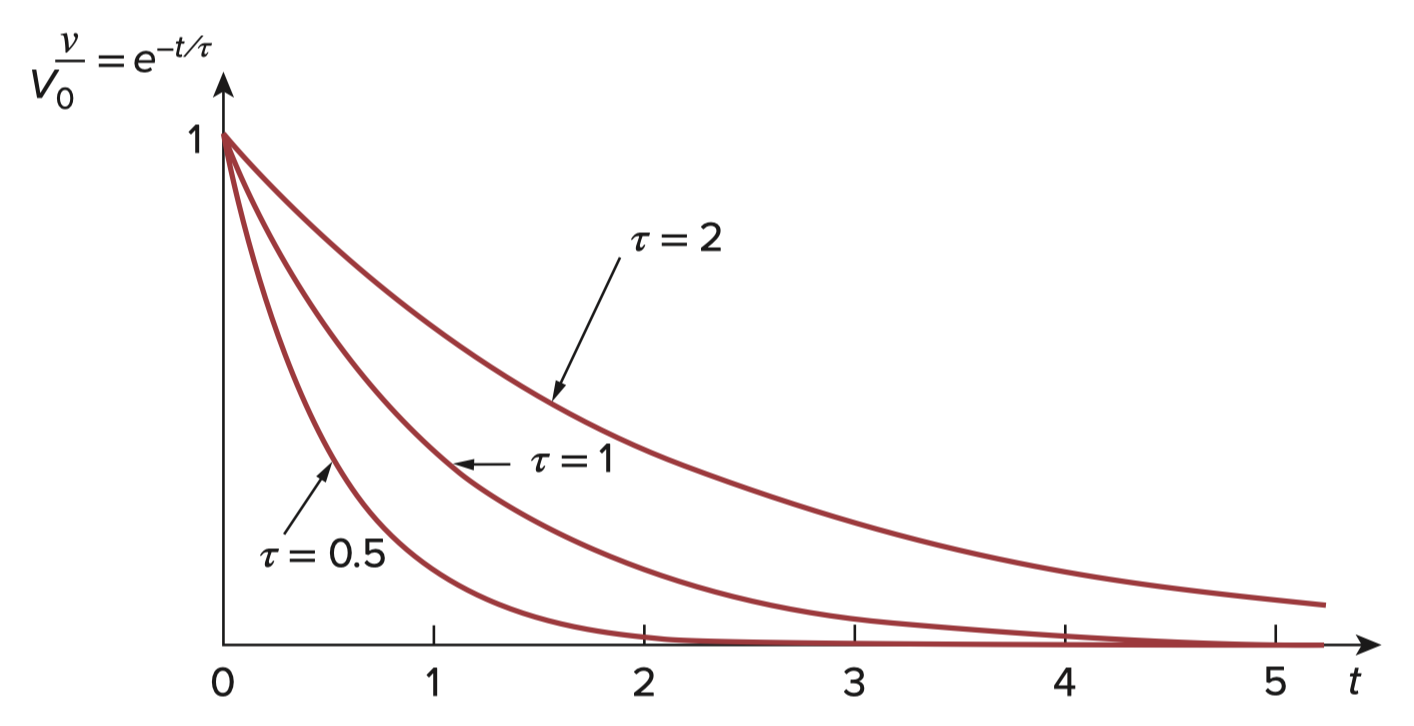
- A circuit with a small time constant gives a fast response in that it reaches the steady state quickly due to quick dissipation of energy stored
- Whereas a circuit with a large time constant gives a slow response because it takes longer to reach steady state.
ยิ่งน้อยก็ยิ่งถึง Steady state เร็ววว!
The Key
The Key to Working with a Source-Free RC Circuit Is Finding:
- The inital voltage across the capacitor
- The time constant .
- ซึ่งอันนี้เป็นวงจร RC ดังนั้น
- Tips:
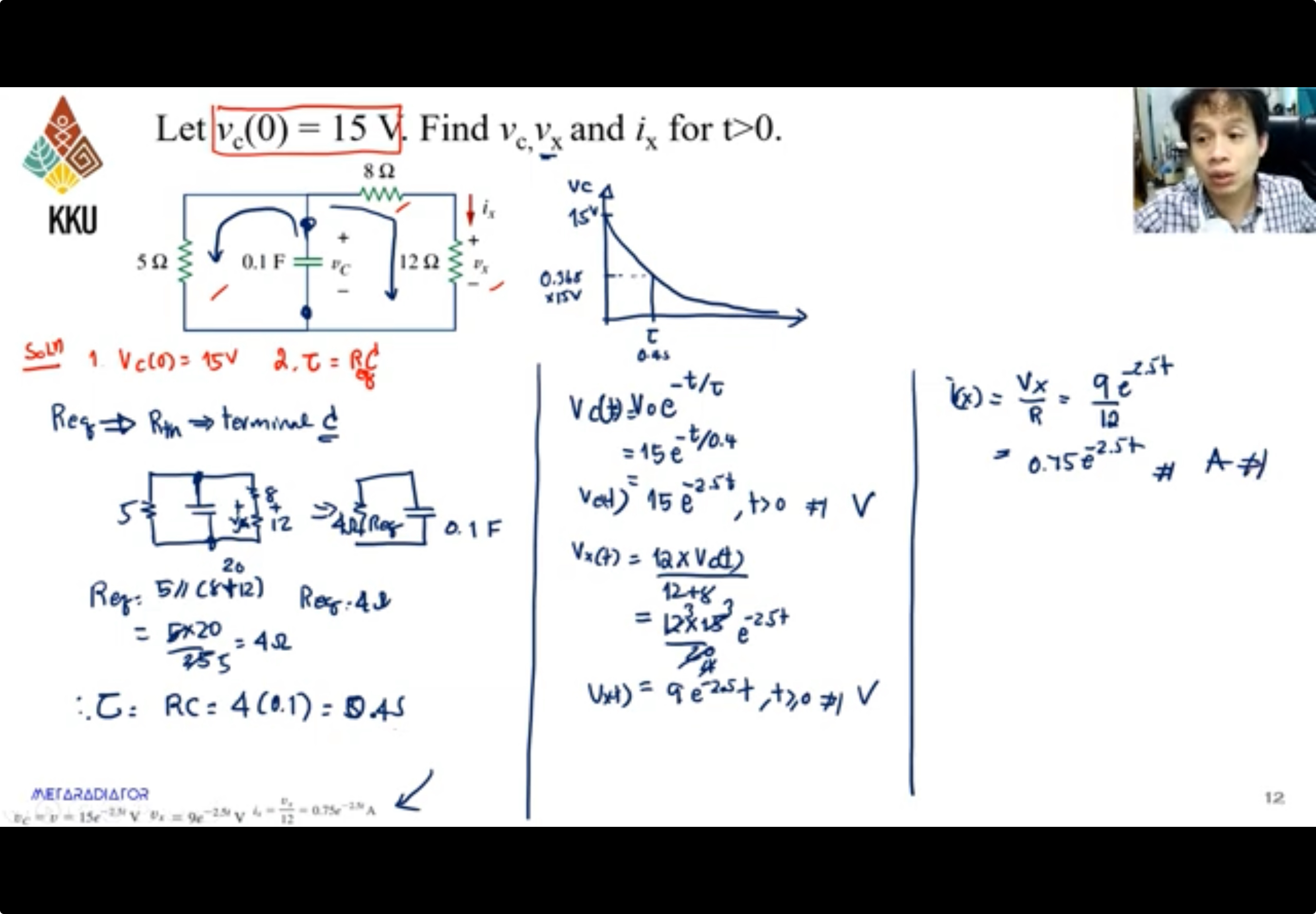
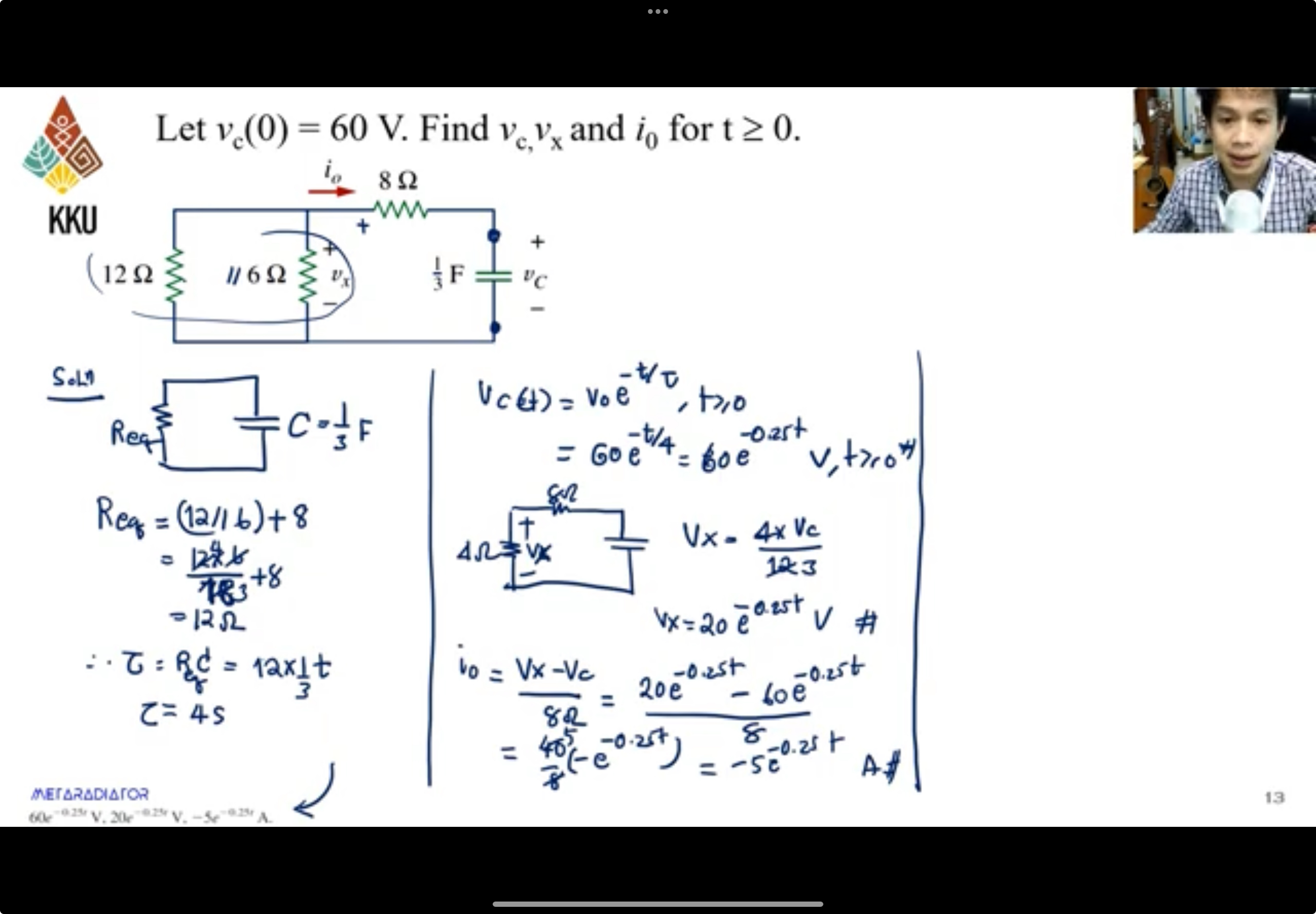
- When a circuit contains a single capacitor and several resistors and dependent sources, the Thevenin’s Theorem can be found at the terminals of the capacitor to form a simple RC circuit.
- Also, once can use Thevenin’s Theorem when several capacitors can be combined to form a single equivalent capacitor (ยุบรวม C, R ก่อน)
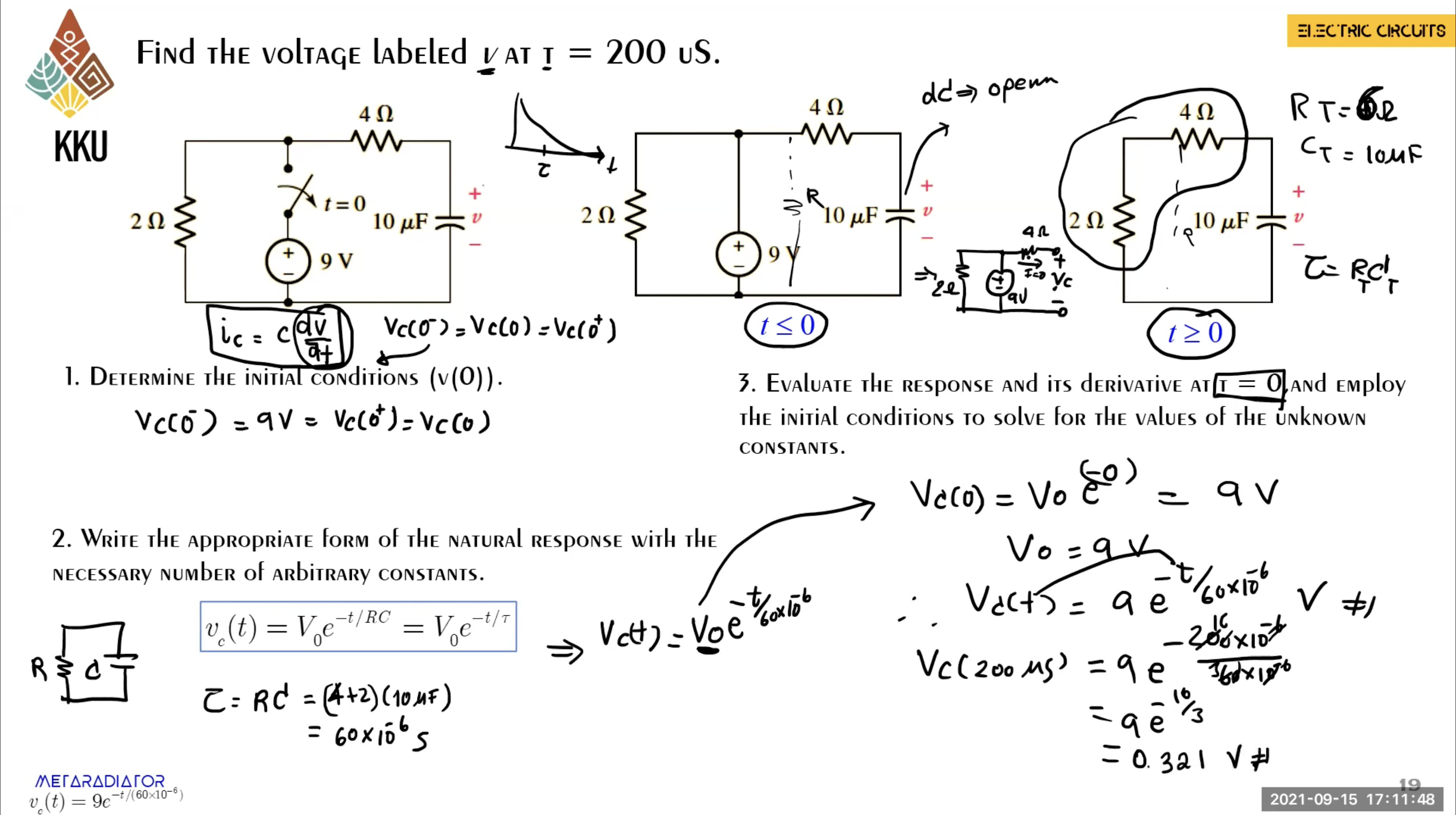
Example
RL Circuit
-
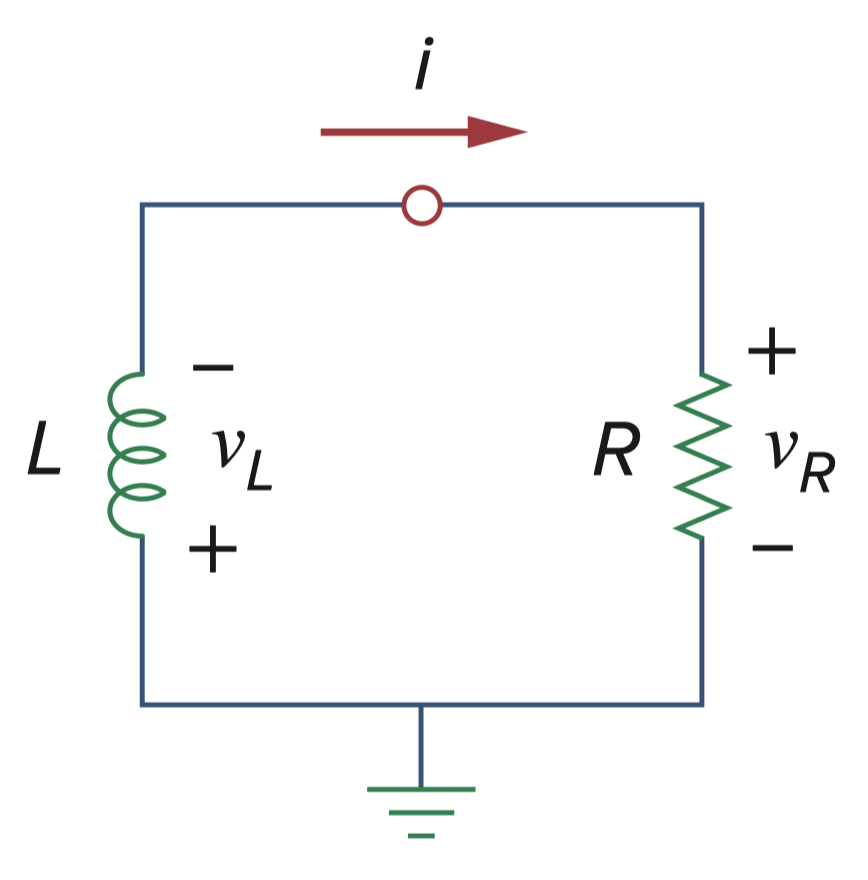
At , we assume that the inductor has an initial current or
-
The energy stored
-
Applying KVL:
- But and
Time Constant
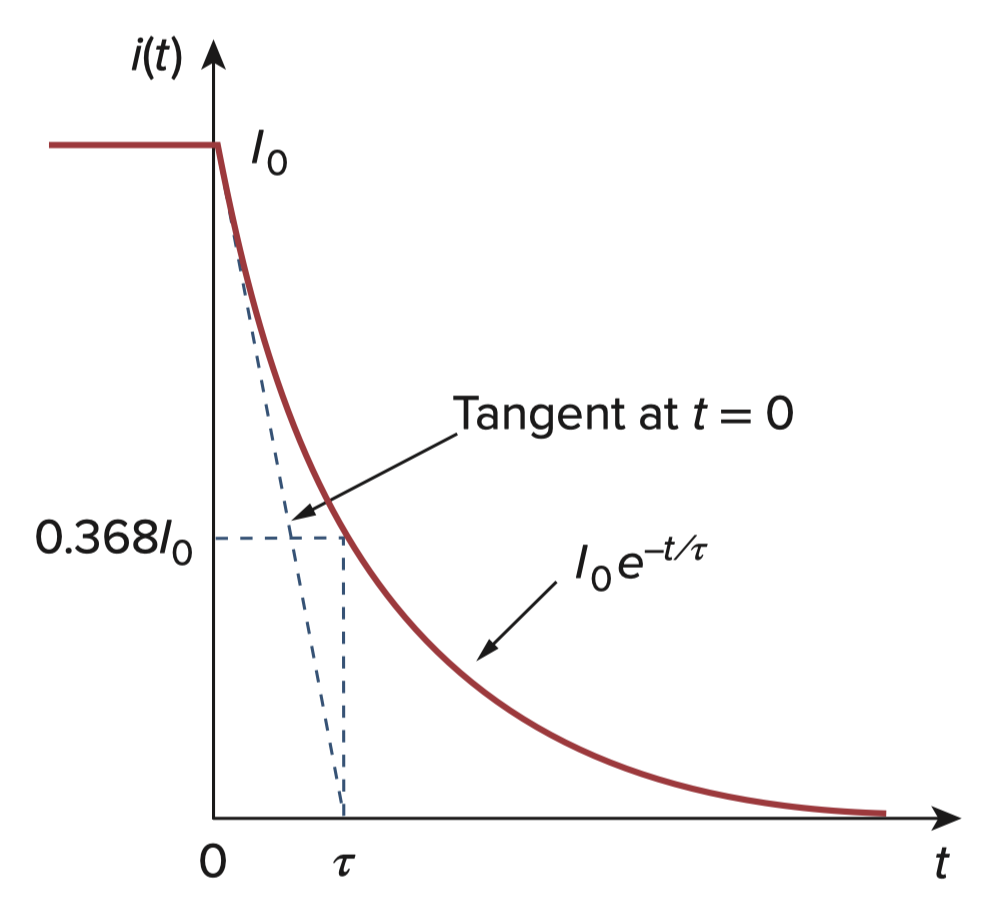
- The time constant for the RL circuit is
- Thus,
The Key to Working with a Source-Free RL Circuit Is to Find:
- The initial current through the inductor.
- The time constant .
- ซึ่งอันนี้เป็นวงจร RL ดังนั้น
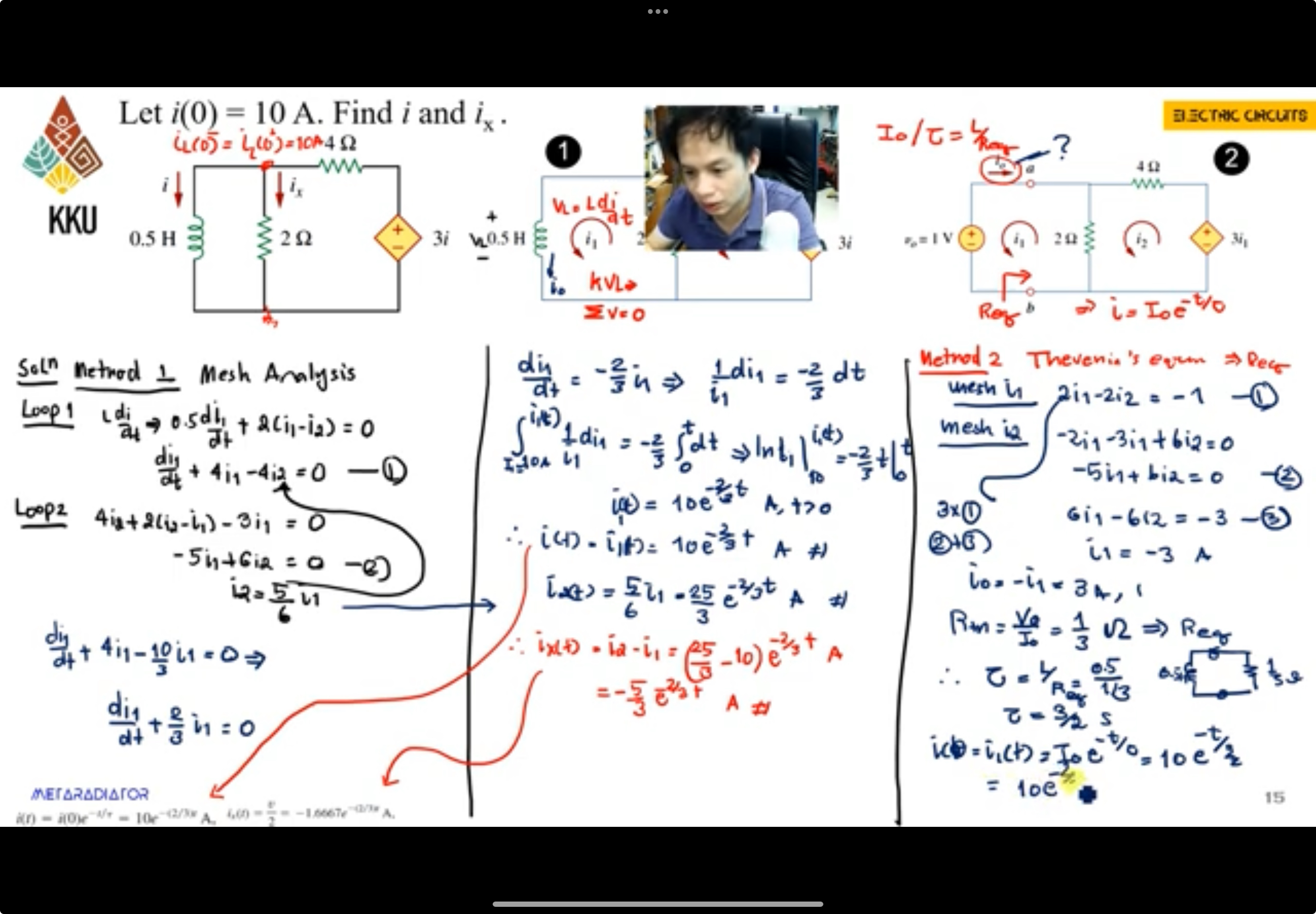
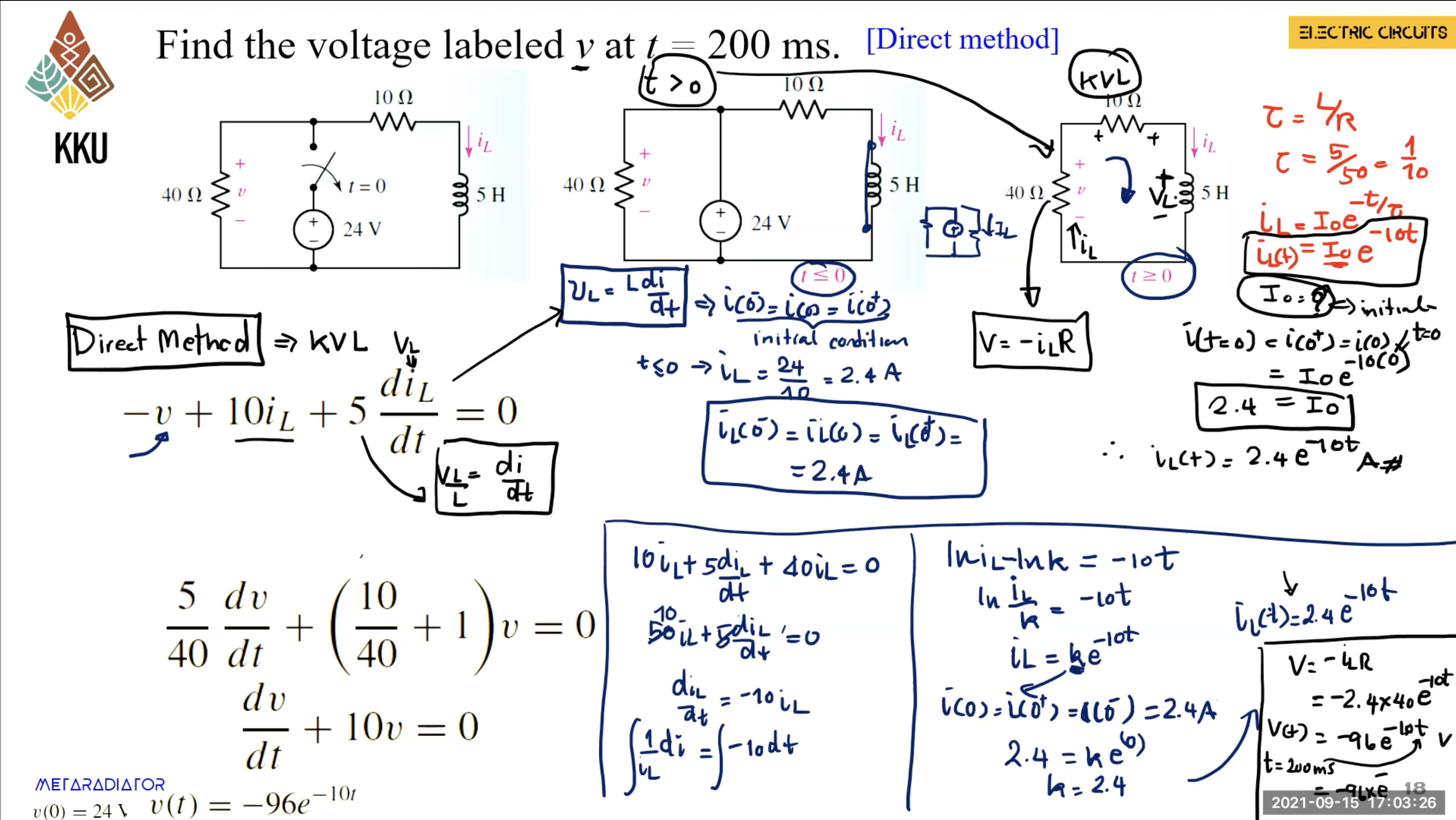
Example
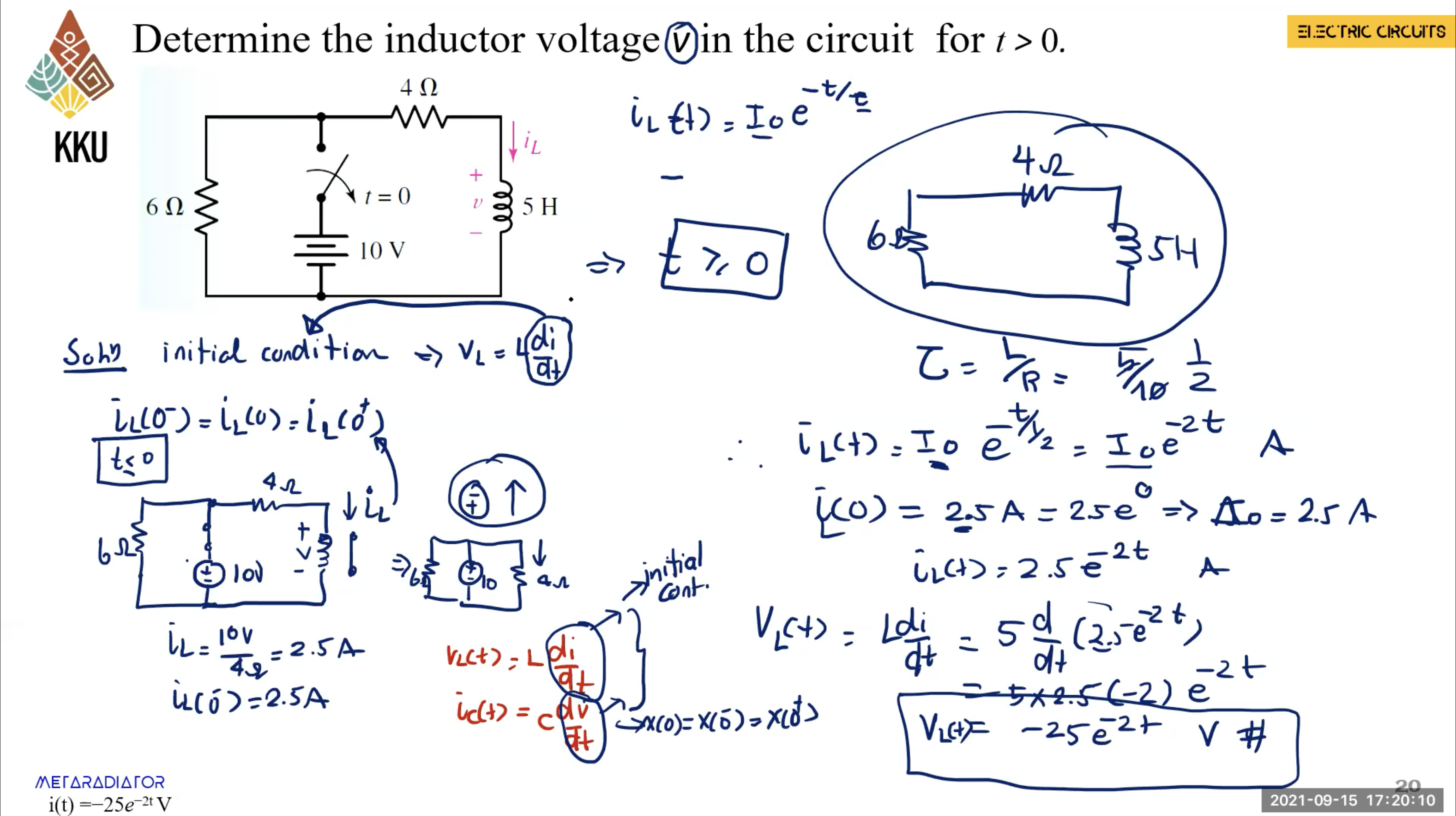
Step Response RL and RC circuits
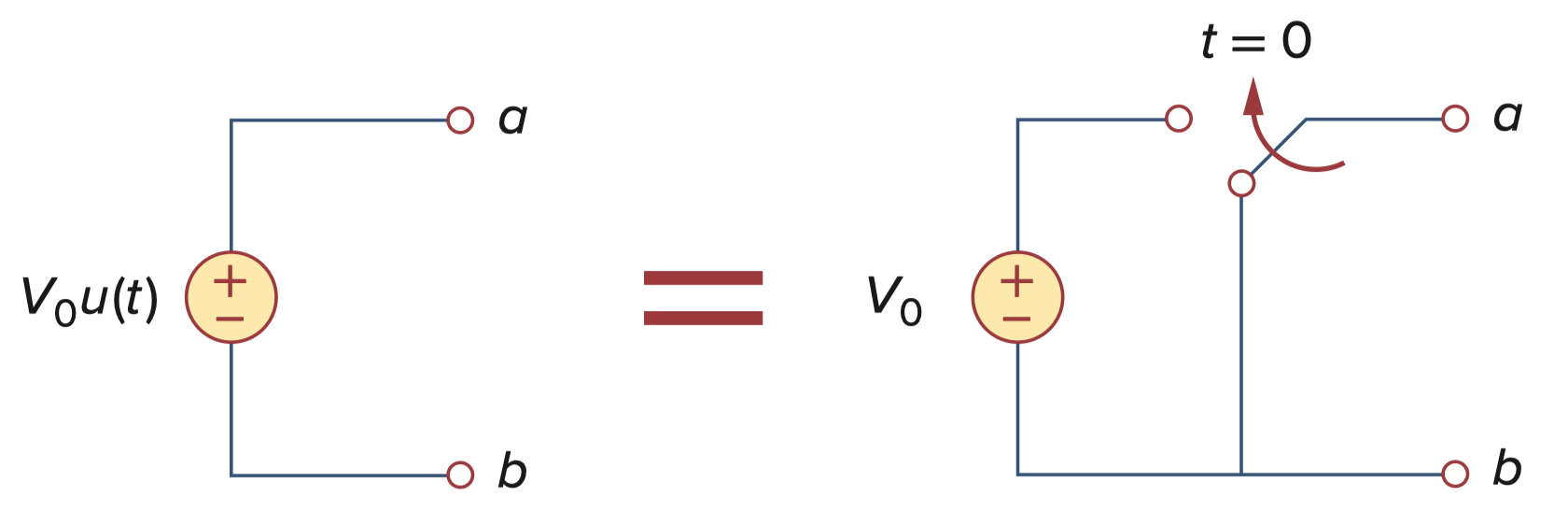
- The step response of a circuit is its behavior when the excitation is the step function, which may be a voltage or a current source.
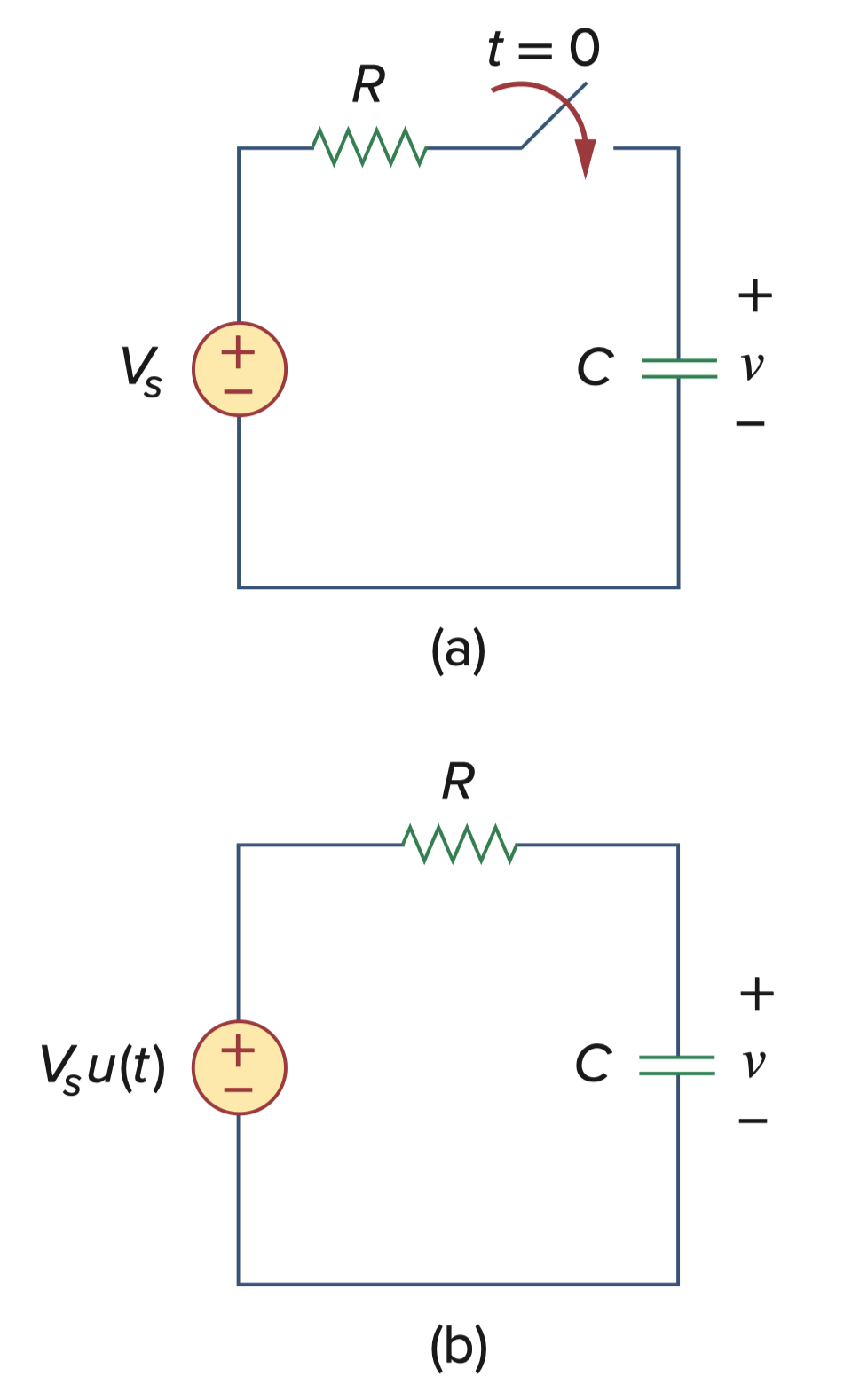
- สองรูปด้านบนคือวงจรเดียวกันเลย
- (a) เขียนให้เห็นอยู่ในรูปของ Switch
- (b) ไม่มี Switch แต่เป็น Function Step Reponse (Unit Step เหมือนเป็นตัวแทนของ Switch) อยู่ที่แหล่งจ่าย
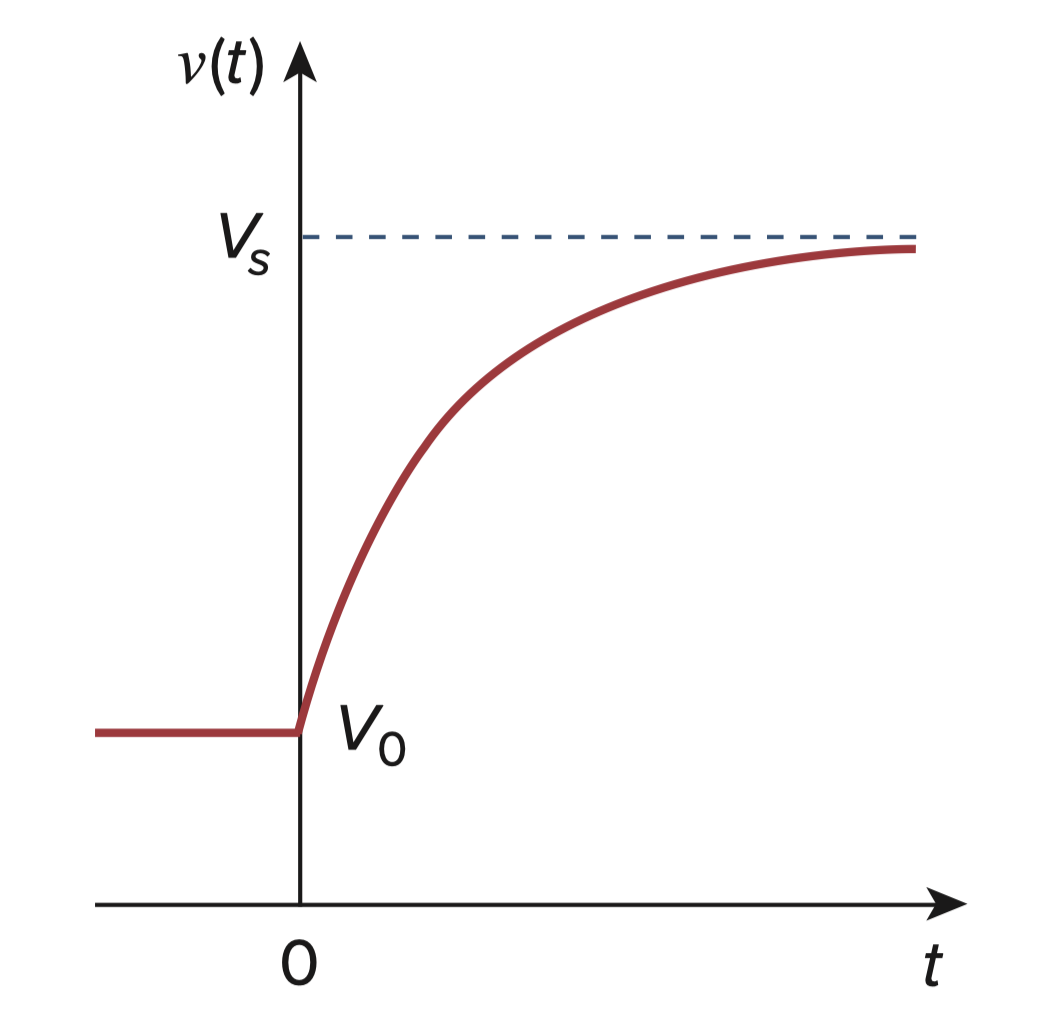
- รูป Graph ด้านบน สอดคล้องกับวงจรเลยนะ แล้วก็ Make sense มากกก เริ่มต้น C มี V อยู่แล้วค่านึง แล้วพอเอา Switch ลงมันก็เหมือน Short Circuit ยังไงสุดท้าย ก็ต้องมีค่าเท่า ใช่ป้ะ
- Graph นี้เรียกว่า Step Response → แล้วเราจะเขียนสมการออกมายังไง?
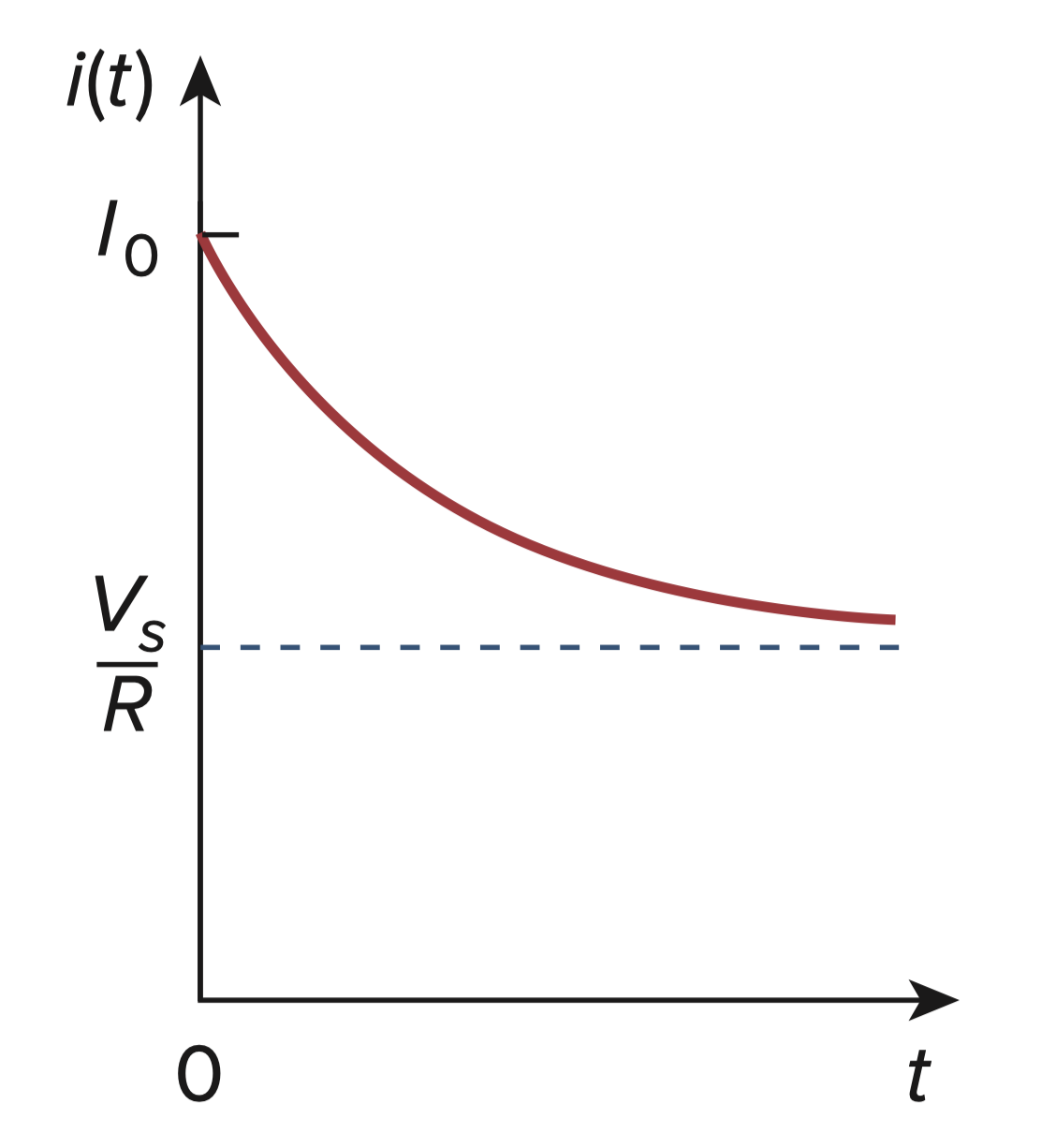
- อันนี้ก็ Make sense เหมือนกันของ RL— เริ่มต้นด้วย ค่าเดิมอยู่ก่อน เสร็จแล้วพอสับ Switch ลง ก็ต้อง ในท้ายที่สุดกลายเป็น ใหม่ที่เท่ากับแหล่งจ่ายคือ ไงงงง
- Graph นี้เรียกว่า Step Response → แล้วเราจะเขียนสมการออกมายังไง?
Important
Graph ต่างกับ Source-Free ยังไงนะ?!
อย่าลืมว่า Graph ของ Source-Free คือเมื่อผ่านไป () จะต้องเข้าใกล้ 0 นะ ไม่ได้สอดคล้องกับแหล่งจ่าย (ก็ใช่สิ เพราะว่ามันไม่มีแหล่งจ่ายไงงงงง55555)
-
แล้วเราจะหาคำตอบของสมการที่เราอยากรู้ได้ยังไง? มาเรียนกันมี 3 รูปแบบนะ!
- ทั้งหมดคือคำตอบเดียวกันหมด อยู่ที่ว่าจะแบ่งพจน์ยังไง! (แต่อันที่ 3 คือนิยมมากที่สุด)
The general solution is obtained by the same procedure that was followed for
RL and RC circuits (First-Order Circuits)
- Determine the initial conditions.
- Obtain a numerical value for the forced response.
- Write the appropriate form of the natural response with the necessary number of arbitrary constants.
- Add the forced response and natural response to form the complete response.
- Evaluate the response and its derivative at , and employ the initial conditions to solve for the values of the unknown constant.
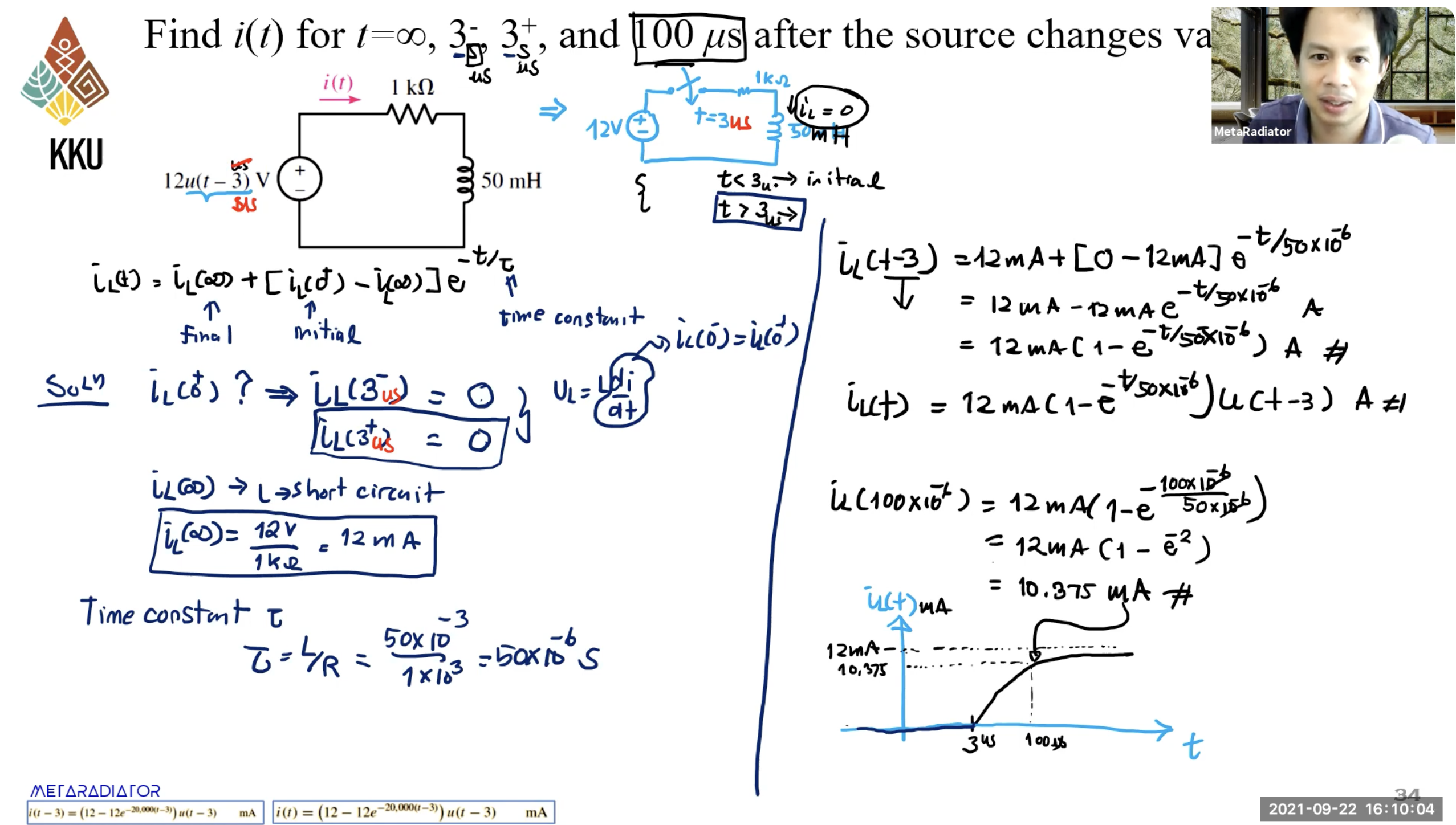
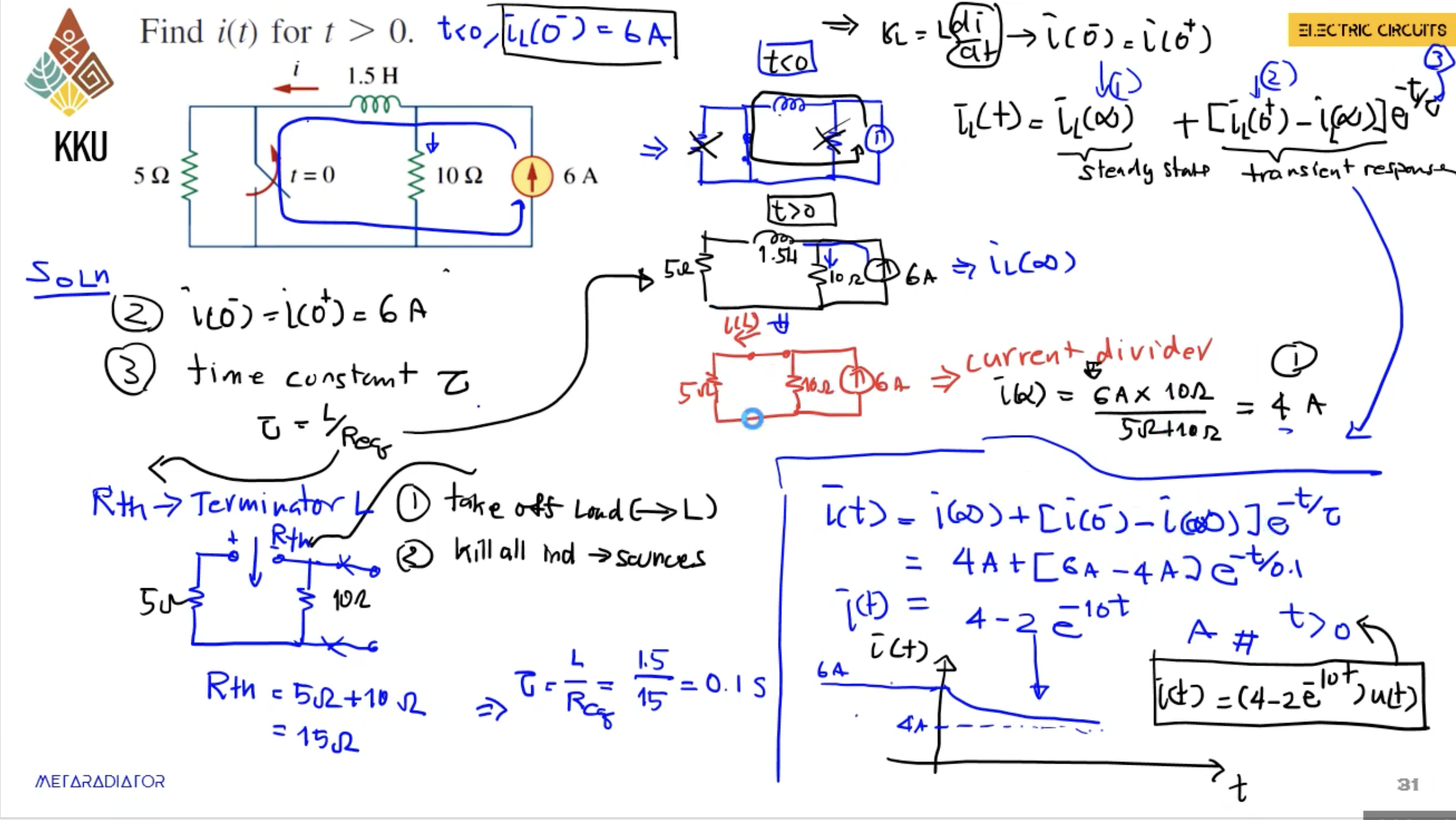
เอาง่าย ๆ เลยนะ คือหาแค่ Initial value, Final value, Time Constant ()
- สมการด้านบนวิธีใช้คือ สามารถเปลี่ยน เป็น (RC) หรือ (RL) ได้ เช่น
โดย แต่ละตัวก็ต่างกันออกไปขึ้นอยู่กับว่า RC หรือว่า RL
- เวลาหา หรือ เอาที่คร่อม L,C นะ
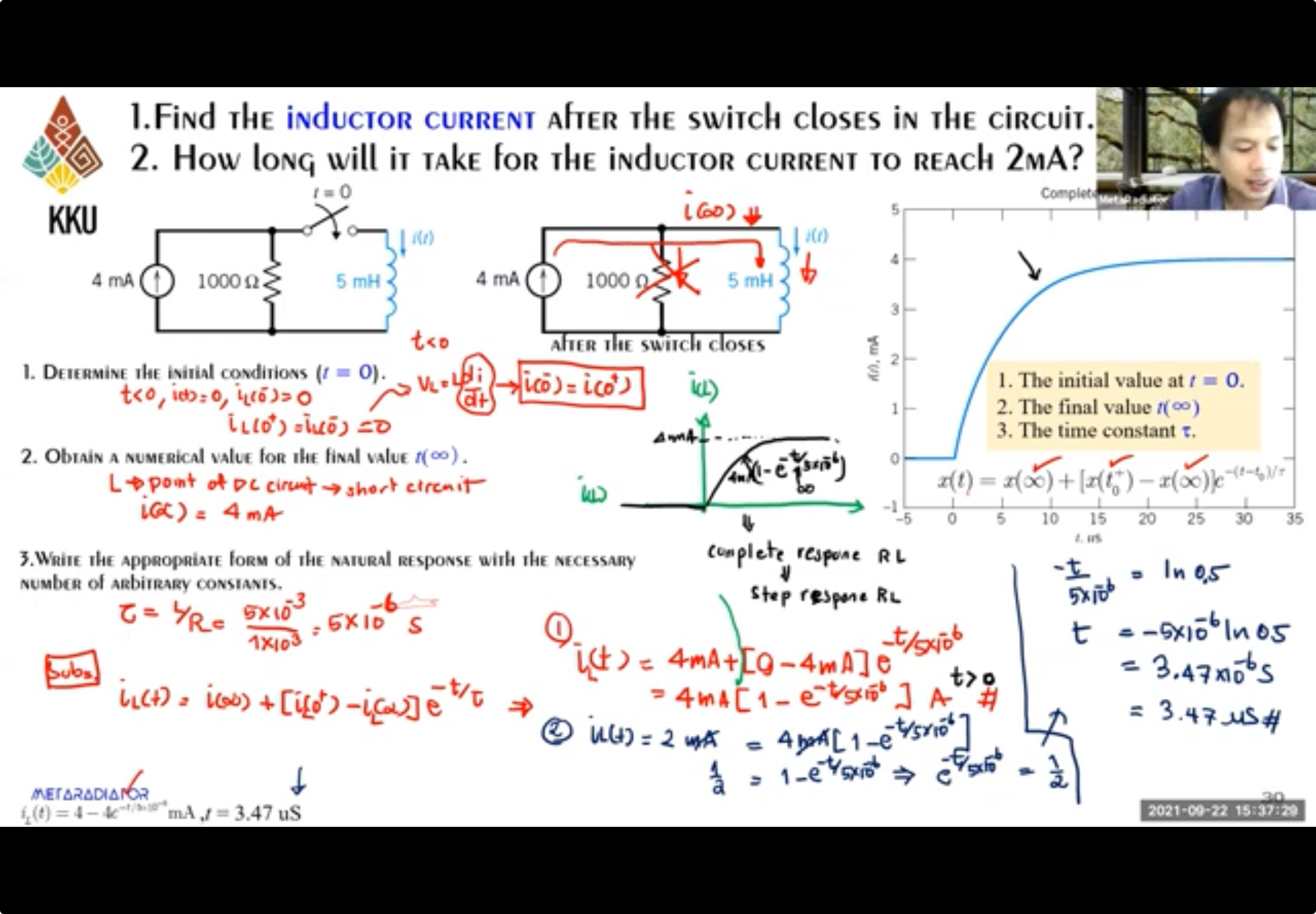
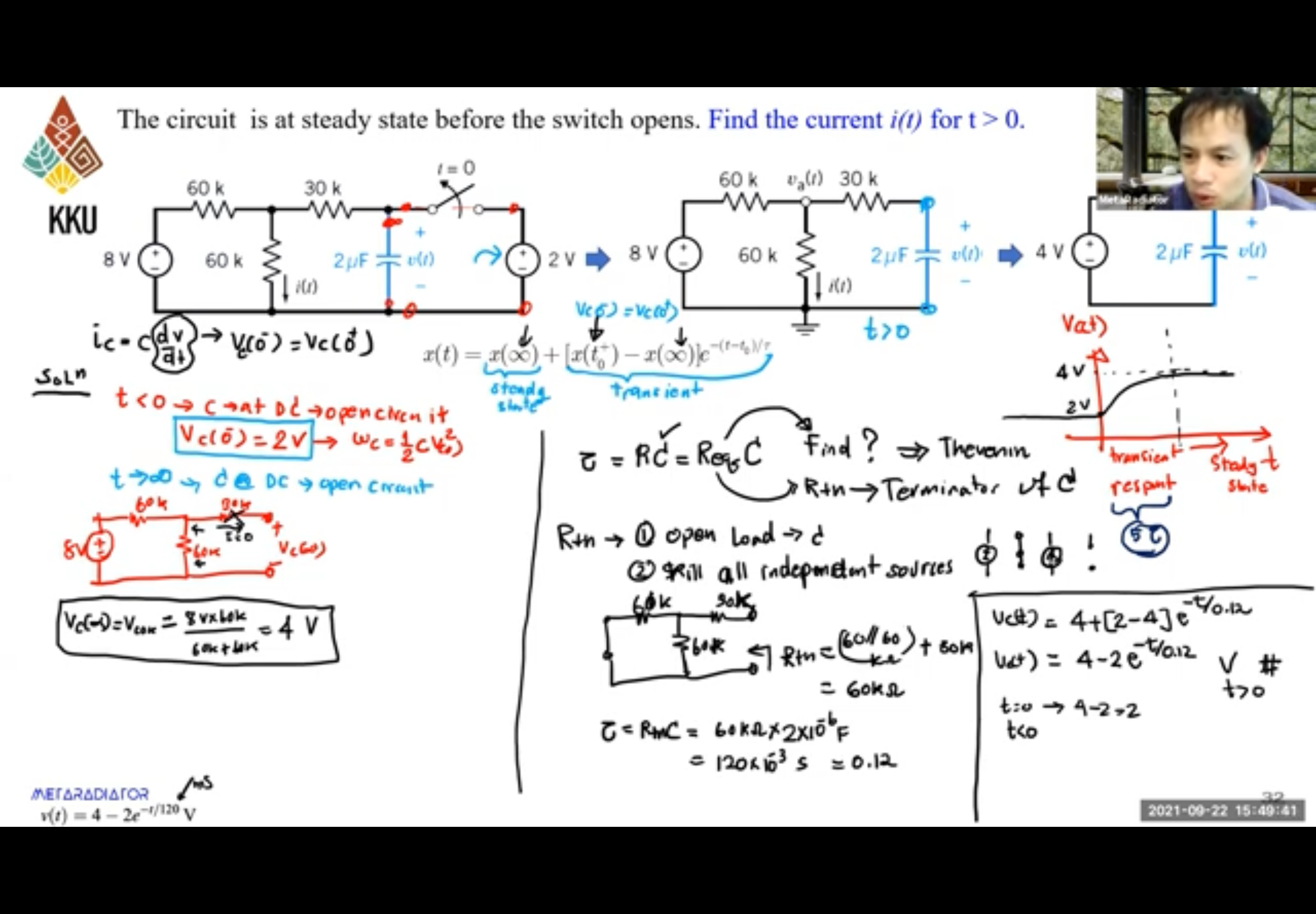
- ก่อนหน้านี้คือใช้ Switch ในการทำงานทั้งหมด— ตอนนี้จะมาดูที่เป็น Unit Step บ้างแล้ว
Sources (Singularity Functions)
- Singularity Functions are functions that either are discontinuous or have discontinuous derivatives.
- มีการเปลี่ยนแปลงทันทีทันใดอย่างไม่ต่อเนื่อง
Unit Step Function
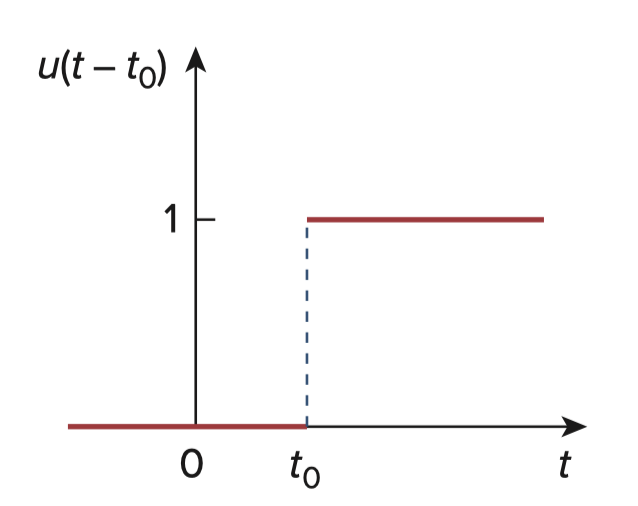
- ก็คือถ้า ก็คือจะสับ Switch ตอน ดูง่าย ๆ เลยนะ