Recursive Algorithm
- A recursive procedure is a procedure that invokes itself.
- Recursion is a powerful and elegant way to solve problems, using divide and conquer technique.
Decompose a problem into smaller problems of the same type as the original problem.
- ต้องมี Base Case ด้วย อย่าลืม!
Complexity of Algorithms (Big-O)
- “Complexity of an algorithm” refers to: “the amount of time and space required to execute the algorithm”.
- “Analysis of an algorithm” refers to: “the process of deriving estimates for the time and space needed to execute the algorithm”.
- The time needed to execute an algorithm is usually estimated as a function of the size of input.
- Given an algorithm, we can ask for:
- The best-case time for inputs of size n
- The minimal time needed to execute the algorithm among all inputs of size n.
- The worst-case time for inputs of size n
- The maximum time needed to execute the algorithm among all inputs of size n.
- The average-case time for inputs of size n
- The average time needed to execute the algorithm over some finite set of inputs all of size n.
- The best-case time for inputs of size n
- We could measure the time required by an algorithm by counting the number of instruction executed.
- Alternatively, we could use a cruder time estimate, such as the number of times each loop is executed.
Big-O
- Bigger and simple
- คือ ทำยังไงให้ได้ให้ มากกว่า ส่วนใหญ่แล้วทำโดยการเอาพจน์ใหญ่ที่สุดไปแทน
Big-Omega ()
- Smaller and simple
- คือทำยังไงก็ได้ให้ น้อยกว่า จะตัดพจน์หลังออกไปก็ได้ ส่วนใหญ่ทำแบบนั้น
- Keep only the term with the highest degree
Big-Theta ()
- อันที่มีในทั้ง Big-O และ Big-Omega จะเรียกว่า “Big-Theta”
- There’s only one Big-Theta notation
More Clever Approach (สำหรับ Big-)
- ถ้าทำอย่างที่บอกเช่น ตัดพจน์ หรือ เอาพจน์ที่ Degree มากสุดมาแทน บางครั้ง Big-O กับ Big-Omega is different → Deduce Big-Theta ไม่ได้ (เพราะ Big-Omega ต่ำไป)
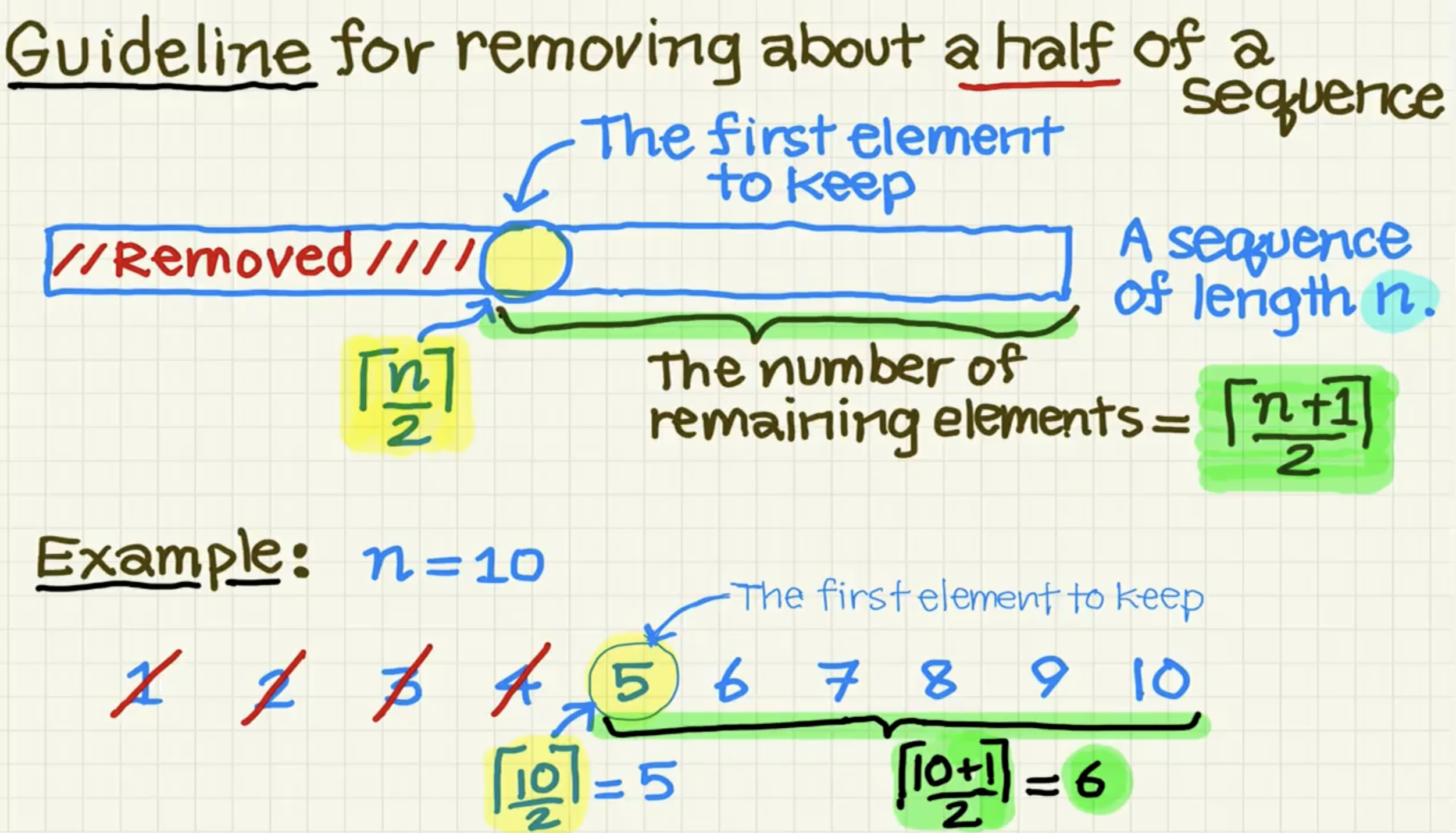
- ดังนั้นเราจะมี Guideline for removing about a HALF of a sequence.
- โดยที่เราจะ remove only about the first half
- Guideline will work whether is odd or even.
- First element to keep
- Number of remaining element
Question
Approach นี้ไว้เพื่อหา Big-Omega อย่างเดียวหรอ?
คำตอบก็คือ ถูกต้องง! อาจารย์บอกว่าถ้าเราตัดออกทั้งหมด Big-Omega ของเรามันจะเล็กเกินไปถูกมั้ย?! ดังนั้นก็ตัดแค่ครึ่งเดียว เพื่อที่ว่าจะได้สรุป Big-Theta ได้ไงงง easy!
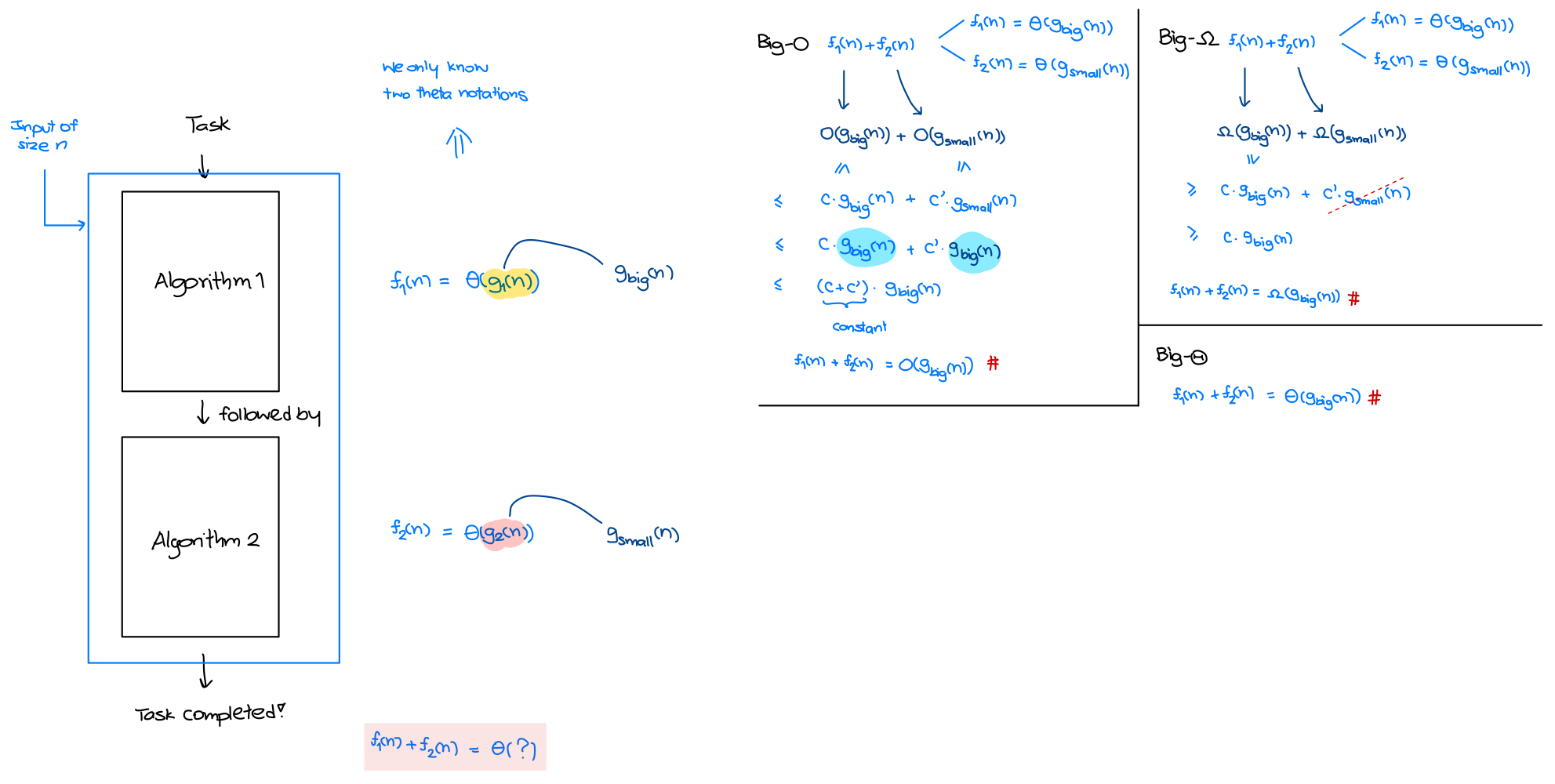
Algorithm followed by another algorithm
- Long story short, conclude ได้เลยว่า
Misconception
- — Order at most (upper bound) IS NOT
- — Order at least (lower bound) IS NOT
- — Order (Estimate) IS NOT
- Each of can have their own
- The best-case, worst-case, and average-case complexities of an algorithm may each have different asymptotic bounds. For example, an algorithm may have different , , and for each of its best, worst, and average cases.
Complexity of Algorithms (in for-loop programming)
	\begin{algorithm}
	\caption{Find a theta notation in terms of $n$ for the number of times the statement $x := x + 1$ is executed.}
	\begin{algorithmic}
	\For{$i := 1$ \to $n$}
		\For{$j := 1$ \to $i$}
			\State $x:= x+1$
		\EndFor
	\EndFor
	\end{algorithmic}
	\end{algorithm}
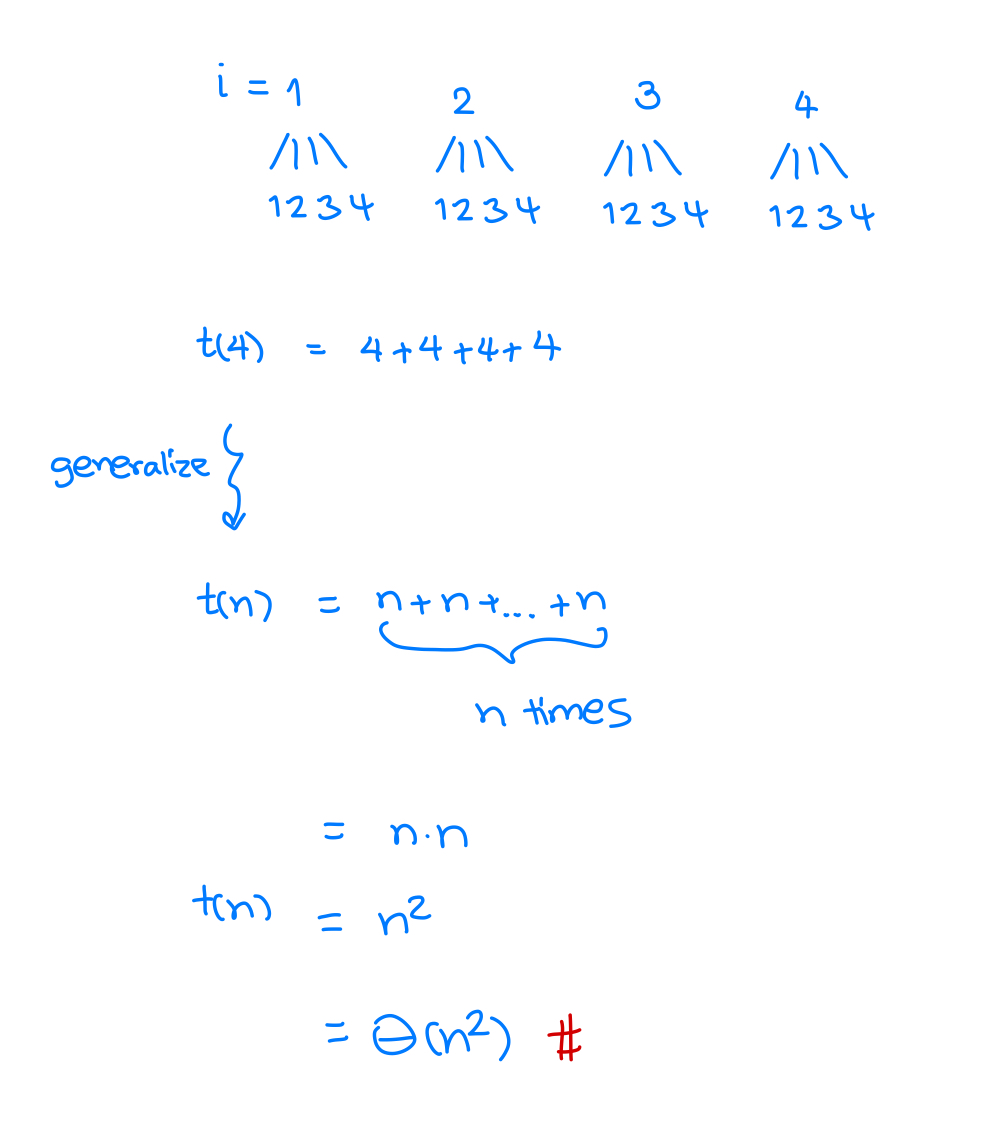
- หลักการทำก็คือเขียนออกมาเลย ไล่ออกมาเป็น Linear Sum ง่าย ๆ แล้วค่อย Generalize ให้อยู่ใน Term ของ แล้วค่อยหา Theta notation ตามที่โจทย์สั่ง
	\begin{algorithm}
	\caption{Find a theta notation in terms of $n$ for the number of times the statement $x := x + 1$ is executed.}
	\begin{algorithmic}
	\State $j:=n$
	\While{$j \ge 1$}
		\State \textbf{begin}
			\For{$i:=1$ \to $j$}
				\State $x:=x+1$
            \EndFor
            \State $j:=\lfloor\frac{j}{2}\rfloor$
		\State \textbf{end}
    \EndWhile
	\end{algorithmic}
	\end{algorithm}
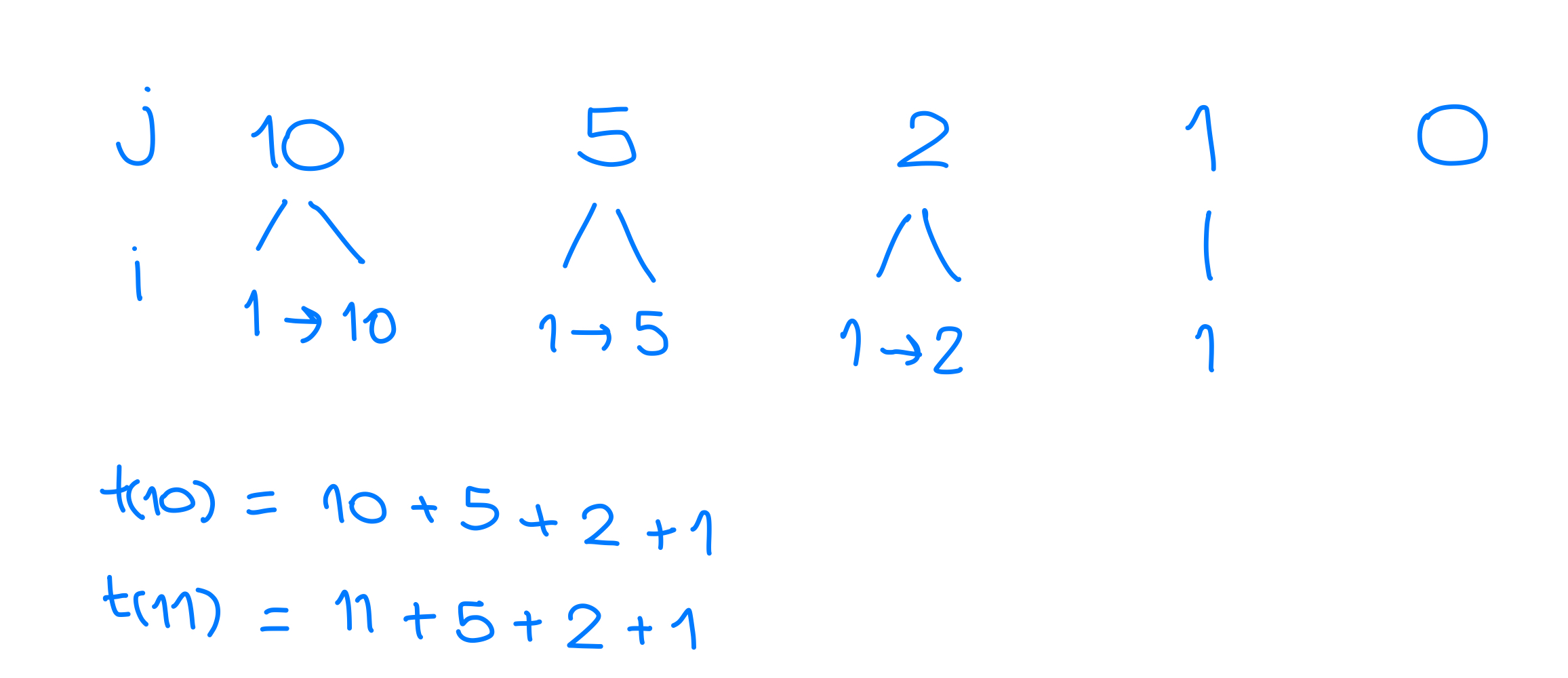
- แบบนี้ก็หา General term () ยากอะสิ → มีวิธีอยู่นะ Geometric Sum ไงงง!
	\begin{algorithm}
	\caption{Find a theta notation in terms of $n$ for the number of times the statement $x := x + 1$ is executed.}
	\begin{algorithmic}
	\For{$i := 1$ \to $n$}
		\For{$j := 1$ \to $\lfloor\frac{i}{2}\rfloor$}
			\State $x := x+1$
        \EndFor
    \EndFor
	\end{algorithmic}
	\end{algorithm}
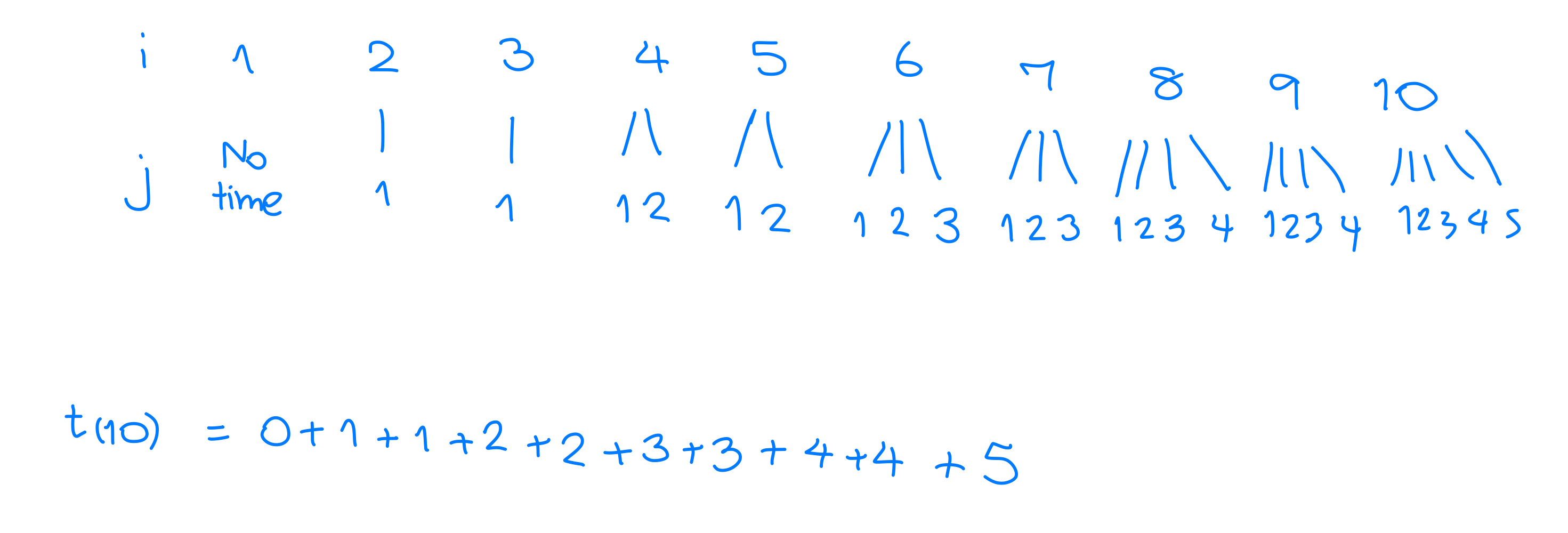
- That is, (Upper bound)
- See that, (Lower bound)
Question
งงนิดหน่อยตรงเปลี่ยนเป็น Lower Bound ไม่เห็นเหมือนตาม Guideline
เพราะว่าอันนี้สังเกต มันไม่ได้เป็น Sequence หนิ เราไม่ได้ทำตาม Guideline เพราะ Guideline เป็นของ Sequence ไง, มันเป็น ดังนั้นเวลาเอา Lower bound เราก็เลือกมาแค่ตัวเดียว เพราะอะไร เราได้เป็น Linear sum แล้วเรารู้สูตรหาอยู่แล้ว ง่าย ๆ เลย เอาให้ง่ายสำหรับเรา