Linear Combinations (ผลรวมเชิงเส้น)
Linear combinations are obtained by multiplying vectors by scalars, and by adding them together.
- กำหนดให้ , และ เป็น Scalar (จำนวนจริง)
- นิยามของ Linear Combination คือ
- เรียก นี้ว่าเป็น Linear Combination ของ ซึ่งมี Weight เป็น ตามลำดับ
Span
อย่าเผลอเอา Homogeneous ไปคิดนะจ๊ะ!
-
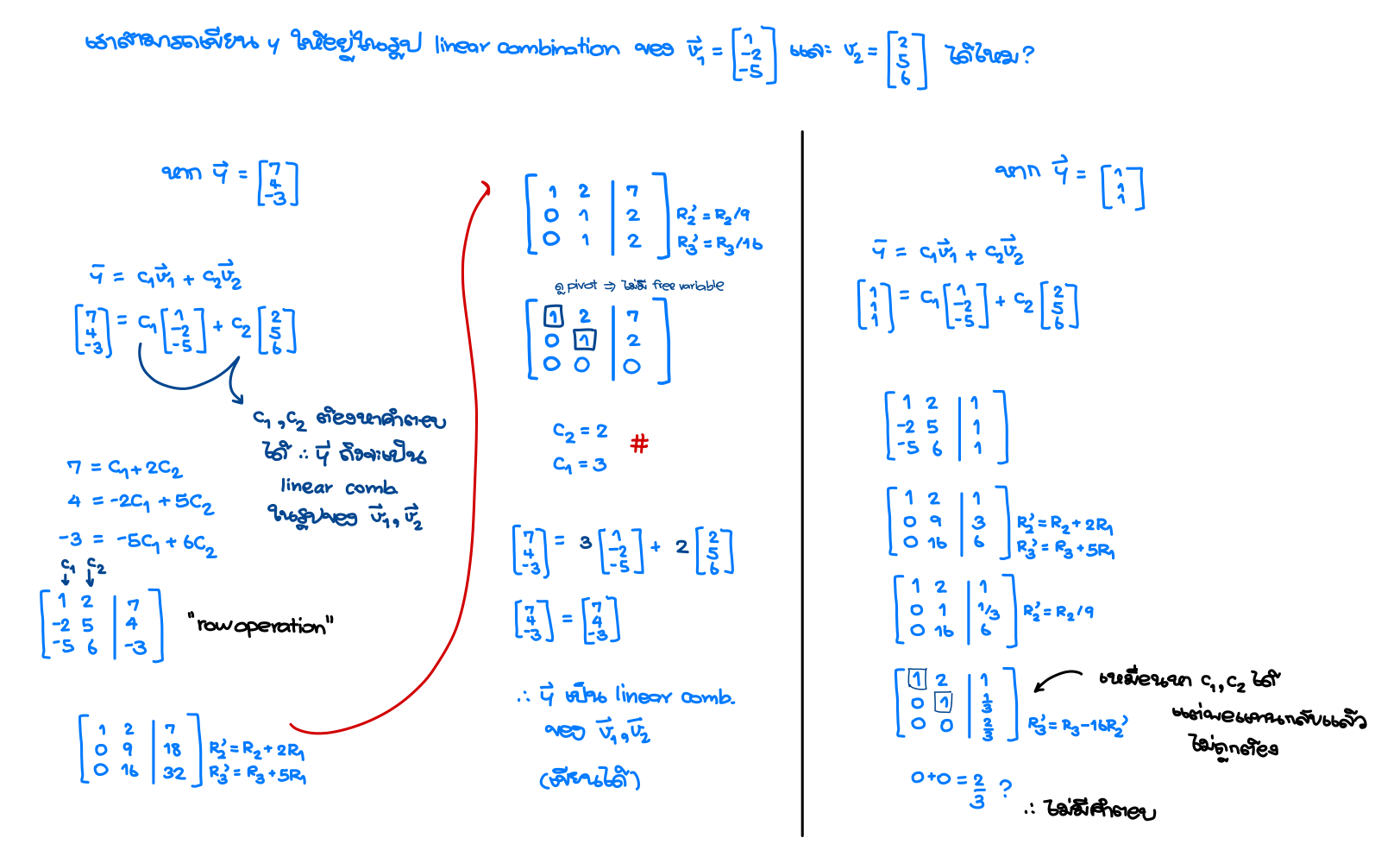
Span คือ Set ที่รวบรวมทุก ที่เป็นไปได้ ซึ่งเกิดจาก Linear Combination ของ
- เรียกว่า
-
Zero Vector เป็นสมาชิกของ Span นั้นเสมอ ก็ต้องใช่สิ มีโอกาสที่ อยู่แล้ว
-
หรือถ้ามองกลับกัน ถ้าได้ Vector มา เราต้องเขียนให้อยู่ในรูป Linear Combination ให้ได้!
-
ถ้ามี Free Variable ก็ถือว่า Span นะ! เพราะ Span must have at least one solution!
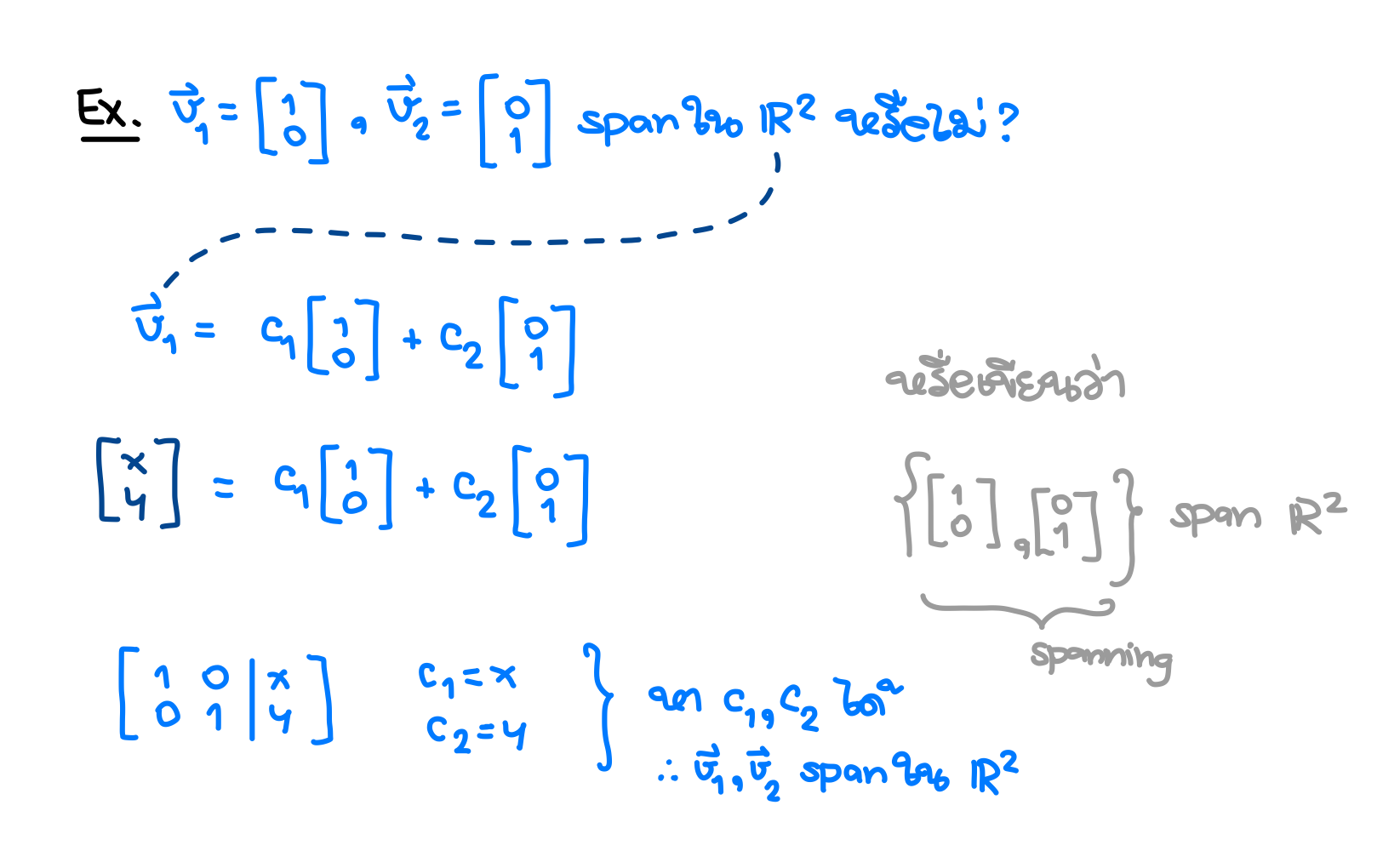
- ข้อนี้เนื่องจากมันเป็น Reduced Echelon Form แล้วมันเลยง่าย
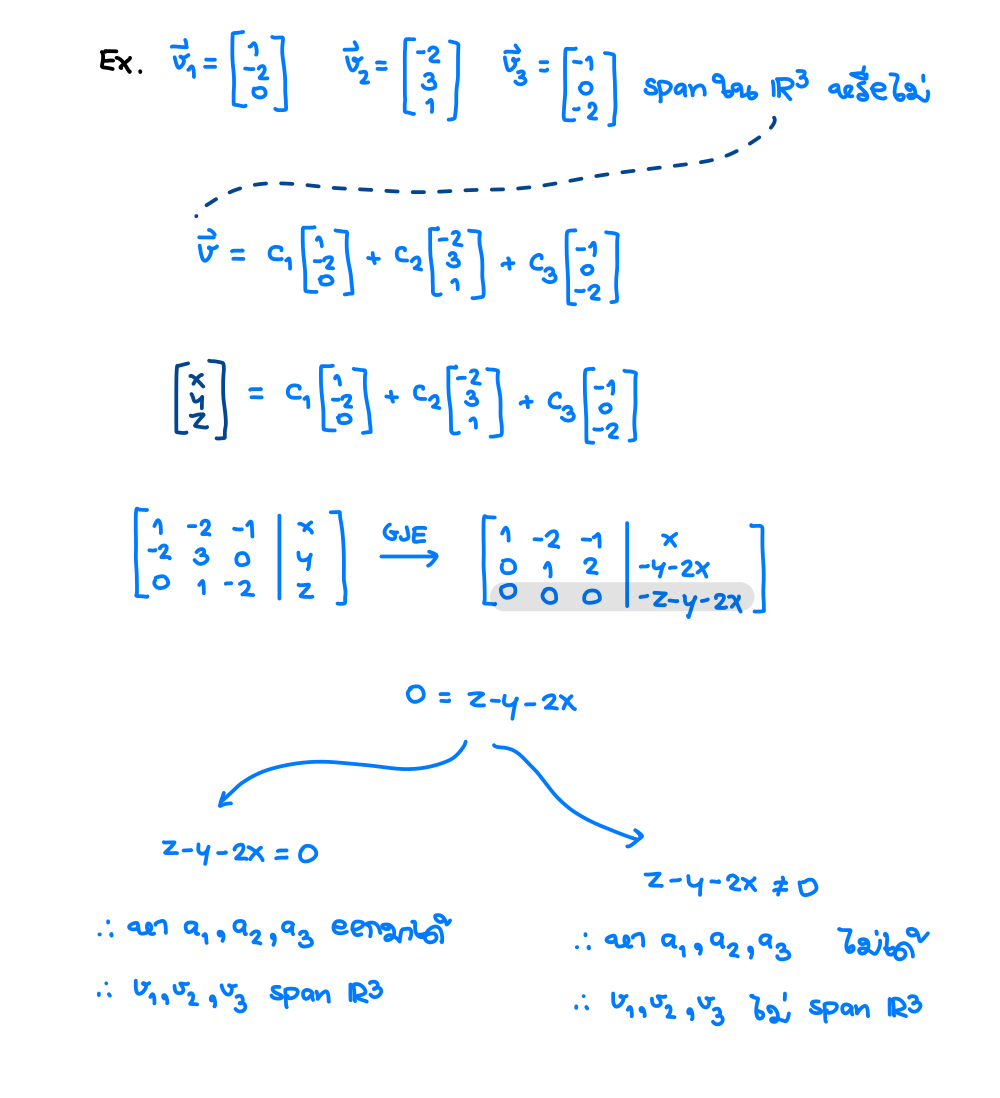
- มีตัวอย่างอีกมากมายใน Math Sum นะ!
Vector Space (Linear Space)
- Linear spaces (or vector spaces) are sets that are closed with respect to linear combinations.
- In other words, a given set is a linear space if the elements can be multiplied by scalars and added together. The results of these algebraic operations are elements that still belong to.
- Check 2 ข้อเท่านั้น!
- การบวกกันของ Vector
- การคูณกันของ Vector กับ Scalar
- คุณสมบัติ (การบวก, คูณ) 10 ข้อ ==ต้องมี 10 ข้อนี้ถึงจะเป็น Vector Space ได้== (ไม่ต้องจำ)
- If and are objects in , then is in .
- There exists an object in , called the zero vector, that is denoted by and has the property that for all in .
- For each in , there is an object in , called a negative of , such that .
- If is any scalar and is any object in , then is in .
- ตัวอย่างของปริภูมิ Vector
Standard Linear Spaces ()
-
the span of a set of vectors is the set of all linear combinations of the vectors
- เอามารวมกัน ถ้าใน 3D ก็อาจจะได้เป็น Plane
-
Span of 1 vector is a line
-
Span of 2 vector is a plane
Polynomial Spaces ()
- Converting polynomials into vectors (no coordinate)
- แล้วพอมีหลายตัวแปล แล้วได้เป็น Matrix ค่อยหา ว่า มั้ย
Matrix Spaces ()
- เป็น Set ที่มีสมาชิกเป็น Matrix จำนวนจริง ขนาด (Row, Column)
Linear Independence (ความอิสระเชิงเส้น)
- ต้องรู้ Concept ของ Homogenous System มาก่อน!
- สมมติว่า Linear Combination มี vectors
- — ให้เปลี่ยนเป็น
-
- มองเป็น Homogenous System ยังไงก็ต้องมีคำตอบอย่างน้อย 1 ตัวอยู่แล้ว (ยังไงต้องมี!) นั่นก็คือ (Trivial Solution)
- ถ้า ระบบสมการมีเฉพาะ Trivial Solution แปลว่า Linearly Independent
- เราไม่สามารถเขียน ให้อยู่ในรูป ได้
- ถ้า ระบบสมการมี Non-trivial ด้วย (เจอ Free Variable) แปลว่า Linearly Dependent
- เราสามารถเขียน ให้อยู่ในรูป ได้
วิธีการเช็ค
Method 1
- หาตรง ๆ เลยว่า ได้คำตอบออกมาเป็นยังไง
- พอแทนกลับเข้าไปในสมการ สุดท้ายก็คือได้ออกมาเป็น System of Equation อยู่ดี
- เราก็ใช้ GJE เช็คจนได้เป็น Reduced Echelon Form
Method 2
- ใช้เรื่อง Homogenous นี่แหละมาช่วยให้ง่ายขึ้น
- หา จาก Augmented Matrix
- ถ้า แปลว่ามีแค่คำตอบเดียวคือ Trivial Solution → Linearly Independent
- ถ้า แปลว่ามี Non-trivial อยู่ด้วย → Linearly Dependent
- แล้วถ้าเจอที่ไม่ใช่ Square Matrix ล่ะ?
- Unknowns > Equations → มี Free Variable แน่ ๆ
- Equations > Unknowns → ลองทำ GE ให้แถวล่างสุดเป็น 0, 0, 0 แล้ว Discard ไป
Method 3 (ทฤษฎี)
- ข้อ 1-3 กล่าวเล็กน้อยในช่วงบนของ Lecture 9
- ถ้ามี Vector ตัว ใน
- ถ้า → Linearly Dependent
- ถ้ามี Vector ตัว ใน
- ถ้า → Linearly Dependent
- ถ้ามี Vector ตัว ใน
- ถ้า → Linearly Dependent
- ถ้ามี Vector ตัวที่ Linearly Independent ต่อกันแล้ว อยู่ใน
- → Vector เหล่านั้นจะ Span ใน ด้วย
- กำหนดให้ Matrix A ขนาด (Square Matrix) แล้วมี Vector มา ก็เอามาเขียนในรูป Matrix (คล้าย ๆ กับ Method 2)
- ถ้า → Linearly Independent
- ถ้า → Linearly Dependent
- ถ้า Vector Linearly Independent ต่อกันแล้ว (Check 6 ข้อนี้: ข้อใดข้อนึงก็ได้) → ถ้าเช็คแล้วเป็นจริง ดังนั้น จะ Span ใน ด้วย
- หา ได้
- Homogenous () เป็น Trivial Solution
- System of Equation () คำตอบมีคำตอบเดียว
- Row Vector ของ เป็น Linearly Independent ต่อกัน
- Column Vector ของ เป็น Linearly Independent ต่อกัน
A Geometric Interpretation of Linear Independence
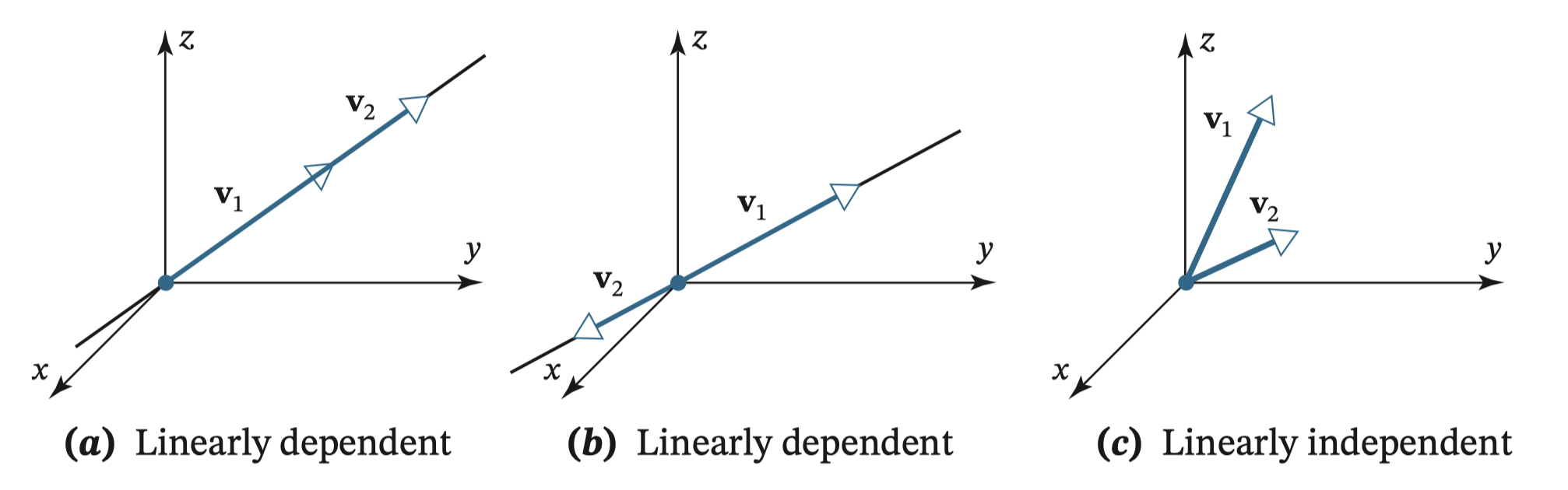
- Two vectors in or are linearly independent if and only if they do not lie on the same line when they have their initial points at the origin. Otherwise one would be a scalar multiple of the other.
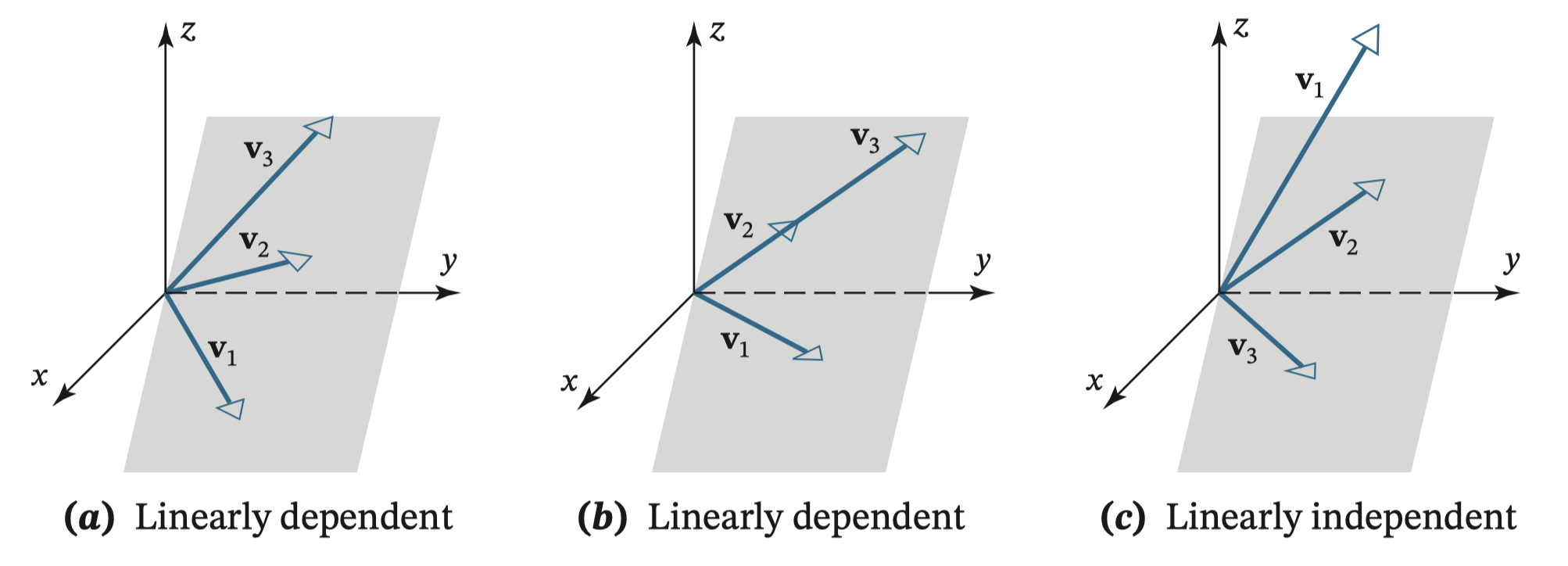
- Three vectors in are linearly independent if and only if they do not lie in the same plane when they have their initial points at the origin. Otherwise at least one would be a linear combination of the other two.