6.1 Games
- A type of search that can be use to playing a game!!
- Computer play a game with human, we want a computer to win a game
- Games or adversarial search problems focus on handling a multi-agent competitive environment.
- ต่างจาก Search อื่นยังไงก็คือมันเป็น Multi-agent — Human + Computer ไงงง
- Limit to the type of games with following characteristics:
- Fully observable, and Deterministic (no random) environment
- Turn-taking: each player selects an action, after which the turn passes to the other player.
- Two-player: human vs. computer
- Zero-sum: Win = +1 and Lose = -1
- Sum the utility of which player receive is zero; called Zero-sum นั่นเอง
- Examples of games with the above properties include Tic-Tac-Toe, Chess, Go, etc.
- Searching to win the game is different from the general search because of the unpredictable opponent, and time constraints.
- Search แบบนี้มี Unpredictable เพราะมีคนไงล่ะ…
6.2 Game as a Search Problem
- : Initial state
- Player(s): define which player has the move in a state
- Actions(s): legal moves available in state s
- Result(s, a): the resulting state after applying action a in state s
- Terminal-Test(s): returns true when the game is over, and false otherwise
- Utility(s, p): final numeric value for a game ending in state s for player p
Game Tree
คล้าย ๆ Search Tree ตรงที่ Nodes = states; edges = actions แต่ต่างกันตรงที่เรามี Max (maximize score) vs. Min (minimize score)
- Purpose: Represents all possible move sequences in a multi-agent, adversarial game
- Structure:
- Nodes = game states
- Edges = legal actions
- Players: (maximize score) vs. (minimize score) alternate turns
- Components:
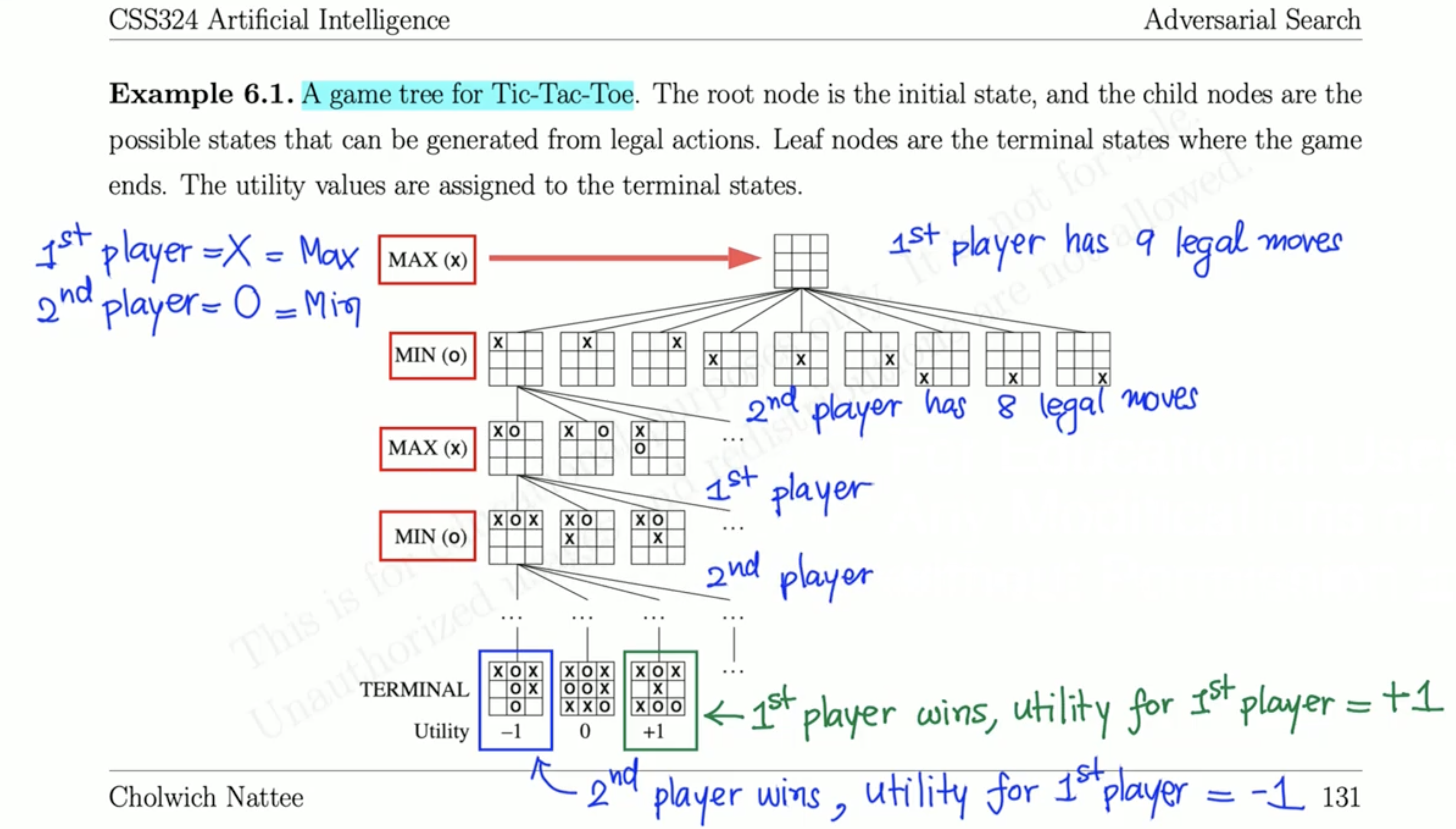
- Root = initial state
- Terminal nodes = game over with utility values (win/lose/draw) = leaf nodes
- Usage: Used in Minimax and Alpha-Beta Pruning to find optimal strategies
- Challenge: Size grows exponentially with depth → use heuristics and depth limits
Example 6.1 - Tic-Tac-Toe Game Tree
- Initial node จะเป็นของ Max player เสมอ
6.3 Optimal Decisions in Games
Optimal Decisions = the move that maximize the utility value!
- Goal: Choose the best move assuming both players act rationally
- MAX player: Tries to maximize the utility value
- MIN player: Tries to minimize the utility value
- Algorithm logic:
- Base case: If s is terminal → return Utility(s)
- Recursive case:
- If Player(s) = MAX → choose action with maximum value
- If Player(s) = MIN → choose action with minimum value
- Advantage: Explores the entire game tree to guarantee optimality
- Drawback: Exponential time complexity in tree depth
6.3.1 Minimax Function
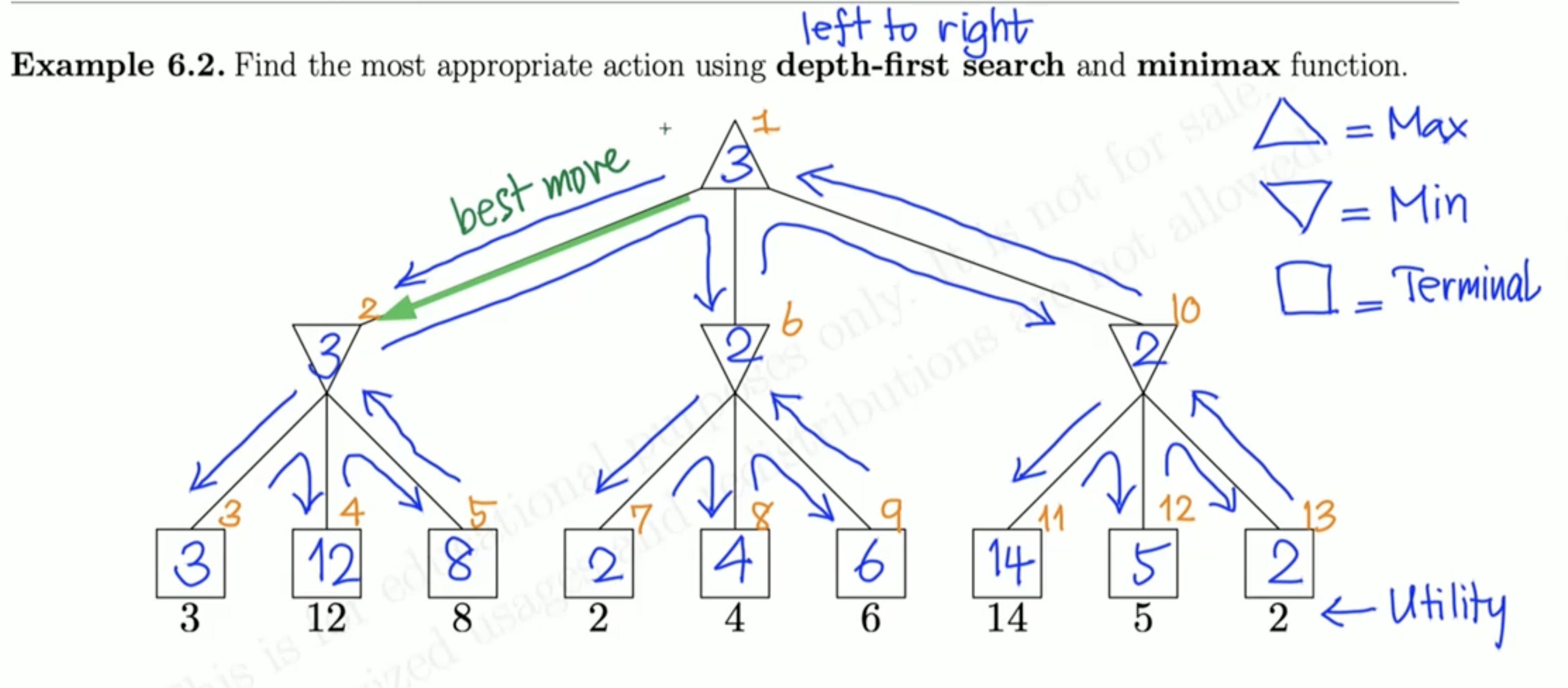
The minimax function is a recursive function that computes the minimax value of a game state. It evaluates the utility of terminal states and propagates these values back up the tree to determine the best move for the current player.
- Search method: Depth-first search is used to explore the game tree and compute the minimax values
- Decision: The best move is the one that maximizes the utility value for the current player
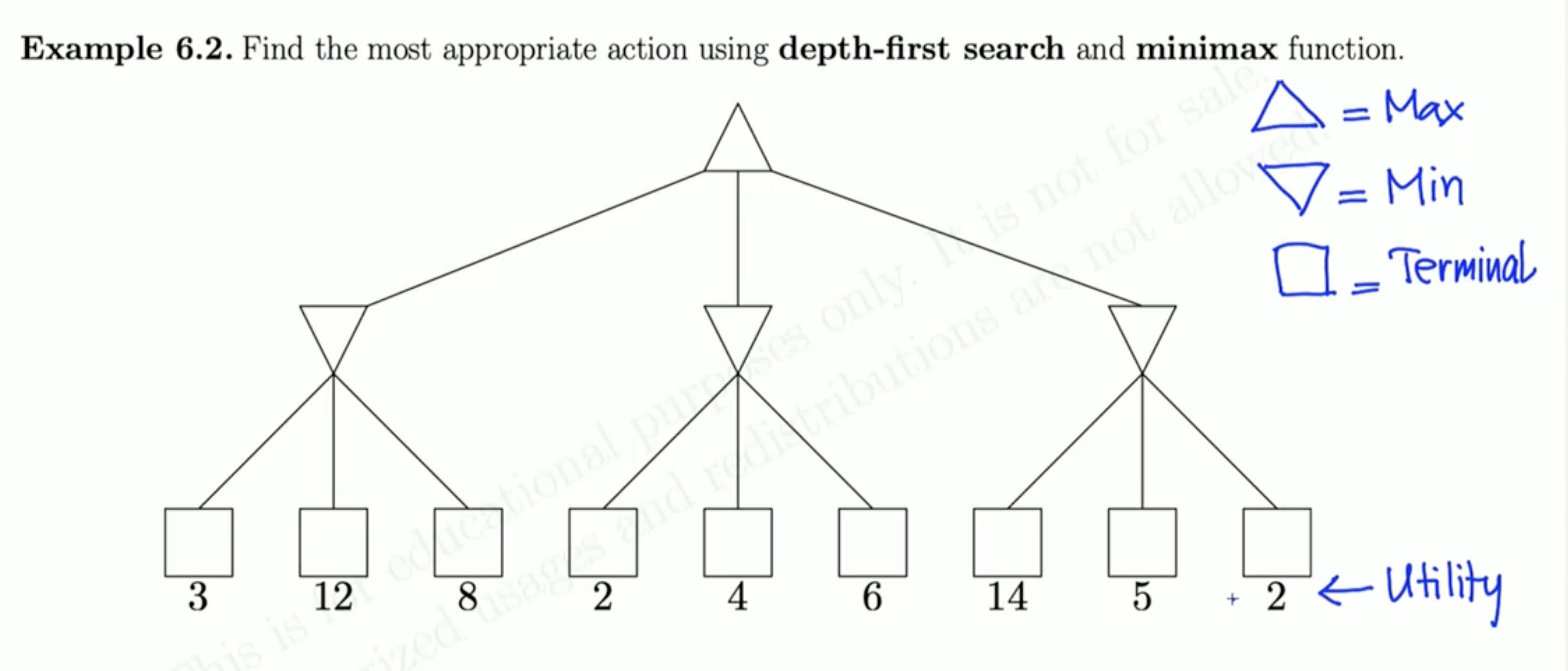
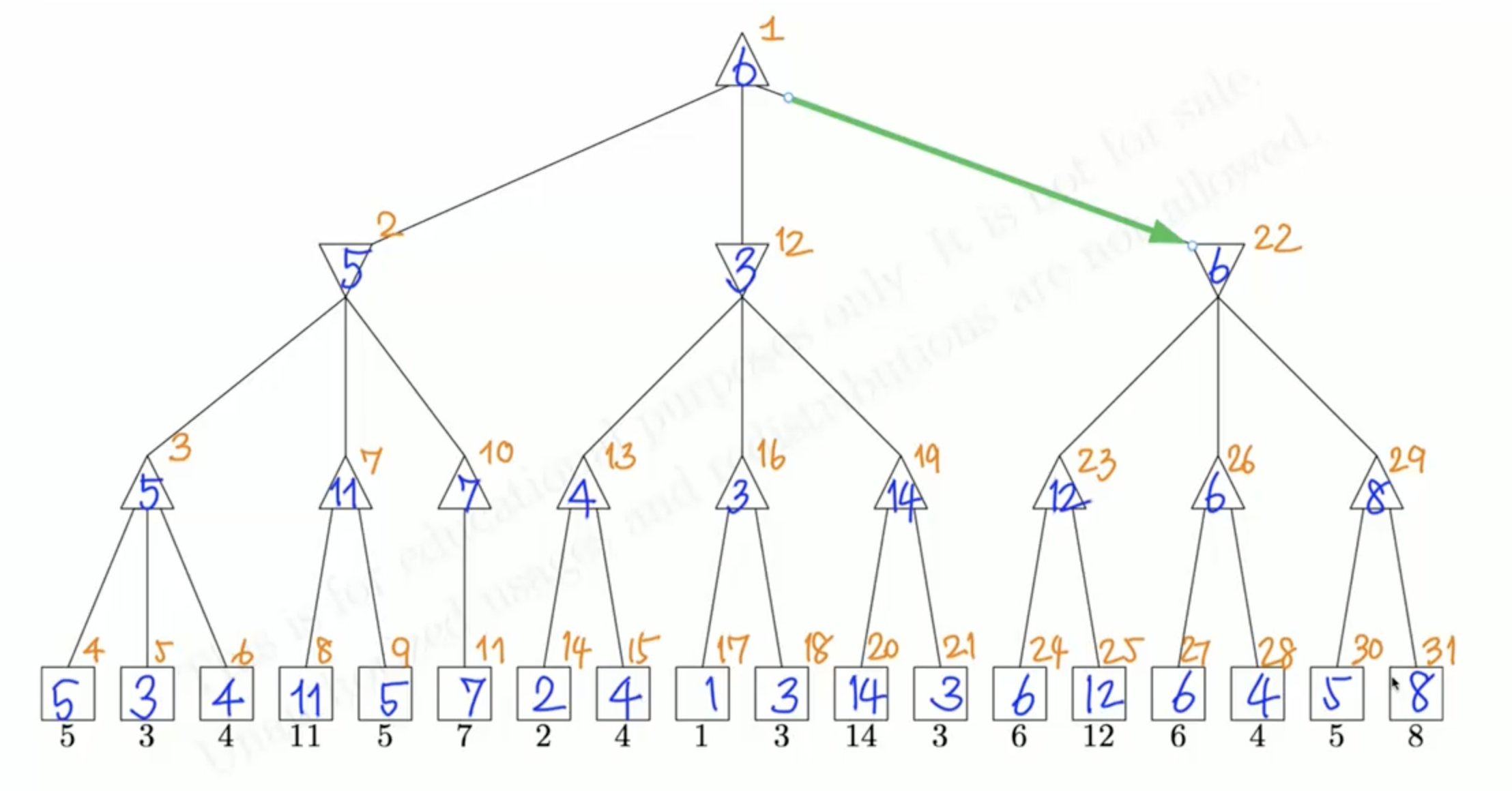
Example 6.2
- เข้าใจ Notation ก่อน
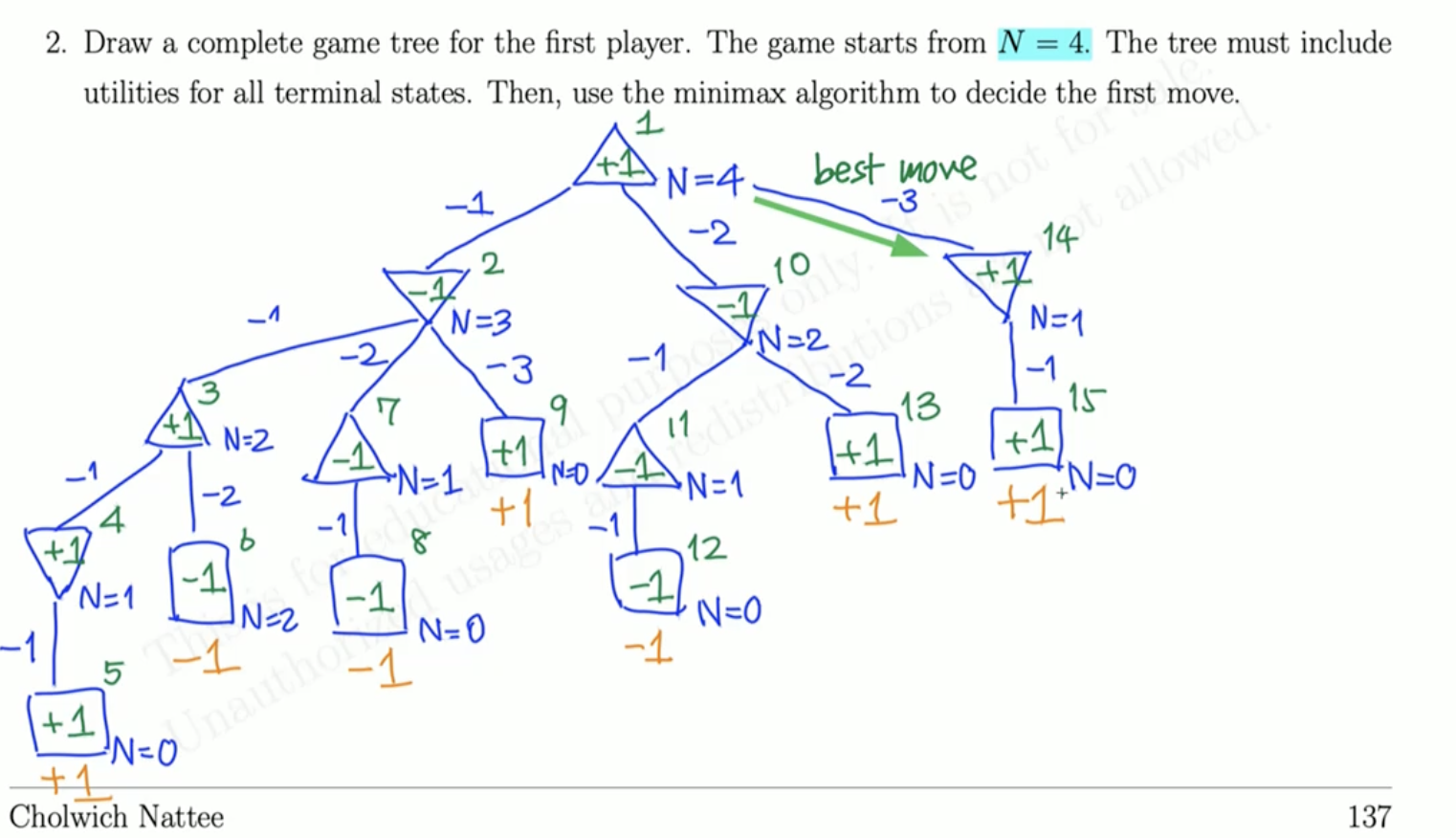
- Green arrow → The best move!
The Minimax Algorithm
- Process: Before making a decision, the minimax algorithm is applied to compute the minimax value from the current state
- Implementation: The algorithm recursively computes the minimax values of each successor state
- Similarity: This is similar to conducting a depth-first or depth-limited search
Example 6.3 - Two-Player Number Game
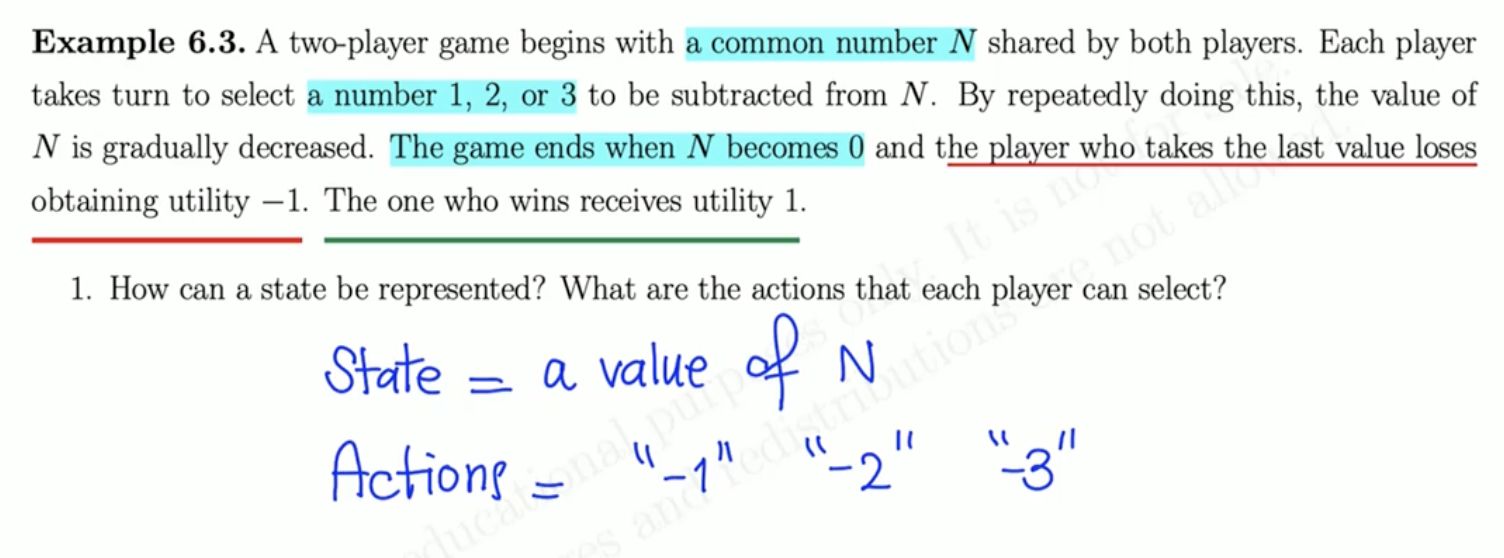
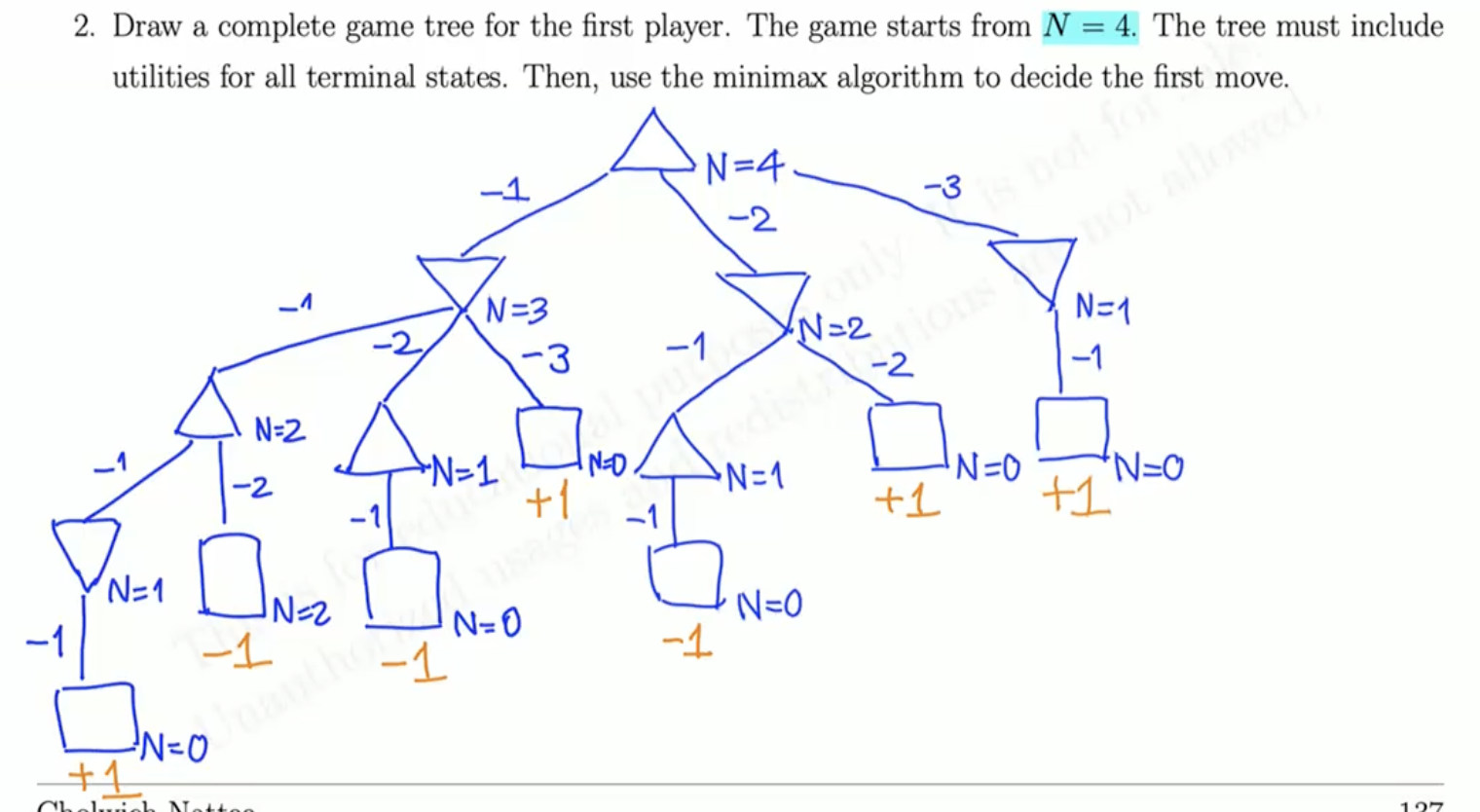
N = 0 นะ อันที่สอง อาจารย์เขียนผิดเลยล่ะ
แล้วถ้าเจออันที่เป็น 1, 1 งี้ล่ะ หมายถึง max สองอัน จะเลือกอันไหนเป็น best move?
Contents

Practical Considerations
- Problem: In previous examples, the search goes deep until a terminal state is found. This is not practical
- Real-world challenge: A game tree in real-world games like Chess contains a huge number of branches and is very deep. It would take too long to reach all the terminal states
- Solution: In practice, the search is limited to a particular depth, and a heuristic function is applied to estimate the utility values of nodes at that depth
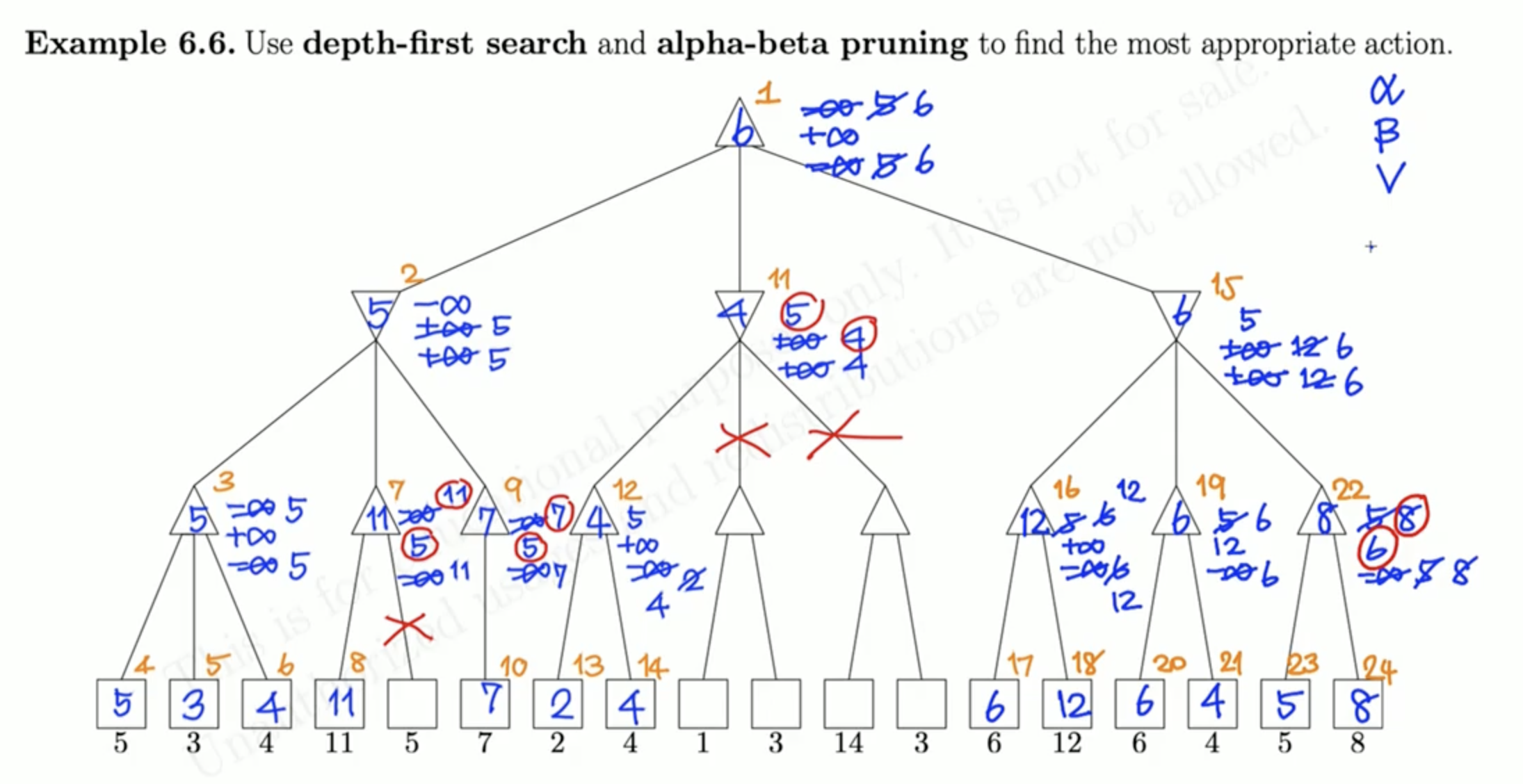
6.4 Alpha-Beta Pruning
- Purpose: Minimax search has a drawback that the number of states it has to examine is huge, and exponential in the depth of the game tree
- Goal: A technique called "alpha-beta pruning" aims to correctly explore the game tree without looking at every node
Algorithm Parameters
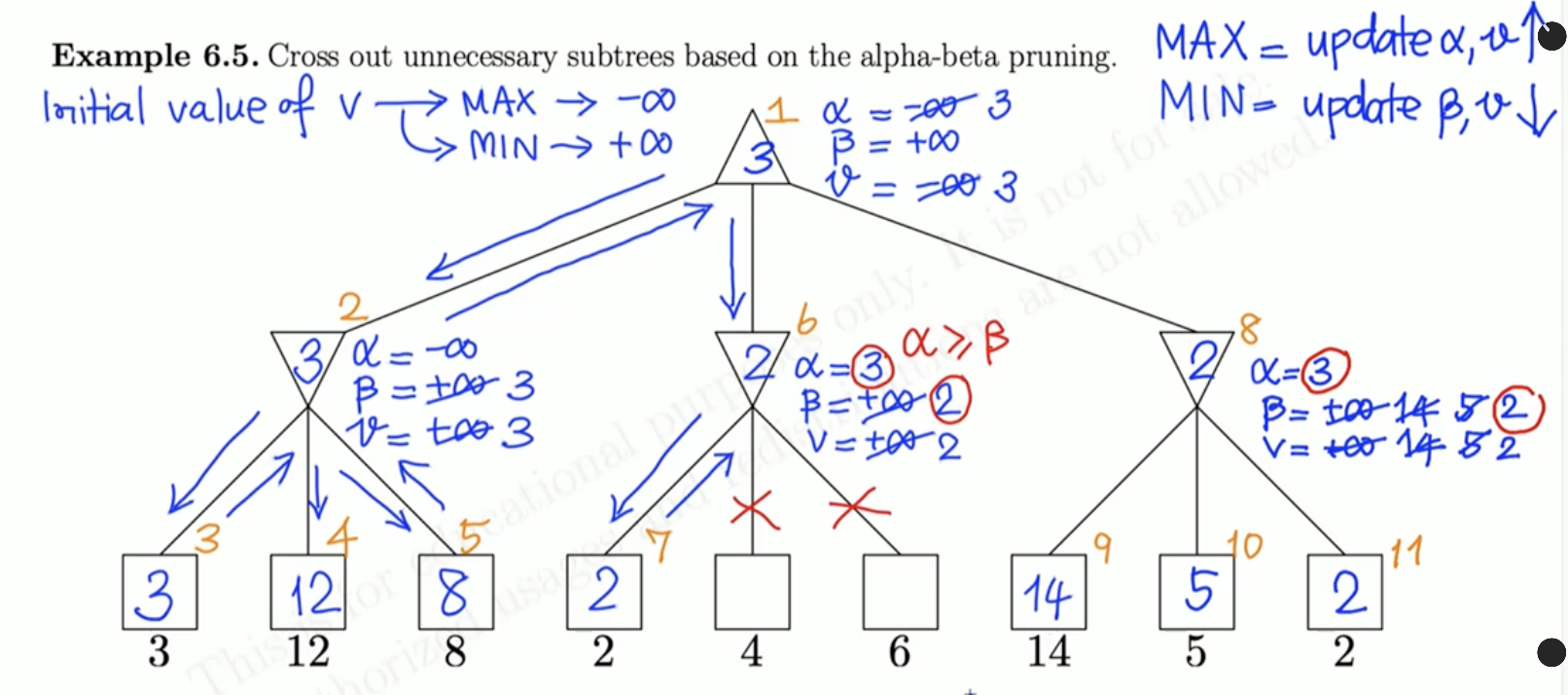
The algorithm maintains two values, and at each node:
- (alpha):
- The best value that the maximizer currently can guarantee at that level or above
- It is the lower bound of the minimax value of a node
- Initial value of of the root node is
- Initial value of of other nodes is inherited from its parent node
- (beta):
- The best value that the minimizer currently can guarantee at that level or above
- It is the upper bound of the minimax value of a node
- Initial value of of the root node is
- Initial value of of other nodes is inherited from its parent node
Pruning Condition
- Rule: Whenever , the player does not need to explore the remaining descendants of the current node
- Lower bound is higher than upper bound!!!
6.5 Deep Blue
- Overview: Deep Blue is a chess-playing computer developed by IBM
- Historical achievement: It was the first computer system to defeat a reigning world chess champion, Garry Kasparov, in a match under standard chess tournament time controls in 1997
- Algorithm: It implements the minimax algorithm with alpha-beta pruning to efficiently search the game tree
- Hardware: It uses custom hardware and parallel processing to evaluate 200 million positions per second
- Evaluation: It uses an evaluation function to assess the desirability of a position based on various factors, such as:
- Material balance
- Piece activity
- King safety