มาดูกันแบบเจาะลึกเลยดีกว่า ว่า ATM มันคืออะไรกันแน่ ทำงานยังไง มันมียุคนึงเลยนะที่ทุกคนมองว่าเป็น Solution แห่งอนาคตเลย สำหรับการจัดส่งข้อมูลที่หลากหลายมาก ๆ (เสียง/วีดีโอ/ข้อมูลทั่วไป) แถมยังทำได้พร้อม ๆ กันบนเครือข่ายเดียวอีกด้วยนะ
What is ATM?
- ATM (Asynchronous Transfer Mode) is a switching technique that uses Asynchronous Time Division Multiplexing for data communications
- A network technology that supports voice, video, and data communications
- ATM encodes data into small fixed-sized cells (suitable for TDM) and transmits them over physical medium
- Originally designed as the transfer mode for implementing Broadband ISDN (B-ISDN)
- Also implemented in non-ISDN environments where very high data rates are required
Note: ISDN = Integrated Services Digital Network
Analogy: Think of ATM like a postal service that only accepts packages of exactly the same size (53 bytes). This standardization makes sorting and delivery much faster and more predictable than handling packages of various sizes.
เวลาทุกอย่างที่มันขนาดเท่ากันหมดเนี่ย การจัดการมันก็ง่าย การคัดแยก การส่งต่อ คาดการณ์เวลาได้ดียิ่งขึ้น ไม่ต้องมากังวลกับ พัสดุที่มาหลายขนาด หลายรูปทรง แต่อย่างใด
ATM Network Architecture
- อาจารย์ไม่ได้เรียงแบบนี้ แต่มันจะเข้าใจมากขึ้น
Network Interfaces
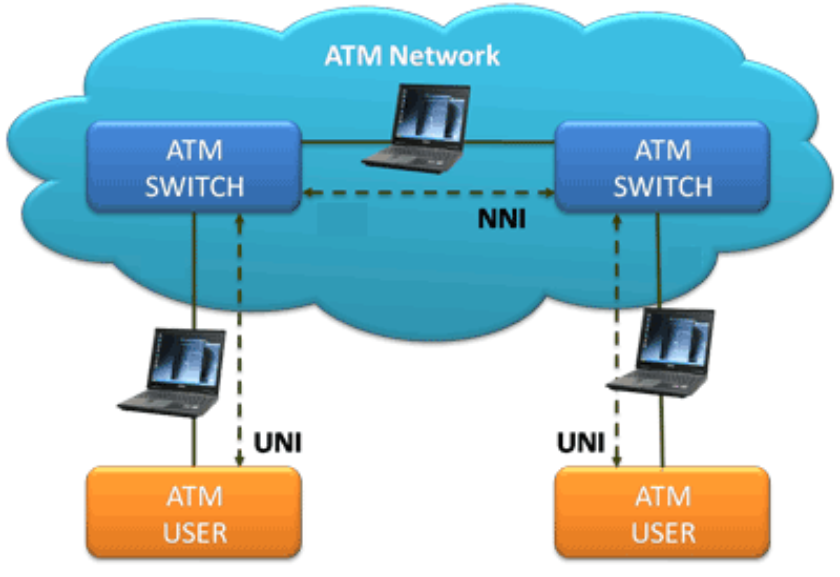
- NNI (Network-Network Interface): Connection between ATM switches within the network
- เชื่อมระหว่าง Switch ATM ด้วยกันเอง
- UNI (User-Network Interface): Connection between user equipment and the ATM network
- เชื่อมระหว่างคอมเราเนี่ยแหละ กับ Switch ตัวแรกในเครือข่าย
ATM Network Diagram
Image showing ATM network with switches connected via NNI and users connected via UNI
ATM Multiplexing
- ATM uses Asynchronous Time Division Multiplexing (ATDM)
- Cells from different sources are multiplexed together
- Unlike traditional TDM, ATM doesn't waste bandwidth on empty time slots
- Cells are sent when data is available (asynchronous)
Key Advantage over Traditional TDM
- No wasted bandwidth: If a source has no data, that time slot can be used by other sources
- Efficient bandwidth utilization: Especially good for bursty data traffic
Analogy: Traditional TDM is like reserved parking spots - even if someone doesn't show up, their spot stays empty. ATM is like first-come, first-served parking - if someone doesn't use their spot, others can take it.
TDM ที่เคยคุยกันใน Lecture 9 - Multiplexing Techniques เนี่ย มันมีข้อเสียตรงที่ว่า จองช่องเวลาตายตัวไปเลย สมมติมี 10 ช่อง แล้วในช่องที่ 3 ดันไม่มีข้อมูลจะส่ง ช่องเวลานั้นก็จะปล่อยว่างไปเฉย ๆ เลย → เปลือง Bandwidth
ATDM จะยืดหยุ่นกว่านั้น ถ้าช่องไหนไม่มีข้อมูลจะส่งตอนนั้น ระบบก็จะข้ามไปเลย ให้ช่องที่มี ส่งไปได้ทันที ไม่ต้องรอรอบของตัวเอง (ไม่เกิดช่องว่างขึ้น) → ใช้ Bandwidth เต็มเม็ดเต็มหน่วย (โดยเฉพาะกับข้อมูลที่มาไม่สม่ำเสมอ Bursty data)
ATM Cell Format
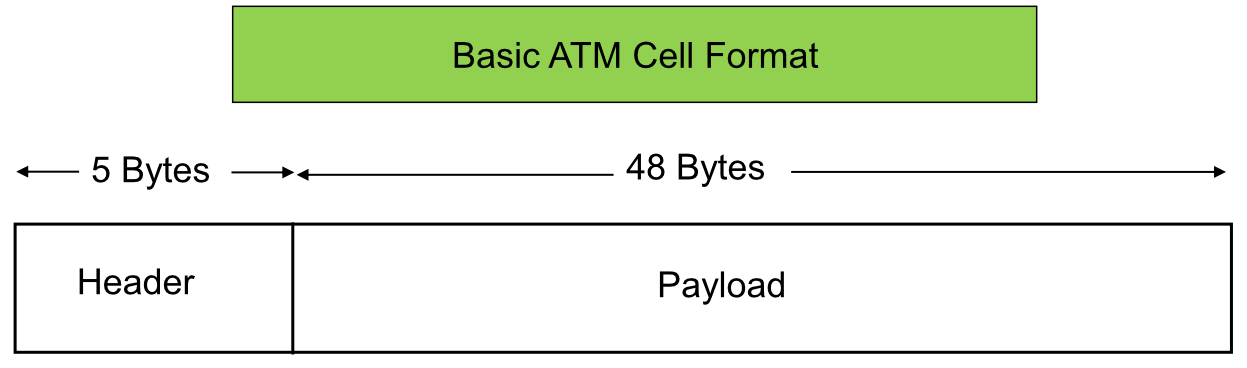
Basic Cell Structure
- Header: 5 bytes
- Payload (Information): 48 bytes
- Total Cell Size: 53 bytes (fixed)
Note: B-ISDN = Broadband Integrated Services Digital Network
ATM Conceptual Model Assumptions
- ATM network is organized as a hierarchy
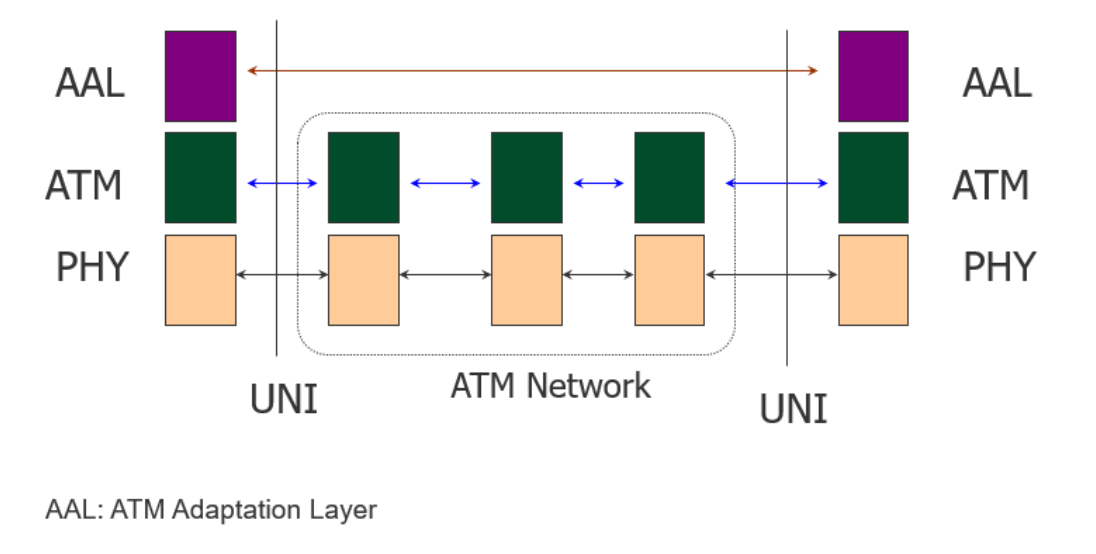
- User equipment connects to networks via UNI (User-Network Interface)
- Connections between networks are made through NNI (Network-Network Interface)
- ATM is connection-oriented (virtual-circuit packet switching)
- A connection (ATM channel) must be established before any cells are sent
การที่ต้องสร้าง Virtual circuit เนี่ย ทำให้เครือข่ายสามารถจองทรัพยากรบางอย่างได้ล่วงหน้าก่อน (อาจจะจอง Bandwidth) หรือให้ Priority ไว้ก่อนเลย
- Switched Access
- Multiple Access Speeds (50 Mbps to 2.4 Gbps)
- Easily Scalable
- ATM operates on a best effort basis
ATM Protocol Reference Model (PRM)
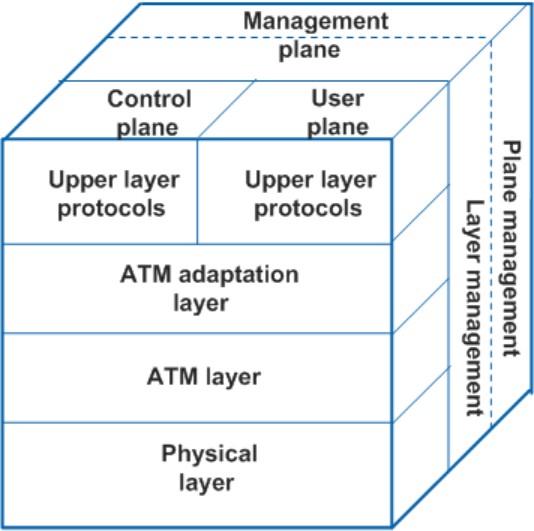
มาดู Model กันหน่อย เป็นขนมชั้น คล้าย ๆ กับ OSI Model เลยล่ะ - ให้เริ่มดูที่ชั้นล่างสุดก่อนเลย ค่อยกลับมาพวก Control Plane, User Plane
Three Planes
- Control Plane
- Used for connection control — จัดการเรื่อง การสร้าง การยกเลิก การเชื่อมต่อ ต่าง ๆ
- Handles connection setup and release functions
- User Plane
- Data is transmitted using protocols in the user plane
- Used once the connection is established
- จัดการเรื่องการส่งข้อมูลของผู้ใช้
- Management Plane
- Provides management functions relating to User and Control planes
- การจัดการภาพรวม ประสานเครือข่าย
Layered Architecture
Layer Management (vertical plane)
- Control plane
- User plane
Layers (horizontal):
- Upper layer protocols
- ATM adaptation layer (AAL)
- ATM layer
- Physical layer (ชั้นล่างสุดอยู่นี่!!)
1. Physical Layer
Overview
- Corresponds to the physical layer of OSI model
- Cells are converted into bit streams and transmitted over the physical medium
Two Sub-layers
1. TC Sub-layer (Transmission Convergence)
- Convert bit stream to cell stream
- Transmission Frame Adaptation: Packing cells into a frame
- Cell Operations:
- Cell scrambling and cell recovery
- Scrambling randomizes the pattern of 1s and 0s in ATM cells
- Prevents continuous, non-variable bit patterns (long strings of all 1s or all 0s)
- Several physical layer protocols rely on transitions between 1s and 0s to maintain clocking
- Cell scrambling and cell recovery
- HEC (Header Error Control) generation/verification
- Cell Rate Decoupling: Insertion and suppression of idle cells
2. PMD Sub-layer (Physical Medium Dependent)
- Defines the details of transmission and reception of individual bits on a physical medium
- Handles:
- Bit timing
- Signal encoding
- Interacting with the physical medium
- Properties of the cable, optical fiber, or wire
- Common examples: Fast Ethernet, Gigabit Ethernet, 10 Gigabit Ethernet (defined by IEEE)
Cell Payload Scrambling
Purpose
- Ensures successful ATM cell delineation (recognizing the start of each new cell)
- At source: Scramble the cell payload
- At receiver: Descramble the cell payload
Benefits
- Increases security and robustness
- Protects against malicious users
- Prevents unintended simulation of HEC (Header Error Check) in the information field
2. ATM Adaptation Layer (AAL)
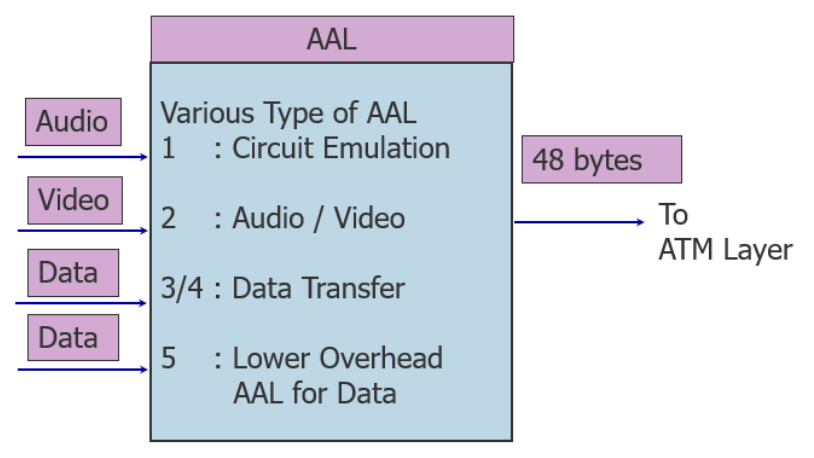
- ตัวนี่แหละ ตัวดีเลย ปกติแล้วเวลามีข้อมูลมา มันเป็นก้อนเล็ก ๆ ให้เลยหรอ โนจ้ะ! ไอ่ชั้นนี้แหละที่จะแปลงให้กลายเป็น 48 bytes ที่ตัวส่ง
- ส่วนที่ตัวรับ เดี๋ยวมันก็ทำหน้าที่รวมข้อมูลเล็ก ๆ หลาย ๆ อันให้เป็นข้อมูลใหญ่
Functions
- Provides mapping of different types of applications to ATM service
- Segments and reassembles data into 48-byte payloads
- Accepts and delivers 48-byte payloads to ATM layer
AAL Types
โอ้ย มีการกำหนดประเภทย่อย ๆ ออกไปอีก เพื่อให้เหมาะสมกับลักษณะของข้อมูลที่ต่างกันออกไป
| AAL Type | Purpose | Application |
|---|---|---|
| AAL 0 | Raw cells (48 bytes payload, no special fields) | - |
| AAL 1 | Circuit Emulation | Voice-grade PCM, Real-time audio/video, Constant bit rate videos |
| AAL 2 | Audio/Video | Compressed real-time video (MPEG), Voice over ATM |
| AAL 3/4 | Data Transfer | Frame Relay, X.25, Connection-oriented/connectionless packet data |
| AAL 5 | Lower Overhead AAL for Data | IP over ATM, Reduced overhead version of AAL 3/4 |
Various Types of AAL (Detailed)
AAL Type 0
- Raw cells consisting of 48 bytes of payload
- No reservation for special fields
AAL Type 1
พวกที่ Real-time ต้องการความเป๊ะเรื่องเวลา
- Supports Constant Bit Rate (CBR)
- Synchronous, connection-oriented traffic
- Examples: Voice-grade PCM, real-time audio/video systems
AAL Type 2
สำหรับบริการที่ Bit Rate แปรผันได้ แต่ยังต้องการการตอบสนองแบบ Real-time อยู่ ซึ่งข้อมูลก็จะบีบอัดมาแล้ว
- Supports Time-Dependent Variable Bit Rate (VBR-RT)
- Connection-oriented, synchronous traffic
- Examples: Voice over ATM
- Widely used in wireless applications due to multiplexing capability
AAL Type 3/4
3/4 คล้ายกัน ส่งข้อมูลทั่วไป มีข้อมูล overhead ค่อนข้างเยอะ ทำให้ไม่ค่อยมีประสิทธิภาพ
- Supports VBR data traffic
- Connection-oriented, asynchronous traffic or connectionless packet data
- Additional 4-byte header in the information payload
- Examples: Frame Relay, X.25
AAL Type 5 (SEAL - Simple and Efficient Adaptation Layer)
ชื่อเล่น SEAL ดีเลยล่ะ ถูกพัฒนาเพื่อแก้ปัญหา Overhead ของ 3/4 โดยตรงเลย ทำให้มีประสิทธิภาพสูงมาก นิยมใช้กันแพร่หลายมากที่สุด
- Similar to AAL 3/4 with simplified information header scheme
- Most widely used ATM adaptation layer protocol
- Introduced to:
- Reduce protocol processing overhead
- Reduce transmission overhead
- Ensure adaptability to existing transport protocols
- Used to transport IP datagrams over ATM networks
- Streamlined transport for connection-oriented protocols
3. ATM Layer
Primary Functions
- Header Processing
- Adding/removing headers
- Handling of Connection Identifiers
- VCI and VPI translation
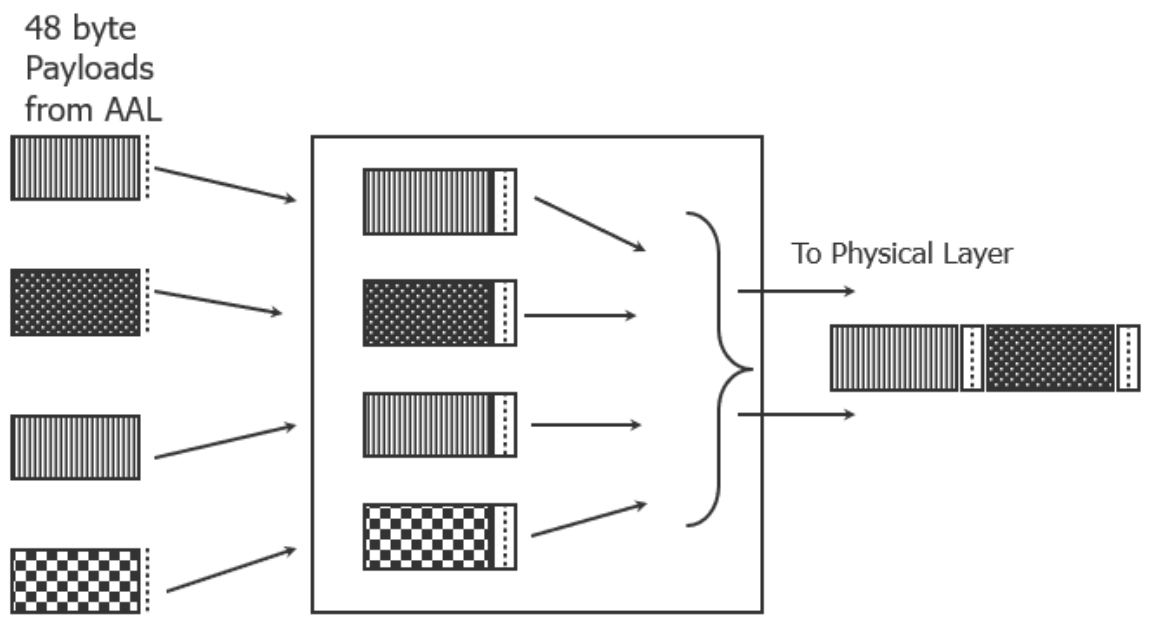
- Cell Multiplexing and Demultiplexing
- Combining cells from different sources
- Separating cells for different destinations
- Generic Flow Control
- Managing traffic flow
ATM Cell Header Format
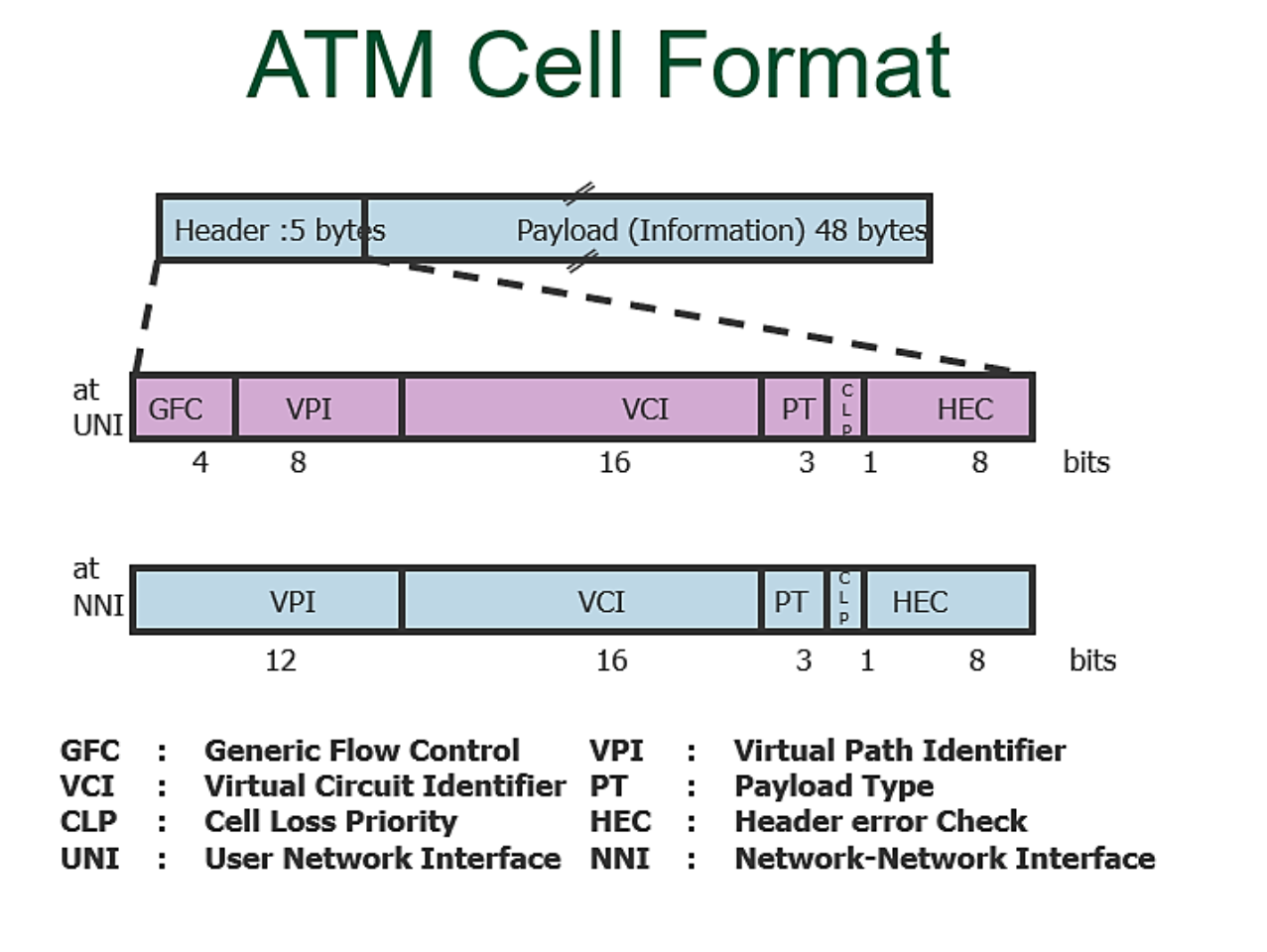
Two Formats
At UNI (User-Network Interface)
┌─────┬─────┬──────────────┬────┬─────┬─────┐
│ GFC │ VPI │     VCI      │ PT │ CLP │ HEC │
│  4  │  8  │      16      │ 3  │  1  │  8  │ bits
└─────┴─────┴──────────────┴────┴─────┴─────┘
At NNI (Network-Network Interface)
┌────────┬──────────────┬────┬─────┬─────┐
│  VPI   │     VCI      │ PT │ CLP │ HEC │
│   12   │      16      │ 3  │  1  │  8  │ bits
└────────┴──────────────┴────┴─────┴─────┘
Header Fields
- GFC (Generic Flow Control): 4 bits
- Used for flow control at UNI
- VPI (Virtual Path Identifier): 8 bits (UNI) or 12 bits (NNI)
- เป็นการรวมกลุ่ม VCI หลาย ๆ อันรวมกัน เป็นเส้นทางหลักเสมือน
- VCI (Virtual Circuit Identifier): 16 bits
- จะระบุการเชื่อมต่อย่อย ๆ แต่ละอัน เหมือนเป็นเลขที่ช่องการสื่อสารแต่ละช่อง
- PT (Payload Type): 3 bits
- Indicates type of payload carried within a cell
- User data or operation and maintenance data (OAM)
- CLP (Cell Loss Priority): 1 bit
- HEC (Header Error Check): 8 bits
ใช้แค่ VCI ระบุการเชื่อมต่ออย่างเดียวเลยได้มั้ย ทำไมต้องมีคู่ VPI + VCI งงเลยล่ะ?
การที่มีทั้ง VPI และ VCI ซ้อนกันเนี่ย มันช่วยเพิ่มประสิทธิภาพ + ความยืดหยุ่น ในการจัดการเครือข่าย
VPI เหมือนเป็นทางด่วนสายหลัก ส่วน VCI เหมือนเป็นแต่ละเลนบนทางด่วนนั้น ๆ
Payload Type (PT) Interpretation
| PT Value | Meaning |
|---|---|
| 000 | User Data, type 0; no congestion |
| 001 | User Data, type 1; no congestion |
| 010 | User Data, type 0; Congestion |
| 011 | User Data, type 1; Congestion |
| 100 | OAM Cell |
| 101 | OAM Cell |
| 110 | Resource Management Cell (to be defined) |
| 111 | Reserved for future use |
Cell Loss Priority (CLP)
Key Points
- Indicates relative priority of a cell
- Indicates if a cell can be discarded in case of congestion
- CLP bit is set by the user or service provider
- In Constant Bit Rate (CBR) connections, cells have
Analogy: Think of CLP like priority mail. CLP=0 is like certified mail that must be delivered, while CLP=1 is like bulk mail that can be discarded if the post office is overwhelmed.
Virtual Circuits in ATM
Virtual Circuit Identifier
Represented jointly by:
- VCI (Virtual Channel Identifier): 16 bits
- VPI (Virtual Path Identifier): 8 bits (UNI) or 12 bits (NNI)
Virtual Channel (VC)
- Path for cell associated with a connection
- Supports transportation of a data stream
- Each VC is assigned a unique VCI on a link
Virtual Path Connections
- Virtual Channel Connections: virtual circuit
- Virtual Path Connections: bundle of virtual connections
- ATM Header contains virtual connection information:
- 8-bit Virtual Path Identifier
- 16-bit Virtual Channel Identifier
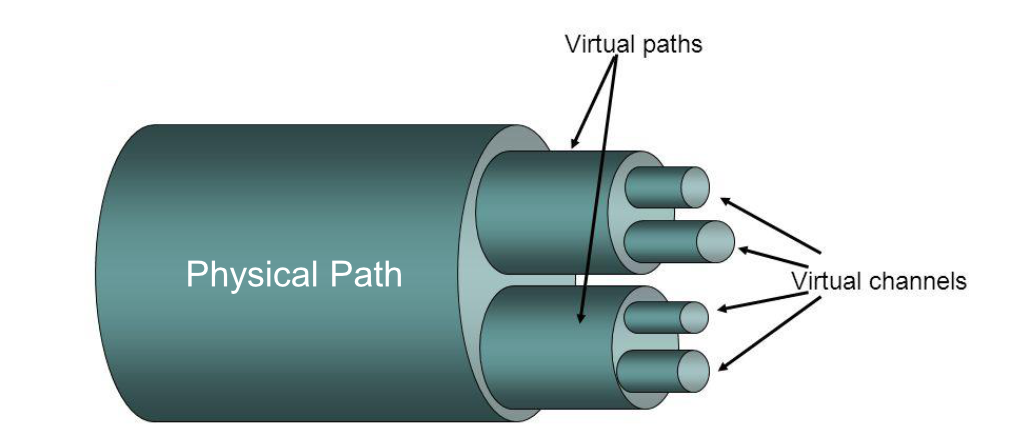
แต่ละเส้นเล็ก ๆ ID ต้องต่างกัน
Virtual Path (VP)
Characteristics
- Grouping of virtual channels on a physical link
- Switching can be performed on the path basis
- Reduces overheads
- Each virtual path is assigned a Virtual Path Identifier (VPI)
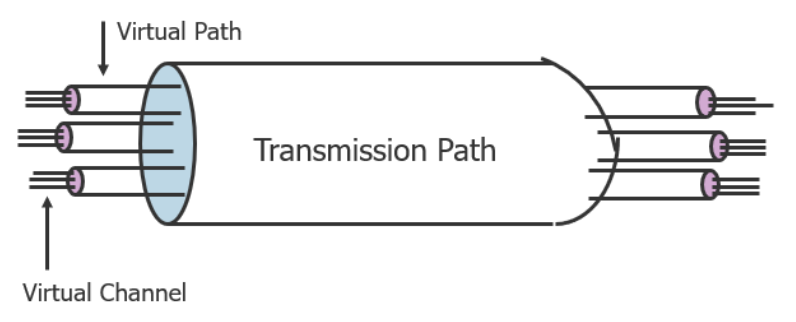
VP/VC Switch
Diagram showing VP/VC Switch architecture
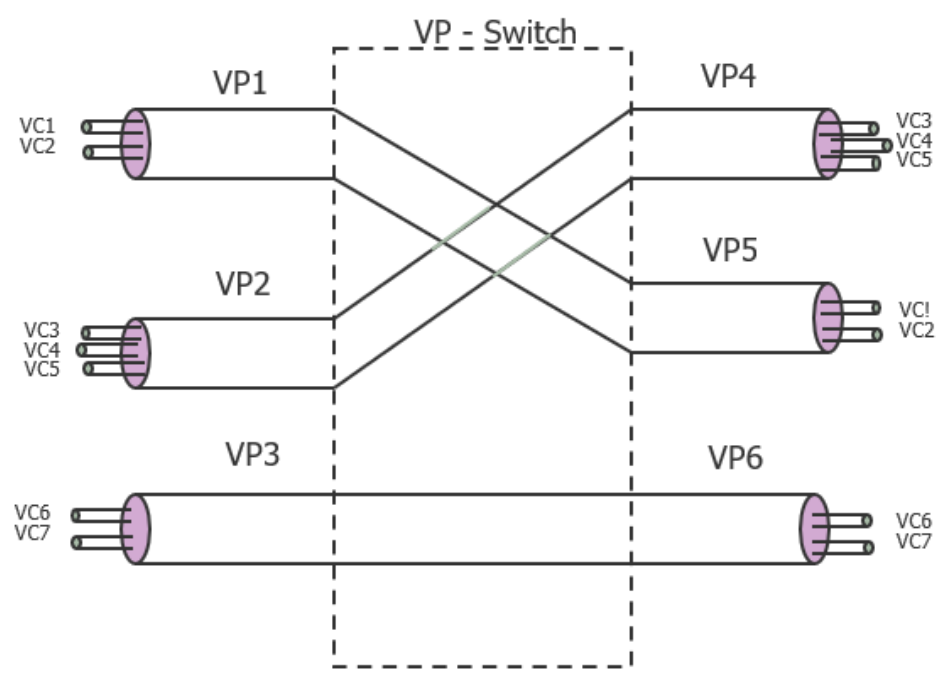
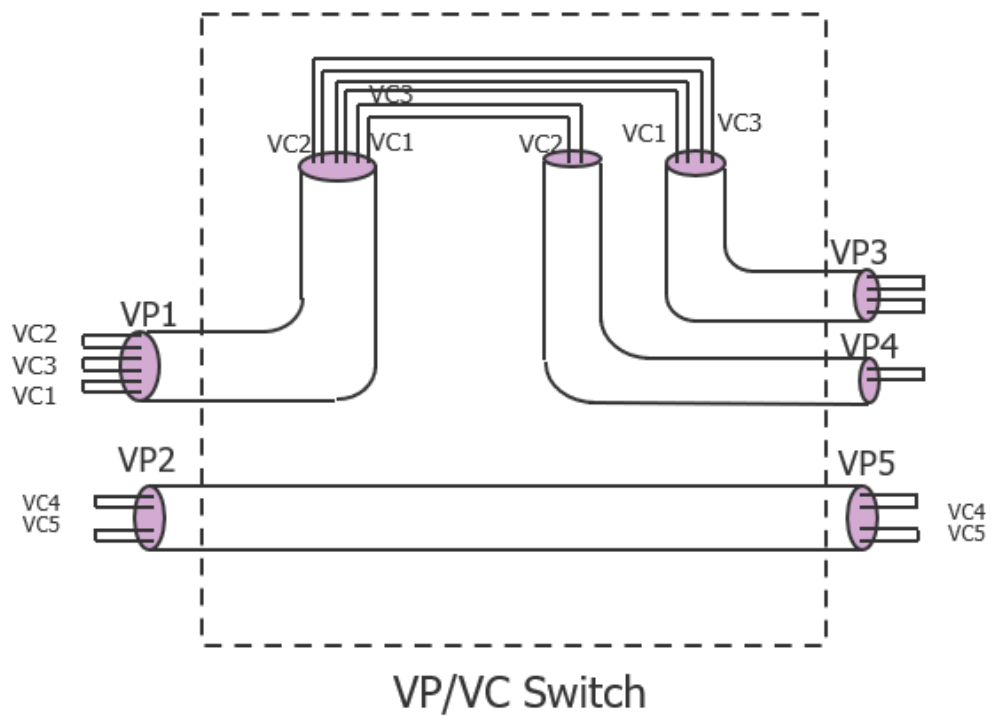
Why VPI/VCI Rather Than a Single VC Number?
Advantages
- Semi-permanent VP reduces setup time
- Virtual Paths can be pre-established
- VCs can be easily added to existing VPs
- Flexibility in connection management
- Reduced size of routing table
- More efficient routing
- Separate groups for different types of streams
- Voice, data, and video can have dedicated virtual paths
- Different QoS can be applied to different VPs
- Quality of Service management at the path level
Analogy: Think of VPI as highway routes and VCI as specific lanes on those highways. You can manage entire highways (VPI) or individual lanes (VCI) depending on your needs.
Applications on ATM
| Application Class | Example Applications |
|---|---|
| Interactive Video, Audio, Text/Data, Image | Video Conferencing, Distributed Classroom, Telephone, Banking Transactions, Credit Card Verification, Multimedia conferencing |
| Video Messaging, Audio Messaging, Text/Data Messaging, Image Messaging | Multimedia Email, Voice Mail, Email/telex/Fax, High Resolution Fax |
| Video Distribution, Audio Distribution, Text Distribution, Image Distribution | Television, Radio/Audio Feed, News Feed/netnews, Weather Satellite pictures |
| Video Retrieval, Audio Retrieval, Text/Data Retrieval, Image Retrieval | Video On Demand (VOD), Audio Library, File Transfer, Library Browsing |
| Aggregate LAN, Remote Terminal, RPC | LAN Interconnection or Emulation, Telecommuting/telnet, Distributed Simulation |
ATM Service Categories
Five main service categories:
- CBR (Constant Bit Rate)
- rt-VBR (Real-time Variable Bit Rate)
- nrt-VBR (Non Real-time Variable Bit Rate)
- UBR (Unspecified Bit Rate)
- ABR (Available Bit Rate)
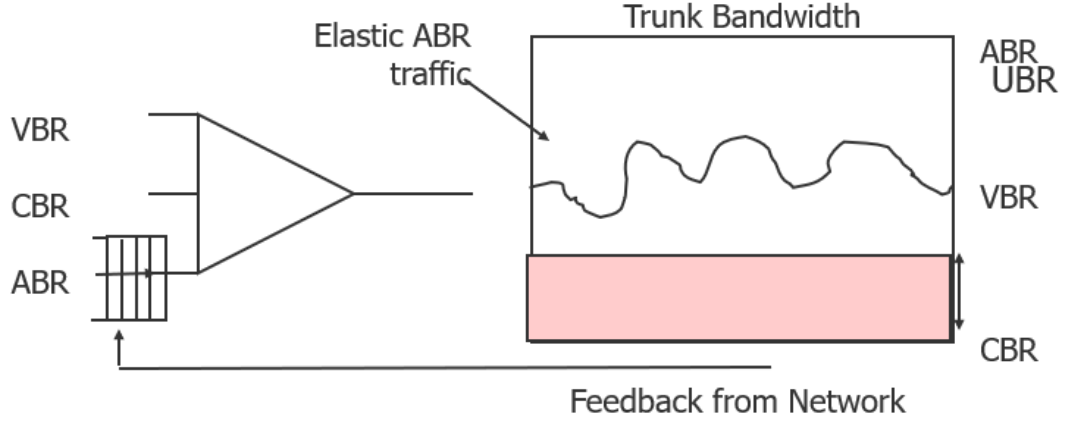
1. Constant Bit Rate (CBR)
ใช้กับข้อมูลที่ต้องการ bitrate คงที่ เช่นเสียง/วิดีโอ real-time
Characteristics
- Emulates a copper wire or optical fiber (circuit emulation)
- No error checking or processing
- Provides reserved bandwidth with minimum cell loss or variation in delay (Jitter)
Suitable For
- Voice grade PCM (Pulse Code Modulation)
- Real-time audio and video systems
- Constant bit rate videos
Analogy: CBR is like a dedicated lane on a highway that's always available at a constant speed, perfect for real-time traffic that can't tolerate delays or speed variations.
2. Real-time Variable Bit Rate (rt-VBR)
ใช้กับข้อมูล real-time แต่มีความแปรผันของ bitrate เช่น video conference
Characteristics
- Variable bit rate
- Stringent real-time requirements - tight bound on delay
- Acceptable loss rate and jitter are specified
Suitable For
- Compressed real-time video (MPEG)
- Audio services
Analogy: rt-VBR is like an express lane that can vary in speed but guarantees you won't be late for an important appointment. It's flexible but still time-sensitive.
3. Non Real-time VBR (nrt-VBR)
สำหรับ data ที่ไม่ real-time เช่นไฟล์ transfer แต่ยังต้องการ throughput ที่แน่นอน
Characteristics
- VBR with less stringent bound in loss rate, delay, and delay variation
- The loss rate allows for statistical multiplexing
Suitable For
- Multimedia Email
- Frame Relay
Analogy: nrt-VBR is like regular traffic lanes where some variation in speed is acceptable. You'll get there, but exact timing isn't critical.
4. Unspecified Bit Rate (UBR)
ส่งตามมีตามเกิด (best effort) ถ้า network คับคั่งก็โดน drop ก่อนเลย55555
Characteristics
- Provides best effort delivery
- No guarantee on cell loss or delay variation
- Open loop system: no feedback about congestion
- UBR is designed to allow use of excess bandwidth
Behavior During Congestion
- In case of congestion, UBR cells will be dropped
Suitable For
- Well suited for TCP/IP packets
- Non real-time bursty data traffic
UBR มันก็อาจจะมีกลไกการส่งซ้ำอะไร ก็แล้วแต่ Protocol ที่ใช้เลยนะ (TCP/IP มีเลย)
Analogy: UBR is like the slowest lane where you use whatever space is available. If traffic gets heavy, you might get stuck or have to exit (dropped packets), but it's the most flexible option.
5. Available Bit Rate (ABR)
- bitrate จะปรับตามความแออัดของ network เหมาะกับการส่งข้อมูลทั่วไปที่ไม่ sensitive ต่อ delay
- เครือข่ายมีกลไก Feedback คอยส่งสัญญาณว่าเครือข่ายว่างหรือแน่นแค่ไหน ถ้าว่างส่งมาเลยเยอะ ๆ ถ้าไม่ว่าง ค่อย ๆ หน่อยนะ LUV
Characteristics
- Suitable for Data Traffic
- Uses excess network bandwidth
- Data traffic is extremely bursty and cannot be carried using CBR or VBR without disturbing other connections
- Bandwidth requirements may vary dynamically in time
- Resource allocation is not an efficient solution
Feedback Mechanism
- Based on closed loop feedback mechanism
- Reports network congestion
- Allows end stations to reduce their transmission rate to avoid cell loss
Ideal For
- Transmitting LAN and other bursty unpredictable data traffic over ATM networks
Analogy: ABR is like a smart traffic system that tells drivers to slow down when roads are congested and speed up when they're clear. It adapts in real-time to network conditions.
Traffic Descriptors
จะรู้ได้ยังไงว่าเครือข่ายทำตามสัญญา — ก็มีการตกลงตั้งแต่ เชื่อมทางกันแล้ววว!
- Peak Cell Rate (PCR)
- Maximum allowable cell rate on a circuit
- Minimum Cell Rate (MCR)
- The minimum cell rate guaranteed by the service provider
- Sustainable Cell Rate (SCR)
- The expected or required cell rate averaged over a long time interval
- Cell Delay Variation Tolerance (CDVT)
- Variation in cell transmission time
- Burst Tolerance (BT)
- The limit to which a transmission can run at its Peak Cell Rate (PCR)
Quality of Service (QoS)
Loss Guarantees
- Cell Loss Ratio (CLR):
Delay Guarantees
- Cell Transfer Delay (CTD)
- Cell Delay Variation (CDV)
Rate Guarantees
- Based on PCR, SCR, MCR, and ACR (Actual Cell Rate)
QoS for Service Classes
ก็คือเวลาส่งข้อมูลใช่มั้ย มันก็คงมี Header หรือว่าอะไรที่เอาไว้บอก QoS อะ ถ้าสมมติเน็ตช้า การจราจรคับคั่ง มันก็จะทิ้งอันล่าง ๆ ไปก่อนเลย UBR แล้ว Maintain traffic อะไรที่มันสำคัญ รับประกันไว้อย่าง CBR อะไรงี้อะ
CBR (Constant Bit Rate)
- Guarantees: PCR, CTD, CDV, CLR
rt-VBR (Real-time Variable Bit Rate)
- Guarantees: SCR, CTD, CDV, CLR
nrt-VBR (Non Real-time Variable Bit Rate)
- Guarantees: SCR, no delay guarantee, CLR
ABR (Available Bit Rate)
- Guarantees: MCR and ACR (Allowed Cell Rate - Dynamically Controlled)
- No delay guarantee
- CLR (Network Specific)
UBR (Unspecified Bit Rate)
- No rate guarantees
- No delay guarantees
- No loss guarantees
ATM Adaptation Layer (AAL) - Detailed
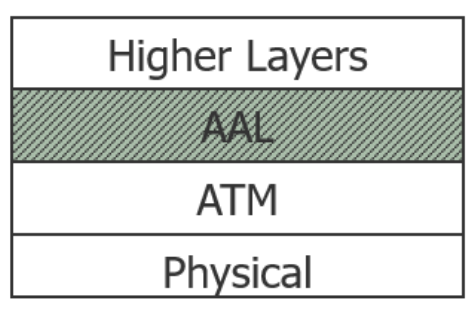
Purpose
- Provides services over ATM Layer
- Performs segmentation and reassembly functions
- Performs service dependent functions:
- Time/clock recovery
- Message identification
AAL Sublayers
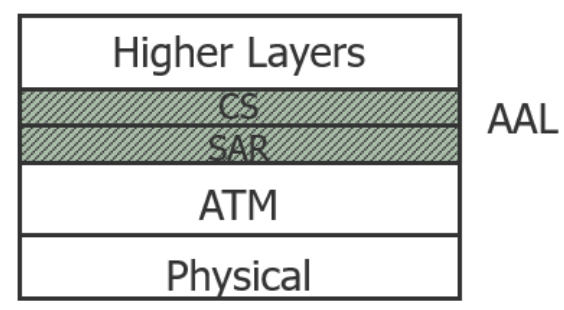
Two Sublayers
- SAR (Segmentation and Reassembly)
- Handles breaking data into cells and reassembling them
- CS (Convergence Sublayer)
- Application dependent
- Time/clock recovery
- Multiplexing/message identification
- Handling of cell delay variation
Service Classes and AAL Types
| Characteristic | Class A | Class B | Class C | Class D |
|---|---|---|---|---|
| Timing Relation between source & destination | Required | Required | Not Required | Not Required |
| Bit Rate | Constant | Variable | Variable | Variable |
| Connection Mode | Connection Oriented | Connection Oriented | Connection Oriented | Connectionless |
| AAL Types | AAL1 | AAL2 | AAL 3/4, 5 | AAL 3/4, 5 |
Examples of Service Classes
- Class A: 64 kbps digital voice
- Class B: Variable bit rate encoded video
- Class C: Frame Relay Over ATM
- Class D: CCITT I.364 (SMDS) over ATM
- Class X: Raw Cell service
AAL Protocol Layers
AAL1 (AAL Type-1) Protocol Layer
Constant-bit-rate data from upper layer
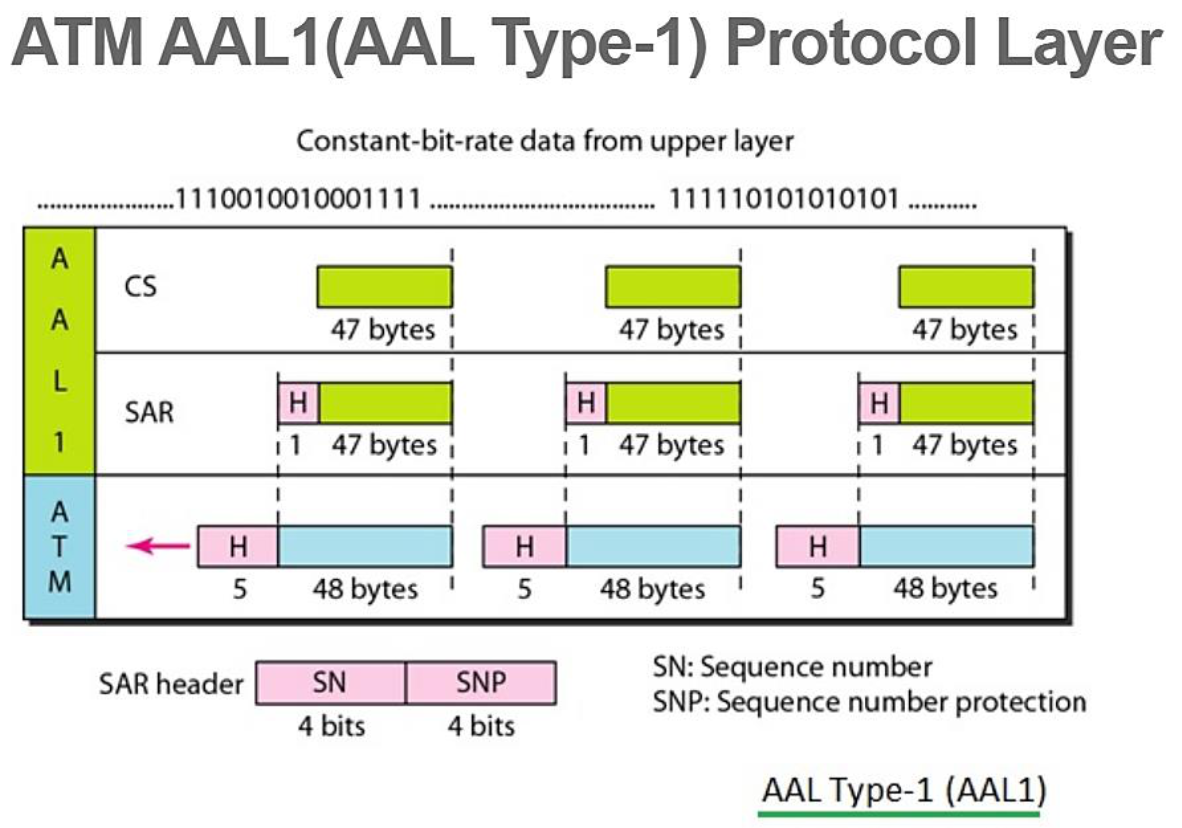
- CS (Convergence Sublayer): 47 bytes per cell
- SAR (Segmentation and Reassembly): Adds 1-byte header (SN | SNP)
- ATM Layer: 5-byte header + 48-byte payload
SAR Header:
- SN (Sequence Number): 4 bits
- SNP (Sequence Number Protection): 4 bits
AAL2 (AAL Type-2) Protocol Layer
Short packets from upper layer (24 bytes)
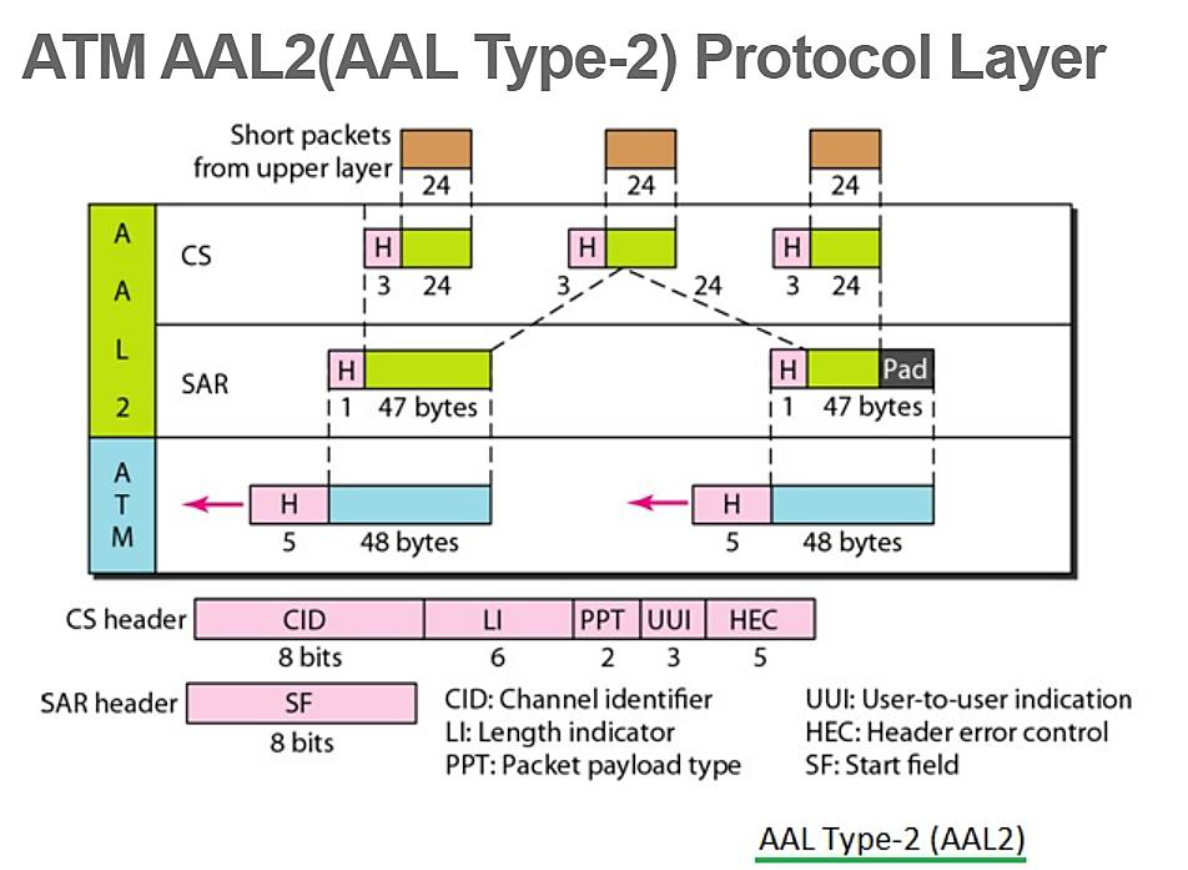
CS Header:
- CID (Channel Identifier): 8 bits
- LI (Length Indicator): 6 bits
- PPT (Packet Payload Type): 2 bits
- UUI (User-to-User Indication): 3 bits
- HEC (Header Error Control): 5 bits
SAR Header:
- SF (Start Field): 8 bits
AAL 3/4 (AAL Type-3/4) Protocol Layer
Data packet up to 65,535 bytes
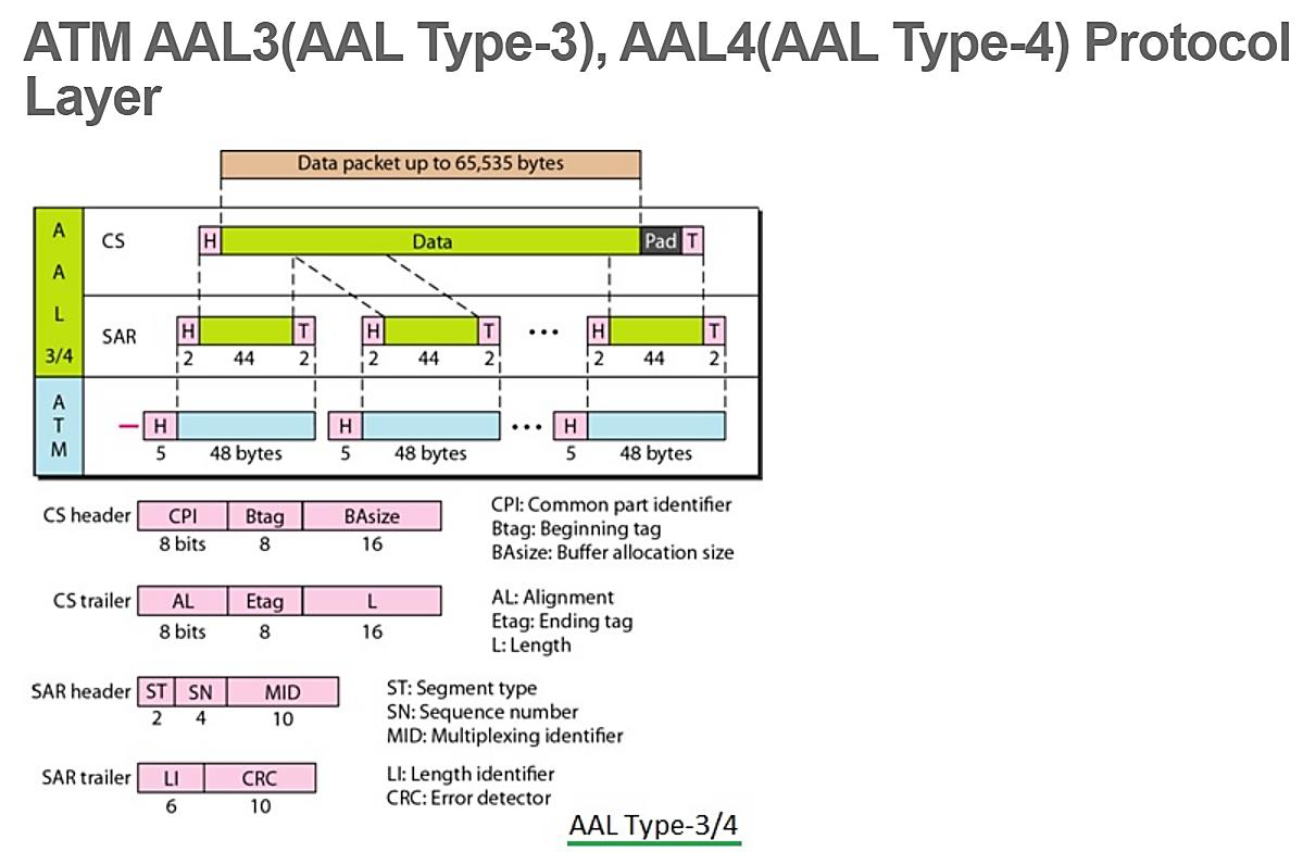
CS Header:
- CPI (Common Part Identifier): 8 bits
- Btag (Beginning Tag): 8 bits
- BAsize (Buffer Allocation Size): 16 bits
CS Trailer:
- AL (Alignment): 8 bits
- Etag (Ending Tag): 8 bits
- L (Length): 16 bits
SAR Header:
- ST (Segment Type): 2 bits
- SN (Sequence Number): 4 bits
- MID (Multiplexing Identifier): 10 bits
SAR Trailer:
- LI (Length Identifier): 6 bits
- CRC (Error Detector): 10 bits
AAL5 (AAL Type-5) Protocol Layer
Data packet up to 65,535 bytes
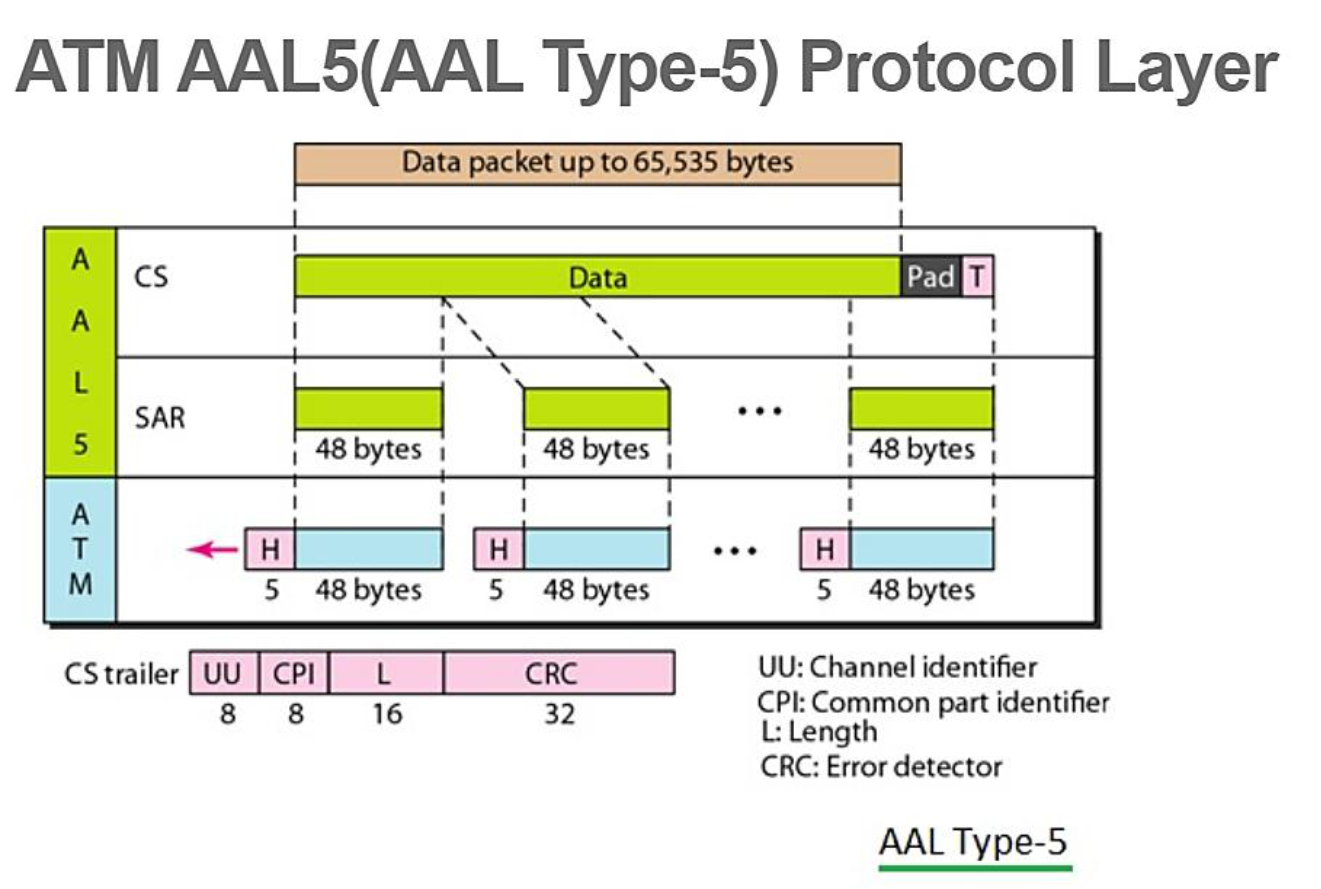
CS Trailer:
- UU (Channel Identifier): 8 bits
- CPI (Common Part Identifier): 8 bits
- L (Length): 16 bits
- CRC (Error Detector): 32 bits
Key Features:
- Simpler than AAL 3/4
- No SAR header (just 48-byte payloads)
- All control information in CS trailer
Summary
ATM Key Points
- Fixed cell size: 53 bytes (5-byte header + 48-byte payload)
- Connection-oriented technology
- Supports multiple QoS levels
- Uses virtual circuits (VPI/VCI)
- Scalable from 50 Mbps to 2.4 Gbps
ATM Layers
- Physical Layer: Bit transmission
- ATM Layer: Cell switching and routing
- AAL Layer: Adaptation to different service types
Service Categories
- CBR: For constant bit rate applications
- VBR: For variable bit rate (real-time and non-real-time)
- UBR: Best effort service
- ABR: Adaptive to available bandwidth
Final Analogy: ATM is like a highly organized package delivery system where everything is packed in identical boxes (cells), sorted by destination labels (VPI/VCI), and delivered with different priority levels (QoS) depending on what's inside and how urgently it's needed.