Opening Examples
Statement A:
- Physician-assisted suicide, which is often confused with mercy killing, is always at the request of patients and is legally permissible only with the patient's consent.
Statement B:
- Physician-assisted suicide is a terrifying, intolerable practice in which doctors, who are sworn to preserve human life, end up destroying it by murdering their patients.
Agenda
- Varieties of Meaning
- Definitions & Their Purposes
- Definitional Techniques
- Criteria for Lexical Definitions
1. Varieties of Meaning
Functions of Language
Ludwig Wittgenstein's View:
- 20th-century philosopher believed language had unlimited functions
- Examples include:
- Ask questions
- Tell stories
- Tell lies
- Guess at answers
- Form hypotheses
- Launch verbal assaults
- Tell jokes
- Flirt with someone
- Give directions
- Sing songs
- Issue commands
- Greet someone
Main Functions:
- To convey information (true or false)
- Directing
- To express or evoke feeling
- มาเอา feeling เราไปได้
- Engaging in ceremonial communication
- "Thank you so much for your help."
- "Congratulations on your graduation!"
- "I'm sorry for your loss."
- Wedding vows: "I promise to love and cherish you."
- These are not mutually exclusive: multiple functions can occur simultaneously
- “The final exam starts at 9 am.” (1, 2, …, 3?)
Examples of Language Functions
Statement A (Death Penalty):
- "The death penalty, which is legal in 31 states, has been carried out most often in Virginia; however, since 1977 Texas holds the record for the greatest number of executions."
Statement B (Death Penalty):
- "It is a cruel and inhuman form of punishment in which hapless prisoners are dragged from their cells and summarily slaughtered only to satiate the bloodlust of the vengeful public."
Analysis:
- Statement A gives information about the death penalty and tries to convince us it's bad
- Statement B tries to make us feel a certain way instead of proving the claim is true
Emotive & Cognitive (Informational) Meaning
Key Definitions:
- Cognitive meaning: Words that give information
- Emotive meaning: Words that show or create feelings
Emotive Statements:
- Have both cognitive and emotive meaning
- Part of the cognitive meaning is the value claim
- Value claim: Something is good, bad, right, wrong, better, worse, more important, or less important
Important Points:
- We focus mainly on the cognitive meaning of a statement
- It's important to separate the facts from the feelings
- In emotive statements, the value claim is the key part of the cognitive meaning
- We should treat value claims as separate statements so we can evaluate them clearly
Obscuring Value Claims with Emotive Terms
Problems with Emotive Terms:
- Value claims require evidence to support them, but...
- A value claim is hidden in the emotive words
- They act as a disguise that covers the real claim
- They add strong emotional force to the message
- They make people accept the claim without asking for proof
- Many speakers and writers don't give reasons since it is easier to use emotive language to make their opinions sound stronger
Emotive Terminology in Advertising
Commercial Applications:
- Companies make big profits by using emotive words in ads
- Drug ads often skip doctors and speak directly to patients
- They use names that are easy to remember and sound positive:
- Lunesta (from "luna", meaning calm or night)
- Viagra (from "vigor", meaning strength)
Emotive Terminology & Arguments
Key Issue:
- The strong force of emotive words can block the listener's or reader's thinking, so they don't notice the bad logic (or manipulation) in the argument
Defective Cognitive Meaning: Vagueness
Vague → not be specific enough
Ambiguity → many more meaning
Unsupported value claims →
Definition:
- A vague expression is one where we can't tell for sure where the boundaries of the word end
Characteristics:
- Allows a continuous range of interpretations
- The meaning is hazy, obscure, & imprecise
- How fresh does something have to be to be called "fresh"?
- It affects the entire statement, often from the way the words are combined
Example:
- "Today our job situation is more transparent."
- What is a "job situation"?
- What does it mean for a job situation to be "transparent"?
Defective Cognitive Meaning: Ambiguous Expressions
Definition:
- An ambiguous expression is one that has two or more clear meanings, and it's not obvious which one is meant in the situation
Example:
- "Light drink" - What makes it light? Flavor? Calories? Texture?
Importance:
- Ambiguity and vagueness are important in logic because countless evaluations of an argument often lead to, "Well, that depends on what you mean by..."
Ambiguity & Vagueness in Disputes
Example Dispute:
- CLAUDIA: "Mrs. Wilson abuses her children. How do I know? I saw her spank one of them after the child misbehaved."
- JANE: "Don't be ridiculous. Children need discipline. By disciplining them, Mrs. Wilson is showing she cares."
Analysis:
- Conflicting arguments: Two or more arguments that say opposite things about the same issue (also called disputes)
- The problem comes from the vague meanings of the words "abuse" and "discipline"
- Where do we draw the line? When does discipline turn into abuse?
- That line is unclear — and unless it's made clear, disputes like this can't be solved
Verbal Disputes vs Factual Disputes
Verbal Disputes:
- Disputes that arise over the meaning of the language
Example:
- BRENDA: "I think Smiley is guilty of arson. He told me last night that he burned down the old school."
- WARREN: "You're wrong. In our country, no one is guilty until a court says so. Smiley hasn't even been accused yet."
คือคำว่า Guilty ความหมายจริง ๆ ก็คือ ต้องให้ court says so แล้ว แต่ Brenda จะมาใช้คำไปเรื่อยไม่ได้
Factual Disputes:
- Disputes that arise from disagreement about facts
Example:
- KEITH: "I'm sure Freddie stole the computer from the old school. Barbara told me she saw him do it."
- PHYLLIS: "That's nonsense! Freddie has never stolen anything. Barbara just blames him because she hates him and wants to protect her criminal boyfriend."
Dealing with Disputes
Process:
- First, ask: Is this a factual dispute, a verbal dispute, or both?
- If it's verbal, ask:
- Does the problem come from ambiguity (more than one meaning)?
- Or from vagueness (unclear meaning or borderline cases)?
Exercise: Disputes
1. Phil vs Arthur:
- PHIL: "That was a great basketball game last night. Stephen Curry scored 37 points."
- ARTHUR:"Your statistics are off. Curry scored only 34 points."
2. Frank vs Shirley:
- FRANK: "Look at that tree that fell last night. It must have made a loud sound when it hit the ground!"
- SHIRLEY: "Not really. Sound is something we hear. And if no one was here to hear it, then there was no sound."
2. Definitions & Their Purposes
Stipulative, lexical, precising, & persuasive definitions
The Contemporary View of Definitions
Historical Perspective:
- Philosophers have disagreed about the purpose of definitions
- Plato: Said a definition should explain the true essence of a thing — like justice or virtue
- Modern logicians: Think a definition should only explain the meaning of words
Definition & Its Parts
Definition:
- A group of words that gives the meaning of another word or phrase
Components:
- Definiendum: The word or phrase that needs to be defined
- Definiens: The group of words that gives the definition
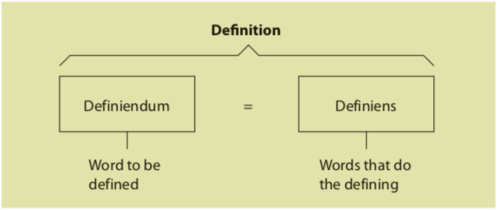
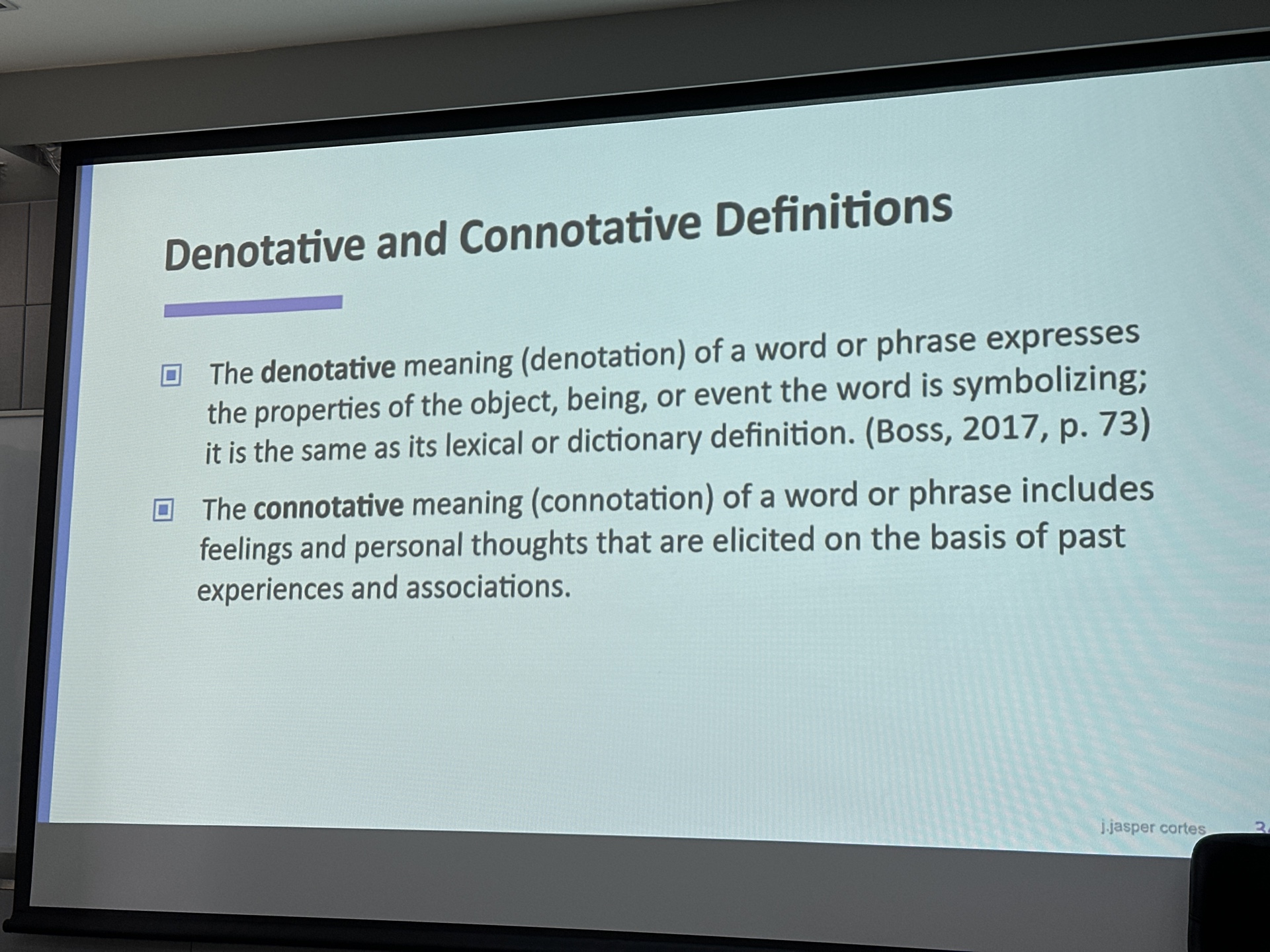
Definitions According to Purpose
Five Types:
- Denotative and Connotative
- Stipulative
- Lexical
- Precising
- Theoretical
- Persuasive
Stipulative Definitions
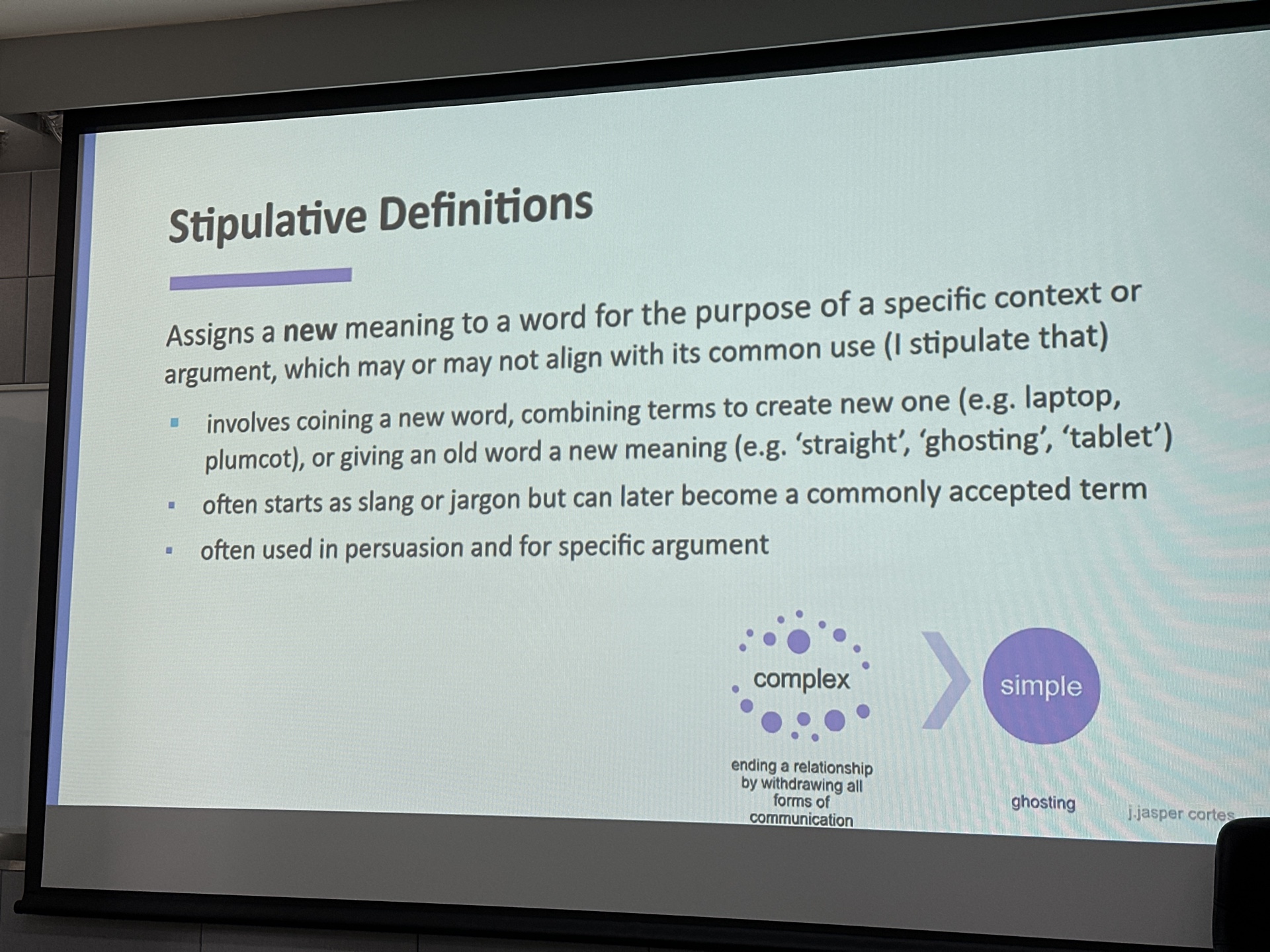
Purpose:
- Assigns meaning to a word for the first time
Characteristics:
- May involve coining a new word or giving an old word a new meaning
- The purpose is usually to replace a more complex expression with a simpler one
Examples:
- Complex: "ending a relationship by withdrawing all forms of communication"
- Simple: "ghosting"
- Mathematical: 10 x 10 x10 x 10 x 10's symbol is 10⁵
Additional Uses:
-
Comes from a new phenomenon or development
-
Crossbreeding plum and apricot → "plumcot"
-
Used for secret codes
-
Manhattan Project, Operation Overlord
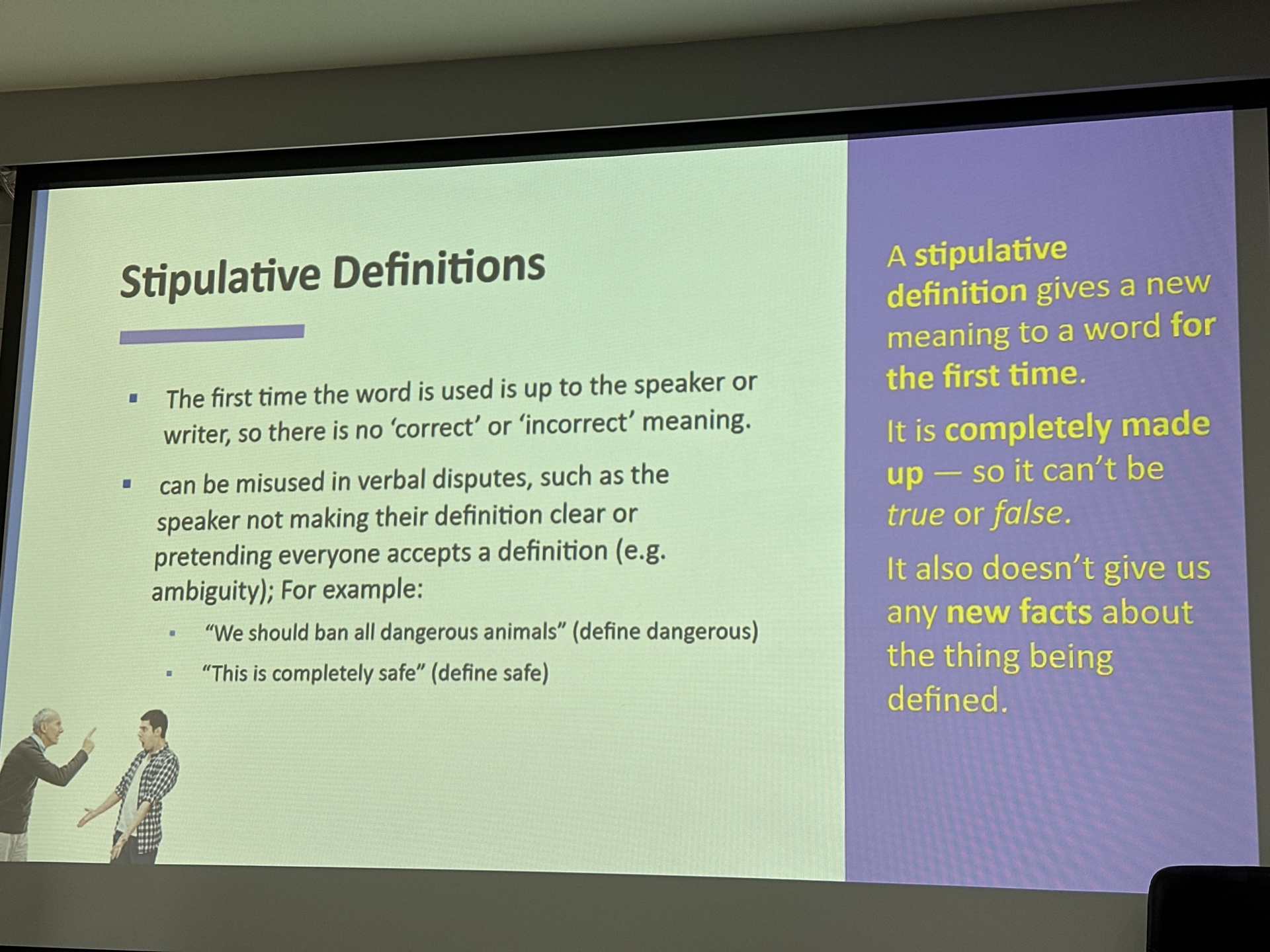
-
The first time the word is used is up to the speaker or writer. There is no right or wrong way
Problems:
- Misused in verbal disputes
- Arguer uses the word in a strange or private way
- Arguer acts like everyone uses the word the same way
Key Points:
- A stipulative definition gives a new meaning to a word for the first time
- It is completely made up — so it can't be true or false
- It also doesn't give us any new facts about the thing being defined
Lexical Definitions
Purpose:
- A lexical definition tells us how a word is already used in a language
Characteristics:
- Dictionary definitions are lexical definitions (LDs)
- LDs can be true or false, depending on whether they match real usage
- If a word has many meanings, an LD helps clear up the confusion
Examples:
- Light:
- Something that makes things visible;
- Electromagnetic radiation;
- Of little weight;
- Having fewer calories than the standard product
- Bank:
- The slope bordering a stream or a river;
- The inclination of an aircraft during a turn;
- An institution for receiving, lending, and safeguarding money
Benefits:
- LDs show all the different meanings a word can have
- This helps us avoid using a word in a confusing way —and helps us spot ambiguity in what other people say
- Hidden ambiguity often causes the most problems
- Some words have many subtle meanings that are easy to mix up
Example of Subtle Meanings:
- If a woman is called "nice," it might mean:
- polite, attractive, modest… or even something inappropriate
- A good lexical definition will distinguish these various shadings & thereby guard against the possibility that two meanings will be unconsciously jumbled together
Precising Definitions
Purpose:
- To reduce the vagueness of the word
Process:
- An expression is vague when there are borderline cases in which it is impossible to tell word applies or does not apply
- Even words like "fresh", "rich", & "poor" can be vague
Example:
- Vague word: "poor"
- Precising definition: "Poor is someone with an annual income of less than 10,000.00 USD and net worth is not more than 20,000.00 USD"
- Decision: "The word 'poor' doesn't apply to Alex whose annual income is 11,500.00 USD & net worth is 30,000.00 USD"
Real-world Application:
- Before a heart transplant can be done, the donor must be dead; otherwise, the doctor will be accused of murder
- When is the person considered dead?
- The US courts decided that "moment of death" means when the brain stops functioning
Key Difference:
- In a stipulative definition, the meaning is made up freely
- In a precising definition, the meaning must be carefully chosen to fit the context
Theoretical Definitions
Purpose:
- A theoretical definition gives a word its meaning through a theory
Functions:
- It tells us how to think about or see the parts of the concept
- This kind of definition helps us:
- Draw logical conclusions
- Plan further investigation
- Understand what follows if we accept the theory behind the term
Scientific Example:
- "Heat" means the energy associated with the random motion of the molecules of a substance
Benefits of this definition:
- ✓ The definition gives the word heat a clear meaning
- ✓ It helps us understand heat as a kind of molecular motion
- ✓ It leads to logical ideas, like: "If molecules move faster, temperature goes up"
- ✓ It suggests experiments we can try to test or explore this theory
The definition of heat doesn't just describe it — it becomes the starting point for a whole scientific theory about heat
Philosophical Examples:
-
Not all theoretical definitions come from science
-
Philosophers often give their own special meanings to big ideas like:
-
substance, form, cause, change, idea, good, mind, and god
-
Each philosopher's version reflects how they see the world— these definitions are part of their unique way of thinking
Historical Examples:
- Gottfried Wilhelm Leibniz's definition of "substance" in terms of what he called "monads" laid the foundation for his metaphysical theory
- John Stuart Mill's definition of "good" as the greatest happiness of the greatest number provided the basis of his utilitarian theory of ethics
Important Note:
- TDs are not true or false
- They are ways of looking at something, like a proposal or lens for understanding a topic or idea
Persuasive Definitions
Purpose:
- Persuasive definitions (PrDs) try to influence how people feel about a word or idea
Characteristics:
- Emotionally loaded language is used to make it seem like the meaning is obvious or true
- PrDs are common in politics and opinion writing
- The objective is to influence the attitude of the reader or listener
Examples:
- "Abortion means a safe & established surgical whereby a woman is relieved of an unwanted burden"
- "Abortion means the ruthless murder of children"
Evaluation:
- Persuasive definitions aren't judged mainly by truth or falsehood, but by how well they persuade
Exercise: Definitions
Identify whether each definition is stipulative, precising, theoretical, or persuasive:
-
"Blind" means, for federal income tax purposes, either the inability to see better than 20/200 in the better eye with glasses or having a field of vision of 20 degrees or less.
-
"Politician" means a person of unquestioned honesty and integrity whom the people, in their collective wisdom, have duly elected to guide the ship of state and protect it from the reefs and shoals that threaten it on every side.
-
"Bimboy" means a boy who is a total airhead.
-
"Magnetism" means a property of certain substances such as iron, cobalt, and nickel that arises from the spin of the electrons in the unfilled inner shell of the atoms that compose the substance.
3. Definitional Techniques
What are the ways to produce definitions?
Two Types of Definitions According to Meaning
Extensional:
- Assigns a meaning to a term by indicating the members of the class that the definiendum denotes
- Types:
- Demonstrative
- Enumerative
- By subclass
Intentional:
- Assigns a meaning to a word by indicating the qualities or attributes that the word connotes
- Types:
- Synonymous
- Etymological
- Operational
- By genus & difference
Extensional = “show me members.”
Intensional = “tell me the qualities.”
Demonstrative Definitions
Characteristics:
- Are the most primitive form of definitions
- To understand the definition, one only needs to know the meaning of pointing
- May be partial or complete, depending if all members of the class denoted by the definiendum are pointed to
Examples:
- "Chair" means this, this, and this--as you point to many things
- "Victory Monument" means that--as you point to it
Limitations:
- Being the most primitive, they are also the most limited since they require the presence of the object(s) that has to be pointed at
- Defining the sun at nighttime
- Defining a zebra when there is none around
Enumerative Definitions
Purpose:
- Assign a meaning to a term by naming the members of the class the term denotes
Types:
- They could be partial or complete
Examples:
- "actress" [would list specific actresses]
- "Baltic state" [would list Estonia, Latvia, Lithuania]
Guidelines:
- Full lists (enumerative definitions) are better than partial ones because they identify the term more confidently
- But if listing everything isn't possible, it's better to point to examples or use a smaller group (subclass) to explain
Definition by Subclass
Purpose:
- Defines a term by naming smaller groups (subclasses) under the main category
Types:
- The list can be incomplete (partial) or complete
Partial Examples:
- "Tree" means oak, spruce, pine, maple, and the like
- "Flower" means a rose, lily, daisy, geranium, zinnia and the like
Complete Examples:
- "Cetaceans" means either a whale, a dolphin, or a porpoise
- "Fictional work" means either a poem, a play, a novel, or a short story
Synonymous Definition
Method:
- The definition uses one word that means the same thing as the word being defined
- That one word is basically a synonym
Examples:
- "Physician" means a doctor
- "Intentional" means willful
- "Voracious" means ravenous
- **"Observe"**means see
Advantages and Limitations:
- If one word means the same thing as the word being defined, it's a quick way to define it
- But many words carry subtle meanings that don't match exactly with any single synonym
- For example, "wisdom" isn't the same as "knowledge," "understanding," or "sense"
Etymological Definition
Purpose:
- Gives the meaning of a word by showing where it came from—its history in its own language and others
Importance:
- They show the original meaning of a word in the language it came from—the base idea from which later meanings grow
- Knowing the origin of the word can help you understand many other related words
Examples:
- "Principle" is derived from the Latin word, "principium" which means beginning or source as in "principles of physics"
- "Orthodox" comes from the Greek words "ortho", meaning right or straight, and "doxa"; one might grasp that "orthopedic" has to do with straight bones
Definition by Genus and Difference
Method:
- Explains a word by first naming its general category (genus) and then adding what makes it different (specific traits)
Benefits:
- This kind of definition works well for most situations and gives clearer results than other types of intentional definitions
Key Terms:
- Genus: the bigger group or category
- Species: a smaller group inside the genus
- **Specific difference:**what makes one species different from the others in the genus
Construction Process:
- A definition using this technique is easy to construct:
- Select the term that is more general than
Criteria for Lexical Definitions
8 Rules of Lexical Definition
- It should conform to the standards of grammar.
- It should convey the essential meaning of the word being defined.
- It should neither be too broad or too narrow.
- It should avoid circularity.
- It should not be negative when it can be positive.
- It should avoid figurative, obscure, vague, or ambiguous language.
- It should avoid affective terminology.
- It should indicate the context to which the definiens pertains.