Signal Encoding Techniques
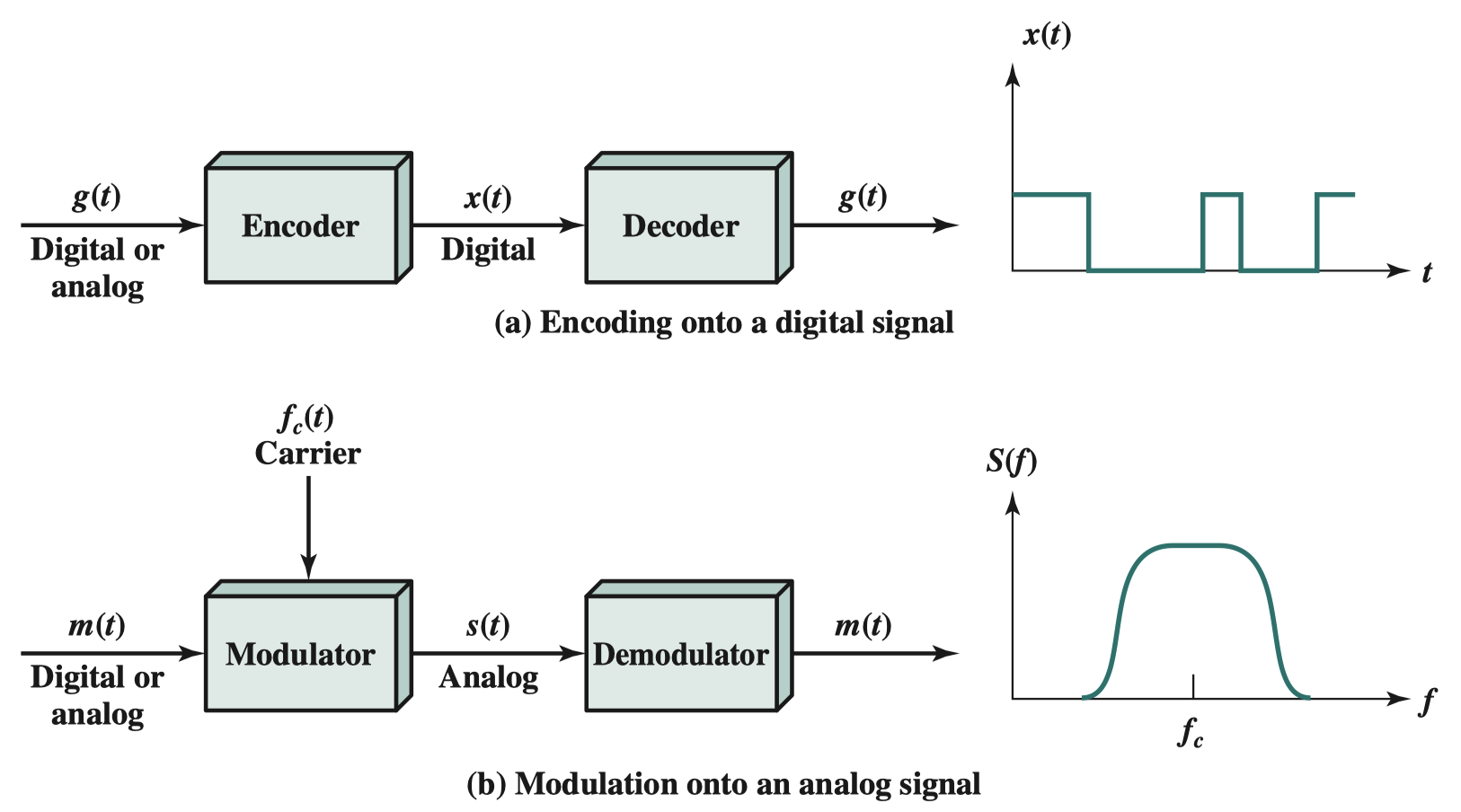
คือแปลงเพื่อให้ Data travel through that signal system ได้
Digital Data, Digital Signal
Digital Signal Characteristics
- Digital signal: discrete, discontinuous voltage pulses
- Each pulse is a signal element
- Binary data encoded into signal elements
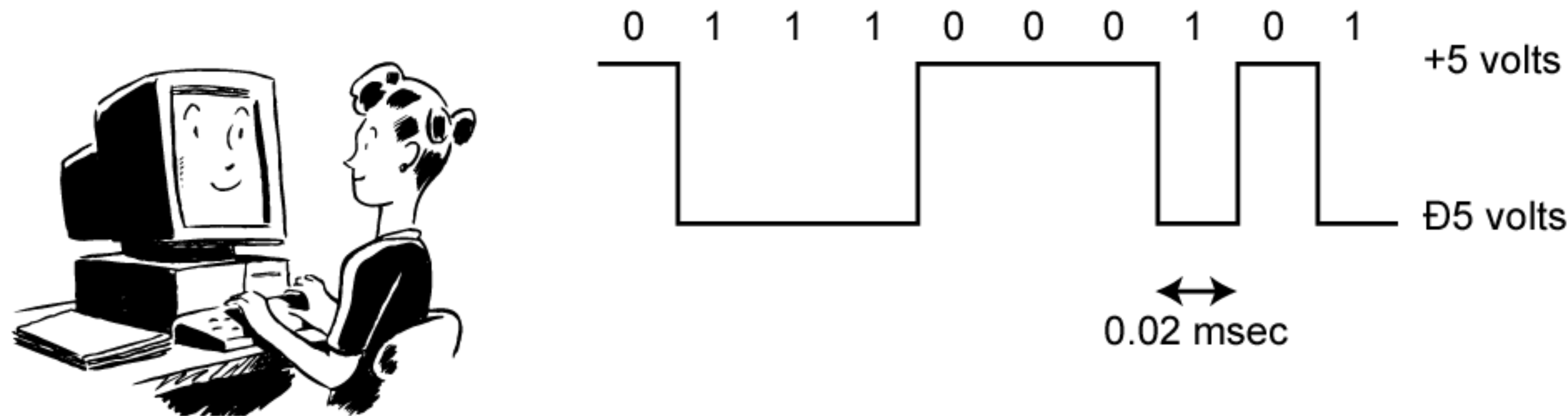
ไม่จำเป็น 1 ต้องเป็น +5 Volts มันแล้วแต่เราเลยล่ะ
อย่างที่เคย Discuss ใน Lecture 3 - Data Transmission มั้ง ว่าถ้าอยากให้ส่งข้อมูลมากขึ้นก็แค่ ส่งข้อมูลใน 1 signal มากขึ้น 11 01 ไรงี้??
Interpreting Signals
Need to know:
- Timing of bits - when they start and end
- Signal levels
Factors affecting signal interpretation:
- Signal to noise ratio
- Data rate
- Bandwidth
- Encoding scheme
Encoding and Modulating Types
Four Main Conversion Types
- Digital-to-digital conversion: encoding digital data into digital signal
- Analog-to-digital conversion: digitizing analog signal
- Digital-to-analog conversion: modulating a digital signal
- Analog-to-analog conversion: modulating analog signal
Encoding Process
Definition
- Coding: process of embedding clocks into a given data stream and producing a signal that can be transmitted over a selected medium
Coding = Insert extra information into data signal (with some technique)
Responsibilities
- Transmitter: responsible for "encoding"
- Inserting clocks into data according to a selected coding scheme
- Receiver: responsible for "decoding"
- Separating clocks and data from the incoming embedded stream
Key Points
- Systems that use coding are synchronous systems
- Must encode data into signals to send them from one place to another
- Signal needs identifiable changes recognizable to sender and receiver
- Information must be translated into agreed patterns of 0s and 1s
- Text translated into ASCII or EBCDIC character codes
Digital-to-Digital Encoding

Overview
- Binary signals created by computer are translated into voltage pulses
- Binary signals have two basic parameters: amplitude and duration
- As bits sent per unit time increases, bit duration decreases
Three Common Methods
Unipolar Encoding
Characteristics
- Simplest and most primitive type of encoding
- One voltage level stands for binary 0, another for binary 1
- Polarity: refers to positive or negative pulse
- Uses only one polarity, usually encoding only the 1
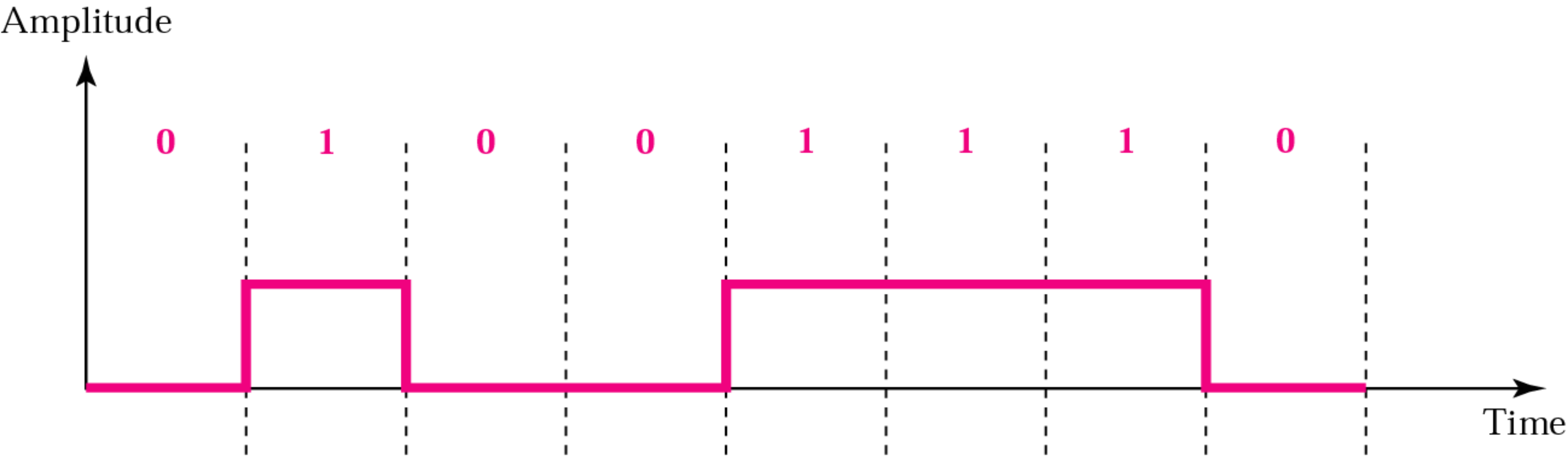
ก็คือเรา define ว่าสัญญาณแบบนี้เป็น 1 นะ แล้วเดี๋ยวอะไรที่ไม่ใช่ ไม่ตรง มันก็จะเป็น 0 เอง
Unipolar encoding uses only one voltage level. → To either represent bit zero or one
Problems with Unipolar
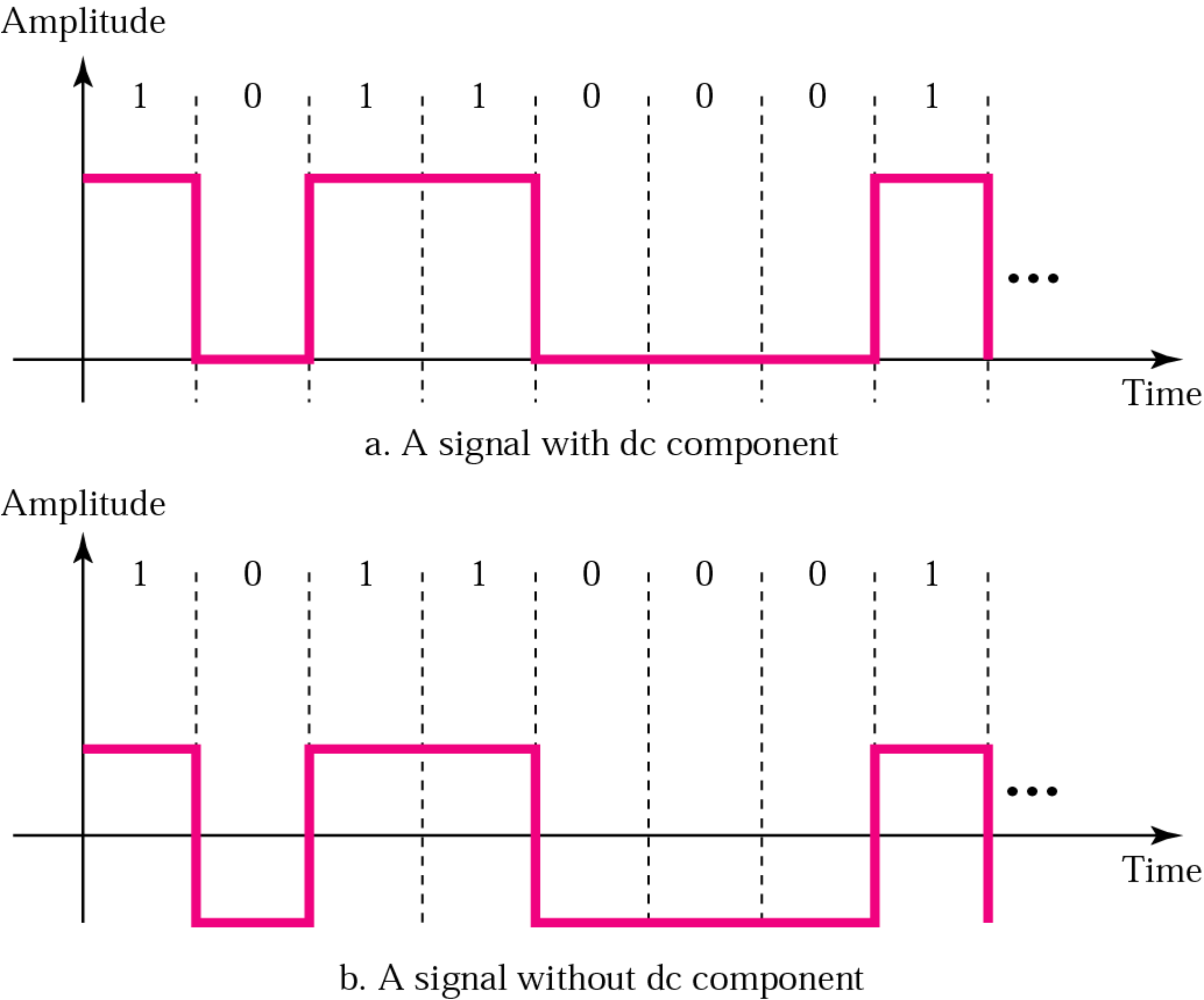
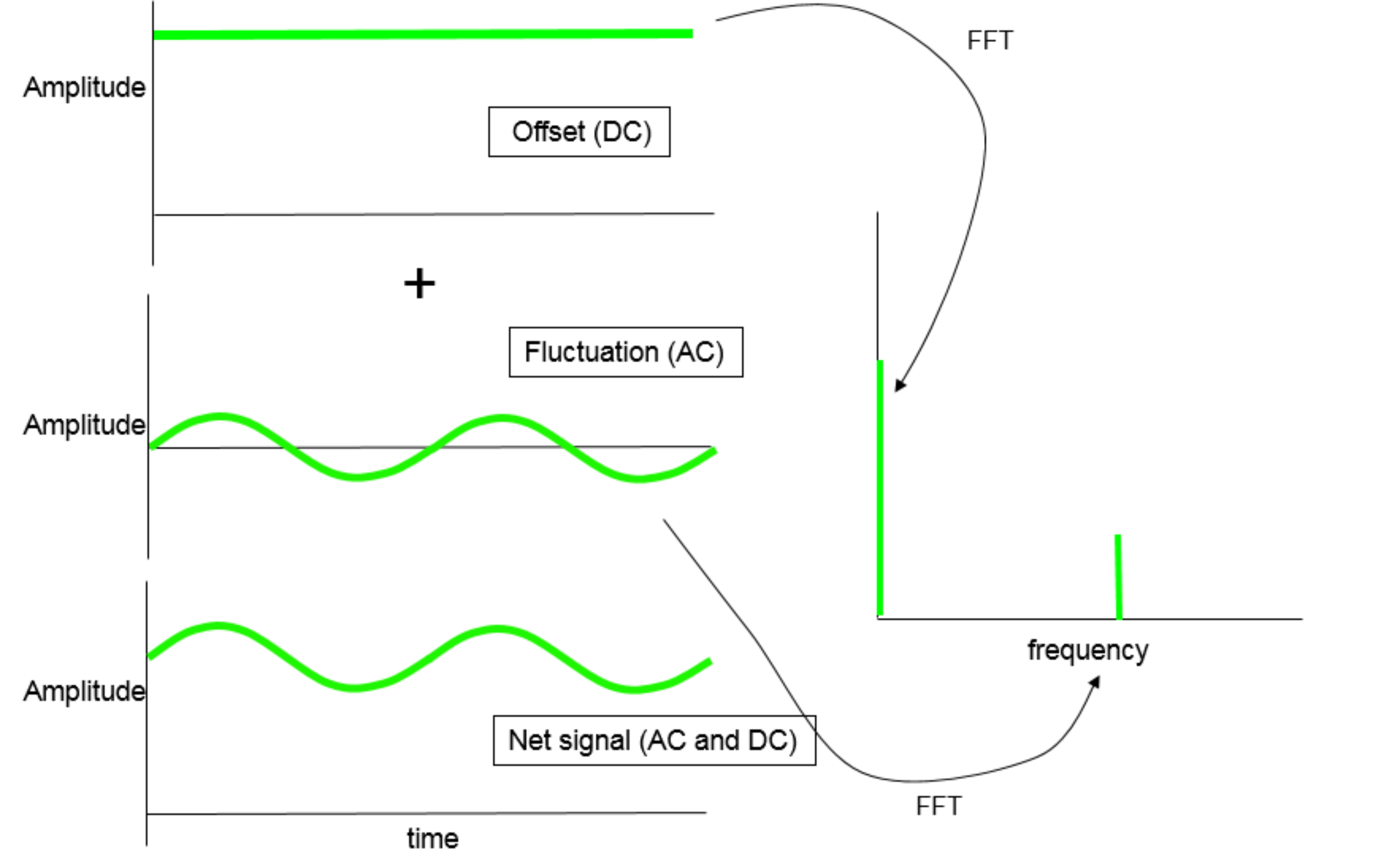
- DC Component
- Average amplitude of unipolar encoded signal is nonzero
- Creates direct current (DC component) that shifts zero level
- Cannot travel through some media (e.g., microwave)
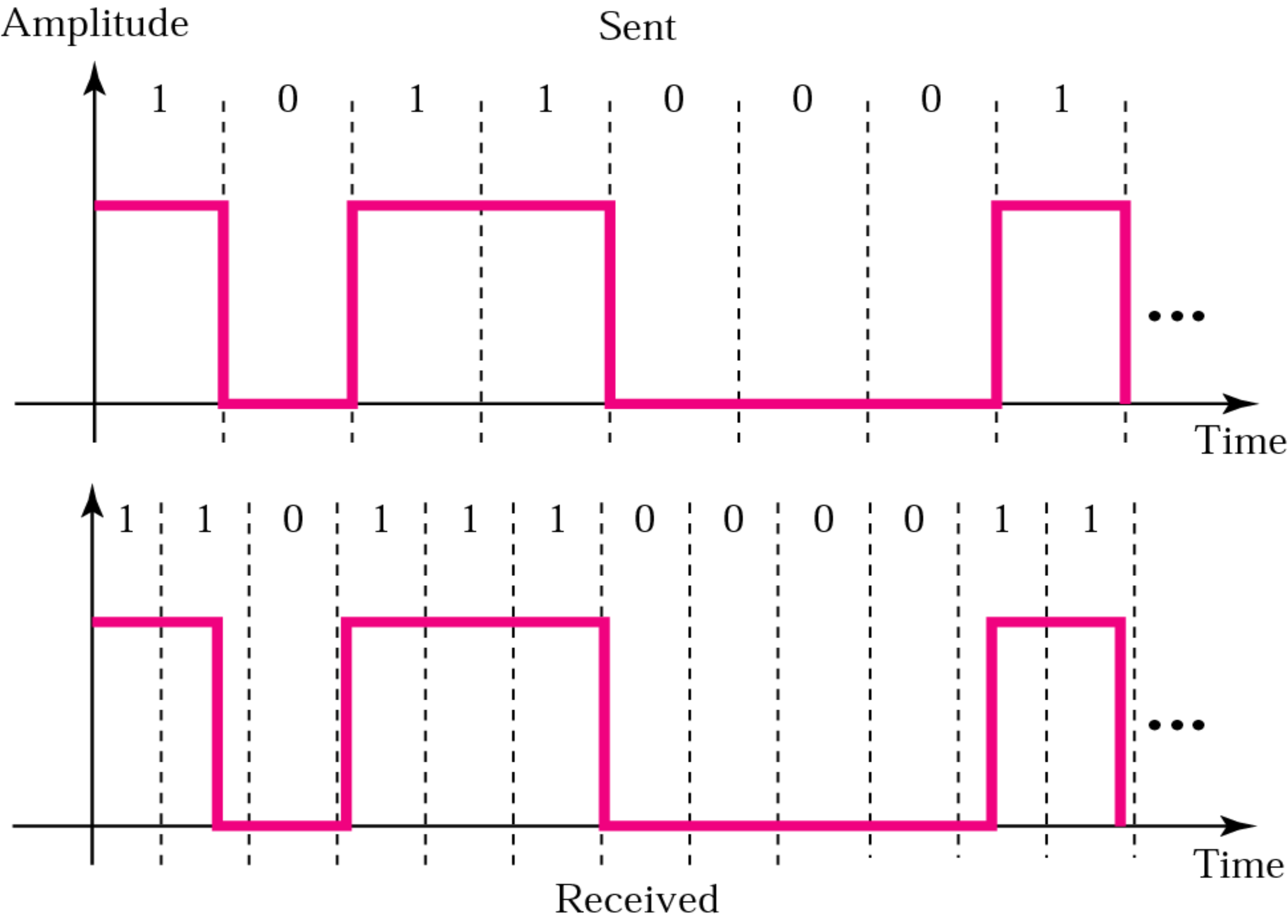
- Synchronization
- Change in voltage for each bit indicates changes in bit type
- Long strings of zeros and ones produce no transitions
- May create problems in error detection and recovery
Polar Encoding
Characteristics
- Uses two levels (positive and negative) of amplitude
- Eliminates some DC residual problem
- Average voltage level on line is reduced
- Power to transmit is half that of unipolar signal
Types of Polar Encoding
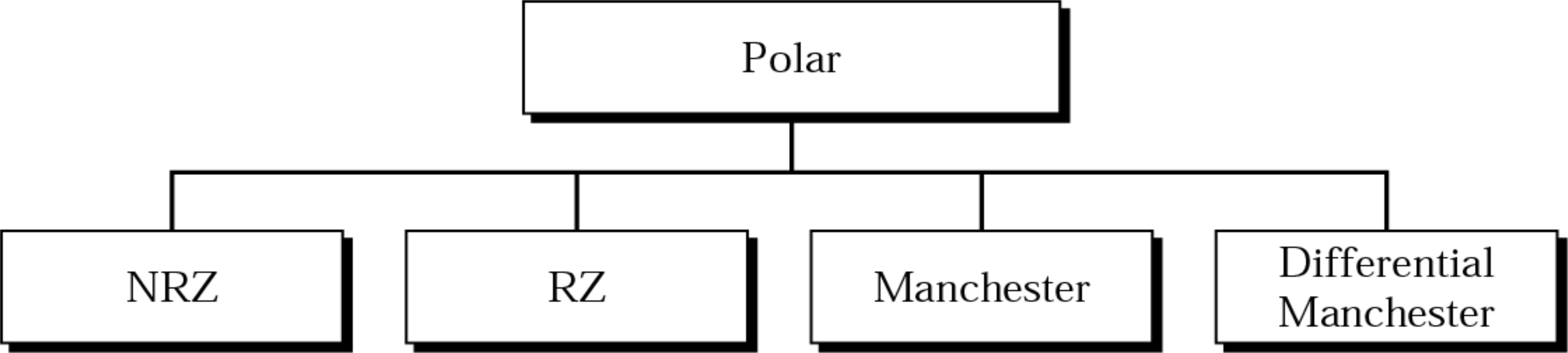
- NRZ (Non-return to Zero)
- [[#Return to Zero (RZ) Encoding|RZ (Return to Zero)]]
- Biphase
Non-return to Zero (NRZ)
General Properties
- Signal never returns to zero voltage
- Value during bit time is a level voltage
- Good for short and well-shielded transmission paths
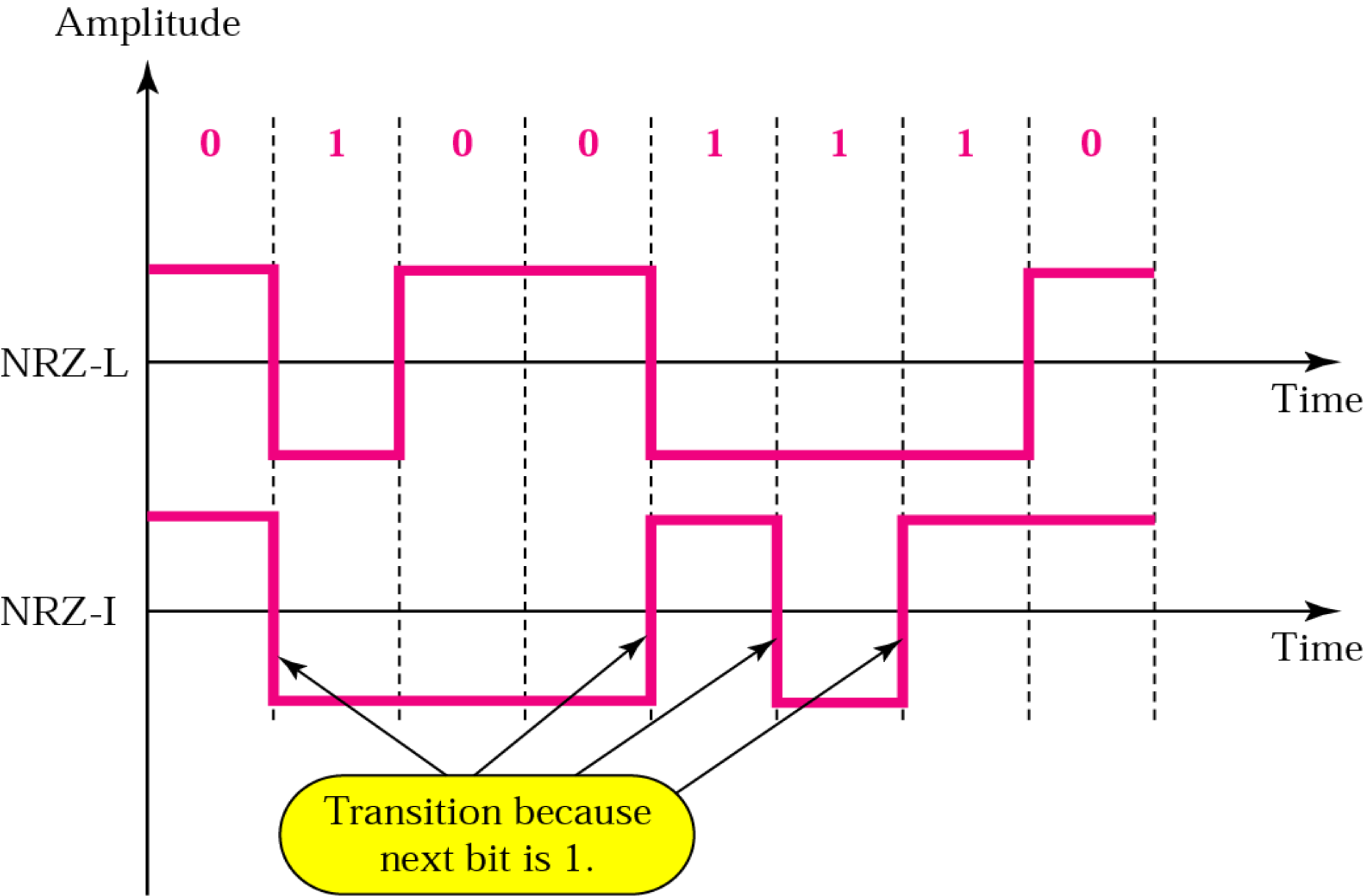
NRZ-Level (NRZ-L)
- Level of signal is dependent upon state of the bit
- Signal is always positive or negative
In NRZ-L the level of the signal is dependent upon the state of the bit.
NRZ-Inverted (NRZ-I)
- "Invert on ones"
- Transition between positive and negative voltage represents a 1 bit
- Provides more synchronization than NRZ-L
- Signal is inverted if a 1 is encountered
In NRZ-I the signal is inverted if a 1 is encountered. — ก็คือจะเปลี่ยนสัญญาณต่อเมื่อเจอ 1 แค่นั้น ถ้า 0 ก็คือ No changes
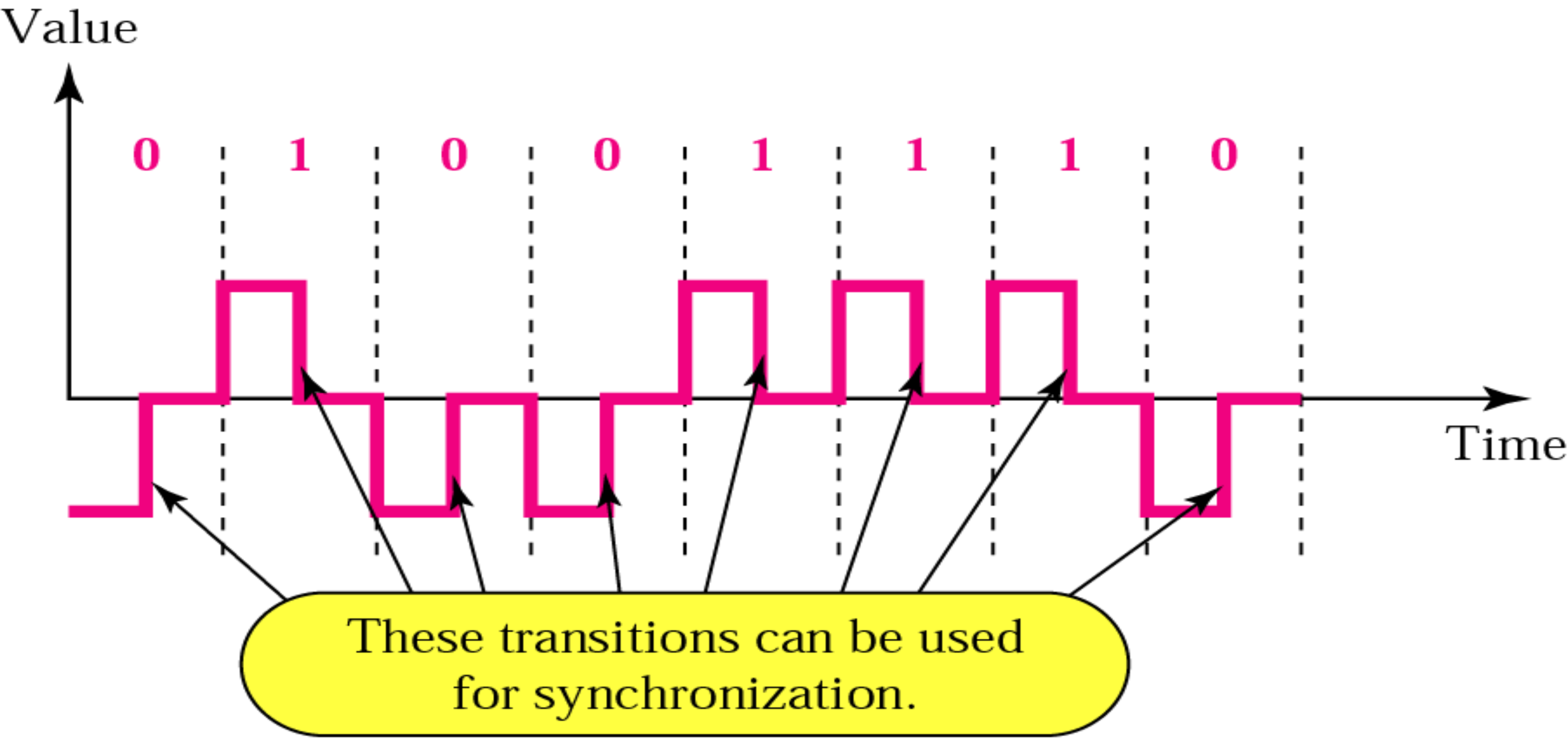
Return to Zero (RZ) Encoding
Characteristics
- Solves problem of losing synchronization due to long strings of consecutive 1s or 0s
- Signal change during each bit promotes synchronization
- Positive voltage = 1
- Negative voltage = 0
- Signal returns to zero halfway through bit interval
Biphase Encoding
General Properties
- Signal changes at middle of bit interval
- Does not return to zero, goes to opposite pole
- Good solution to synchronization problem
Two Types
- Manchester
- Differential Manchester
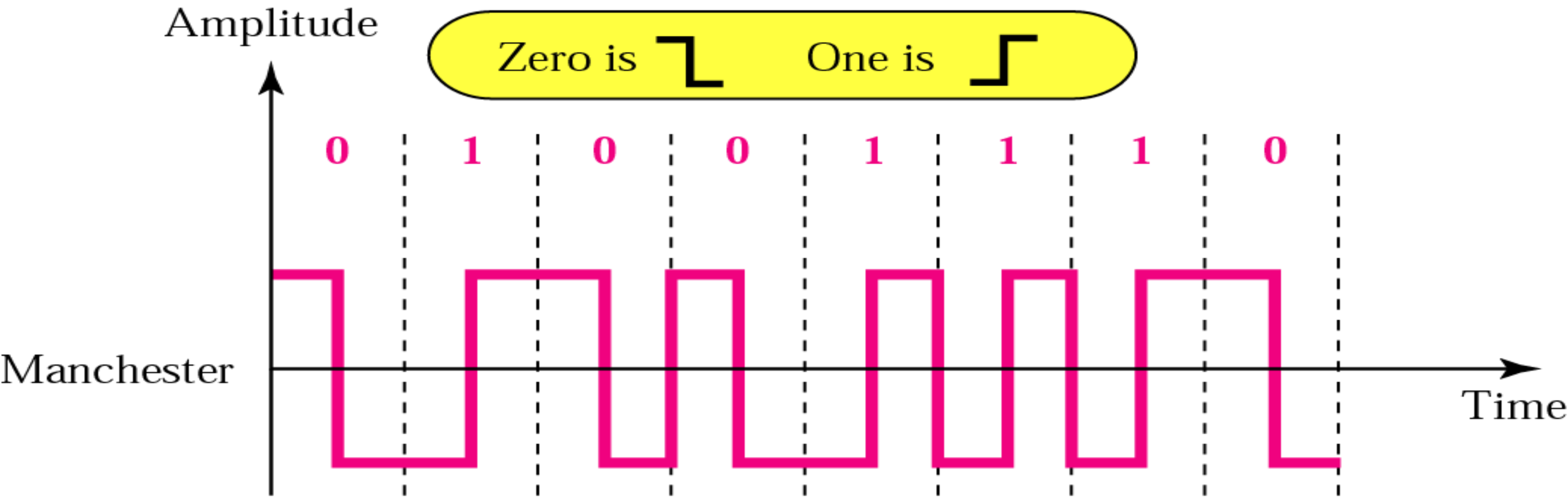
Manchester Encoding
Characteristics
- Self-clocking code
- Provides transition for every bit in middle of bit cell
- Transition used only for clocking
- +ve to -ve transition = "0" bit
- -ve to +ve transition = "1" bit
- Residual DC component eliminated by having both polarities for every bit
- Used in Ethernet and IEEE 802.3 compliant LANs
อันนี้เปลี่ยนใหม่บ้าง เช่น เปลี่ยนจาก + ไป - อันนี้จะ represent ด้วย 0 ไรงี้
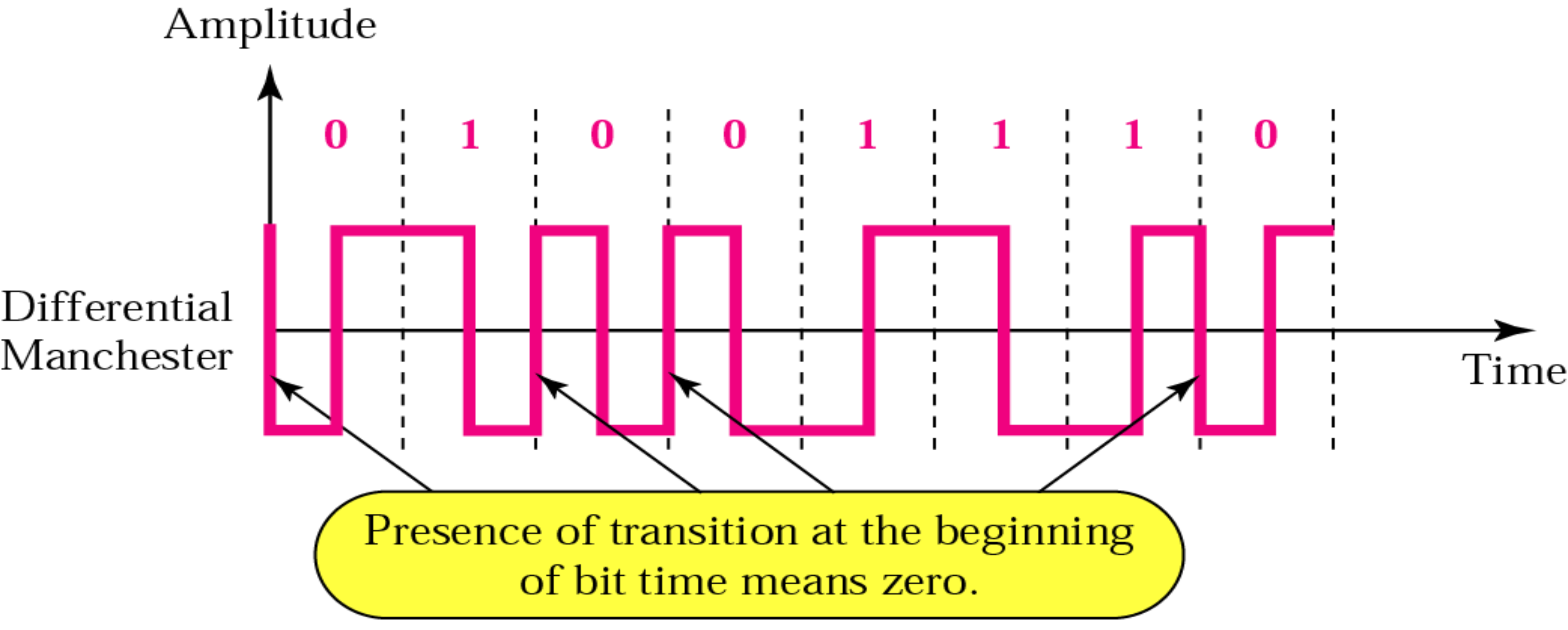
Differential Manchester Encoding
Characteristics
- Self-clocking code
- Transition for every bit in middle of bit cell
- Transition at beginning of bit cell if next bit is "0"
- NO transition at beginning of bit cell if next bit is "1"
- Used in Token Ring or IEEE 802.5 compliant LANs
- Transition at middle used only for synchronization
- Bit representation defined by inversion or non-inversion at beginning of bit
Read This & Got It
ก็คือตรงหน้าสัญญาณก็ต้องมีการเปลี่ยนแปลงของสัญญาณด้วย แต่การเปลี่ยนแปลงก็จะเหมือนข้างบน Manchester ธรรมดา ๆ +
Homework Exercise
Given binary data: 0101 1101 0011 1010
Encode using following techniques:
- Unipolar Encoding (+5 volt represent value 1)
- Polar Encoding:
- NRZ-L
- NRZ-I
- Manchester
- Differential Manchester
Analog-to-Digital Encoding
Challenge
- Transform potentially infinite values in analog message to digital without losing data
- Example: voice on CD
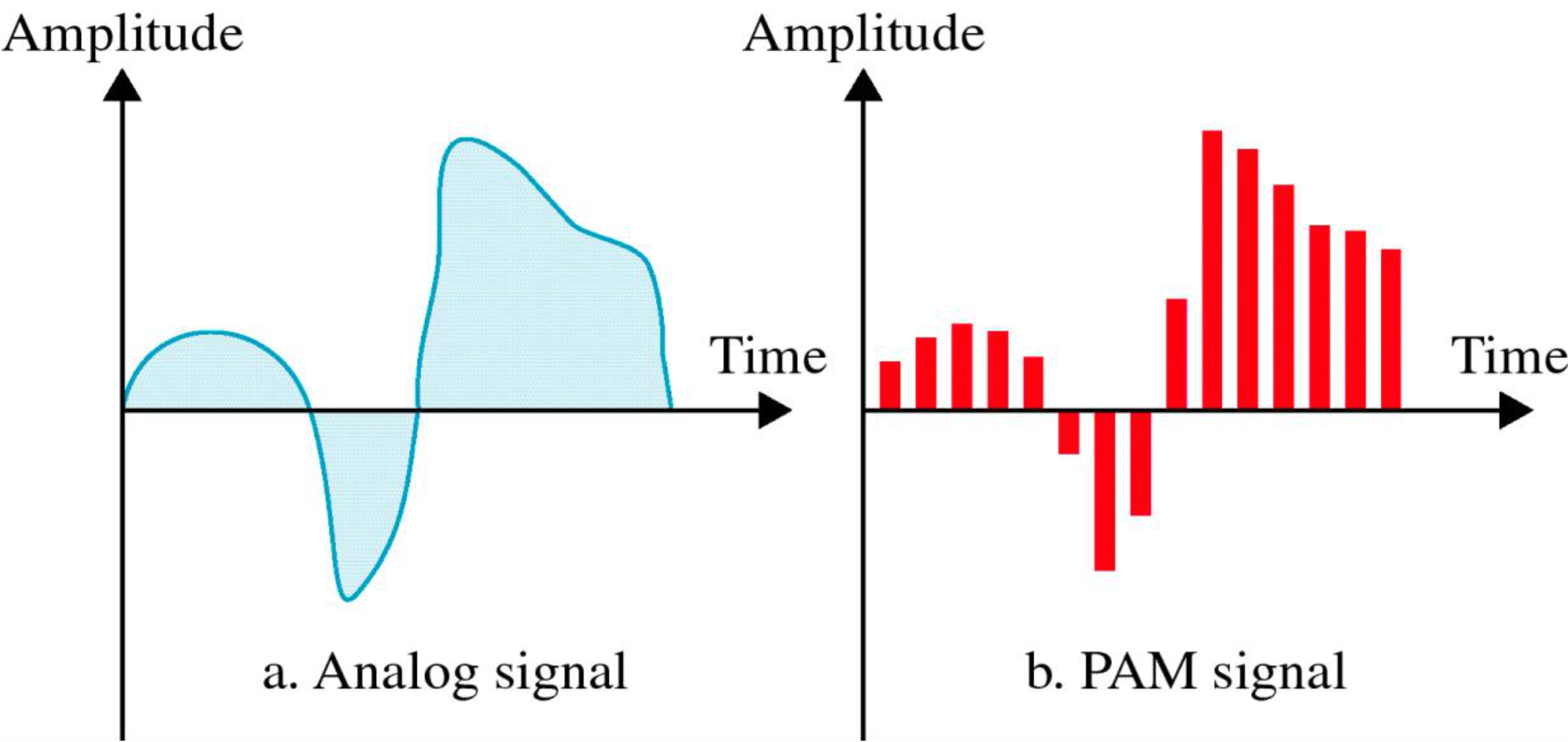
Pulse Amplitude Modulation (PAM)
Reread the value of the voltage at some discrete point, then it’ll changes to digital (0s or 1s) based on the amplitude ไงล่ะ
- Samples the analog message and generates pulses based on sampling
- Sampling: measures amplitude of signal at equal intervals
Pulse Code Modulation (PCM)
ในการจะ Convert เป็น Digital ได้ ต้องใช้ PAM + PCM ด้วยนะ
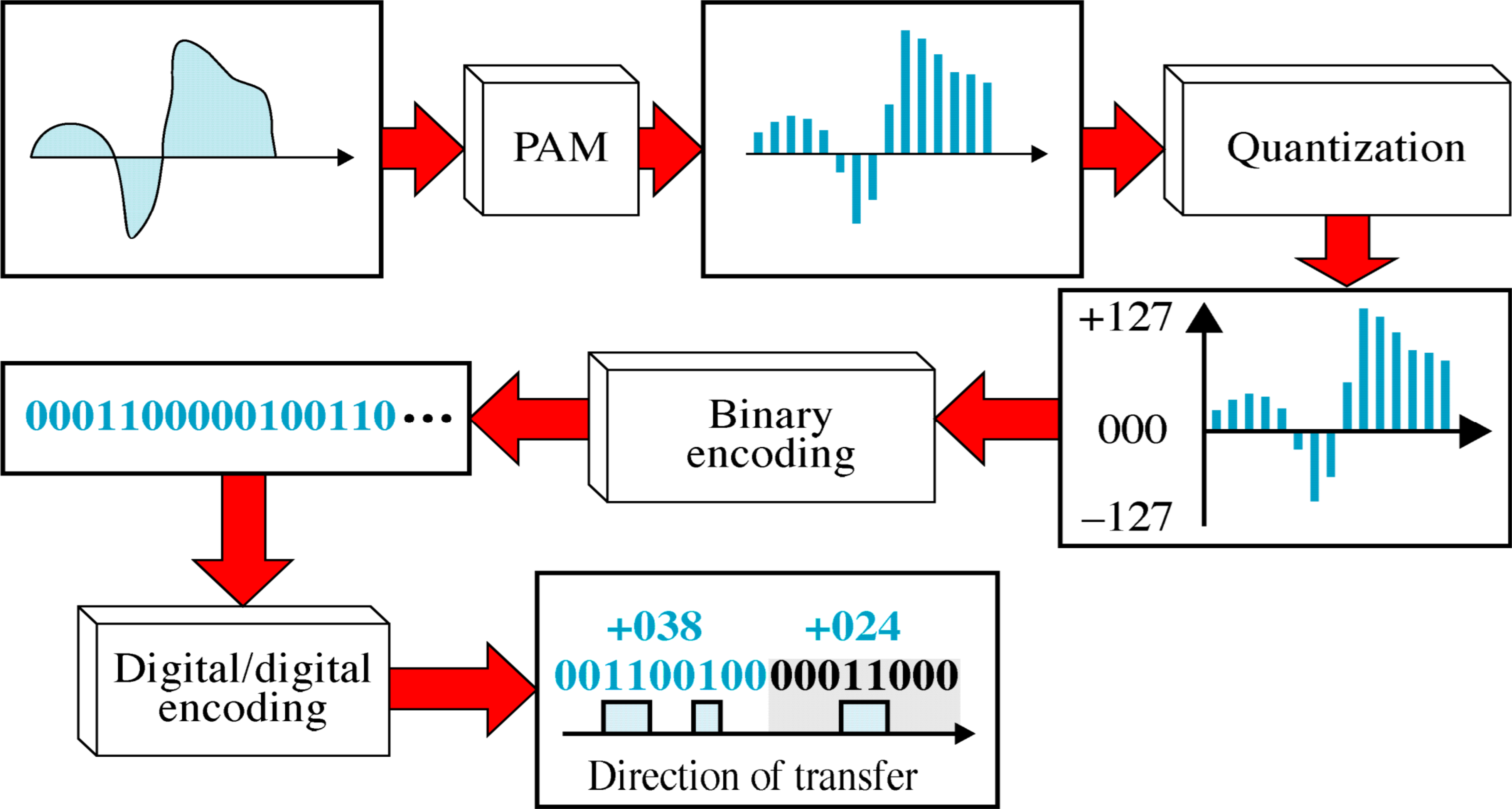
- Uses 3-4 processes to create digital signal:
- PAM (sampling)
- Quantization (discrete amplitudes +/- value)
- Binary encoding
- Digital-to-digital encoding
Key Points about PCM
- Sampling method used to digitize voice in T-line transmission
- Used in North American telecommunications system (codecs)
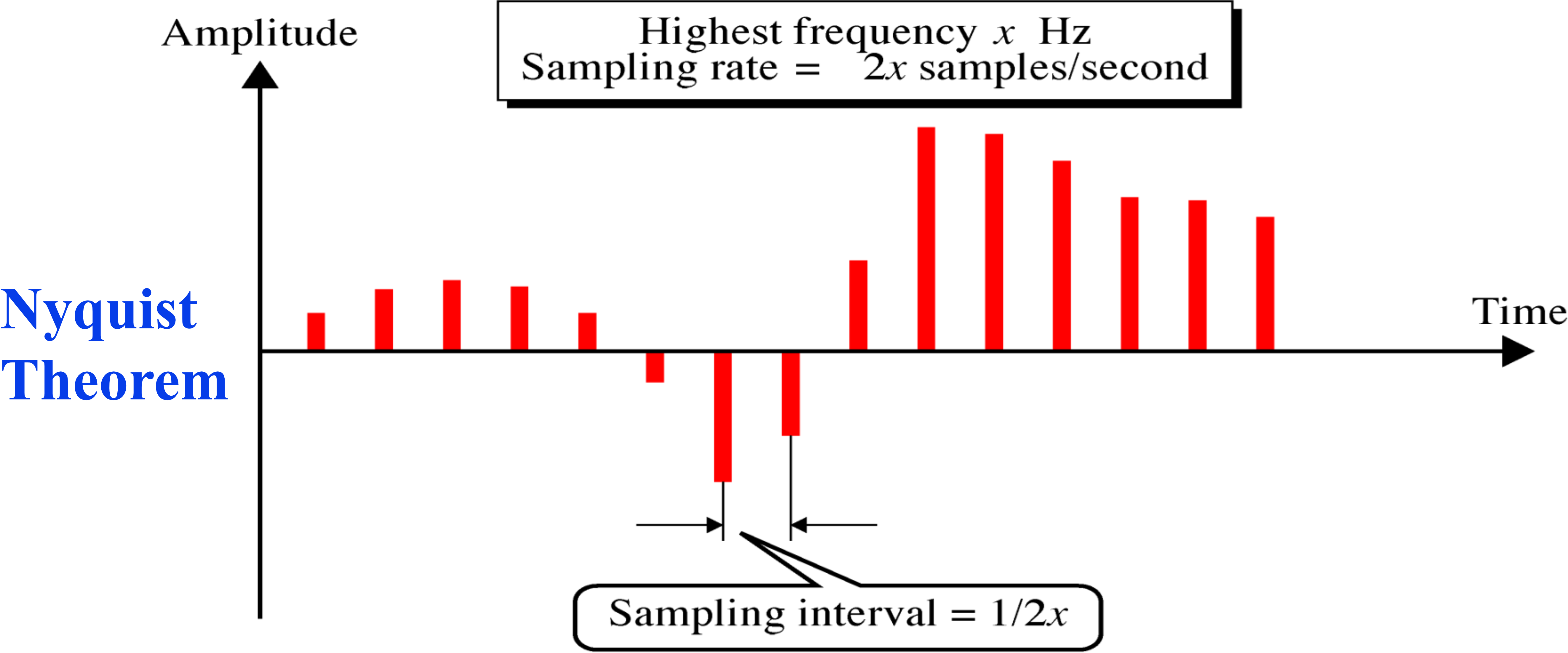
- PCM sampling rate: twice the highest frequency of original signal
- Ensures accurate reproduction of original analog signal using PAM
- Based on Nyquist Theorem
Digital-to-Analog Encoding
- Used in transmitting data from computer to computer across public access phone line
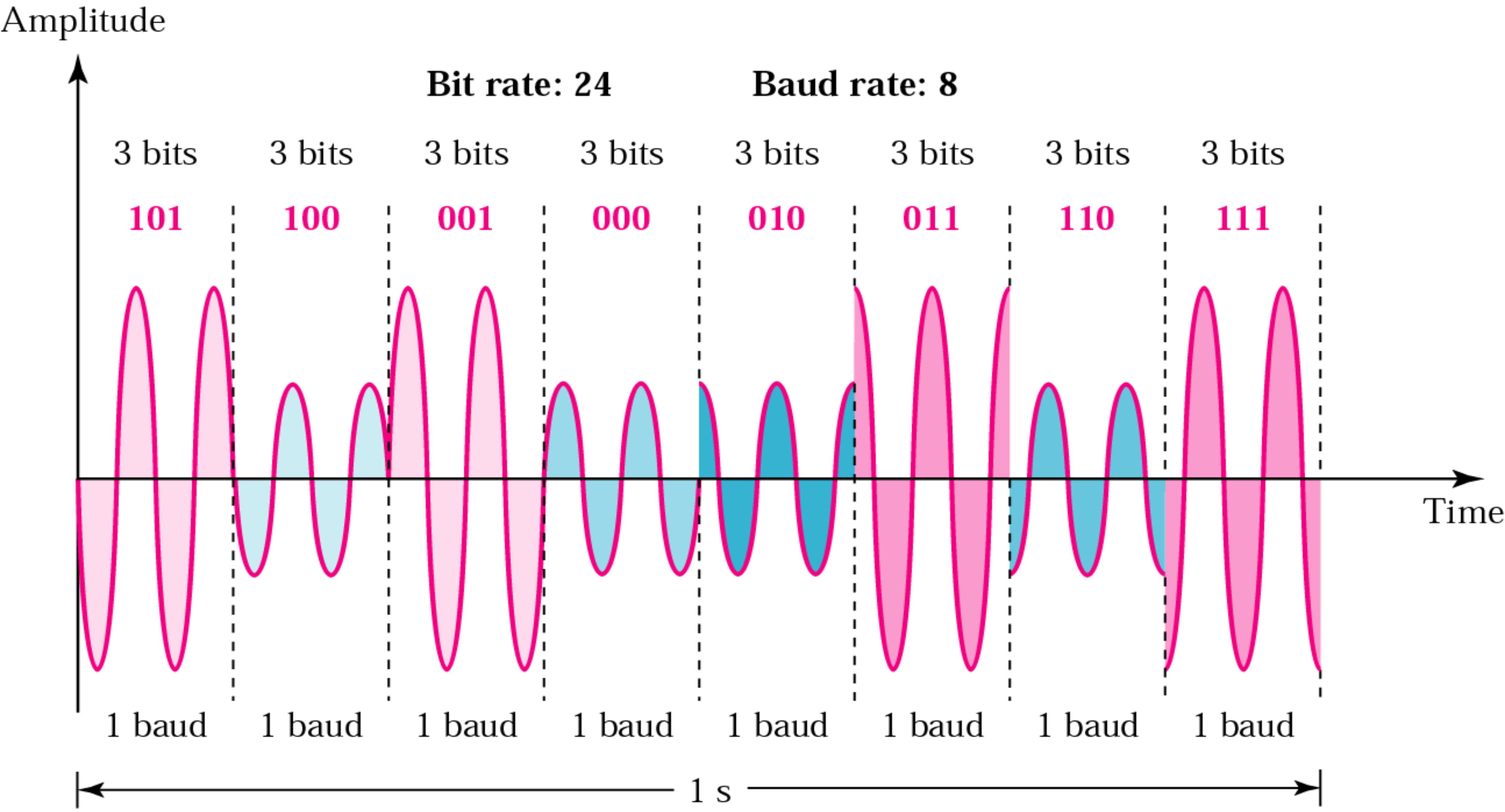
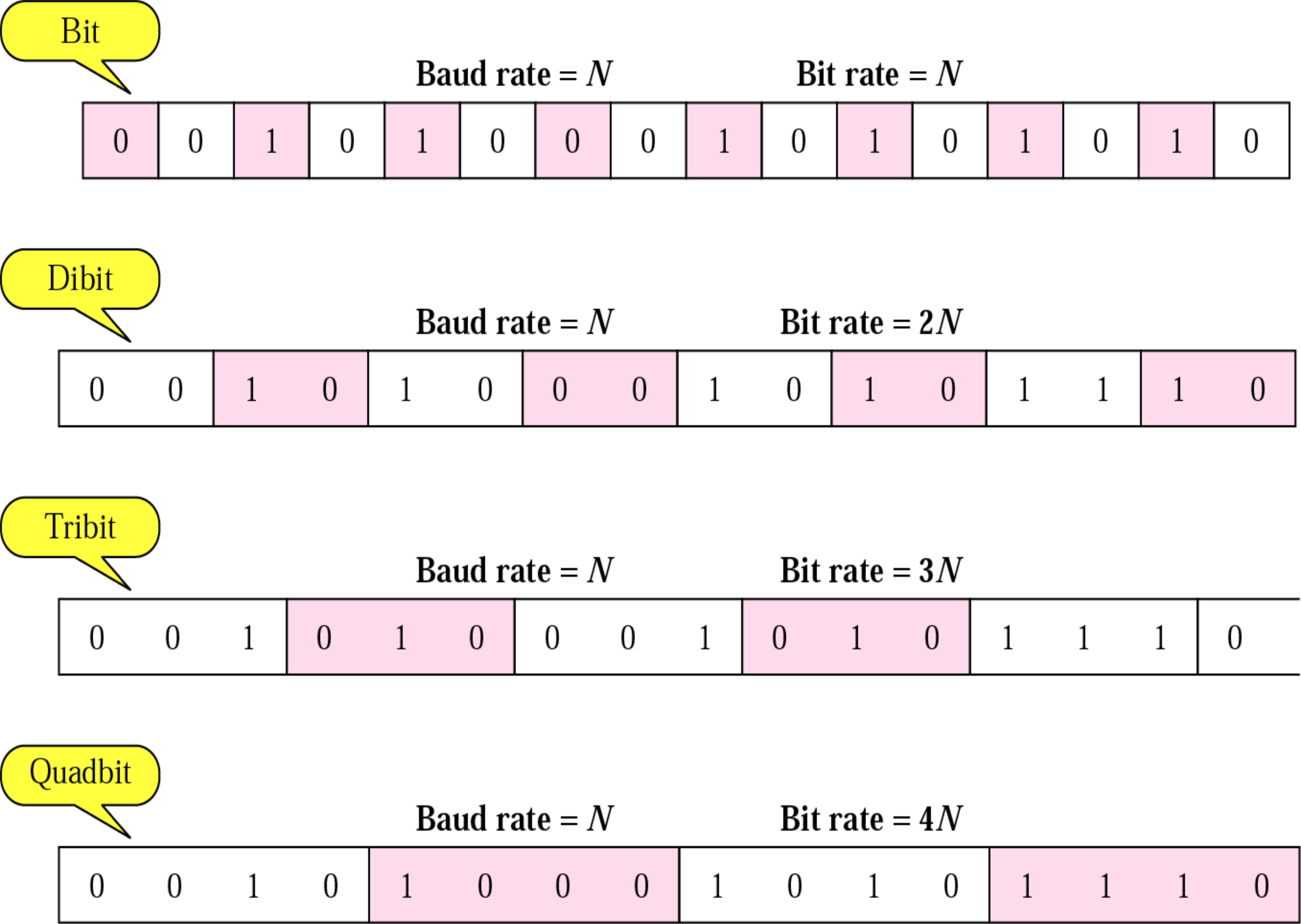
Bit Rate and Baud Rate
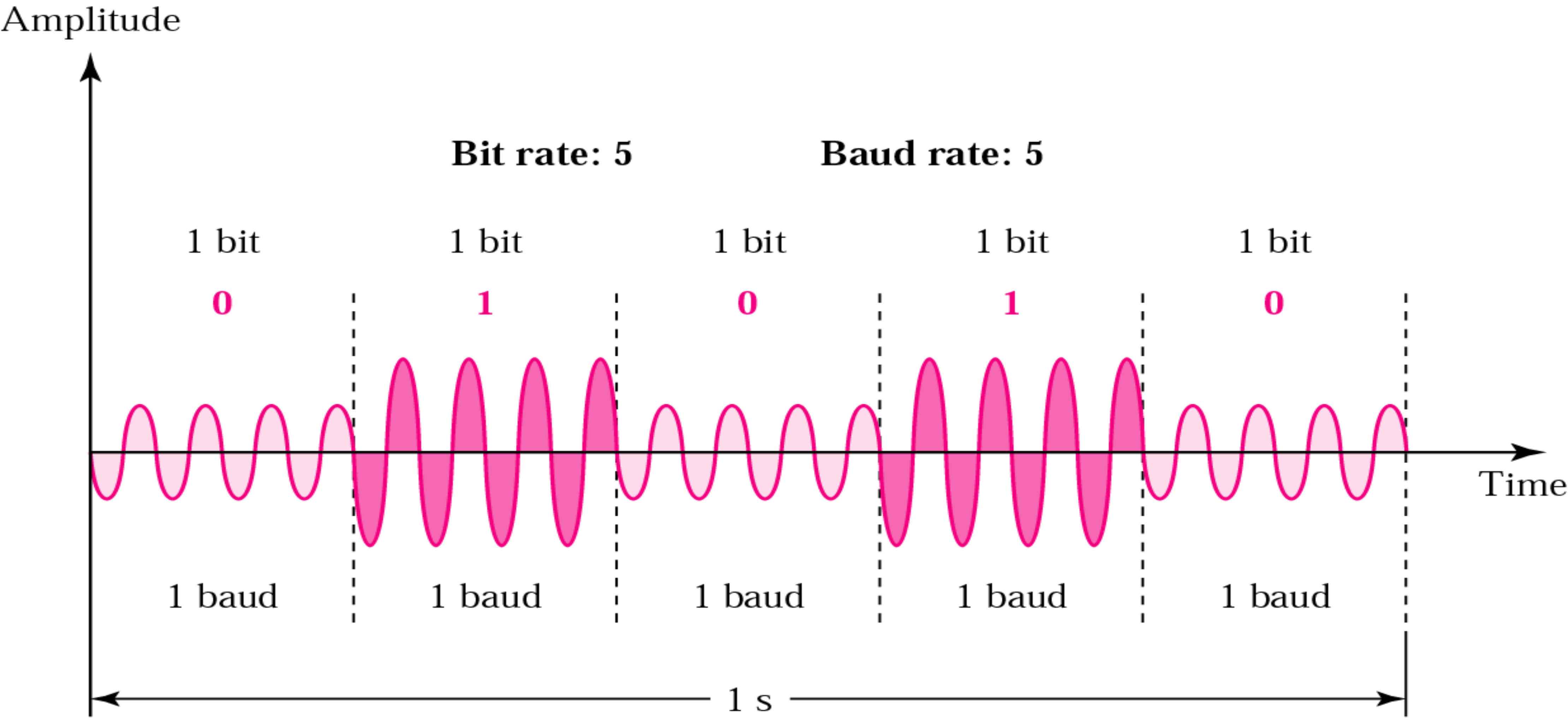
- Bit rate: number of bits transmitted per second
- always ≥ baud rate
- Baud rate: number of signal units per second required to send those bits
Formula
Carrier Signal
- High-frequency signal that acts as basis for information signal (by sender)
- Digital information encoded by modulating signal's:
- Amplitude
- Frequency
- Phase
Examples
Example 1
Problem: Analog signal carries 4 bits in each signal unit. If 1000 signal units are sent per second, find baud rate and bit rate.
Solution:
- Baud rate = 1000 bauds per second (baud/s)
- Bit rate = bps
Example 2
Problem: Bit rate of signal is 3000. If each signal unit carries 6 bits, what is baud rate?
Solution:
- Baud rate = 3000 ÷ 6 = 500 baud/s
Amplitude Shift Keying (ASK)
Characteristics
- Amplitude is varied to represent binary signals (1 or 0)
- Keying: means turning transmitter on and off
- Highly susceptible to noise interference
- Noise: random electrical signals (voltages) that generate transmission errors
- Introduced by heat from circuit components or natural disturbances
Bandwidth Relationship
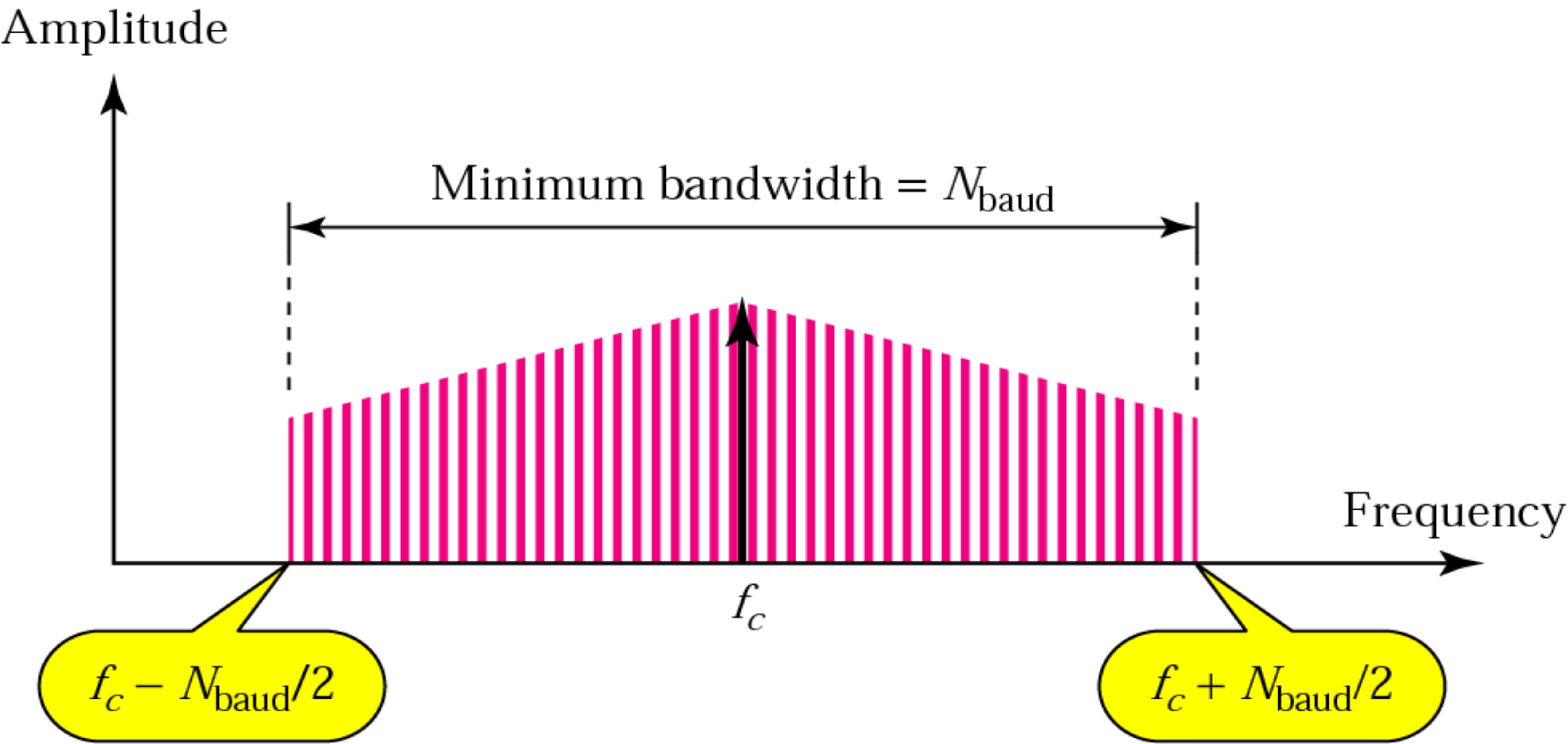
- Minimum bandwidth for ASK signal equals its baud rate
- In ASK: baud rate = bit rate = bandwidth
Examples
Example 3
Problem: Find minimum bandwidth for ASK signal transmitting at 2000 bps. Transmission mode is half-duplex.
Solution:
- In ASK: baud rate = bit rate = 2000
- Minimum bandwidth = 2000 Hz
Example 4
Problem: Given bandwidth of 5000 Hz for ASK signal, what are baud rate and bit rate?
Solution:
- Baud rate = bandwidth = 5000
- Bit rate = 5000 bps
Frequency Shift Keying (FSK)
Characteristics
- Frequency is varied to represent binary 1 or 0
- Noise interference not a problem
- Looks for frequency changes, doesn't care about voltage spikes
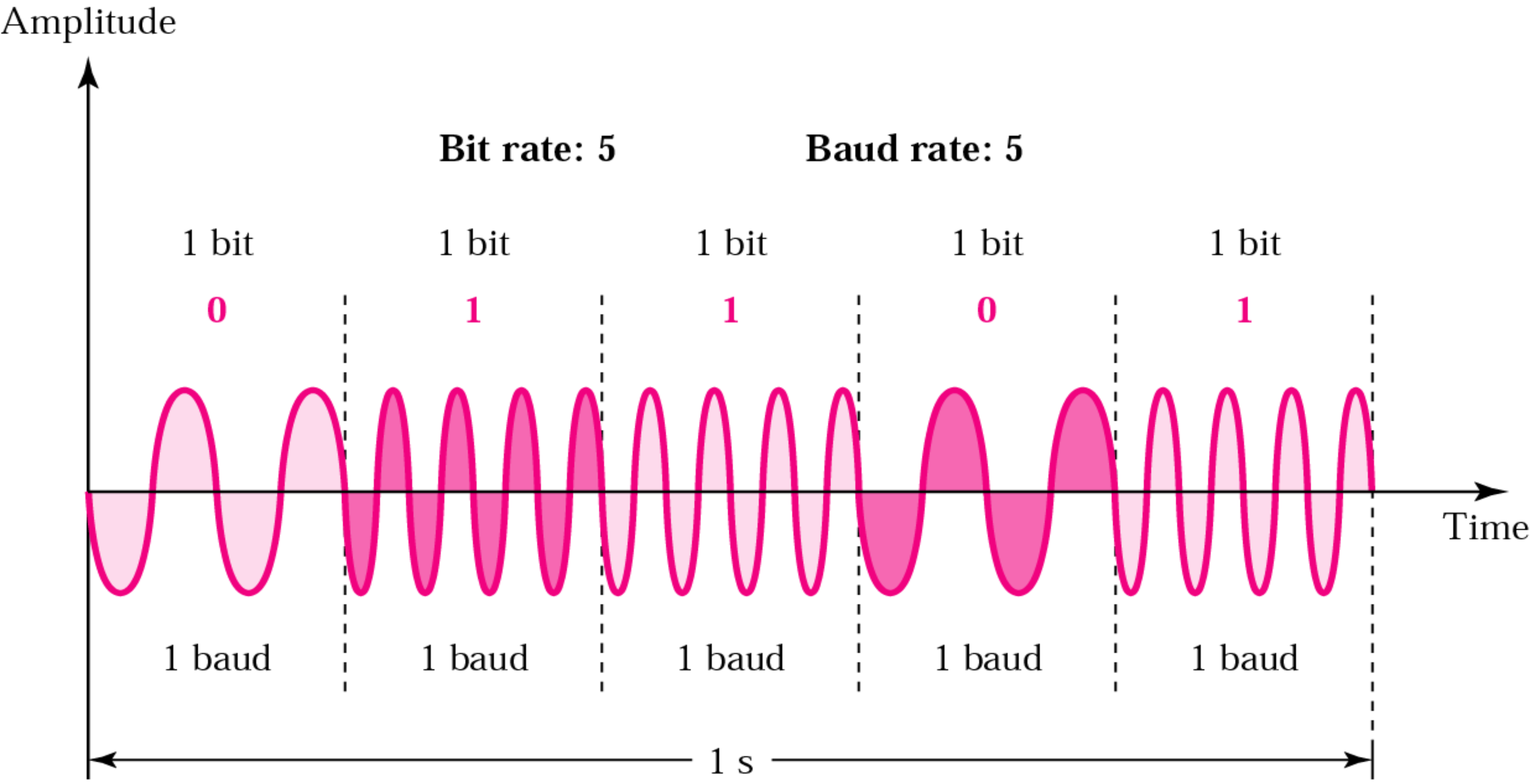
Phase Shift Keying (PSK)
Characteristics
- Phase is varied to represent binary 1 or 0
- Limited by equipment's ability to detect small phase differences
- This limits its potential bit rate
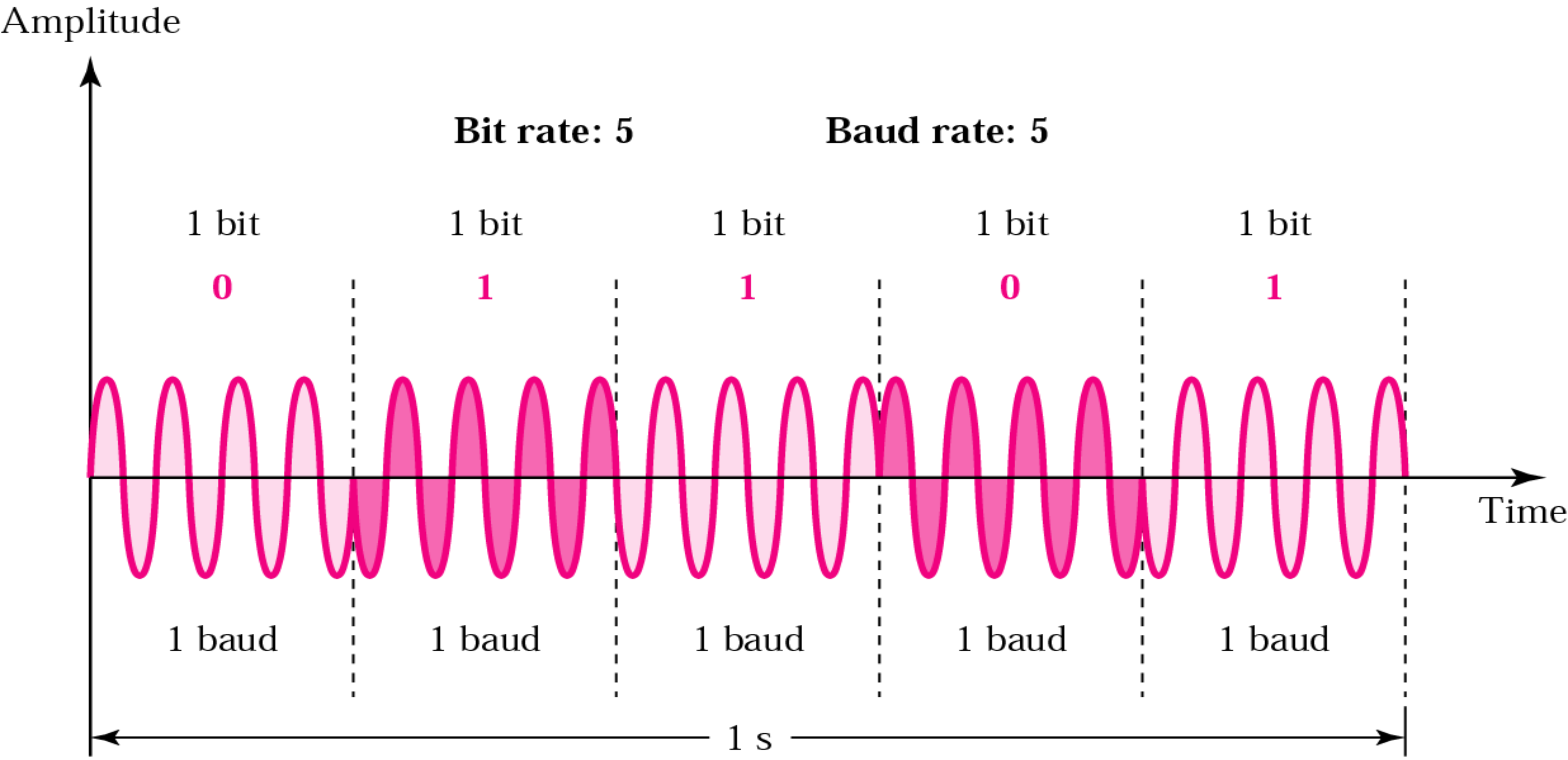
Quadrature Amplitude Modulation (QAM)
Characteristics
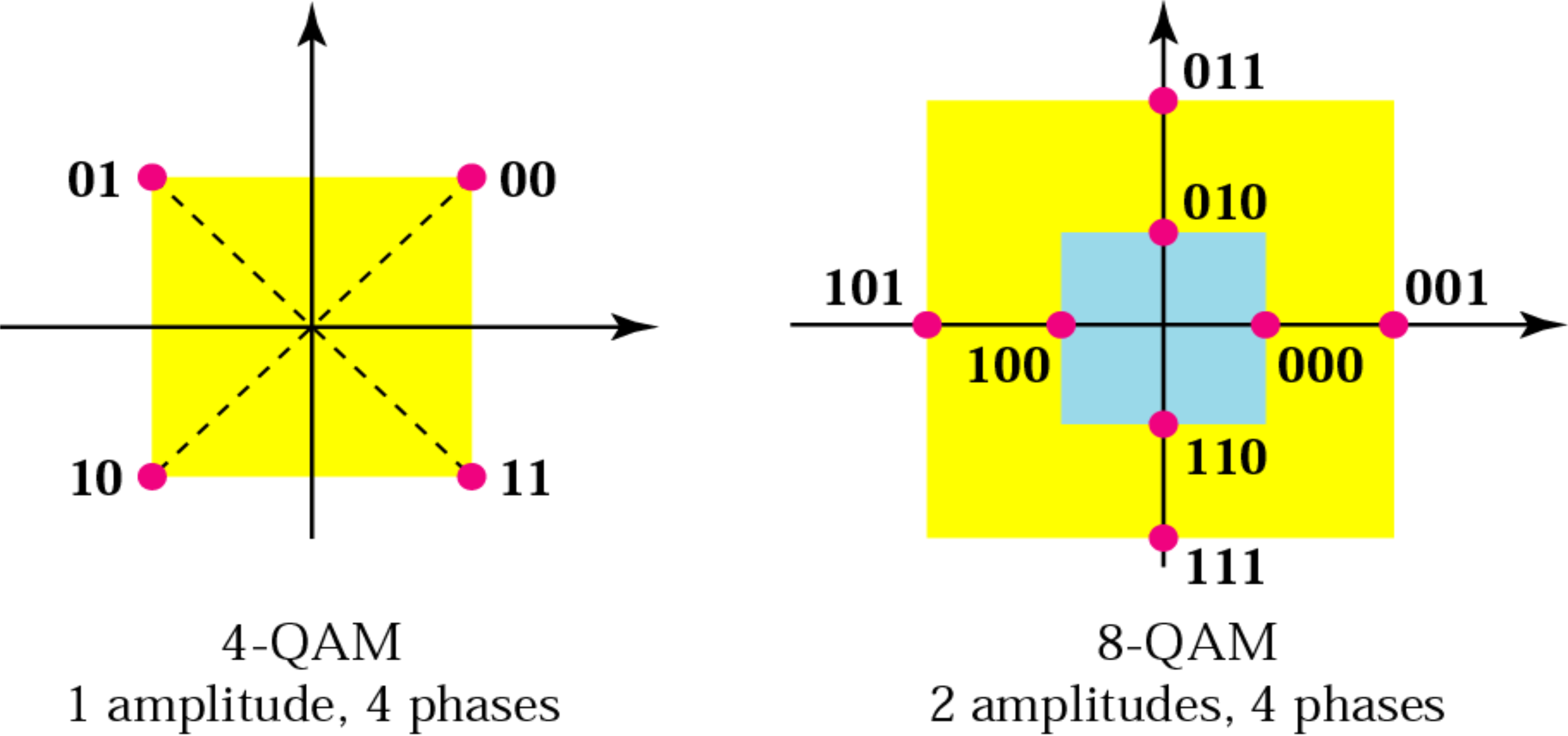
- Combines ASK and PSK for maximum contrast between bits
- Works with: bit, dibit (one-pair), quadbit (two-pair), etc.
- Theoretically: any measurable amplitude changes can combine with any measurable phase changes
- Uses more phase shifts than amplitude shifts to reduce noise susceptibility
Bit and Baud
Analog-to-Analog Encoding

Three Methods
- Amplitude Modulation (AM)
- Frequency Modulation (FM)
- Phase Modulation (PM)
Amplitude Modulation (AM)
Characteristics
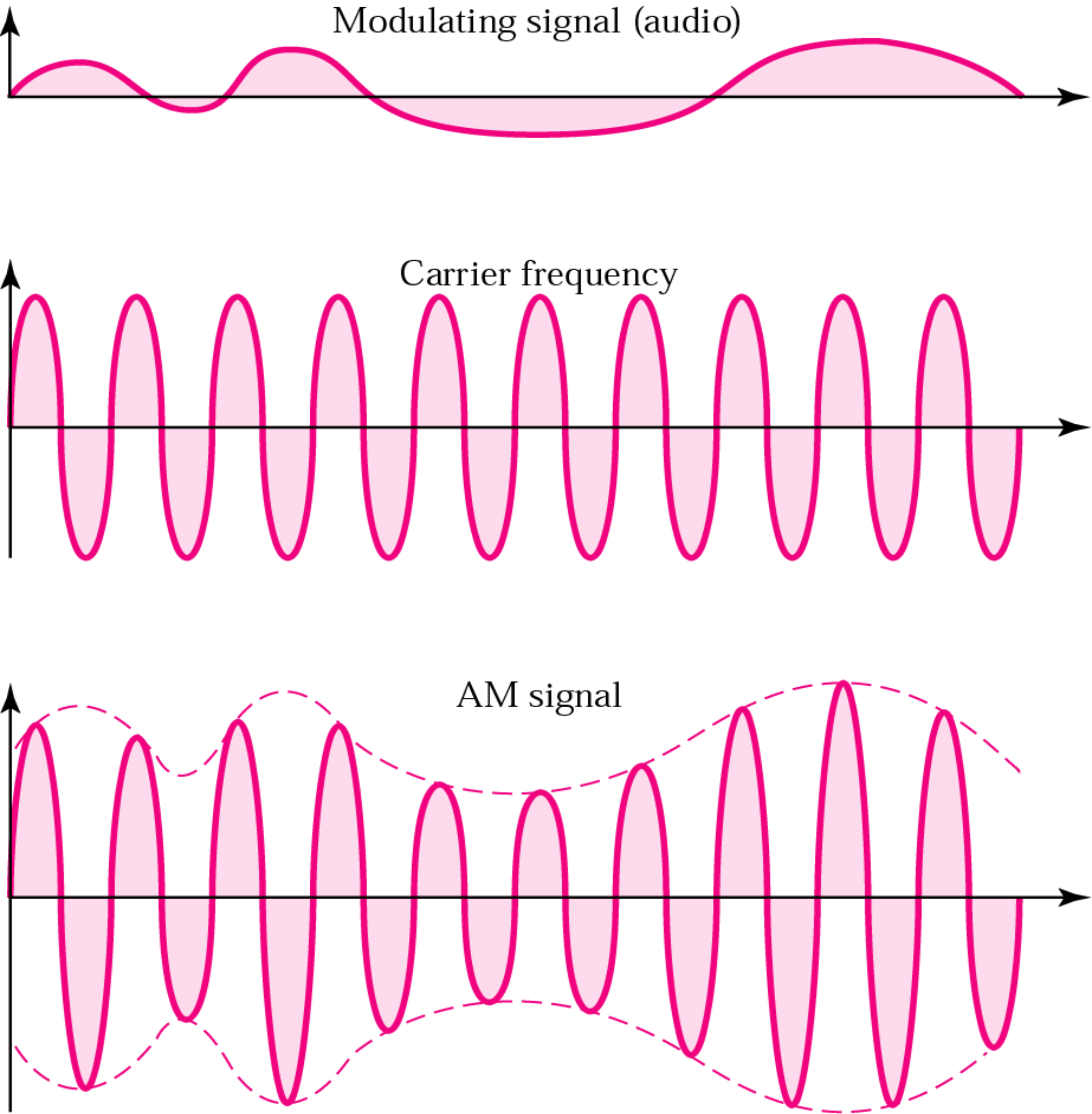
- Carrier signal modulated so amplitude varies with changing amplitude of signal
- Bandwidth: equal to twice the bandwidth of modulating signal
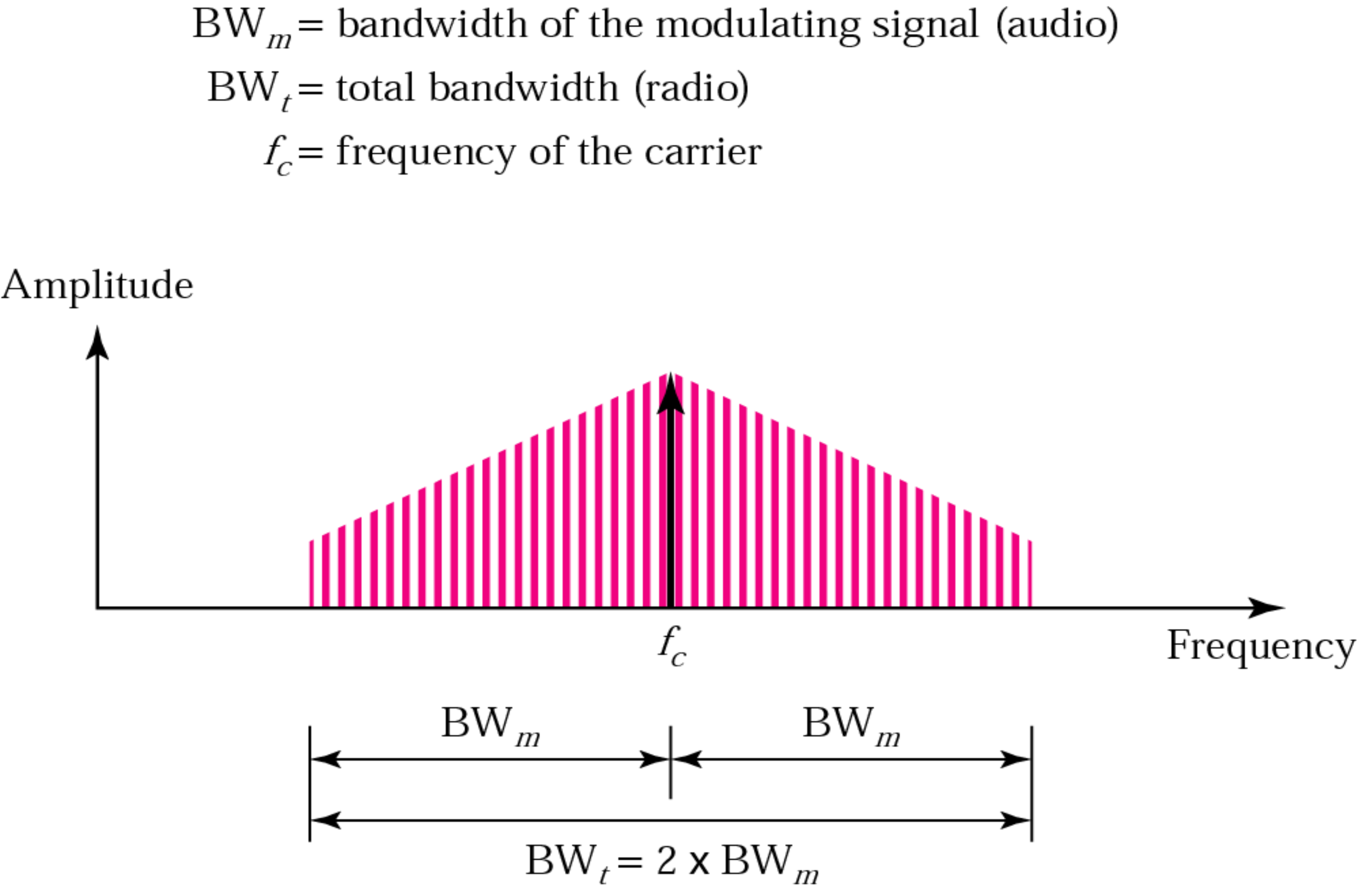
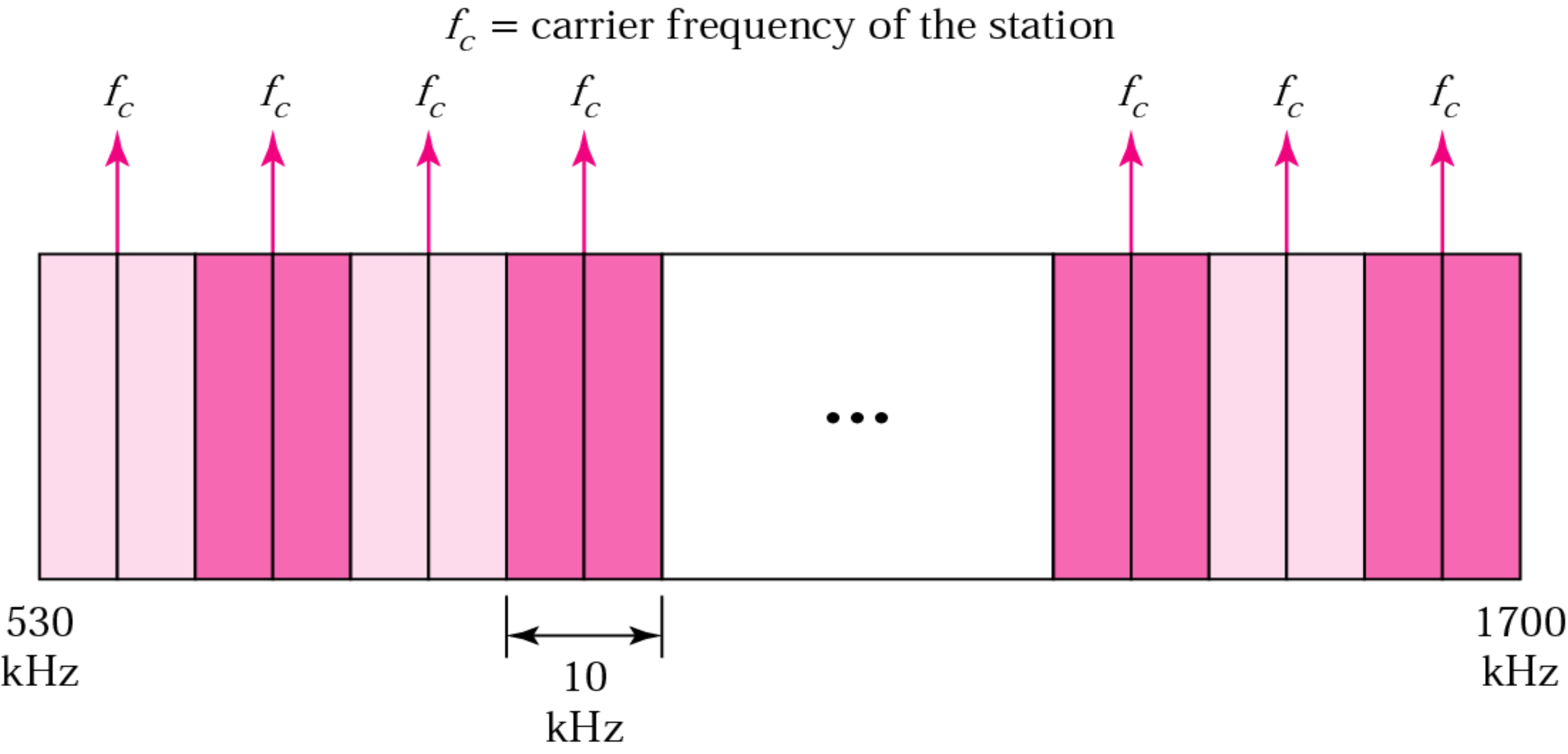
- Covers range centered around carrier frequency
- AM radio stations: need minimum bandwidth of 10 KHz
Example
Problem: Audio signal with bandwidth of 4 KHz. What bandwidth needed for AM modulation? (Ignore FCC regulations)
Solution:
- AM signal requires twice the bandwidth of original signal
- BW = KHz = 8 KHz
Frequency Modulation (FM)
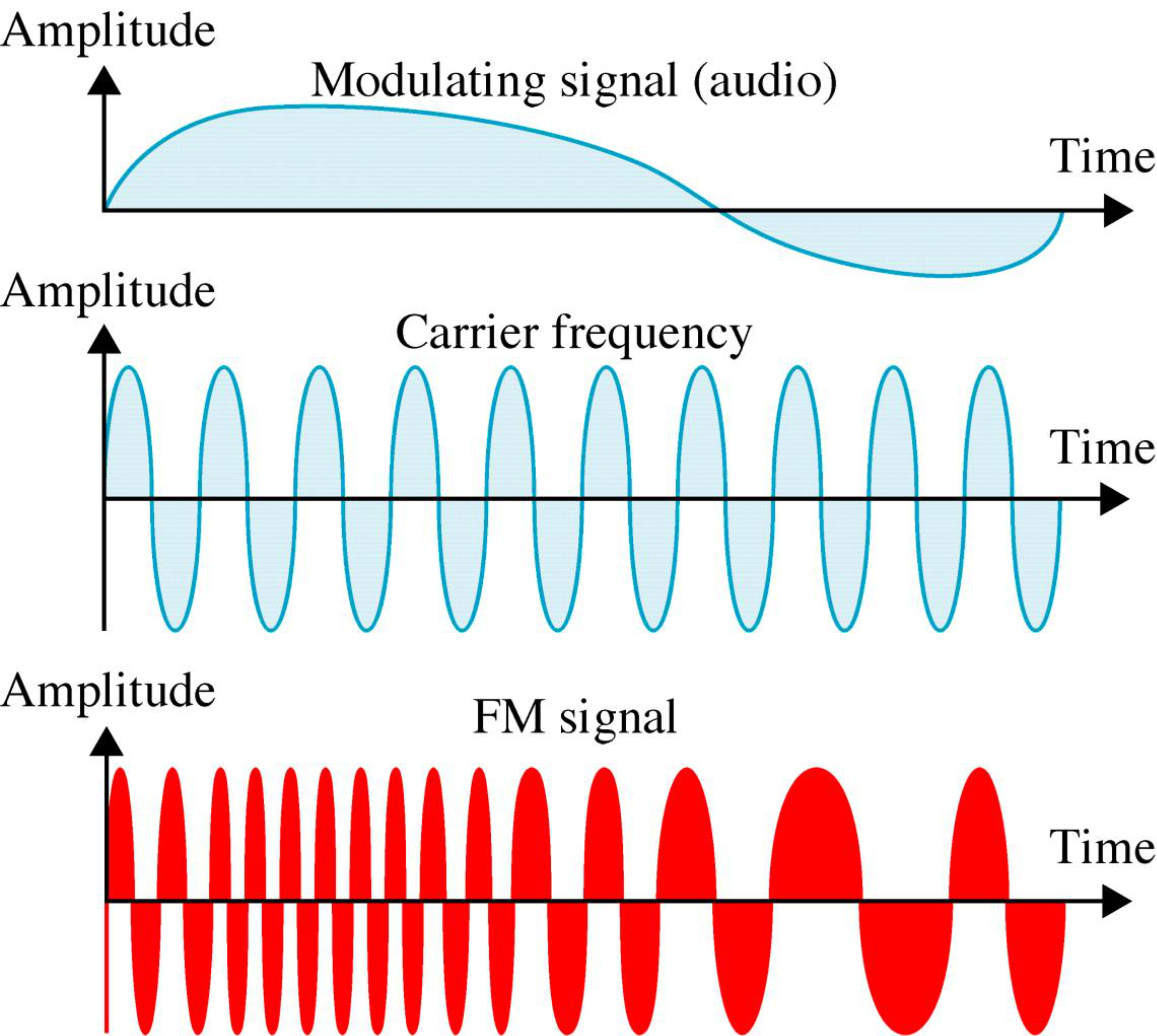
Characteristics
- Frequency of carrier signal modulated to follow changing voltage level of modulating signal
- Bandwidth: equal to 10 times the bandwidth of modulating signal
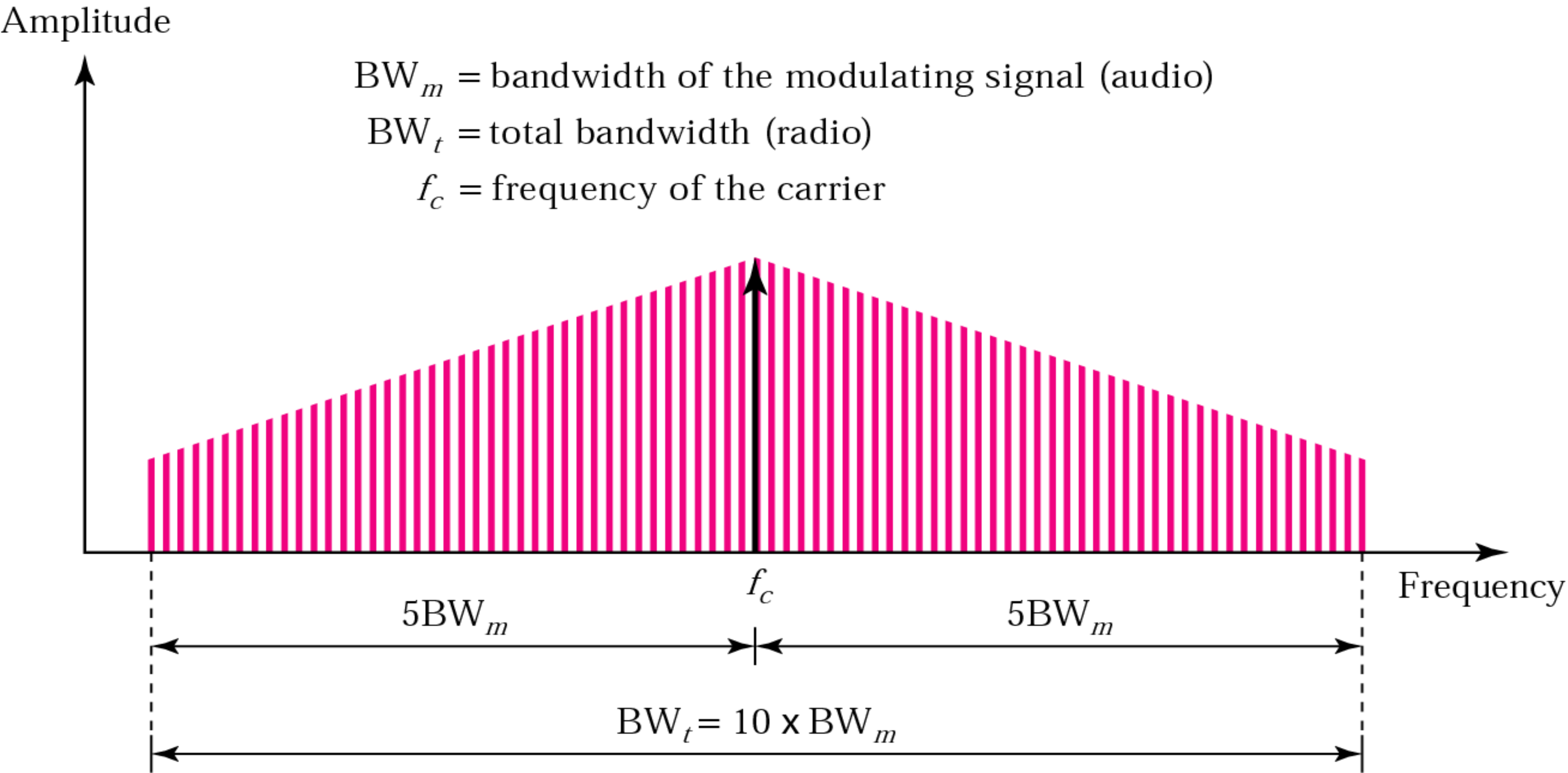
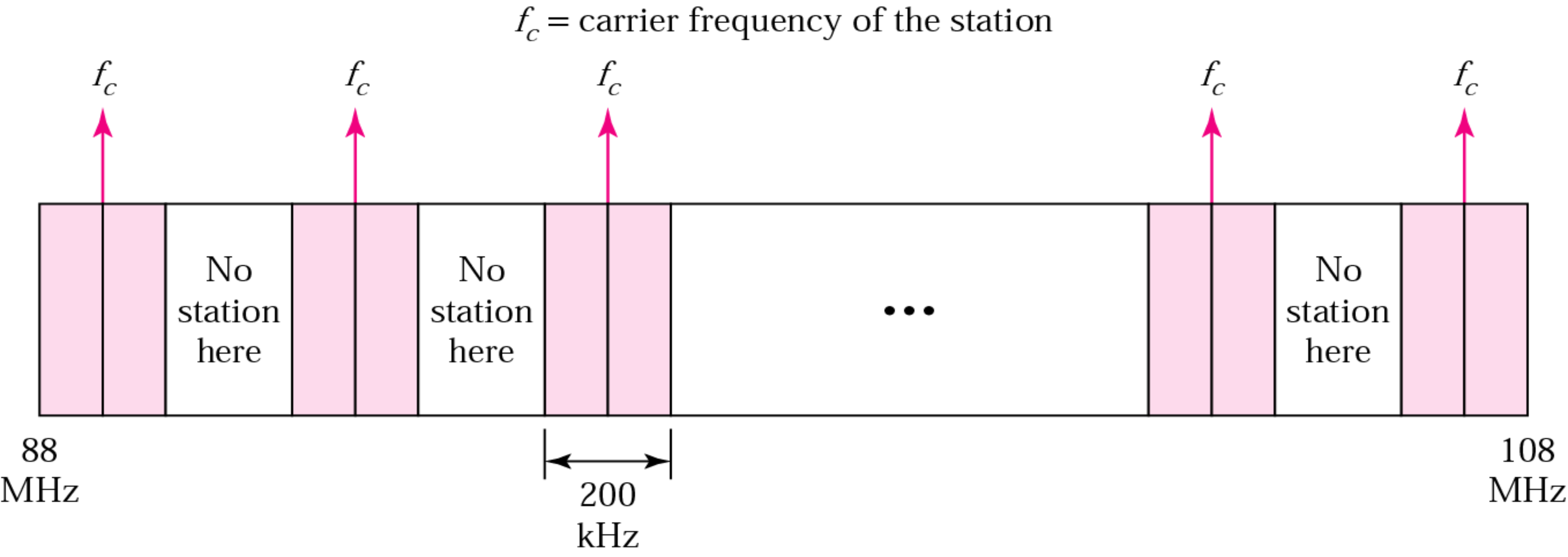
- FM station: needs bandwidth of 200 KHz (0.2 MHz)
Note
- Bandwidth of stereo audio signal usually 15 KHz
- FM station needs at least 150 KHz bandwidth
- FCC requires minimum bandwidth of at least 200 KHz (0.2 MHz)
Example
Problem: Audio signal with bandwidth of 4 MHz. What bandwidth needed for FM modulation? (Ignore FCC regulations)
Solution:
- FM signal requires 10 times bandwidth of original signal
- BW = 10 × 4 MHz = 40 MHz
Phase Modulation (PM)
Characteristics
- Phase of carrier signal modulated to follow changing voltage level of modulating signal
- Used as alternative to frequency modulation
Additional Exercises
Exercise 1
Problem: Analog signal carries 16 bits in each signal unit and each signal unit takes 0.2 second for transmission time. Find baud rate and bit rate.
Answer:
- 5 signal units can be sent in 1 second
- Baud rate = 5
- Bit rate = 16 × 5 = 80 bps
Exercise 2
Problem: Given bandwidth of 2000 Hz for ASK signal, what are baud rate and bit rate?
Answer:
- For ASK: Bandwidth = Baud rate = Bit rate = 2000 bps
Exercise 3
Problem: Given original audio signal with 25 MHz, what is total bandwidth for FM signal transmission?
Answer:
- Bandwidth of FM signal is 10 times the original signal
- Therefore, requires 250 MHz for FM transmission