Process vs Mechanism Descriptions
What's the difference?
- Process descriptions are time dependent
- They describe things that happen in steps or stages
- They may contain many mechanisms and materials, and may be natural or artificial
- (To make describing processes easier and more systematic, we allow also for the idea of natural mechanisms here, which is an expansion on our definition in the last class. E.g. We might consider wind a natural mechanism. It has an overall function and is made up of the material air and the force of movement)
Structure
-
(No diagram step is necessary this time)
Example
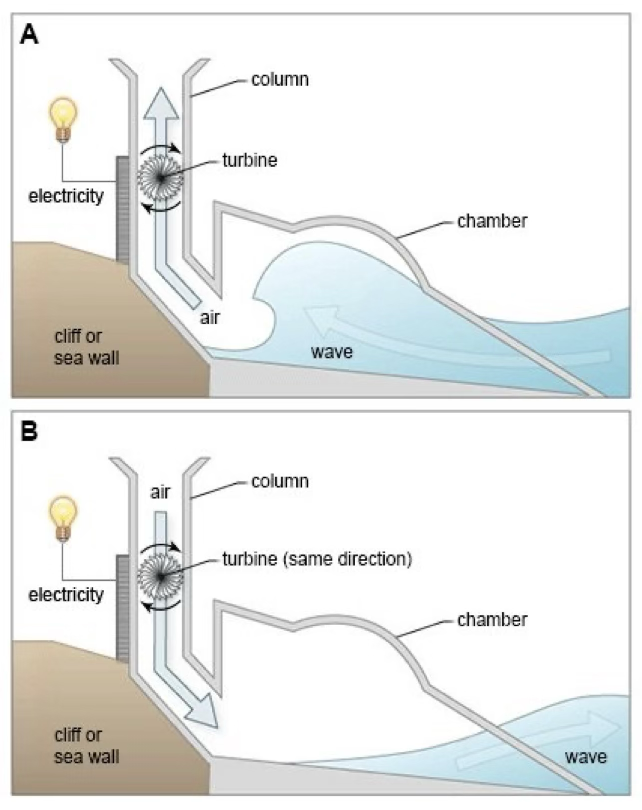
The diagrams below show a process that is used to generate electricity from wave power. Make a process description of the information
- รูปนี้อาจารย์เอามาจาก IELTS
- Title:
- Wave Power Generation
- Hydro-electircity Generation
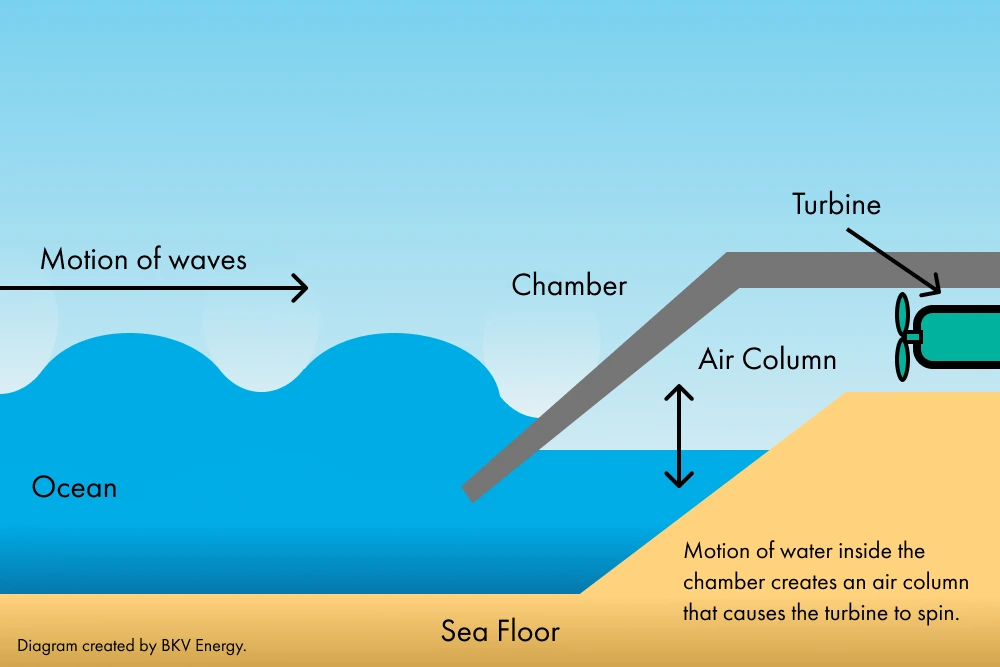
Step 1: Title
- This may be listed on the diagram
- If so, copy it. If not, think of a suitable title
- What title might we use for this diagram?
- (You do not need specific technical terms but a reasonable description that matches the diagrams is necessary. + Remember to use title case capitalization when you write the title even if there is a title that is not capitalized on the diagram)
Step 2 - Introduction and Overview
We can use the answers to these questions:
-
Is it a linear or a cyclical process?
- I think it’s cyclical ,
-
Where does the process start and end?
- Start: wave coming in the chamber
- End: wave exiting the chamber.
-
How many steps/stages are there to the process?
- Steps:
- The wave pushes the air to rotate the turbine. (1)
- the electricity being generated as turbine turn around. (1)
- the wave goes back, and it creates lower pressure down there, pull the air (2)
- the electricity being generated as the turbine rotates. (2)
- Stages:
- Wave coming in (1)
- Wave exiting the chamber. (2)
- Steps:
-
What materials/mechanisms (natural or artificial) are involved?
ให้ถามตัวเองว่า is there anything made of ___ มั้ย ถ้าไม่มีให้เป็น mechanism หมด
- Cliff (natural mechanism)
- Column (artificial mechanism)
- Chamber (artificial mechanism)
- Turbine (artificial
materialmechanism) - Pressure/Air (natural
mechanismmaterial) - Sea wave formation (natural mechanism)
- Electricity (artificial material)
-
What is the result of the process? (Is something produced etc)
- The production of electricity
Exercise 1: Write an introduction/overview
- Answer the previous questions in relation to the example given.
- Now form them into a paragraph similar to the one below:
Template
The diagram shows the (linear/cyclical) process of (from title). There are ___ stages in the process, each with several steps (or you can specify the exact number of steps). The main natural materials are.... The main artificial materials are... The main natural mechanisms are... The main artificial mechanisms are.... The outcome of the process is....
The diagram shows the cyclical process of wave-powered generation. There are 2 stages in the process, each with several steps (or you can specify the exact number of steps). The main natural materials is the pressure and the air, The main artificial materials are... The main natural mechanisms are... The main artificial mechanisms are.... The outcome of the process is....
Step 3 - Body
- Use each stage that you identified as a basis for a paragraph
- If there is only one noticeable stage with several steps, there will only be one body paragraph. This is usually not the case though
- So, normally, you should end up with 2-5 body paragraphs depending on how you organize and group the steps into stages
ใน Midterm ขอให้ถ้ามีกี่ Stages ก็ควรมี body อธิบายเรื่องพวกนั้นให้ครบนะ
Body Content Should Include:
- More detail
- What happens in each step?
- Where does it happen?
- What mechanisms/materials are involved?
- What do the steps/stages achieve or produce (if relevant)?
- Link to next stage (if relevant)
Sample Body Paragraph (Stage 1)
- In the first part of the diagram, the incoming wave fills a large chamber. This forces the air inside this space up the column and through the turbine. The flow of the air rotates the turbine which begins to generate a current of electricity. [description of steps and outcome of stage] The process does not end there, for the structure is able to continue producing power in the next stage. [Link to next stage/paragraph]
Exercise 2: Write a body paragraph
Use the previous example to help you write the second body paragraph.
- In the second (lower) part of the diagram, the wave begins to exit a large chamber. This results in a lower pressure within the space in the column and chamber, causing the air entering through the column to rotate the turbine. This rotation generates an electric current once again.
Supplementary Exercise: Describe the Process
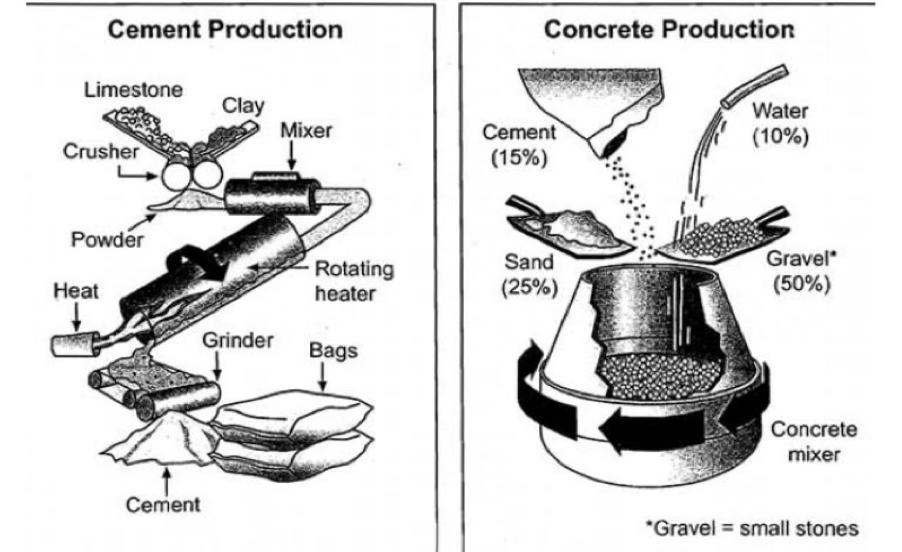
- Cement and Concrete Production Process
Graded Writing
- Next Week: Mechanism Description Test (10%)
- Starts at 15 minutes past class start time
- Finishes after exactly one hour
- Please be on time. You will not be locked out if you are late but you will have one point deducted
- Afterwards, there will be an opportunity to ask questions about the midterm or anything else you are unsure of (optional)
- As with all texts, this will be marked first out of 15 according to the rubric. In this case, it will then be converted to 10%
Mid-Term
Process description on IELTS (Section 1 or Part 1 อะไรซักอย่าง)
- Duration: 2 hours
- 2 parts:
- Grammar questions: 10%
- Tenses (mixture of MCQs similar to the practice test and fill-in-the-blanks type questions)
- Writing: 20%
- ONE piece of writing from a CHOICE of two
- ANY of the types of writing you have studied may appear on the exam (except mechanism descriptions)
- Memo, emails, but not mechanism description - อะไรก็ได้ ต้องจำให้หมดเลย Good news, bad news memo!
- Grammar questions: 10%
Attached rubric,