Linearity Property
- All of the circuits which we plan to analyze can be classified as linear circuits
- A linear circuits as a circuit composed entirely of
- independent sources, (Circle)
- linear dependent sources, (Square)— ถ้าเป็น ได้ แต่ถ้า ไม่ได้นะ
- and linear elements— ง่ายสุดก็คือ Resistor
Linear เอาง่าย ๆ ก็จะหมายถึง ตาม Ohm’s Law นั่นเอง!
- A linear circuits as a circuit composed entirely of
- ทั้งหมดนี้จึงทำให้เกิด Superposition Principle นั่นเองงงงง
Superposition
- In any linear resistive network, the voltage across or the current through any resistor or source may be calculated by adding algebraically all the individual voltages or currents caused by the separate independent sources acting alone, with all other independent voltage sources replaced by short circuits and all other independent current sources replaced by open circuits.
Steps to apply superposition principles are as follow.
- Select one of the independent sources. Set all other independent sources to zero (kill).
- Dependent sources are in general active in every experiment.
- Relabel voltages and currents using suitable notation
- Analyze the simplified circuit to find the desired currents and/or voltages
- อาจจะเป็นง่าย ๆ เช่น Voltage Divider หรือว่ายากหน่อยก็ Node/Mesh
- Repeat steps 1 through 3 until each independent source has been considered.
- Add the partial currents and/or voltages obtained from the separate analyses.
- ตรงนี้ระวังเรื่องเครื่องหมายด้วยนะในการ sum
- Superposition technique is based on linearity. For this reason, it is not applicable to effect on power due to each source, because the power absorbed by a resistor depends on the square of the voltage or current. If the power value is needed, the current through (or voltage across) the element must be calculated first using superposition.
Source Transformation
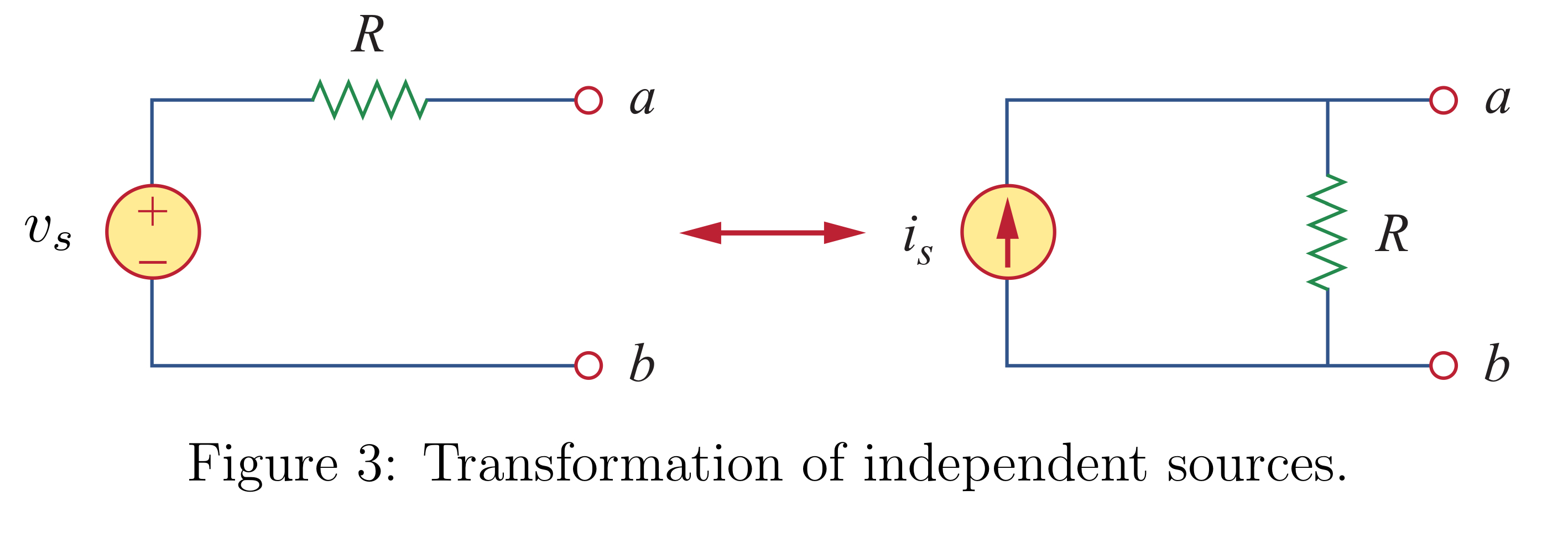
- This technique is the concept of equivalence.
Mnemonic: VS, CP
- Voltage source and series resistor → Current source and parallel resistor
- Current source and parallel resistor → Voltage source and series resistor
- Source transformation also applies to dependent sources
Warning
ก็เหมือนใช้แค่ Ohm’s Law หนิ มีอะไรที่ต้องระวังมั้ย? → มี!!
- The arrow of the current source is directed toward the positive terminal of the voltage source.
- Source transformation is not possible when , which is the case with ideal voltage source.
Summary of Source Transformation
- A common goal in source transformation is to end up with either all current sources or all voltage sources in the circuit
- อันนี้ก็เพราะว่า พอมันเป็น Source เดียวกันแล้ว เราจะสามารถยุบรวมกันได้
- Repeated sources transformations can be used to simplify a circuit by allowing resistors and sources to eventually be combined
- ทำกี่รอบก็ได้ ไปเรื่อย ๆ รวม ได้เยอะ ๆ
- The resistor value does not change during a source transformation, but it is not the same resistor
- If. the voltage or current associated with a particular resistor is used as a controlled variable for a dependent source, it should not be included in any source transformation
- If the voltage or current associated with a particular element is of interest, that element should not be included in any source transformation.
- อย่ายุบรวมอะไรที่ต้องการหา โอเคม้ายยย
- In a source transformation, the head of the current source arrow corresponds to the ”+” terminal of the voltage source.
Thevenin’s Theorem
เป้าหมายทั้งหมดคือ— A way to reduce the complexity of an electric circuit so that it can be analyzed more easily
-
ต้องการสร้าง Equivalent Circuit ให้อยู่ในรูปแหล่งจ่าย 1 ตัว + ความต้านทาน 1 ตัว
- Thevenin— Voltage Source and Series Resistor
- Norton— Current Source and Parallel Resistor
-
If a circuit has a variable element while other elements are fixed, each time the variable element is changed, the entire circuit has to be analyzed again.
-
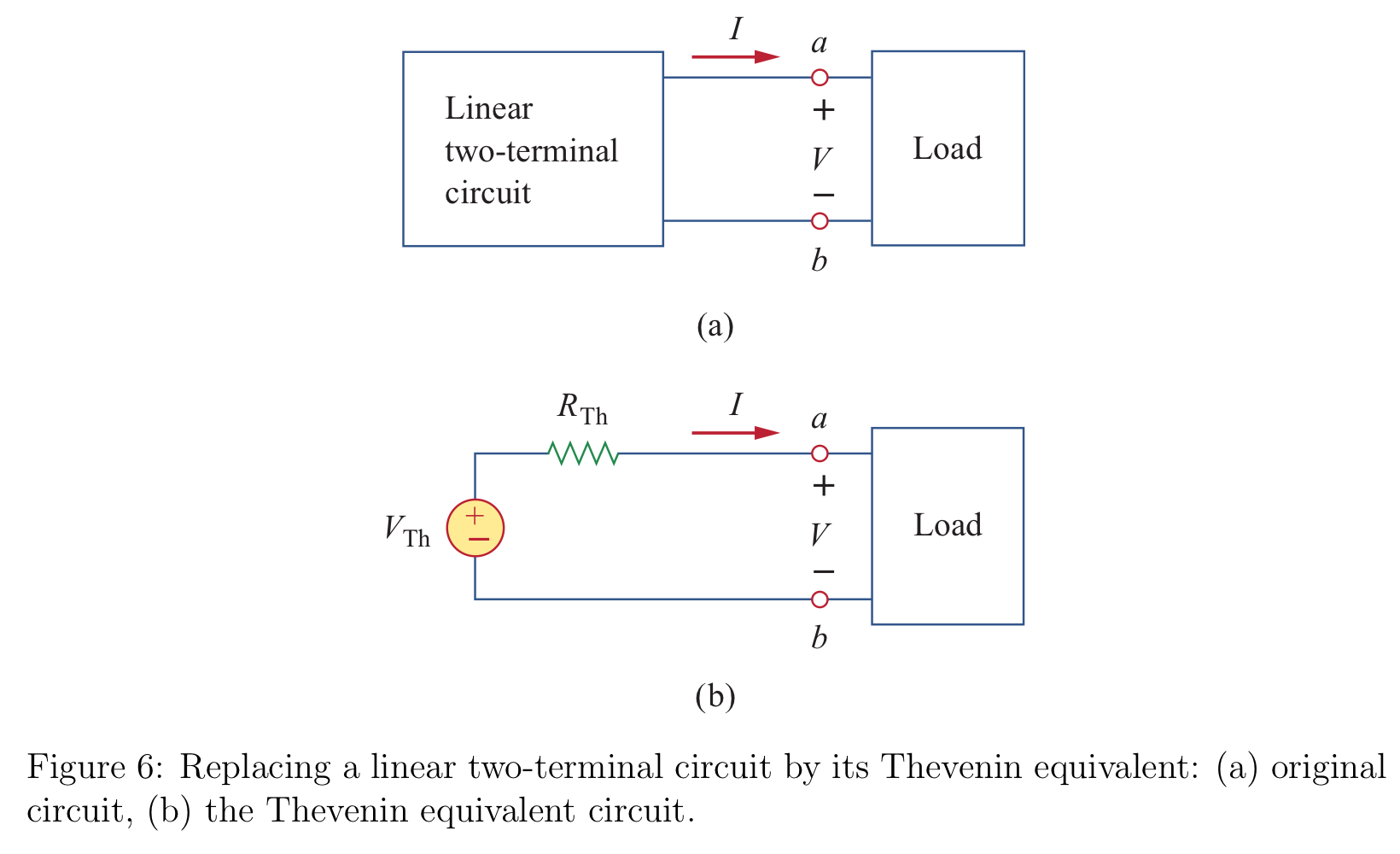
Thevenin’s theorem can help simplify the calculation by replacing the fixed part of the circuit by an equivalent circuit as follows.
-
Thevenin’s theorem states that a linear two-terminal circuit can be replaced by an equivalent circuit consisting of a voltage source in series with a resistor , where is the open-circuit voltage at the terminals and is the input or equivalent resistance at the terminals when the independent sources are turned off.
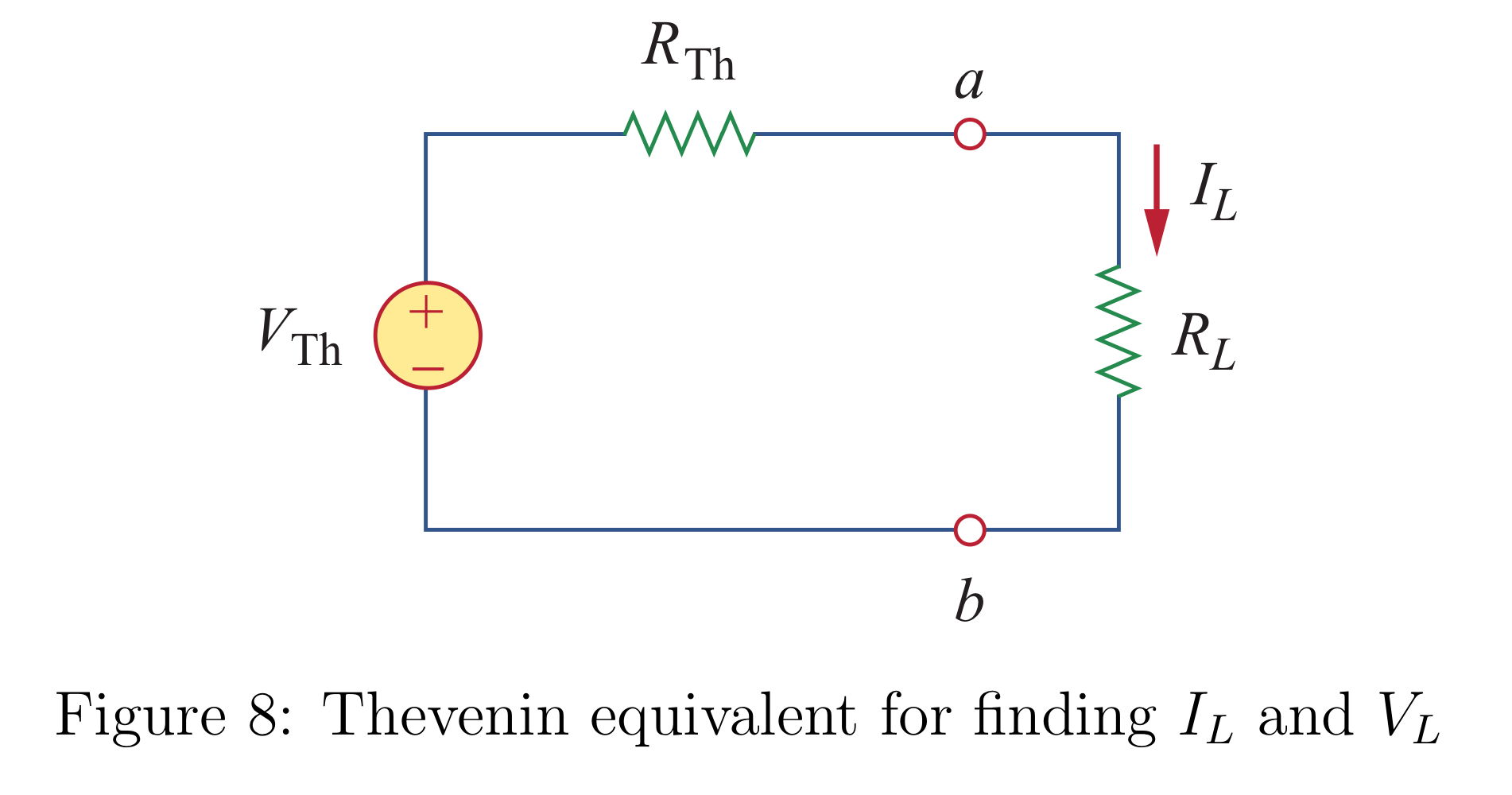
ไม่ว่าจะมี/ไม่มี Dependent Source หา เหมือนกันเลย ก็ใช้ Node, Mesh Analysis
Finding and without Dependent Sources
Finding
and without Dependent Sources
- Find : Turn off all independent source. (Kill ให้หมดเลย)
- ปลด Load แน่นอน
- ก็เหมือนเดิม Voltage Source ก็ Short Circuit, Current Source ก็ Open Circuit
- หลังจากนั้นก็แค่ยุบ ให้เหลือตัวเดียว ง่าย ๆ ชิว
- Find : Open the two terminal (remove the load)— อันนั้นแหละคือ ที่เราต้องการหา
- ก็อาจจะใช้ Node, Mesh Analysis เหมือนเดิมนั่นแหละ หา ที่ตกคร่อมตรงที่เราเอาออกไปนะ
- แต่ส่วนใหญ่แล้วใช้ Node Analysis, Source Transformation ในการหานะ!
- Connect and in series to produce the complete Thevenin equivalent of the original circuit.
Finding and with Dependent Sources
- Kill all independent source (ที่เป็นวงกลม) แต่ห้ามแตะต้อง Dependent Source
- ใส่ Voltage Source () หรือ Current Source () ที่รู้ค่าเข้าไปที่ขั้ว และ
- ถ้าใส่ Voltage Source ให้คำนวณหา ที่ไหลผ่าน เพื่อใช้คำนวณ
- ถ้าใส่ Current Source ให้คำนวณหา ที่ตกคร่อม เพื่อใช้คำนวณ
แนะนำว่าควรใช้ หรือ เพราะคำนวณง่าย!
Norton’s Theorem
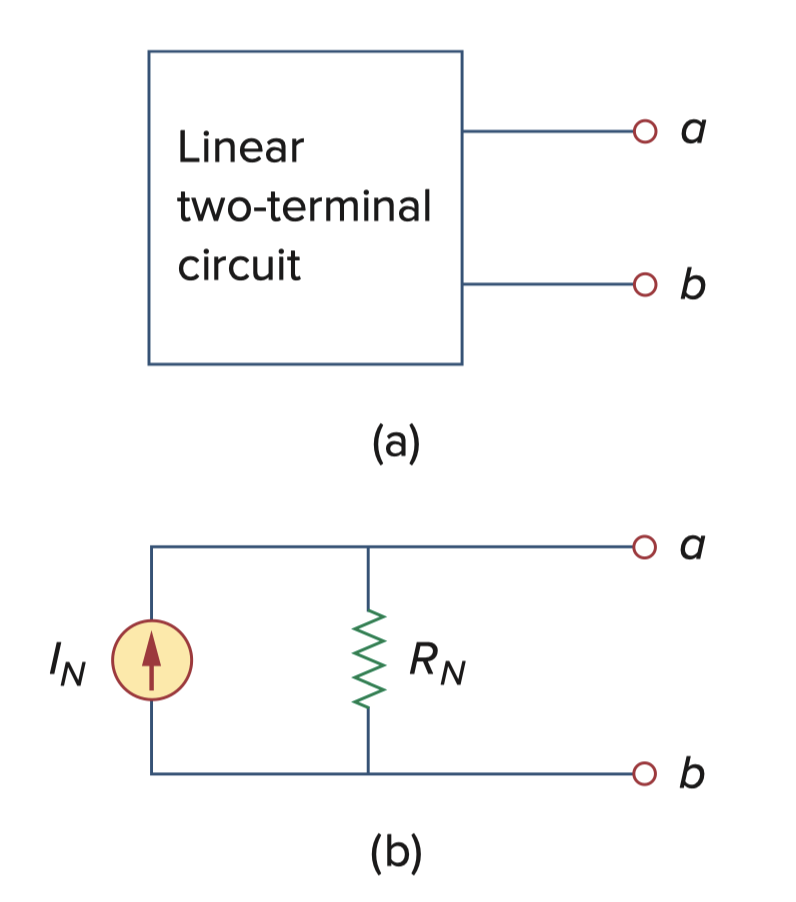
- Norton’s theorem states that a linear two-terminal circuit can be replaced by an equivalent circuit consisting of a current source in parallel with a resistor , where IN is short-circuit current through the terminals and is the input or equivalent resistance at the terminals when the independent sources are turned off.
มีค่าและวิธีการหาเหมือนกับ ทุกประการเลยนะ แต่อย่าลืมว่าถ้าเป็น Norton มันจะเอาไป Parallel
- หรือว่าไม่อยากคิดให้ยุ่งยาก ก็แค่เอา Thevenin แล้วมาทำ Source Transform ให้กลายเป็น Norton
Finding and without Dependent Sources
Finding
and without Dependent Sources
- Find : วิธีเดียวกับ ทุกประการ
- Find : Short circuit terminal A-B. Find current pass through a and b, that is
- ก็เหมือนเอา Ammeter ไปวัดตรงปลายอะ
- Connect and in parallel to produce the complete Norton equivalent of the original circuit.
Maximum Power Transfer
- ก็คงเจอคู่กับ Dependent Source ด้วย (ทบทวนนน!)
- สำคัญมาก!
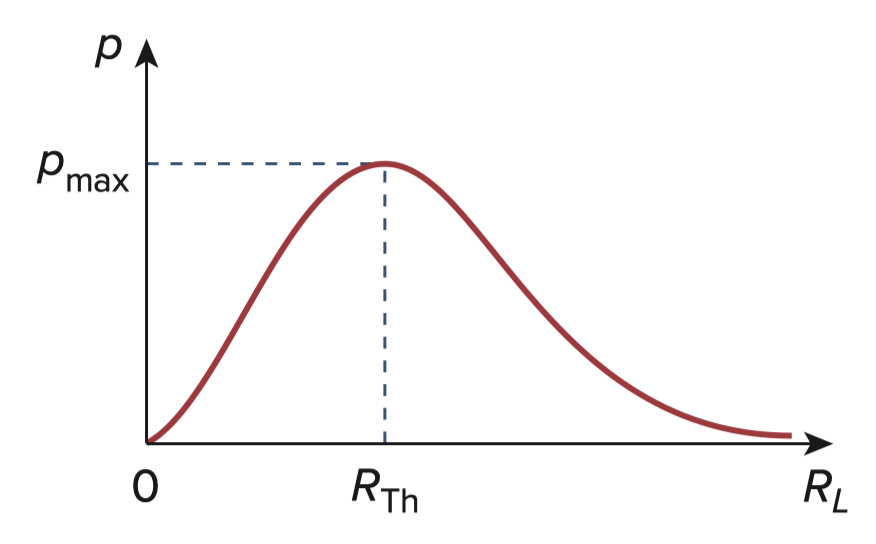
กำลังงานจากแหล่งจ่าย ส่งไปยัง Load ทำยังไงให้เกิดกำลังงานสูงสุด
- When select which method is better (mesh, node), the number of variables tell you that!