- Suppose we have Coin 5, 6, 10
- What is the minimum of coin that gives the value of 12
- ถ้าที่เคยเรียนไปแล้ว
- Brute Force ก็เอาทุก possible ways เลย แม้ว่า
- Greedy คือเราเลือกจากอันสูงสุดก่อน ก็คือ 10, ไล่ลงมา ก็เป็น (OK Solution)
- แต่มันก็ไม่ได้ Optimal (เพราะเราใช่ 3 coin) แต่จริง ๆ มันก็มี
- Dynamic Programming ก็สามารถมาช่วยตรงนี้ได้!
Idea of Dynamic Programming
- Invented by Richard Bellman in the 1950s for optimizing multistage decision problems.
- "Programming" refers to planning, not coding.
- Used for problems with overlapping subproblems and optimal substructure.
- Good for optimization problems
- Dynamic programming suggests solving each of the smaller subproblems only once and recording the results in a table from which we can then obtain a solution to the original problem.
Steps in Dynamic Programming
- Characterize the structure of an optimal solution.
- Define the value of an optimal solution recursively.
- Compute the value iteratively (bottom-up fashion).
- Construct the optimal solution (from computed information).
Fibonacci Example
Recursive (Inefficient)
ALGORITHM F(n)
BEGIN
    if n <= 1 then return n
    else return F(n-1) + F(n-2)
END.
This creates a large recursion tree with repeated calculations.
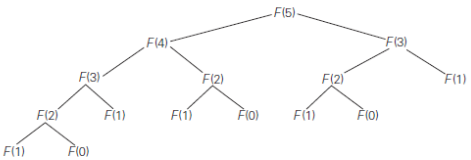
Tree of recursive calls for computing F(5)
- ถ้าดูอันนี้จะเห็นว่า
F(2)ถูกเรียกตั้งหลายครั้ง มันก็จะ Compute ใหม่ทุกรอบเลย - จริง ๆ เราสามารถใช้ Result จากการ Compute
F(2)รอบเดียวเลยไม่ได้รึ?!
This is
Memoization (Top-Down)
ALGORITHM FibMemo(n)
BEGIN
    for i=0 to n do F[i] = -1
    return FibLookUp(n)
END.

ALGORITHM FibLookUp(n)
BEGIN
    if n < 2 then return n
    if F[n] = -1 then F[n] = FibLookUp(n-1) + FibLookUp(n-2)
    return F[n]
END.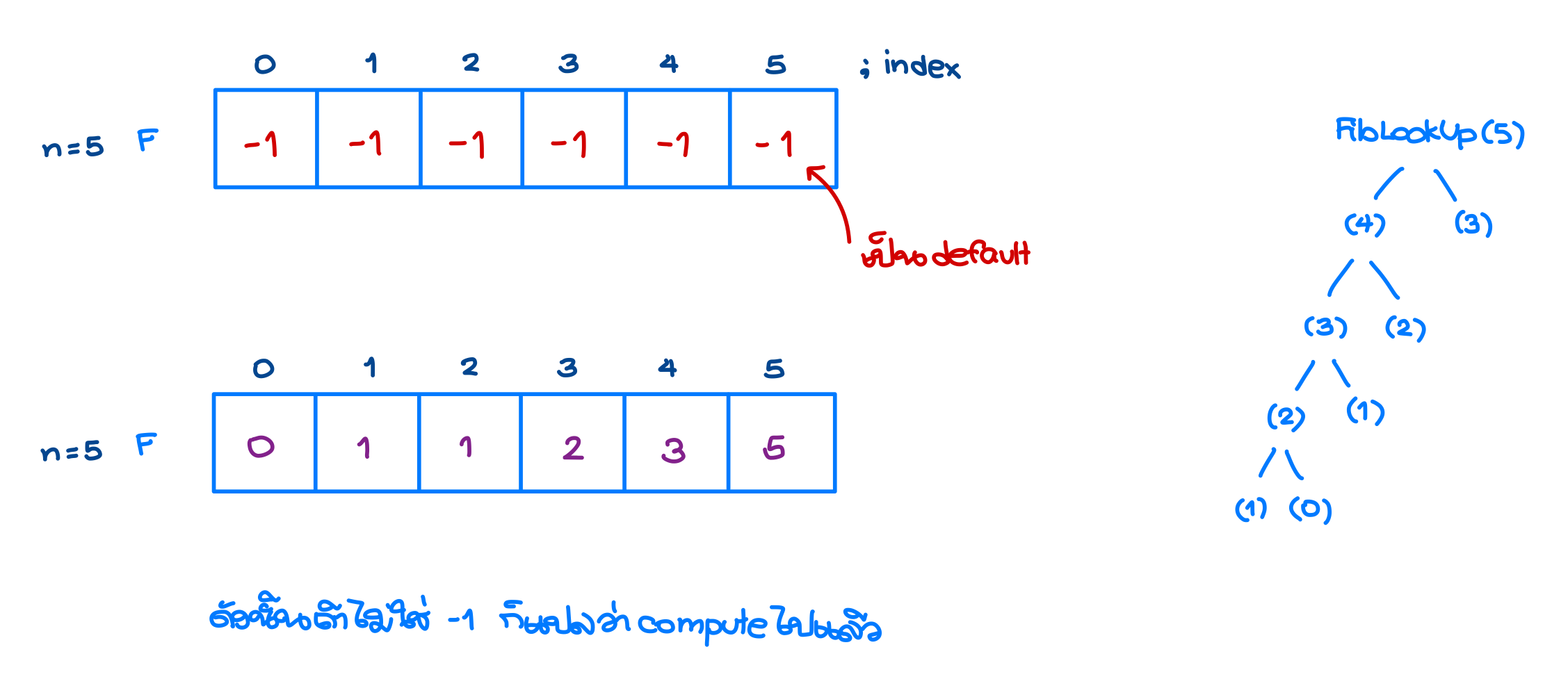
Bottom-Up Approach (Efficient)
ALGORITHM FibDynamic(n)
BEGIN
    F[0] = 0;
    F[1] = 1;
    for i = 2 to n do
        F[i] = F[i-1] + F[i-2]
    return F[n]
END.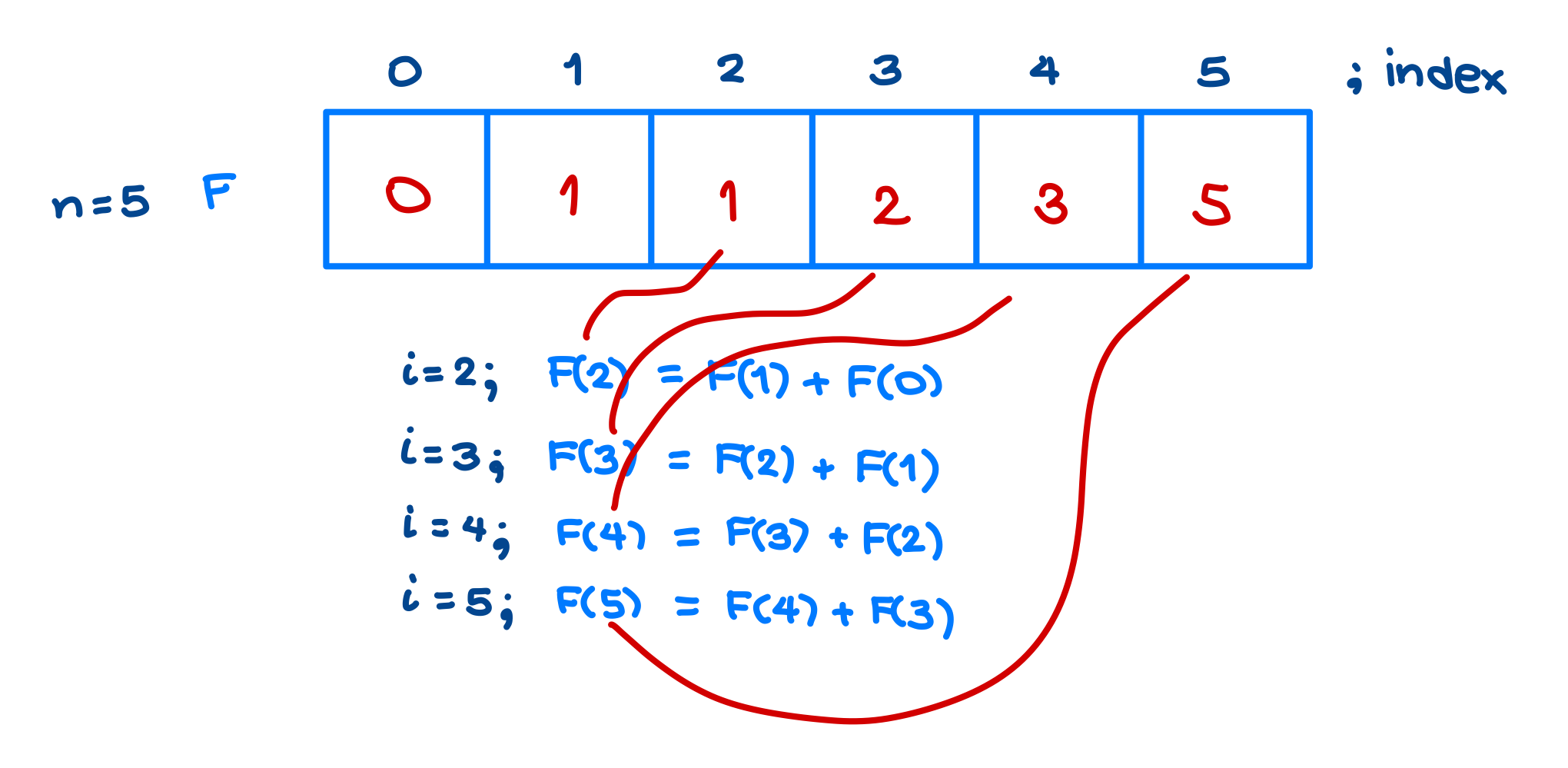
Alternatively, using O(1) space: (ข้างบนใช้ Array, ข้างล่างใช้ 2 Variable)
ALGORITHM FibDynamic2(n)
BEGIN
    fn1 = 0;
    fn2 = 1;
    for i = 2 to n do
        fn = fn1 + fn2;
        fn1 = fn2;
        fn2 = fn;
    return fn
END.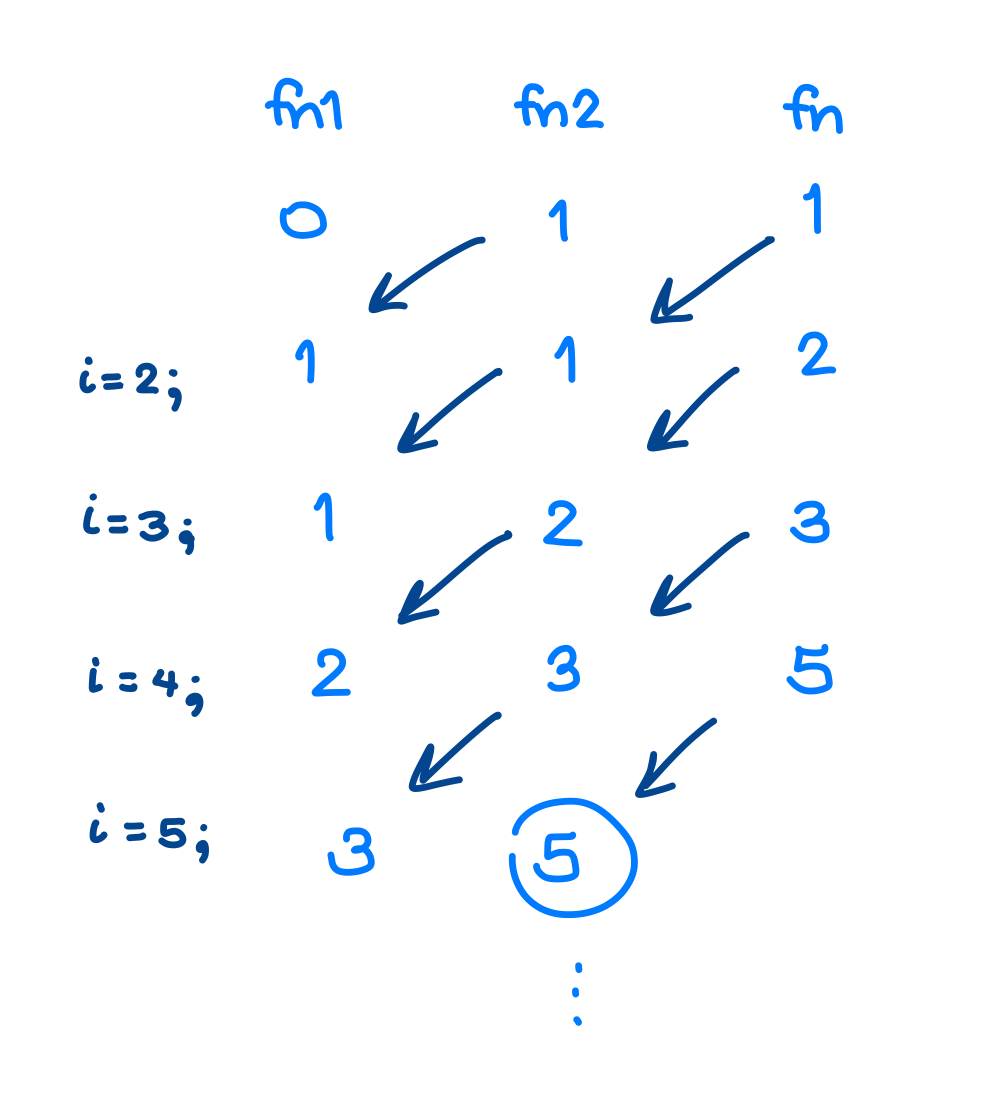
Coin Change Problem
- Given coins of denominations , find the minimum number of coins to make an amount .
- Define as the minimum number of coins needed to make using the first denominations.
- For example, the given coin denominations are
- Thus, แปลว่าจะหา Minimum numberof coins to make change for the amount 200 baht, USING coins and
- เข้าใจมั้ยถ้าเป็น ก็คือใช้ทุก Coin ไง
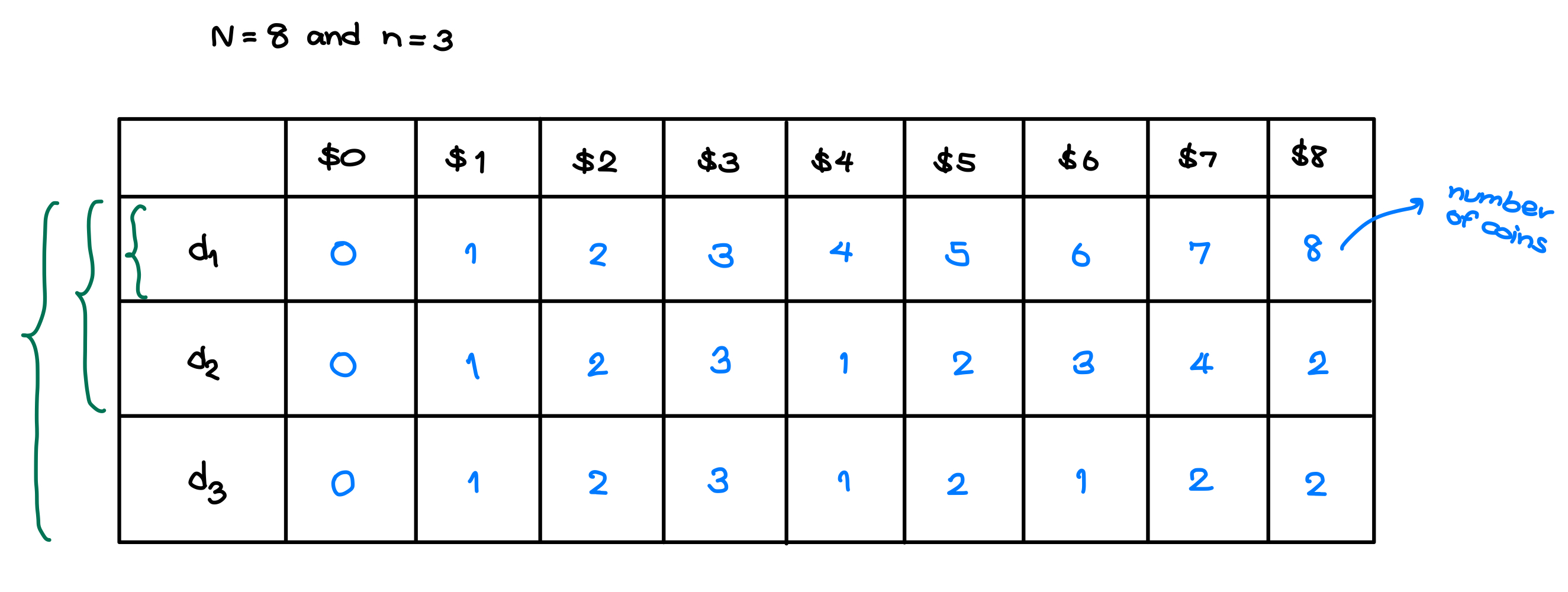
- Recurrence relation:
- ลองใช้สมการ สมมติมอง d_2$
- จะได้ความหมายว่า no user 1 (งงมาก)
- ลองใช้สมการ สมมติมอง d_2$
จะ Compare ในสมการก็ได้หรือว่าง่าย ๆ ก็คือ Compare ระหว่าง ข้างบนเรา กับ เลื่อนกลับไปจำนวน (ค่าของเหรียญนั้น ๆ) ช่อง!! แล้วหา Min นะ
Algorithm:
ALGORITHM CoinChange(n, N)
BEGIN
    for i=1 to n do C[i,0] = 0
    for i=1 to n do
        for j=1 to N do
        BEGIN
            c1 = C[i-1, j]
            c2 = 1 + C[i, j - d[i]]
            C[i, j] = min(c1, c2)
        END
    return C[n, N]
END.
Example
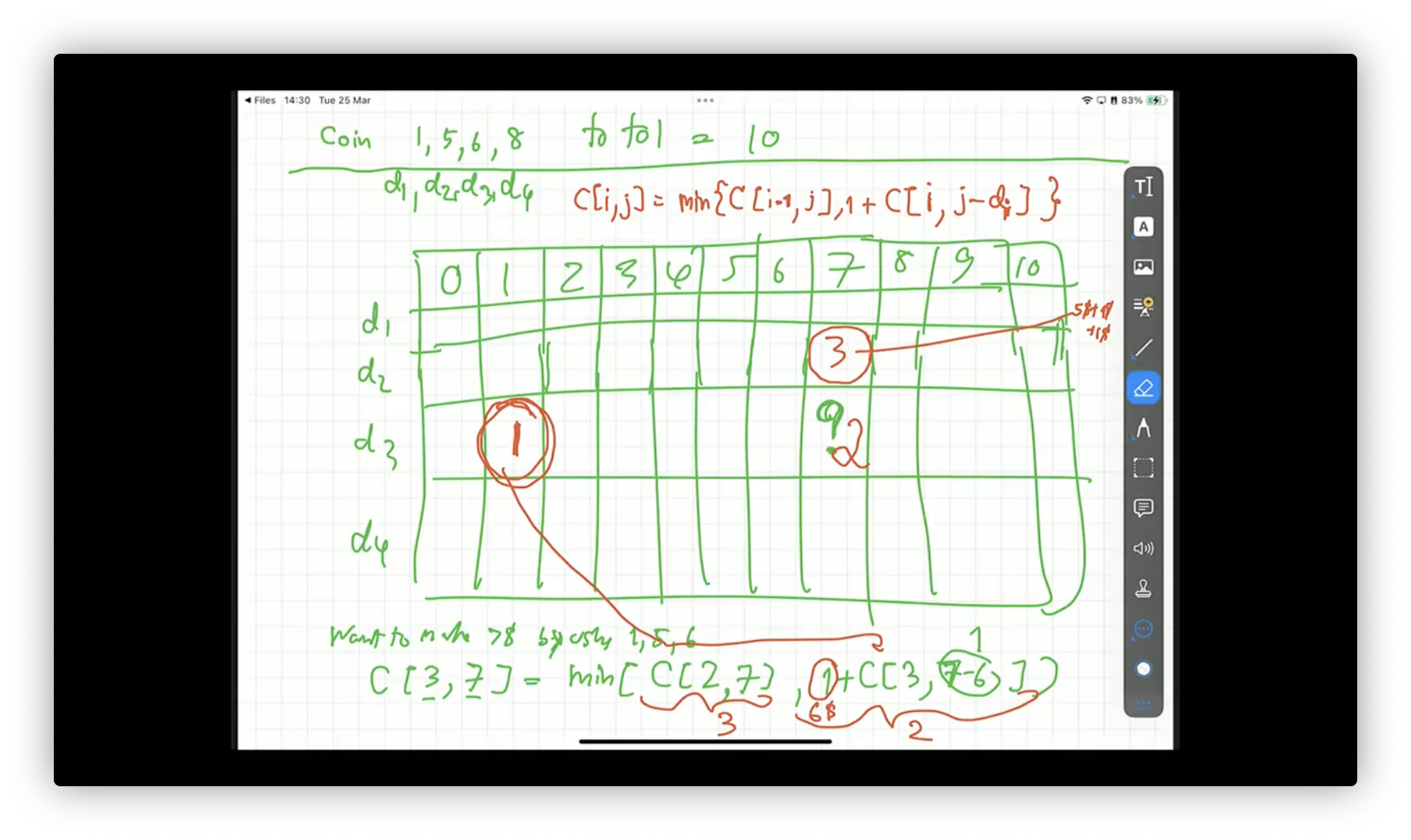
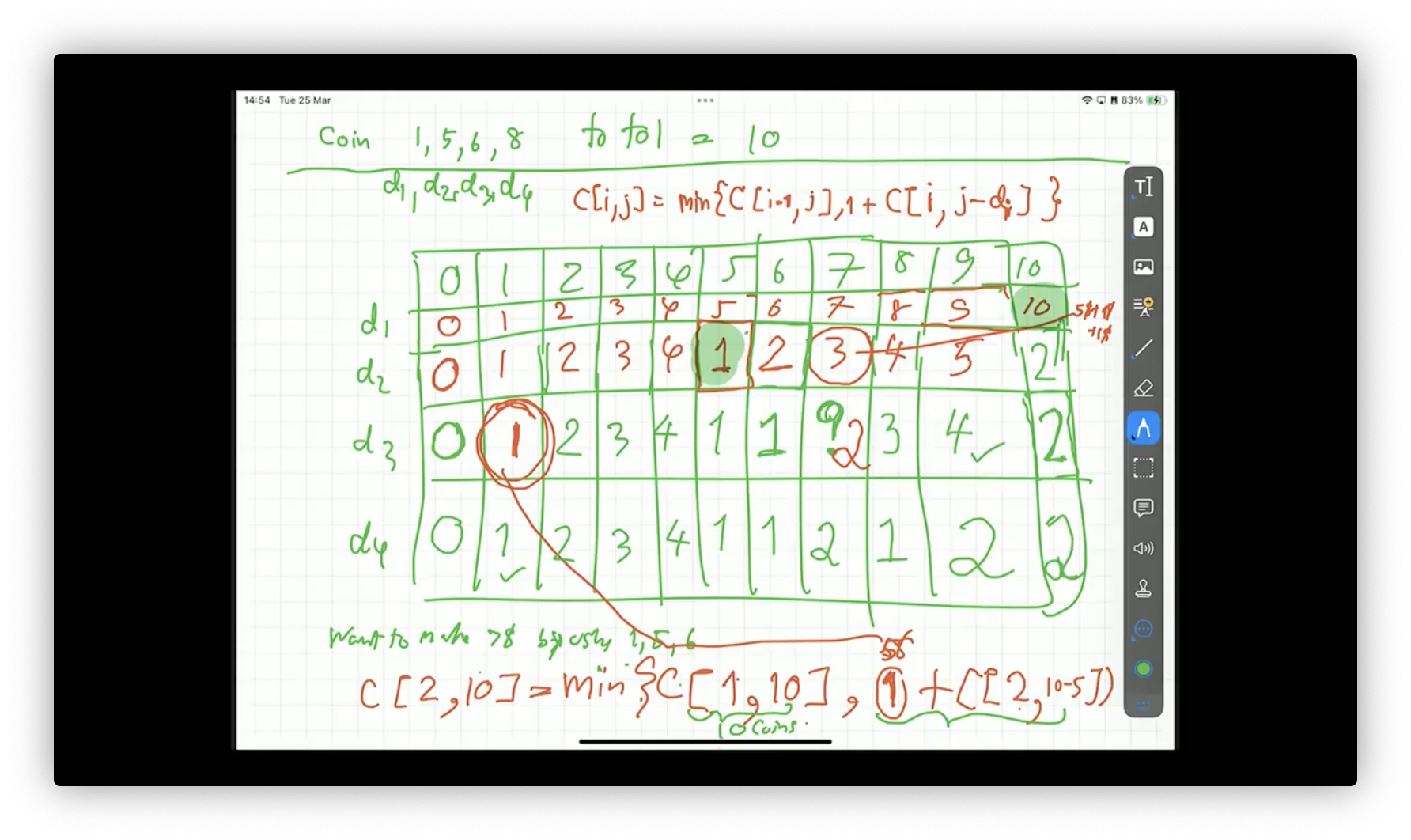
0/1 Knapsack Problem
- ก่อนหน้านี้เป็น Continuous (Fraction) Knapsack Problem
- ก็คือสามารถเอาไปแค่บางส่วนของ Package ได้
- แต่ 0/1 คือไม่สามารถเอาไปแค่บางส่วนได้ ได้แค่เอา/ไม่เอา จบ!!
- Given items with weights and values , and a knapsack of capacity , find the most valuable subset that fits.
- Define as the maximum value obtained using the first items and a knapsack of size .
- Recurrence relation:
Example
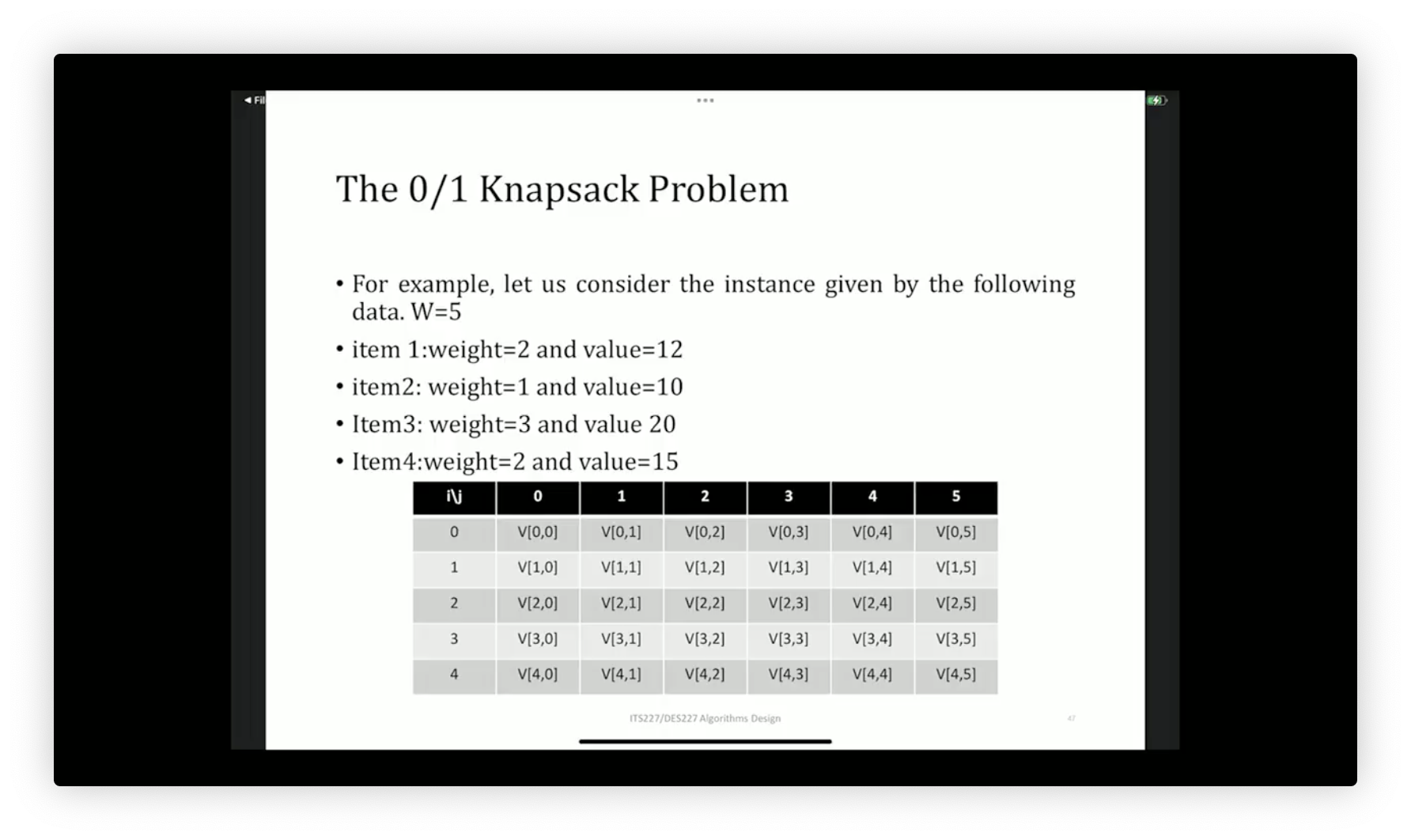
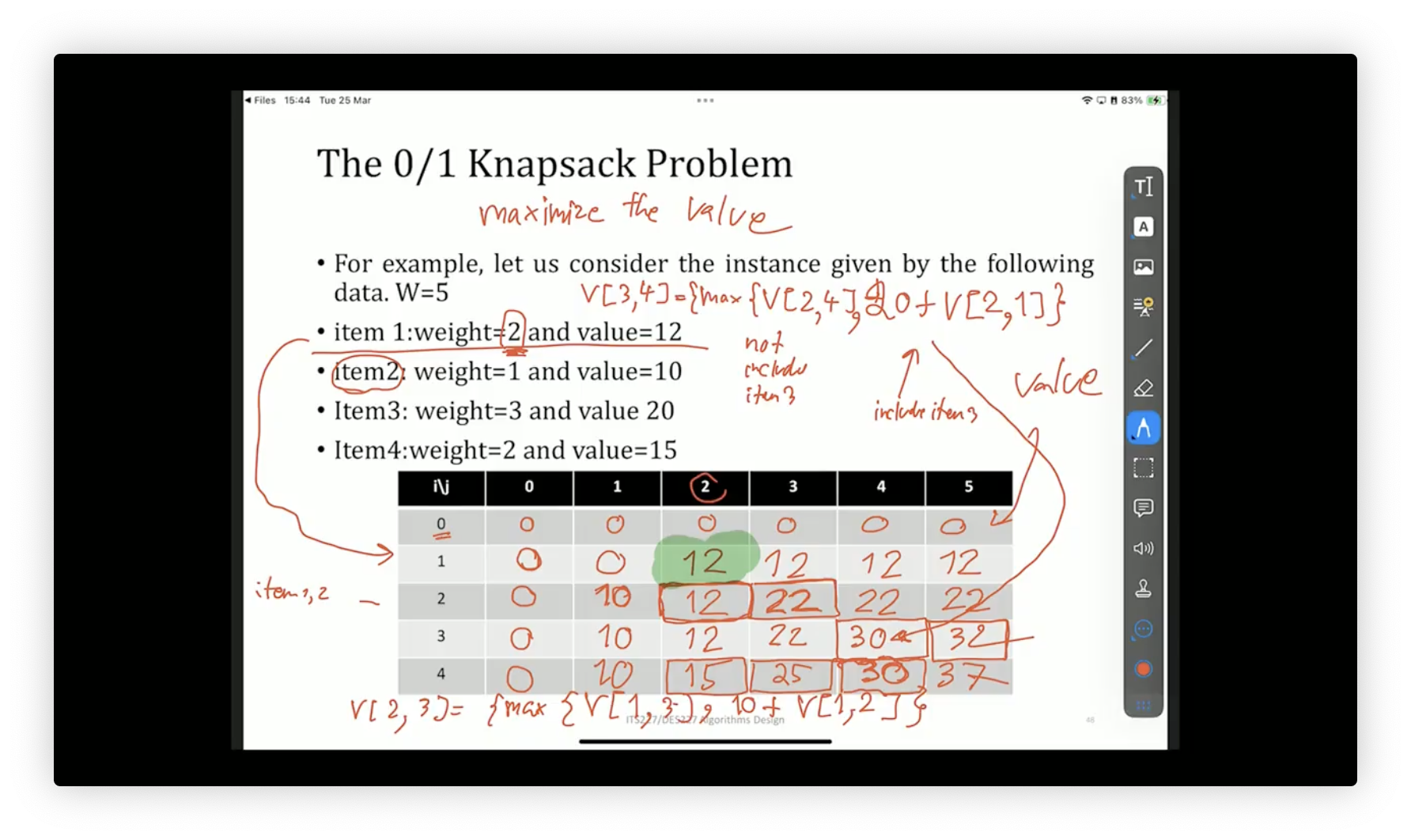
Algorithm:
ALGORITHM Knapsack(v[1…n], w[1…n], W)
BEGIN
    for i=0 to n do V[i,0] = 0
    for j=0 to W do V[0,j] = 0
    for i=1 to n do
        for j=1 to W do
        BEGIN
            if (j < w[i]) then V[i,j] = V[i-1,j]
            else V[i,j] = max(V[i-1,j], v[i] + V[i-1, j - w[i]])
        END
    return V[n, W]
END.
Matrix Chain Multiplication
- ผลลัพธ์จะออกมาเป็นมิติ (นอก)
- (ใน) ต้องเหมือนกัน จึงจะคูณกันได้
-
อยากรู้ว่าต้อง Dot Product กี่ครั้ง?!
- ก็จะเป็นจำนวน Dot Product ที่เกิดขึ้น
-
สมมติมี Matrix
- ควรเอาอะไรคูณอะไรก่อน Efficiency ก็จะต่างกันนะ!
- ถ้าไม่เชื่อลองเอา กับ หาจำนวน Dot Product มันจะไม่เท่ากัน
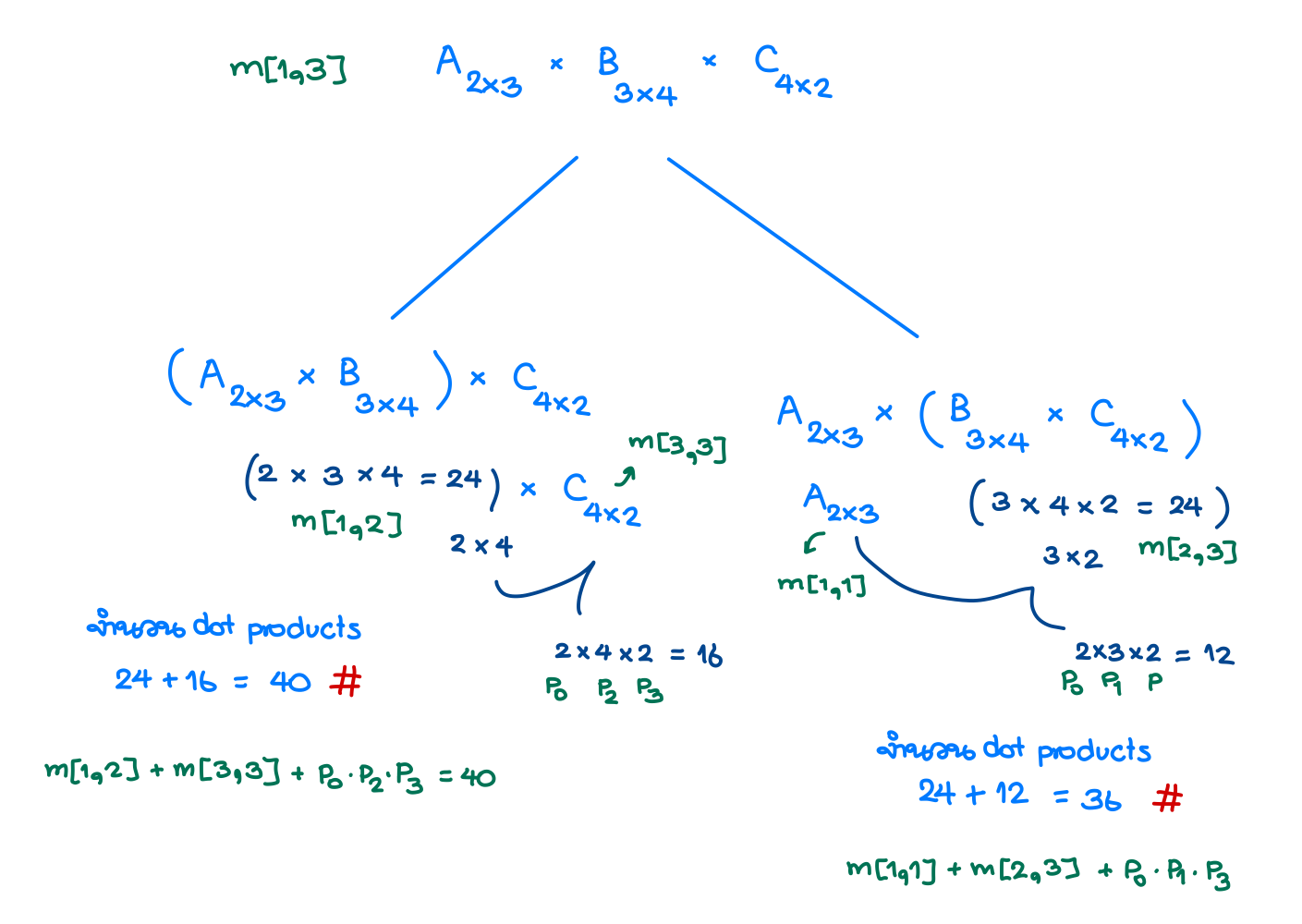
-
Given a sequence of matrices with dimensions , find the optimal way to parenthesize them to minimize multiplications.
-
Key Idea: The order of multiplication affects efficiency, but the actual matrix multiplication is not performed—only the optimal order is determined.
Example
For matrices , , :
- Parenthesization: → multiplications.
- Parenthesization: → multiplications.
- First parenthesization is 10x faster!
Algorithm
ALGORITHM matrix_chain(p)
BEGIN
    for i = 1 to n do
        m[i, i] = 0
    for l = 2 to n do
        for i = 1 to n - l + 1 do
        BEGIN
            j = i + l - 1
            m[i, j] = infinity
            for k = i to j-1 do
            BEGIN
                q = m[i, k] + m[k+1, j] + p[i-1] * p[k] * p[j]
                if q < m[i, j] then
                BEGIN
                    m[i, j] = q
                    s[i, j] = k
                END
            END
        END
    return m, s
END.
Floyd–Warshall algorithm
- Shortest path algorithm, เคยเรียนแล้วคือ Dijska แต่อันนั้นใช้ได้กับ Source เดียว
- แต่อันนี้ใช้ได้