Technical Writing: Mechanism Descriptions - Complete Notes
What is a Mechanism?
Common Examples
- A screwdriver
- An air conditioning machine
- A stapler
- A fan
- A pencil
- A car engine
- A lawnmower
- A watch
- A handbag
- A measuring tape
- Answer: They can all be considered "mechanisms"
Definition of Mechanism
- Our definition: A set of parts that work together to make a recognizably functioning whole
Criteria for Mechanisms
- Must have a number of material, mechanical, and/or electronic parts that work together
- They must have a clear overall function/use
- They must be recognizable and nameable as a tool, appliance, accessory, machine etc.

What is a Mechanism Description?
Purpose
- Describes the main parts of a device or machine
- Tells the purpose of the mechanism
- Describes the overall design
- Explains what the parts are
- Describes what they look like
- Explains what their function is
Uses of Mechanism Descriptions
- Catalogs
- Instruction manuals
- Owner's manuals
- Employee training
Examples of Mechanisms Include:
- Car parts (e.g., an engine)
- Furniture (e.g., a lampshade)
- Kitchen tools (e.g., a blender)
Key Questions to Ask:
- What is this?
- What is it used for?
- How many parts does it have?
- What are the names of each part?
- How would you describe each part?
Structure of Mechanism Description
Overall Structure Requirements:
#Review
- TITLE: Be specific
- INTRODUCTION: Define the mechanism, describe it, and preview the parts
- DIAGRAM: Include all four components
- BODY: Describe size, shape, color, location, material, function, and purpose of each part under separate headings
02 Introduction Section
Components Required:
- Clearly define the mechanism
- Describe the overall function or purpose (can be part of the definition)
- Describe the overall appearance
- List the mechanism's parts in the order in which they will be described
Example Introductions:
Pencil Example:
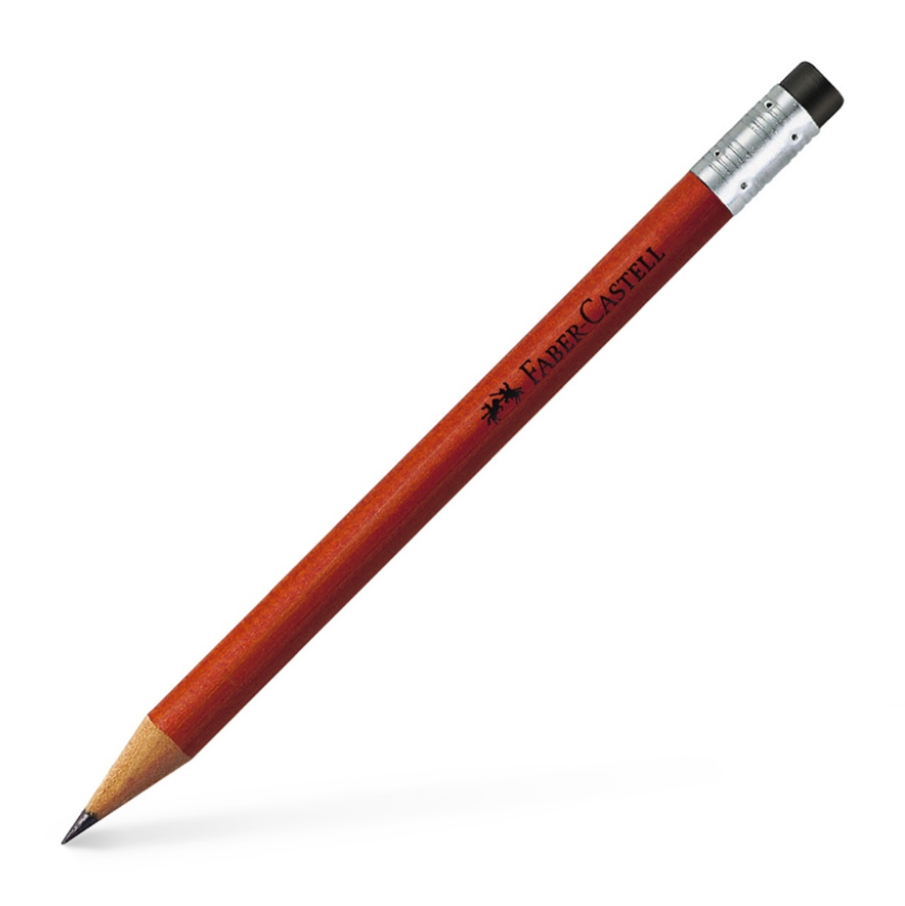
- A pencil is a tool used for writing. Pencils come in various sizes. This pencil is roughly 10cm long and 1 cm in diameter. As per Fig 1. below, it has four main parts: a wooden body, a graphite core, an aluminum band, and a rubber eraser.
Scissors Example:
- Scissors are tools used for cutting. Scissors come in various sizes. These scissors are roughly 10cm long and 5 cm wide. As per Fig 1 below, they have three main parts: metal blades, handles, and a lever.
Introduction Components Breakdown:
- Definition (including function):
- ✏️ A pencil is a tool used for writing
- ✂️ Scissors are tools used for cutting.
- Overall Appearance:
- ✏️ Pencils come in various sizes. This pencil is roughly 10cm long and 1 cm in diameter
- ✂️ Scissors come in various sizes. These scissors are roughly 10cm long and 5 cm wide.
- List of parts:
- ✏️ As per Fig 1. below, it has four main parts: a wooden body, a graphite core, an aluminum band, and a rubber eraser
- ✂️ As per Fig 1 below, they have three main parts: metal blades, handles, and a lever.
Definition Sentence Structure:
Subject + General Category + Purpose
Examples:
- A pair of scissors is a(n) _ _ _ _ _ _ _ _ used for _ _ _ _ _ _ _ _
- A watch is a(n) _ _ _ _ _ _ _ _ used to _ _ _ _ _ _ _ _
- An air conditioner is a(n) _ _ _ _ _ _ _ _ that _ _ _ _ _ _ _ _
- A (specific mechanism) is a (general category) that (verb phrase)
General Categories for Definitions:
- apparatus
- appliance
- device
- piece of equipment
- gadget
- machine
- contraption
EXERCISE 1: DEFINITIONS
Write a definition of THREE of the following:
- A tin opener
- A tin opener is a device used for open the tin
- A stapler
- A vacuum cleaner
- A vacuum cleaner is a electric device used for cleaning the room
- A thermometer
- A fan
- A fan is a machine used for cooling things down
- A hosepipe
- A leaf clippers
- A lawnmower
- A belt
Listing Parts Requirements:
- The final sentence of the introduction must list the parts
- Tell the reader how many parts it has, and the names of each part
Example:
- It has four main parts: a wooden body, a graphite core, an aluminum band, and a rubber eraser.
EXERCISE 2: LISTING PARTS
List the parts of two of the mechanisms you chose (for this, if you don't know the name of the parts, you can look online. Only choose main parts. Each one will form a paragraph later (3-5 parts is enough)).
- A tin opener
- A vacuum cleaner
- A fan has … parts
03 Diagram Section
Four Required Components:
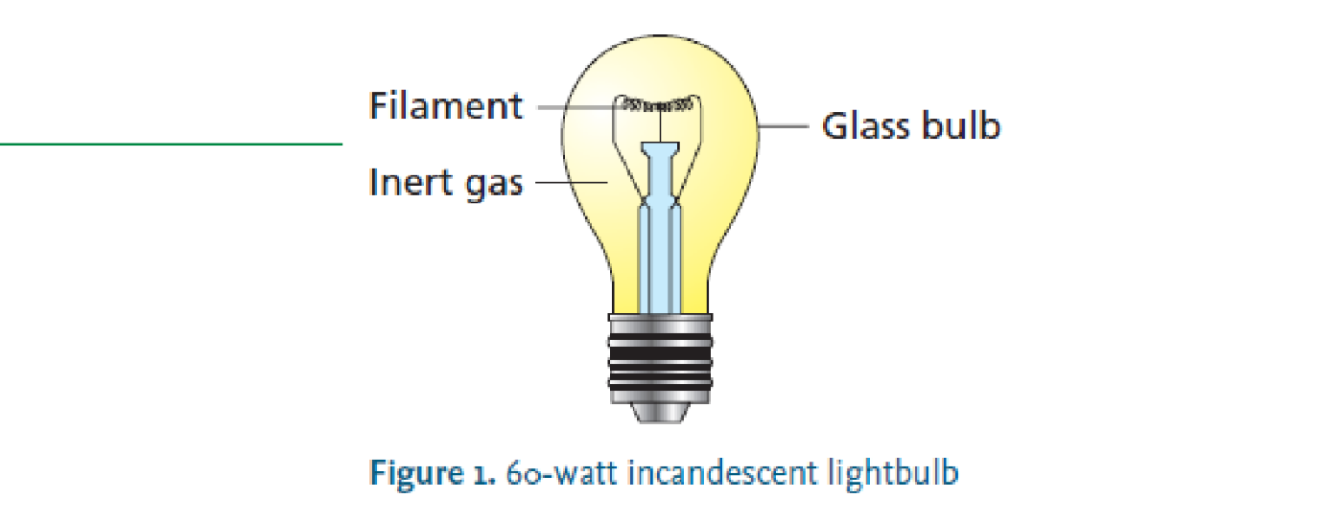
- Graphic (drawing or picture)
- Callouts (names of parts with lines; place on sides)
- Title (Figure 1 + simple description e.g., "A fan")
- White Space surrounds the diagram
Example Diagram Elements:
ในข้อสอบจะให้วาดภาพ แต่ไม่ต้องสวยมากก็ได้ เขียน Label ให้ด้วย
EXERCISE 3: DIAGRAM
From the three mechanisms you chose from Exercise 1, make a diagram of one of them.
04 Body Section
Format and Structure:
- Describe each part in separate paragraphs
- Use the name of each part as a HEADING for each paragraph
- List in the same order as in the introduction
- Describe each part's overall function or purpose
- Describe the physical characteristics of the part in detail (e.g., size, shape, color, location, and material)
Example: Eraser Description
เวลาทำใน Exam, try to at least have four
ERASER
- FUNCTION/PURPOSE
- The eraser is used to remove unwanted markings on paper
- COLOUR AND MATERIAL
- It is brown and made of rubber
- SIZE AND SHAPE
- It is 0.8 cm in diameter, 0.65 cm high and has a cylindrical shape
- LOCATION
- It is located at the top of the pencil
Grammar Requirements:
- Make sure to write complete sentences with a subject, verb and full stop at the end
- Notice the use of passive voice (Be + Past Participle)
Common Passive Voice Constructions:
- … is made of
- … is located at
- … is attached to
- … is used to
- … is used for
Location and Connection Vocabulary
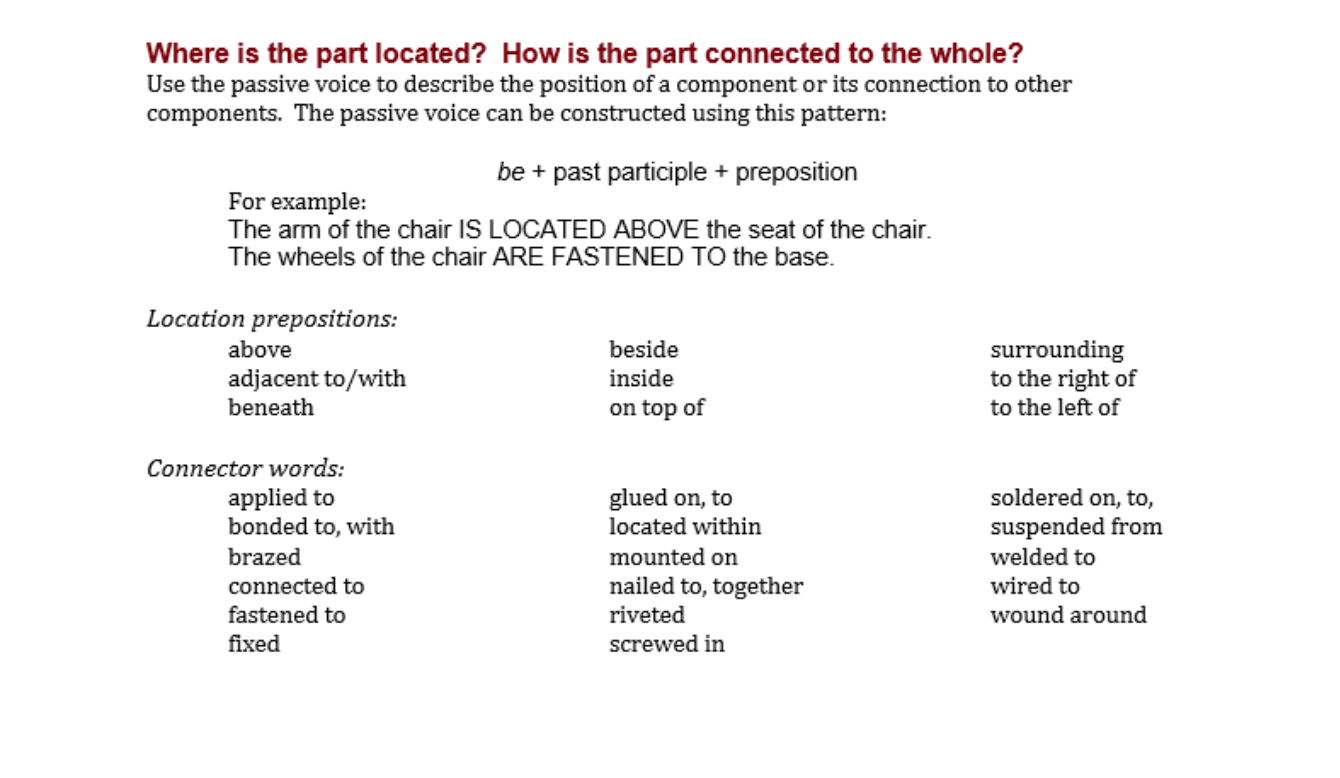
Pattern: be + past participle + preposition
Examples:
- The arm of the chair IS LOCATED ABOVE the seat of the chair
- The wheels of the chair ARE FASTENED TO the base
Location Prepositions:
- above
- adjacent to/with
- beneath
- beside
- inside
- on top of
- surrounding
- to the right of
- to the left of
Connector Words:
- applied to
- bonded to, with
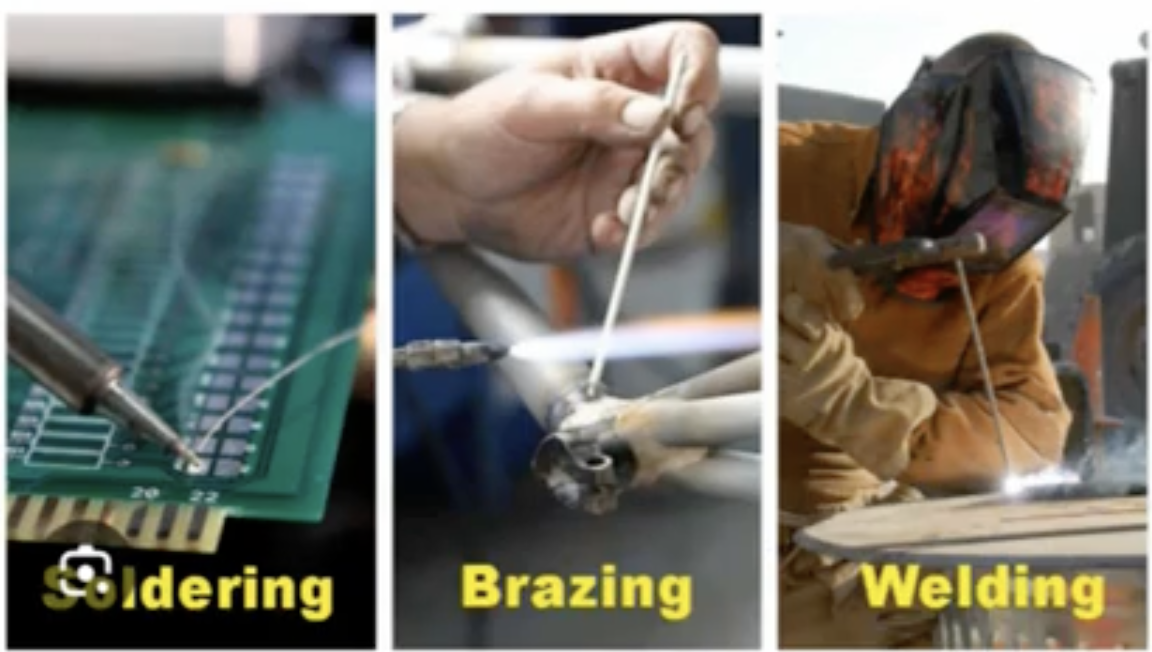
- brazed
- connected to
- fastened to
- fixed
- glued on, to
- located within
- mounted on
- nailed to, together
- riveted
- screwed in
- soldered on, to
- suspended from
- welded to
- wired to
- wound around
Shape Description
Importance of Accurate Shape Description:
- It is important to describe an object's shape as accurately as possible in order for your readers to form the right image in their mind of what you are describing
Table of Common Shapes:
2 Dimensional Shapes:
- circle → circular
- semi-circle → semi-circular
- square → square
- rectangle → rectangular
3 Dimensional Shapes:
- sphere → spherical
- cylinder → cylindrical
- tube → tubular
- rectangular block → rectangular
- cube → cubic
- cone → conical
Other Helpful Descriptors:
- hollow (not solid)
- irregular (not regular)
EXERCISE 4: BODY
Take one of the three mechanisms you chose from Exercise 1 and complete the body for it (SAME ONE AS DIAGRAM)
Assessment and Feedback
Rubric Feedback Criteria:
- Use the Rubric to mark your friend's work
- Show me your mark and explain it
- Pay particular attention to structure
Structure Assessment:
- If the introduction (definition only today), diagram, and body are all present and contain the necessary elements, give a minimum of three (primary structure is correct)
- Secondary structure will refer to the elements being properly arranged, right order, logically connected etc within primary structure
Content/Task Assessment:
- Check the layout and a minimum of 100 words
Language Assessment:
- Check use of [[06 Grammar 1#Passive Voice|passive voice]] and special vocabulary
Example: Complete Mechanism Description
Incandescent Lightbulb Example
The 60-watt bulb in your kitchen fixture is a glass enclosure that illuminates a small area—roughly an 8' x 8' area—with 960 lumens (photometric units of light output) when an electric current passes through the filament. Figure 1 shows a 60-watt incandescent lightbulb that consists of four parts: glass bulb, inert gas, filament, and base.
Bulb
- The pear-shaped bulb is 2.5" in diameter at the thickest part and tapers to 1.0" in diameter at the smallest part near the base
- The inside of the glass is coated with a diffusing material made of phosphor to give the glass its white appearance and to soften light, thereby reducing shadows
- The wattage (60 watts) and voltage (120V) are stamped on top of the bulb in black print
Gas
- Inside the bulb, an inert gas (e.g., argon) replaces most of the air
Filament
- The filament is made of tungsten, which is drawn into a fine wire only 0.001" in diameter
- The tungsten wire is a meter or more of wire coiled or double-wound into a 2 cm or smaller coil
- The filament is welded to the power leads in the base of the bulb that are embedded in a 1" x 1/8" cylindrical glass structure fused to the glass bulb
- The tungsten filament heats to over 2500°C (4500°F) and produces the light
Base
- The base contains two electrical contacts and insulation
- The base is a 1" threaded aluminum circular screw thread (resembling a wood screw) that can be screwed into the light socket of a fixture without falling out
- Two contacts running up either side of the glass mount hold the filament
- An electrical foot contact that looks like a 1/8" nail head is at the center of the base on the bottom
- The metal contact conducts the electrical current into the bulb, activating the tungsten filament