Overview
- Topic: Short-run business decisions in changing markets
- Key Decision Types:
- Special order decisions
- เราจะ Accept หรือว่า Reject, special order?
- Care about incremental cost, incremental revenue.
-
Make or buy decisions
- Sell, scrap, or rebuild decisions
- Special order decisions
The Challenge of Changing Markets
Market Dynamics
- Product markets can change quickly due to:
- Competitor price cuts
- Changing customer preferences
- Introduction of new products by competitors
Management Response
- Managers must make short-run decisions with a fixed set of resources to react to the changing marketplace
Analogy: Think of it like optimizing your code when you can't upgrade your hardware. You have to work with what you have (fixed resources) and make quick decisions about what features to prioritize or cut.
The Concept of Relevant Cost Information
Example: Florida Spring Break Decision
Scenario: Should you drive or fly to Florida for spring break?
Given Information:
- Motel cost: $80 per night
- Meal cost: $20 per day
- Car insurance: $100 per month
- Kennel cost for dog: $5 per day
- Round-trip gasoline: $200
- Round-trip airfare + rental car: $500
- Trade-off: Driving requires 2 days with overnight stay, cutting Florida time by 2 days
Cost Analysis (8 days total):
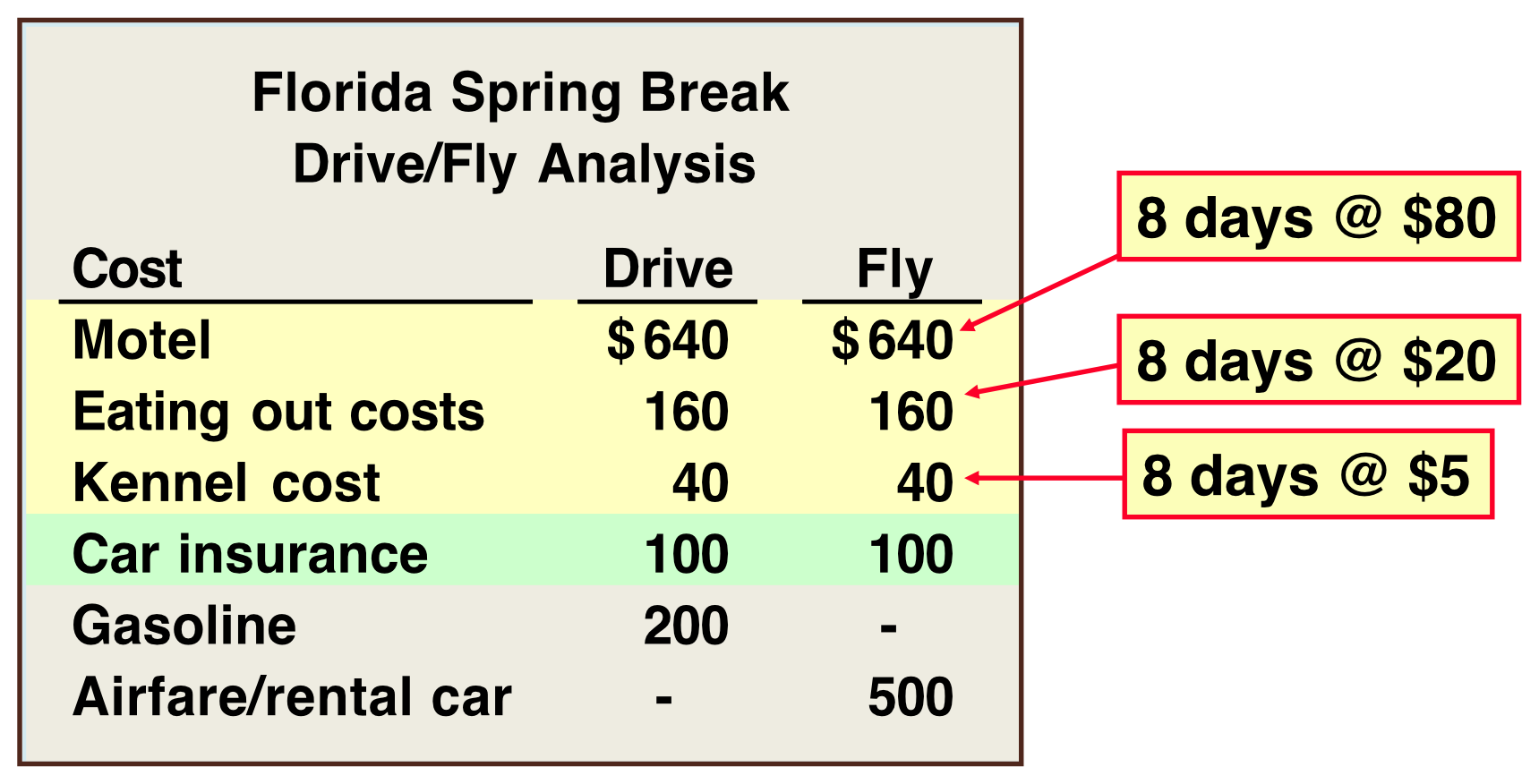
| Cost | Drive | Fly |
|---|---|---|
| Motel (8 days × $80) | $640 | $640 |
| Eating out (8 days × $20) | $160 | $160 |
| Kennel (8 days × $5) | $40 | $40 |
| Car insurance | $100 | $100 |
| Gasoline | $200 | - |
| Airfare/rental car | - | $500 |
Key Insights:
- Costs that don't differ (motel, meals, kennel, car insurance) are NOT relevant to the decision
- Car insurance is not relevant because it's a past cost (sunk cost)
- Transportation costs differ between alternatives, so they are relevant
Key Question: Are the extra 2 days in Florida worth the 300 extra cost to fly? $$\text{Extra cost to fly} = 500 - 300$$
Analogy: Like choosing between two cloud hosting services - you only compare the features/costs that are different. If both offer the same storage, you ignore that and focus on what differs (price, speed, support).
Decision Making Process
Five Steps of Decision Making:
- Define the problem
- Identify the alternatives
- Collect information on alternatives
- Eliminate irrelevant information
- Make a decision with the remaining relevant information
Analogy: Like debugging code:
- Identify the bug
- Think of possible fixes
- Gather data (logs, test results)
- Ignore irrelevant error messages
- Implement the best solution
Relevant Information in Business Decisions
Definition
Relevant Information: Information that varies among the possible courses of action being considered.
- Also called: Incremental costs and revenues
Important Cost Concepts:
- Opportunity costs
- Sunk costs
- Out-of-pocket costs
Opportunity Cost (ต้นทุนค่าเสียโอกาส)
Definition
The benefit that could have been attained by pursuing an alternative course of action.

Example: College Attendance
- If you were not attending college, you could be earning $20,000 per year
- Your opportunity cost of attending college for one year includes the $20,000
Key Characteristics:
- NOT recorded in accounting records
- ARE relevant to decisions because they represent a real sacrifice
Analogy: Choosing to work on a side project means you can't work on another project during that time. The potential income from the alternative project is your opportunity cost - even though you never see it on paper, it's a real trade-off.
Sunk Costs vs Out-of-Pocket Costs
Sunk Costs
Definition
All costs incurred in the past that cannot be changed by any decision made now or in the future.
Key Rule
Example: Car Purchase
- You bought an automobile that cost $10,000 two years ago
- The 10,000 cost
Analogy: Like hours you've already spent on a project. Whether you continue or abandon the project, those hours are gone. The question is: "What's the best use of my time NOW?" not "How much time have I already invested?"
Out-of-Pocket Costs vs Sunk Costs Example
Scenario:
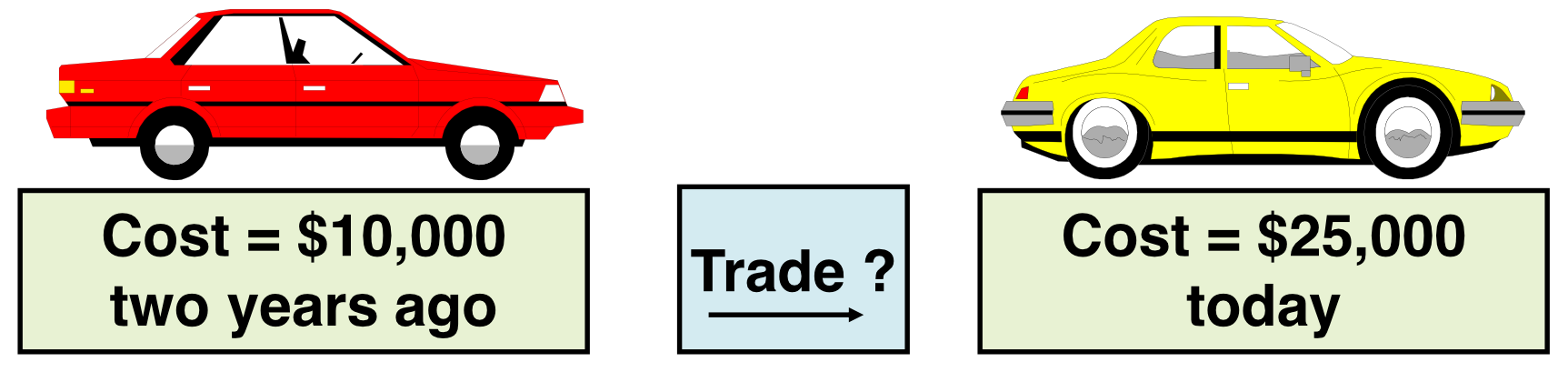
- Your car: Cost $10,000 two years ago (SUNK)
- New car: Costs $25,000 today
- Trade offer: Dealer will trade for $20,000 plus your car
Key Question:
What amount is relevant to your decision?
- ❌ The $10,000 sunk cost of your car
- ✅ The $20,000 out-of-pocket cash differential
Analogy: You spent 100 hours building a feature that users don't want. Do you:
- Consider the 100 hours (sunk cost) and keep the feature?
- OR focus on what it costs NOW to maintain vs rebuild (out-of-pocket cost)?
The 100 hours are gone regardless - focus on future costs/benefits!
Special Order Decisions
Key Principle
The decision to accept additional business should be based on:
- Incremental costs
- Incremental revenues
Incremental amounts: Those that occur only if the company decides to accept the new business
Example: View Co.
Current Business (100,000 units):
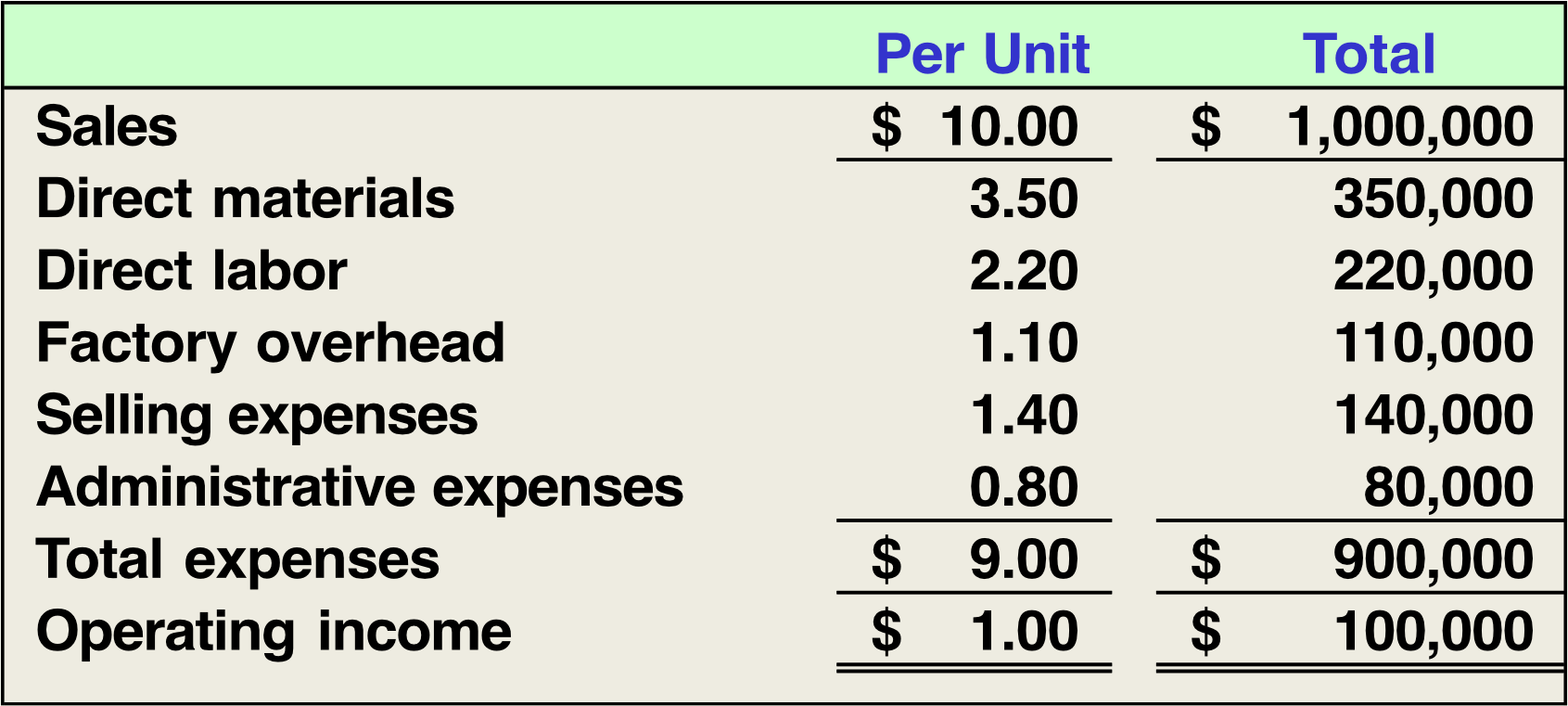
| Item | Per Unit | Total |
|---|---|---|
| Sales | $10.00 | $1,000,000 |
| Direct materials | $3.50 | $350,000 |
| Direct labor | $2.20 | $220,000 |
| Factory overhead | $1.10 | $110,000 |
| Selling expenses | $1.40 | $140,000 |
| Administrative expenses | $0.80 | $80,000 |
| Total expenses | $9.00 | $900,000 |
| Operating income | $1.00 | $100,000 |
Special Order Offer:
- Customer: Overseas company
- Quantity: 10,000 units
- Price: $8.50 per unit
- Additional costs if (offer) accepted:
- Factory overhead: +$5,000
- Selling expenses: +$2,000
- Administrative expenses: +$1,000
❌ Incorrect Reasoning:
"Our cost is 8.50 per unit."
- This ignores that some costs are fixed and won't increase with additional units
✅ Correct Analysis:
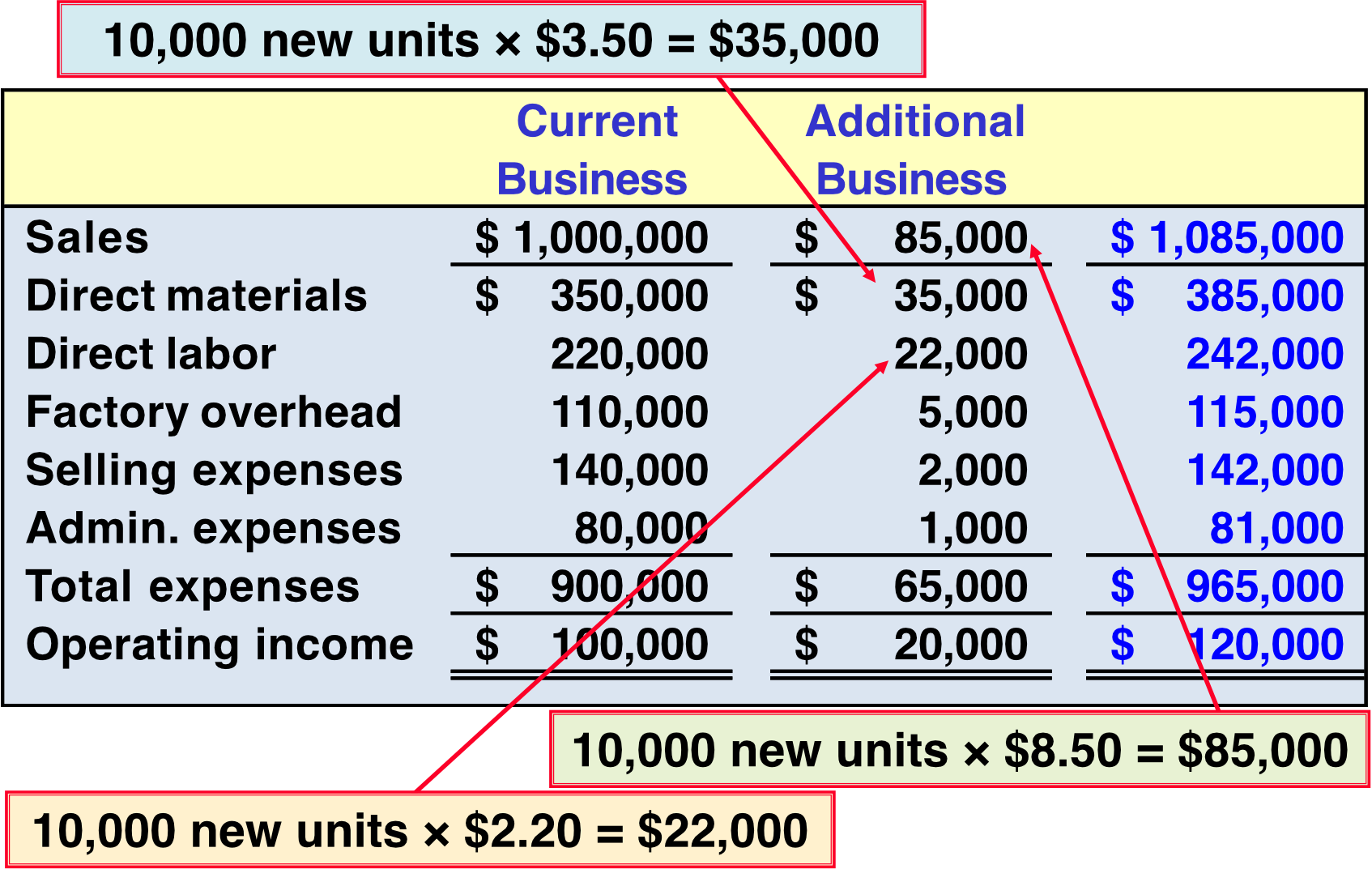
| Item | Current Business | Additional Business | Combined |
|---|---|---|---|
| Sales | $1,000,000 | $85,000 | $1,085,000 |
| Direct materials | $350,000 | $35,000 | $385,000 |
| Direct labor | $220,000 | $22,000 | $242,000 |
| Factory overhead | $110,000 | $5,000 | $115,000 |
| Selling expenses | $140,000 | $2,000 | $142,000 |
| Admin expenses | $80,000 | $1,000 | $81,000 |
| Total expenses | $900,000 | $65,000 | $965,000 |
| Operating income | $100,000 | $20,000 | $120,000 |
Calculations:
- Additional revenue: \times8.50 =
- Additional direct materials: \times3.50 =
- Additional direct labor: \times2.20 =
Conclusion: ✅ Accept the offer - net income increases by $20,000
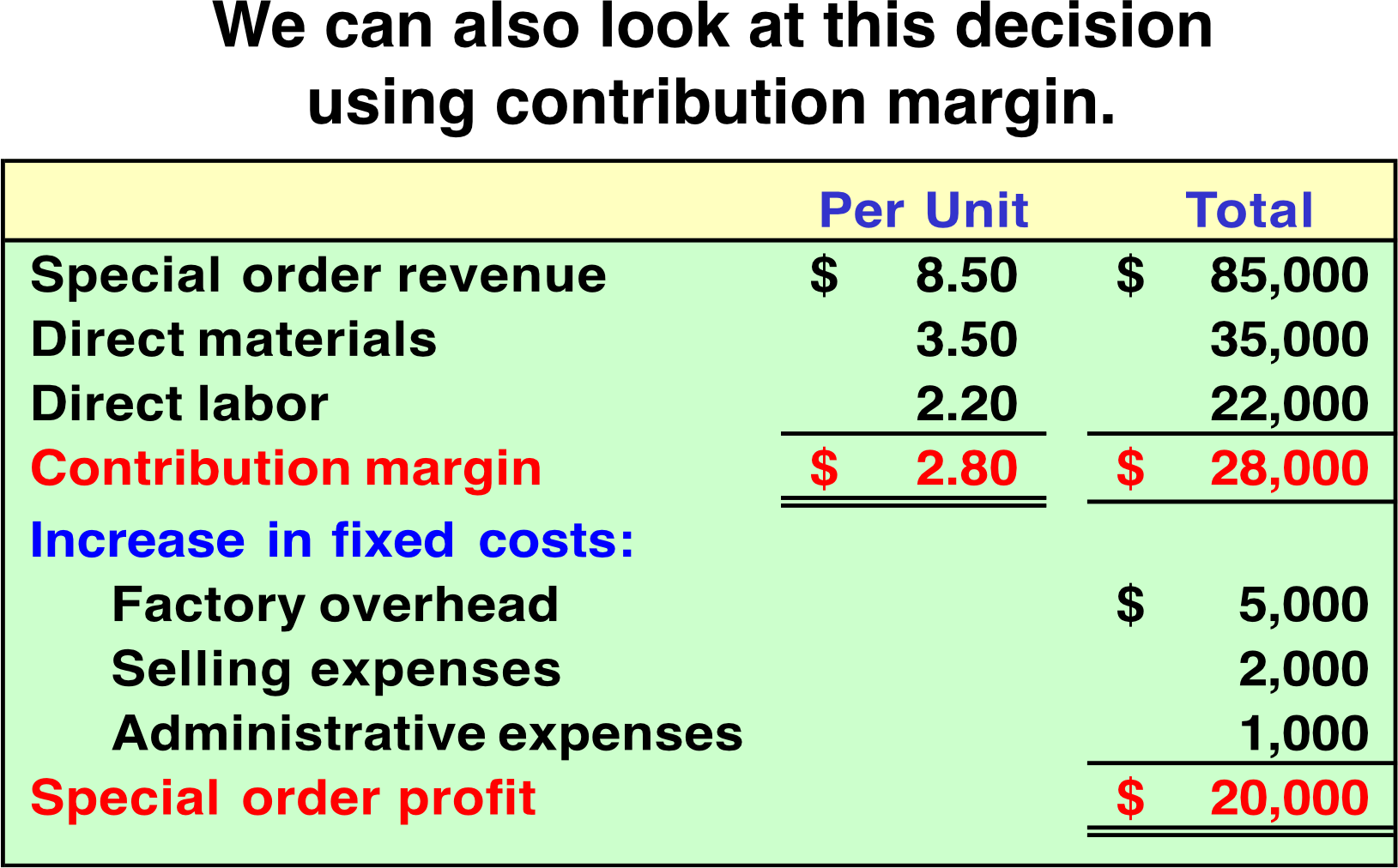
Alternative Analysis Using Contribution Margin:
| Item | Per Unit | Total |
|---|---|---|
| Special order revenue | $8.50 | $85,000 |
| Direct materials | $3.50 | $35,000 |
| Direct labor | $2.20 | $22,000 |
| Contribution margin (กำไรส่วนเกิน) | $2.80 | $28,000 |
| Increase in fixed costs: | ||
| Factory overhead | $5,000 | |
| Selling expenses | $2,000 | |
| Administrative expenses | $1,000 | |
| Special order profit | $20,000 |
Analogy: A game developer can run servers for 100,000 players. They're offered a deal to host a special event for 10,000 players at a discounted rate. The server costs (like factory overhead) barely increase - they're mostly fixed. As long as the revenue covers the variable costs (bandwidth, support) plus any small fixed cost increases, it's profitable even at a discount.
Make or Buy Decisions
Key Questions:
- Should I continue to make the part, or should I buy it?
- How do I compare the outside purchase price with manufacturing costs?
- What will I do with my idle facilities if I buy the part?
If we buy a part here, we will have free factory building, we can rent the factory to another company to use them, so we’ll get the revenue back or something. (CHECK!!)
Important Principles:
- Incremental costs are important in make-or-buy decisions
- The cost to produce must include:
- Direct materials
- Direct labor
- Incremental overhead (NOT the predetermined overhead rate)
Analogy: Should you write your own authentication system or use a third-party service? Consider:
- Your development time (direct labor)
- Any libraries/tools needed (direct materials)
- Extra server costs (incremental overhead)
- DON'T consider: Your salary (it's fixed/sunk), office rent, etc.
Example: Excel Company
Current Manufacturing Costs (20,000 chips per year):
| Cost Component | Unit Cost |
|---|---|
| Direct Material | $9.00 |
| Direct Labor | $5.00 |
| Variable Overhead | $1.00 |
| Fixed Overhead | $13.00 |
| Total | $28.00 |
Supplier Offer:
- Price: $25 per chip for 20,000 chips
- Fixed overhead costs: Will NOT be avoided if purchased
- เช่น พวก Factory building, depreciation of factory building มันก็ไม่สามารถ avoid ได้อยู่แล้ว
- Idle facilities: No alternative use
Analysis - Differential Costs of Making:
| Cost Component | Unit Cost |
|---|---|
| Direct Material | $9.00 |
| Direct Labor | $5.00 |
| Variable Overhead | $1.00 |
| Total | $15.00 |
Conclusion: ❌ Do NOT buy
- Don't pay 15/unit of costs
- ==Fixed costs are irrelevant (they continue regardless)==
- งั้นต้นทุน $13 นี้ ตัดทิ้งจากการตัดสินใจได้ เพราะ:
- ทำเอง → ก็ต้องจ่าย
- ซื้อ → ก็ยังต้องจ่าย
- มัน ไม่เปลี่ยนตามการตัดสินใจ = irrelevant cost
- งั้นต้นทุน $13 นี้ ตัดทิ้งจากการตัดสินใจได้ เพราะ:
\boxed{\text{Differential cost per unit} = $15.00 < $25.00 \text{ (supplier price)}}
ถ้าทำเอง → ประหยัดได้แค่ต้นทุนที่ “หลีกเลี่ยงได้” =
Direct Material 9 + Direct Labor 5 + Var OH 1 = 25
ถามว่า:
จะยอมจ่าย 15 ไหม?
New Information: Lease Opportunity
New scenario: If Excel buys chips, idle facilities could be leased for $250,000/year.
Should Excel buy the chips and lease the facilities?
Analysis:
| Item | Amount |
|---|---|
| Disadvantage of buying: 25 - | |
| Opportunity cost of facilities (lease revenue) | |
| Advantage of buying and leasing | $50,000 |
Conclusion: ✅ NOW it makes sense to buy and lease!
Key Question: "What is the best use of Excel's facilities?"
Analogy: You could maintain your own email server (make) or use Google Workspace (buy). Initially, maintaining your own costs less. BUT if using Google Workspace frees up your team to build a new feature that generates $250k/year, suddenly buying makes sense! The opportunity cost changed the equation.
Sell, Scrap, or Rebuild Decisions
Key Principles:
- Costs incurred in manufacturing defective units are sunk costs and cannot be recovered
- As long as rebuild costs are recovered through sale AND rebuilding doesn't interfere with normal production, we should rebuild
Example: Servo Company
Scenario:
- Defective units: 10,000 units
- Original cost: $1.00 each (SUNK)
- Options:
- Scrap now: $0.40 each
- Rebuild: 1.50 each
- Trade-off: Rebuilding prevents production of 10,000 new units that would also sell for $1.50
Cost Analysis Without Opportunity Cost (WRONG):
| Option | Scrap Now | Rebuild |
|---|---|---|
| Sale of defects | $4,000 | $15,000 |
| Less rebuild costs | - | - |
| Less opportunity cost | - | - |
| Net return | $4,000 | ? |
This makes rebuild look good (4,000)!
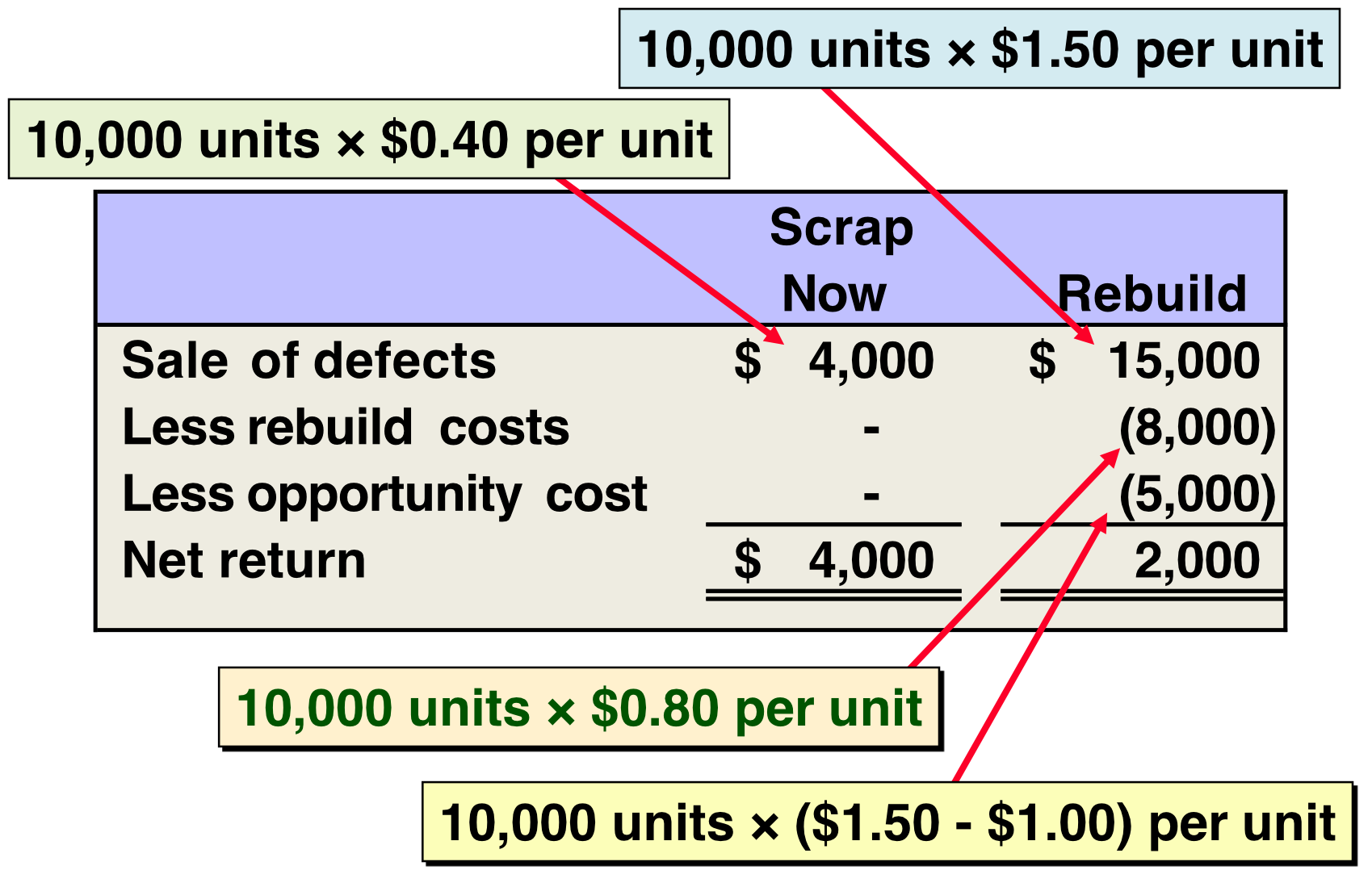
Correct Analysis (WITH Opportunity Cost):
| Option | Scrap Now | Rebuild |
|---|---|---|
| Sale of defects | $4,000 | $15,000 |
| Less rebuild costs | - | |
| Less opportunity cost | - | |
| Net return | $4,000 | $2,000 |
Calculations:
- Scrap revenue: \times0.40 =
- Rebuild revenue: \times1.50 =
- Rebuild costs: \times0.80 =
- Opportunity cost: \times1.50 - 5,000$
- This is the profit from 10,000 new units you CAN'T make if you rebuild
Conclusion: ✅ Scrap the units now
\boxed{\text{Net return from scrapping} = $4,000 > $2,000 \text{ (net return from rebuilding)}}
Warning: If Servo fails to include opportunity cost, rebuild shows $7,000 return, making it appear favorable!
Analogy: You have buggy code deployed that's generating some revenue ($4k). You could:
- Leave it running (scrap/accept it as-is)
- Spend time fixing it to make it better (15k)
BUT if fixing it means you can't build a new feature that would earn $5k profit, you need to factor that in! Sometimes the "opportunity cost" of time spent fixing old code is higher than the benefit.
Non-financial Considerations
Important Factors Beyond Numbers:
Even with clear financial analysis, managers must consider:
- Legal issues
- Compliance requirements
- Contractual obligations
- Labor laws
- Reputation
- Brand impact
- Customer perception
- Market position
- Environmental impacts
- Sustainability
- Carbon footprint
- Waste management
- Ethical implications
- Fair treatment of suppliers
- Labor conditions
- Social responsibility
- Distinguishing fact from opinion
- Verify assumptions
- Question biases
- Seek objective data
Key Principle:
"It would be irresponsible for me to base my decision entirely on revenue and cost figures."
Analogy: When choosing a tech stack, you don't just look at licensing costs. You consider:
- Community support (reputation)
- Security compliance (legal)
- Energy efficiency (environmental)
- Open-source ethics (ethical)
- Long-term viability (not just current cost)
Summary Formulas
Relevant Costs Decision Rule:
Incremental Analysis:
Contribution Margin Approach:
Make-or-Buy Decision:
Opportunity Cost:
Key Takeaways
- Ignore sunk costs - They're gone regardless of your decision
- Focus on incremental changes - What actually changes between alternatives?
- Consider opportunity costs - What are you giving up?
- Fixed costs often don't matter - They continue regardless
- Look beyond the numbers - Consider legal, ethical, and reputational factors
Final Analogy: Incremental analysis is like Git branching - you're comparing different paths forward from the current state, not dwelling on the history (sunk costs) behind you. The question is always: "Which branch leads to the best outcome from HERE?"