Orthogonal Vectors
เวกเตอร์ที่ตั้งฉากกัน
ดูได้ที่ Inner product (Dot product นั่นแหละ)— u ⃗ ⋅ v ⃗ = 0 \vec{u}\cdot \vec{v}=0 u ⋅ v = 0 u ⃗ ⊥ v ⃗ \vec{u}\perp\vec{v} u ⊥ v
Orthogonal Basis
A = { u ⃗ 1 , u ⃗ 2 , … , u ⃗ P } A=\{\vec{u}_1,\vec{u}_2,\dotso,\vec{u}_P\} A = { u 1 , u 2 , … , u P }
ตามนิยามของ Basis เลย
Vector ทุกตัวข้างในต้อง Linear Independent ต่อกัน + (Span the space ด้วยแหละ)
และการที่จะถือว่าเป็น Orthogonal ได้เนี่ย ต้องมีคุณสมบัตินี้
ทุก ๆ Vector ใน Set A A A u ⃗ 1 ⋅ u ⃗ 2 = 0 , u ⃗ 1 ⋅ u ⃗ 3 = 0 , ⋮ u ⃗ 1 ⋅ u ⃗ p = 0 , u ⃗ 2 ⋅ u ⃗ 3 = 0 , ⋮ u ⃗ p − 1 ⋅ u ⃗ p = 0. \begin{align*} \vec{u}_1 \cdot \vec{u}_2 &= 0, \\ \vec{u}_1 \cdot \vec{u}_3 &= 0, \\ &\vdots \\ \vec{u}_1 \cdot \vec{u}_p &= 0, \\ \vec{u}_2 \cdot \vec{u}_3 &= 0, \\ &\vdots \\ \vec{u}_{p-1} \cdot \vec{u}_p &= 0. \end{align*} u 1 ⋅ u 2 u 1 ⋅ u 3 u 1 ⋅ u p u 2 ⋅ u 3 u p − 1 ⋅ u p = 0 , = 0 , ⋮ = 0 , = 0 , ⋮ = 0.
u ⃗ i ⋅ u ⃗ j = 0 \vec{u}_i \cdot \vec{u}_j=0 u i ⋅ u j = 0 ∀ i \forall i ∀ i ∀ j \forall j ∀ j i ≠ j i \ne j i = j
Orthonormal Basis
จะต้องมีเงื่อนไข 3 จาก Orthogonal Basis
∣ u ⃗ 1 ∣ = ∣ u ⃗ 2 ∣ = … = ∣ u ⃗ p ∣ = 1 |\vec{u}_1|=|\vec{u}_2|=\dotso=|\vec{u}_p|=1 ∣ u 1 ∣ = ∣ u 2 ∣ = … = ∣ u p ∣ = 1
ทุกตัวในนั้นต้องเป็น Unit Vector ด้วย
Example
A = { [ 2 − 3 ] , [ 6 4 ] } A=\left\{\begin{bmatrix} 2 \\ -3 \end{bmatrix}, \begin{bmatrix} 6 \\ 4 \end{bmatrix}\right\} A = { [ 2 − 3 ] , [ 6 4 ] }
แล้วถามว่าเป็น Orthogonal Basis มั้ย?
Linearly Independent ทั้งสองตัว ✅
u 1 ⋅ u 2 = 2 ( 6 ) + ( − 3 ) ( 4 ) = 0 u_1 \cdot u_2=2(6)+(-3)(4)=0 u 1 ⋅ u 2 = 2 ( 6 ) + ( − 3 ) ( 4 ) = 0 (แต่ถ้าอยากให้เป็น Orthonormal ด้วย ก็ต้องทำให้ทุกตัวเป็น Unit Vector)
Orthonormal, then whaaattttt?
พอทำให้เป็น Orthonormal แล้ว (กล่าวคือ Vector ที่อยู่ในโลก B B B Lecture 10 - Change of Basis
ก็คือไม่ต้องใช้ Transformation Matrix เลยนะ แบบนี้อะ
การที่จะเปลี่ยนจาก v B S v_{B_S} v B S v B v_B v B
Example
v = [ 1 − 3 ] B S B = { 1 2 [ 1 1 ] , 1 2 [ 1 − 1 ] } v=\begin{bmatrix} 1\\ -3 \end{bmatrix}_{B_S}\quad \quad \quad B=\left\{ \frac{1}{\sqrt{2}}\begin{bmatrix} 1 \\ 1 \end{bmatrix}, \frac{1}{\sqrt{2}}\begin{bmatrix} 1 \\ -1 \end{bmatrix}\right\} v = [ 1 − 3 ] B S B = { 2 1 [ 1 1 ] , 2 1 [ 1 − 1 ] }
Vector ใน B B B
การที่จะหา v B v_B v B ( v , v 1 ) = [ 1 − 3 ] ⋅ 1 2 [ 1 1 ] = − 2 (v,v_1)=\begin{bmatrix} 1\\ -3 \end{bmatrix}\cdot\frac{1}{\sqrt{2}}\begin{bmatrix} 1 \\ 1 \end{bmatrix}=-\sqrt{2} ( v , v 1 ) = [ 1 − 3 ] ⋅ 2 1 [ 1 1 ] = − 2 ( v , v 2 ) = [ 1 − 3 ] ⋅ 1 2 [ 1 − 1 ] = 2 2 (v,v_2)=\begin{bmatrix} 1\\ -3 \end{bmatrix}\cdot\frac{1}{\sqrt{2}}\begin{bmatrix} 1 \\ -1 \end{bmatrix}=2\sqrt{2} ( v , v 2 ) = [ 1 − 3 ] ⋅ 2 1 [ 1 − 1 ] = 2 2 ∴ v B = [ − 2 2 ] \therefore v_B=\begin{bmatrix} -\sqrt2\\ 2 \end{bmatrix} ∴ v B = [ − 2 2 ]
ในที่อาจารย์สอนจะมีตัวที่ยังเป็น Orthogonal แล้วก็บอกอีกด้วยว่า ก็ต้องทำให้เป็น Orthonormal ก่อน
Orthogonal Projection
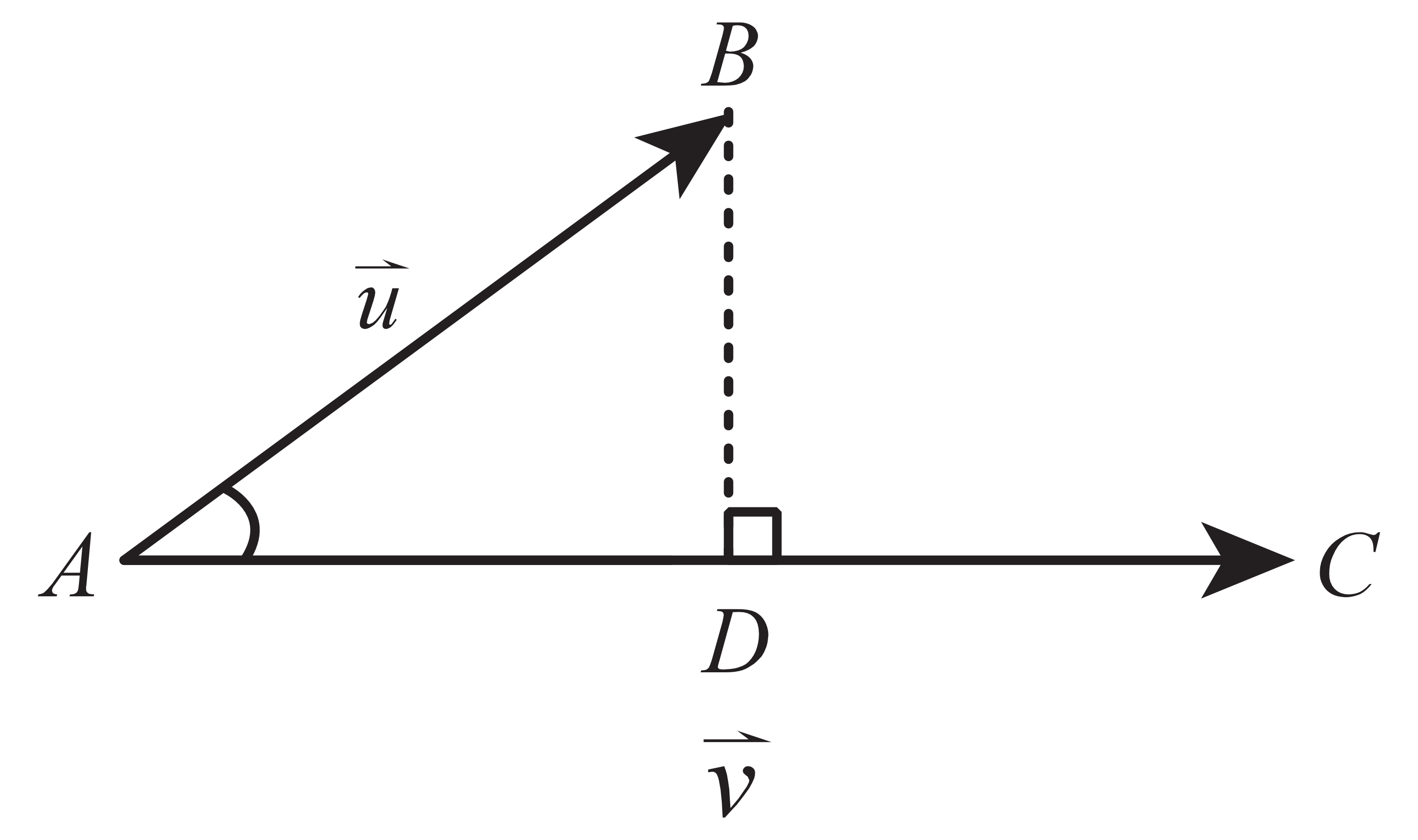
ทวนอีกรอบได้ที่ Projections — Lecture 7 A B → = u ⃗ \overrightarrow{AB}=\vec{u} A B = u A C → = v ⃗ \overrightarrow{AC}=\vec{v} A C = v
A D → = ( u ⃗ ⋅ v ⃗ ) v ⃗ ∣ v ⃗ ∣ 2 = Proj v ⃗ u ⃗ \overrightarrow{AD}=(\vec{u}\cdot\vec{v})\frac{\vec{v}}{|\vec{v}|^2}=\text{Proj}_{\vec{v}}\vec{u} A D = ( u ⋅ v ) ∣ v ∣ 2 v = Proj v u What about projection onto basis?
ให้ H H H R 3 \mathbb{R}^3 R 3 B B B
B=\left{ \begin{bmatrix} 0 \ 1 \0 \end{bmatrix}, \frac{1}{\sqrt{2}}\begin{bmatrix} 1 \ 0 \ 1 \end{bmatrix}\right}proj H v \text{proj}_H v proj H v v = [ 1 2 2 ] v= \begin{bmatrix} 1\\ 2 \\ 2 \end{bmatrix} v = 1 2 2
proj H v = ( v , v 1 ) v 1 + ( v , v 2 ) v 2 \boxed{\large{\text{proj}_H v=(v,v_1)v_1+(v,v_2)v_2}} proj H v = ( v , v 1 ) v 1 + ( v , v 2 ) v 2
โดยอันนี้จะเหมือนว่าเป็น Projection ของ v v v R 3 \mathbb{R}^3 R 3
The Gram–Schmidt Process
Normal Basis → Gram–Schmidt (GSO) Orthogonal Basis → Normalize Orthonormal Basis \boxed{\text{Normal Basis}}\xrightarrow{\text{Gram–Schmidt (GSO)}}\boxed{\text{Orthogonal Basis}}\xrightarrow{\text{Normalize}}\boxed{\text{Orthonormal Basis}} Normal Basis Gram–Schmidt (GSO) Orthogonal Basis Normalize Orthonormal Basis
สมมติให้ Normal Basis เป็น { x ⃗ 1 , x ⃗ 2 , … , x ⃗ p } \{\vec{x}_1,\vec{x}_2,\dotso,\vec{x}_p\} { x 1 , x 2 , … , x p }
เราอยากได้ Orthogonal Basis เป็น { v ⃗ 1 , v ⃗ 2 , … , v ⃗ p } \{\vec{v}_1,\vec{v}_2,\dotso,\vec{v}_p\} { v 1 , v 2 , … , v p }
Process คือได้ดังนี้
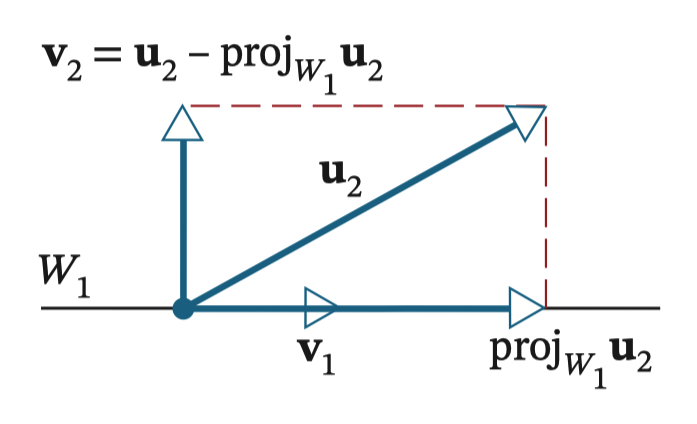
v ⃗ 1 = x ⃗ 1 , v ⃗ 2 = x ⃗ 2 − proj v ⃗ 1 ( x ⃗ 2 ) , v ⃗ 3 = x ⃗ 3 − proj v ⃗ 1 ( x ⃗ 3 ) − proj v ⃗ 2 ( x ⃗ 3 ) , ⋮ v ⃗ k = x ⃗ k − proj v ⃗ 1 ( x ⃗ k ) − proj v ⃗ 2 ( x ⃗ k ) − ⋯ − proj v ⃗ k − 1 ( x ⃗ k ) . \begin{align*} \vec{v}_1 &= \vec{x}_1, \\ \vec{v}_2 &= \vec{x}_2 - \text{proj}_{\vec{v}_1}(\vec{x}_2), \\ \vec{v}_3 &= \vec{x}_3 - \text{proj}_{\vec{v}_1}(\vec{x}_3) - \text{proj}_{\vec{v}_2}(\vec{x}_3), \\ &\ \vdots \\ \vec{v}_k &= \vec{x}_k - \text{proj}_{\vec{v}_1}(\vec{x}_k) - \text{proj}_{\vec{v}_2}(\vec{x}_k) - \cdots - \text{proj}_{\vec{v}_{k-1}}(\vec{x}_k). \end{align*} v 1 v 2 v 3 v k = x 1 , = x 2 − proj v 1 ( x 2 ) , = x 3 − proj v 1 ( x 3 ) − proj v 2 ( x 3 ) , ⋮ = x k − proj v 1 ( x k ) − proj v 2 ( x k ) − ⋯ − proj v k − 1 ( x k ) .
ในรูปคือให้เห็นเป็นภาพว่ามันจะทำให้เป็น Orthogonal Basis ได้ยังไง
สรุปสุดท้ายจะได้
Orthogonal Basis = { v 1 , v 2 , v 3 } \text{Orthogonal Basis} = \{v_1,v_2,v_3\} Orthogonal Basis = { v 1 , v 2 , v 3 } Orthonormal Basis = { v 1 ∣ ∣ v 1 ∣ ∣ , v 2 ∣ ∣ v 2 ∣ ∣ , v 3 ∣ ∣ v 3 ∣ ∣ } \text{Orthonormal Basis} = \{\frac{v_1}{||v_1||},\frac{v_2}{||v_2||},\frac{v_3}{||v_3||}\} Orthonormal Basis = { ∣∣ v 1 ∣∣ v 1 , ∣∣ v 2 ∣∣ v 2 , ∣∣ v 3 ∣∣ v 3 }
Orthogonal Complement
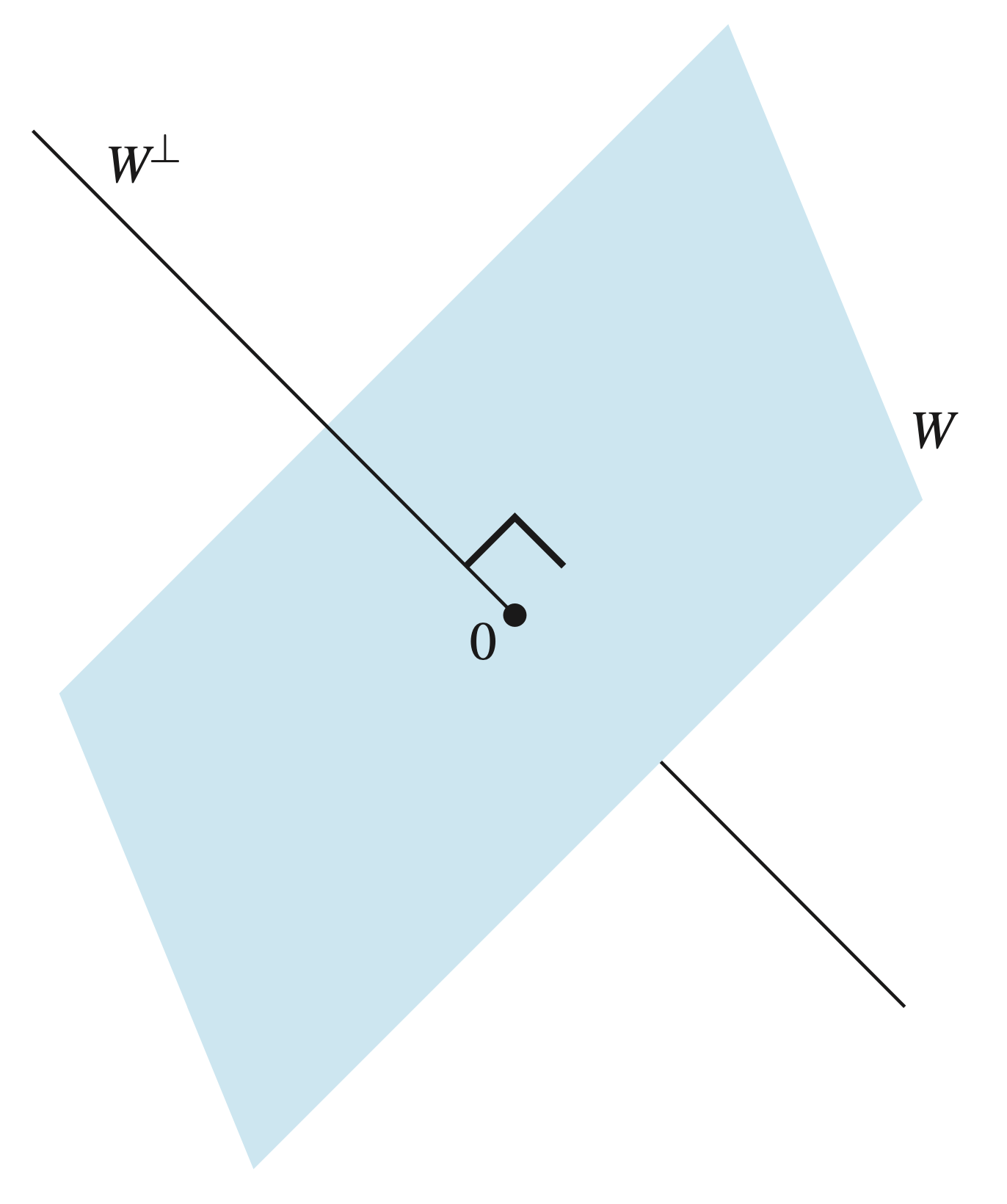
The orthogonal complement of a subspace H H H V V V H ⊥ H^\perp H ⊥ V V V H H H S ⊥ = { v ⃗ ∈ R n : v ⃗ ⋅ u ⃗ = 0 for every u ⃗ in S } \mathcal{S}^\perp=\{\vec{v}\in\mathcal{R}^n:\vec{v}\cdot\vec{u}=0\text{ for every }\vec{u}\text{ in }\mathcal{S}\} S ⊥ = { v ∈ R n : v ⋅ u = 0 for every u in S }
For example, if S = R n \mathcal{S}=\mathcal{R}^n S = R n S ⊥ = { 0 } \mathcal{S}^\perp=\{0\} S ⊥ = { 0 } S = { 0 } \mathcal{S}=\{0\} S = { 0 } S ⊥ = R n \mathcal{S}^\perp=\mathcal{R}^n S ⊥ = R n
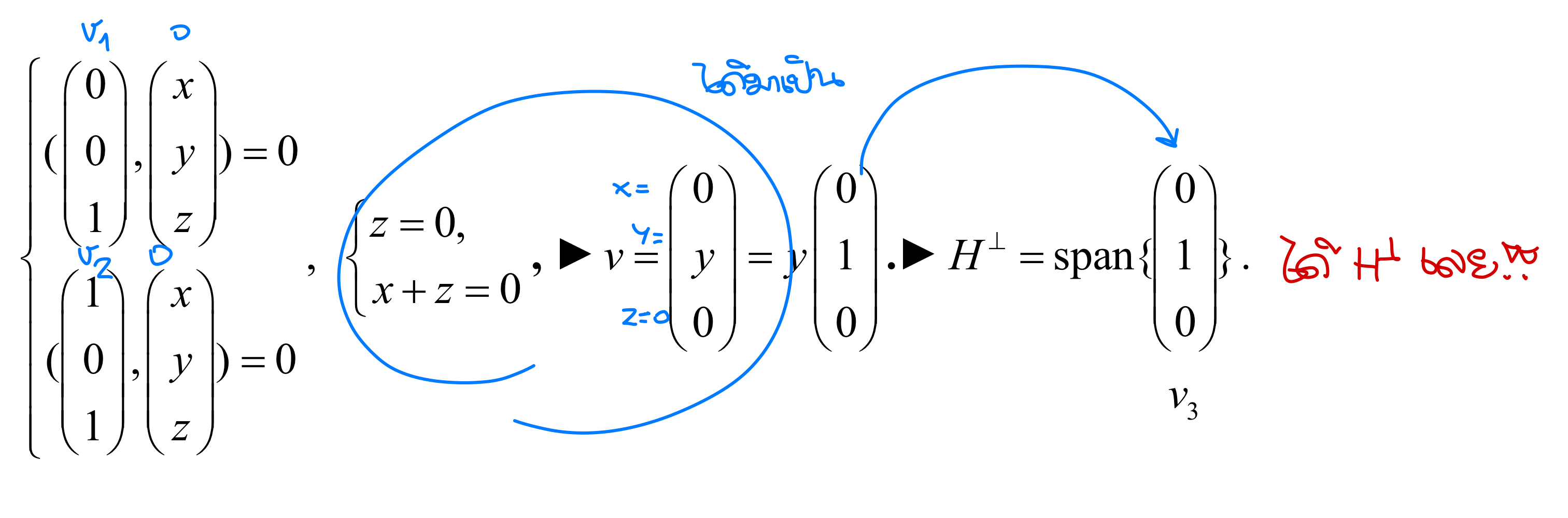
If basis of H H H { v 1 , v 2 , … , v k } \{v_1,v_2,\dotso,v_k\} { v 1 , v 2 , … , v k } H ⊥ H^\perp H ⊥ ( v , v 1 ) = 0 ( v , v 2 ) = 0 ⋮ ( v , v k ) = 0 \begin{aligned}
(v,v_1)&=0 \\
(v,v_2)&=0 \\
\vdots \\
(v,v_k)&=0
\end{aligned} ( v , v 1 ) ( v , v 2 ) ⋮ ( v , v k ) = 0 = 0 = 0 v = ( x 1 , x 2 , … , x k ) ∈ H ⊥ v=(x_1,x_2,\dotso,x_k) \in H^\perp v = ( x 1 , x 2 , … , x k ) ∈ H ⊥ H ⊥ H^\perp H ⊥
ง่าย ๆ ก็คือเอา Vector แต่ละตัว ใน Basis เนี่ยไป Dot กับ (x, y, z) = 0
ไม่จำเป็นต้องทำเป็น Orthonormal basis นะ!