Agenda
- Know how to tell when someone is making an argument
- Practice breaking an argument into parts
- Learn how to diagram those parts to understand arguments better
1. What is an Argument
Recognizing an Argument
- When someone starts by stating a strong opinion instead of asking a question or being open to different ideas, they are often using rhetoric, not logical reasoning
- Many people confuse persuasive language (rhetoric) with arguments that are based on reason and evidence
Rhetoric vs Arguments
- Rhetoric:
- Focused on persuading people
- Even if it ignores important evidence of opposing views
- Aims to win
- Argument:
- Gives reasons to support a claim
- Purpose is to discover the truth
Types of Arguments
- Deductive arguments:
- The conclusion must be true if the reasons (premises) are true
- Inductive arguments:
- The conclusion is likely true if the reasons (premises) are true
Propositions
- A proposition is a complete statement that can be true or false
- Examples:
- The earth revolves around the sun
- God exists
- Chris doesn't show me enough affection
- Cheating on exams is wrong
- Chiangmai is the capital of Thailand
Multiple Propositions in One Sentence
- Some sentences have more than one proposition
- Example: "Karen is smart, but she is not very motivated to do well in school or to try to find a job that uses her talent"
- Karen is smart
- Karen is not very motivated to do well in school
- Karen is not very motivated to try to find a job that uses her talent
Non-Propositions
- Directive: Please sit down
- Expressive: Oh my word!
- Interrogative: Did you see that?
Premises & Conclusion
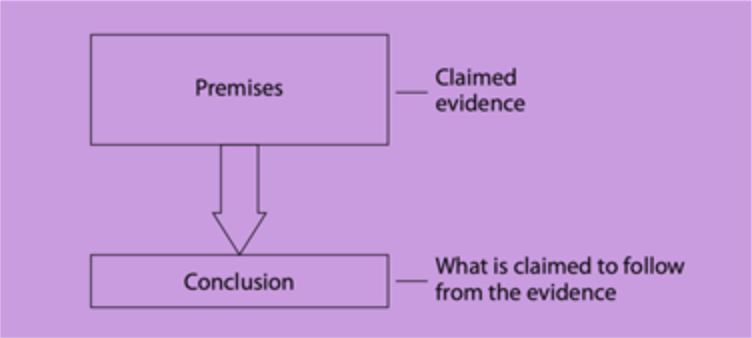
- Conclusion:
- The proposition supported by other propositions
- What the argument tries to prove
- Premise:
- The proposition that supports the conclusion
- If it is true, it helps us believe the conclusion
Quick Review: Identifying the Conclusion
- Passage 1: "I saw the movie last night. It was horrible. The story was very predictable, and the acting was very amateur. There were too many continuity errors too."
- Passage 2: "Mr. Jones is absent. He must not be feeling well."
- Passage 3: "Telling the truth can sometimes be more hurtful than telling lies. Also, it is not possible to tell a complete, absolute truth. Lying also improves relationships. With a bit of lie, we can keep our friends or maintain the right vibe. Lies are justifiable."
Types of Premises
- Descriptive:
- Based on observation or facts
- Examples: The canteen closes at 3:00 PM; Our dorm Wi-Fi was down last night
- Prescriptive:
- Contain value statements about ought or not ought to be done
- Examples: We should have more spaces for group study; It is unfair to grade group work equally when not everyone participates
- Analogical:
- Comparison is made between two similar events or things
- Example: Her multitasking on Zoom was like juggling knives while blindfolded
- Definitional:
- Contains a definition of a key term for purposes of precision or clarification
- Example: Academic integrity means not using unauthorized help in assessments
Hunting Out Conclusions
- People use reasoning to reach a conclusion
- A summary recaps the main points, but a conclusion interprets the information from those points to make a judgment
- Conclusions are often at the start or at the end
- A conclusion is the writer's interpretation or judgment
Conclusion Signal Words
- therefore
- so
- as a consequence
- finally
- phrases that mean "therefore"
Deduction Signal Words
- this ought to
- as a result
- therefore
- this should
- this must
- this means that
- in effect
Nonarguments
Disagreement
- An argument includes a proposition (conclusion) that is supported by at least one other proposition (premise)
- A simple disagreement without any supporting reason is ==not an argument==
- Example:
- A: Top Gun: Maverick was 2022's biggest box office hit. It earned more than 700 million in the US.
- B: I don't think so.
Explanation
- An explanation is a statement about why or how something happens
- Explanations do not attempt to persuade
- Example: "In our study, we found that drivers become sleepy, and driving for long hours causes accidents. We then put more stops along the highways for more breaks."
Description
- A description tells us how something is done or what something looks like
- They do not explicitly prove causes
- They do not judge
- Examples:
- "The solution was put in a test tube and heated to 38°C. Yellow vapor came out, but it had no smell. Then, 40 ml of water was added and heated until it boiled. Grey steam came out."
- "The painting shows many people near a cottage. Some are in the shadow. Others in the front are in the light."
Summaries
- A summary is typically the reduced version of a longer message or text
- Repeats what has been said
- Does not add new information
Conditional Statement
- A conditional statement is a sentence that starts with "if" and says what will happen if something else is true
- It doesn't make a conclusion. It only shows a possible result
- This is different from a conditional argument, which tells us whether the condition is true or false
- Examples:
- Conditional statement: "If you get at least a 3.8 GPA, I will buy you a new car."
- Conditional argument: "If you get at least a 3.8 GPA, I will buy you a new car. Your GPA is only 3.2, so you will not get a new car from me."
2. Breaking Down an Argument
Importance of Argument Analysis
- Knowing how to spot and draw arguments helps us understand them better
- We can use a diagram to show the different parts of an argument
- This lets us see the full idea:
- The statements (propositions)
- The support (premises)
- The final point (conclusion)
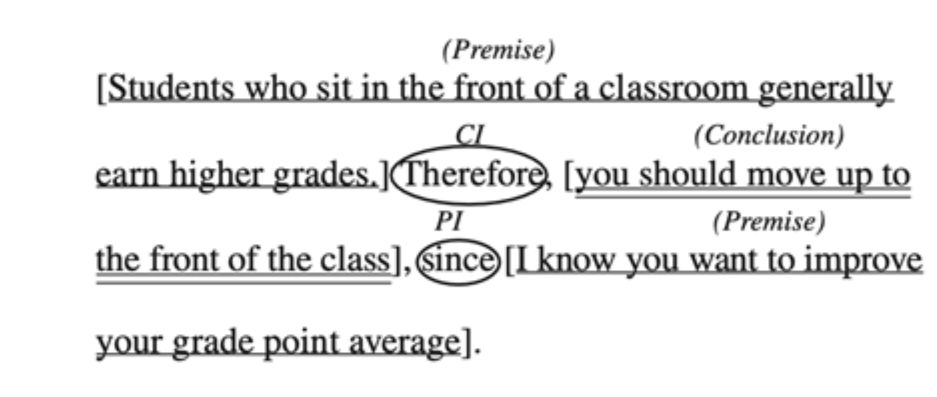
How to Break Down an Argument (Steps)
Step 1
- The entire argument may appear in one sentence or in several sentences
Step 2
- Put brackets around each proposition in the argument

Step 3: Identify the Conclusion
- What is the arguer trying to prove?
- Usually, but not always, it comes after:
- therefore
- thus
- hence
- so
- which shows that
- for these reasons
- consequently
- it follows
Step 4: Identify the Premises
- The premises often, but not always, follow these premise indicators:
- because
- since
- for
- given that
- may be inferred from
- the reason is that
- as shown by
- in view of
Step 5
- Draw a double line under the conclusion and a single line under the premise
Step 6
- Circle any conclusion or premise indicators
Types of Premises and the Subconclusion
- Independent premise:
- A reason that can completely support a conclusion by itself
- Dependent premise:
- An incomplete reason that cannot support the conclusion without another dependent premise
- Subconclusion:
- A proposition that is the midpoint in reasoning
- It interprets the premises that support it and then becomes a reason for the main conclusion
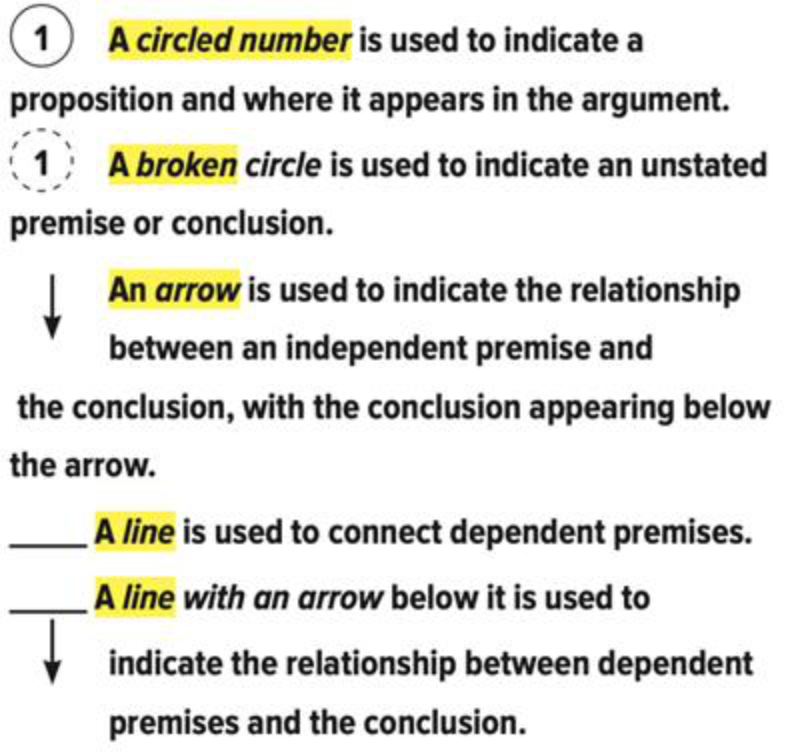
Diagramming Arguments Using Symbols
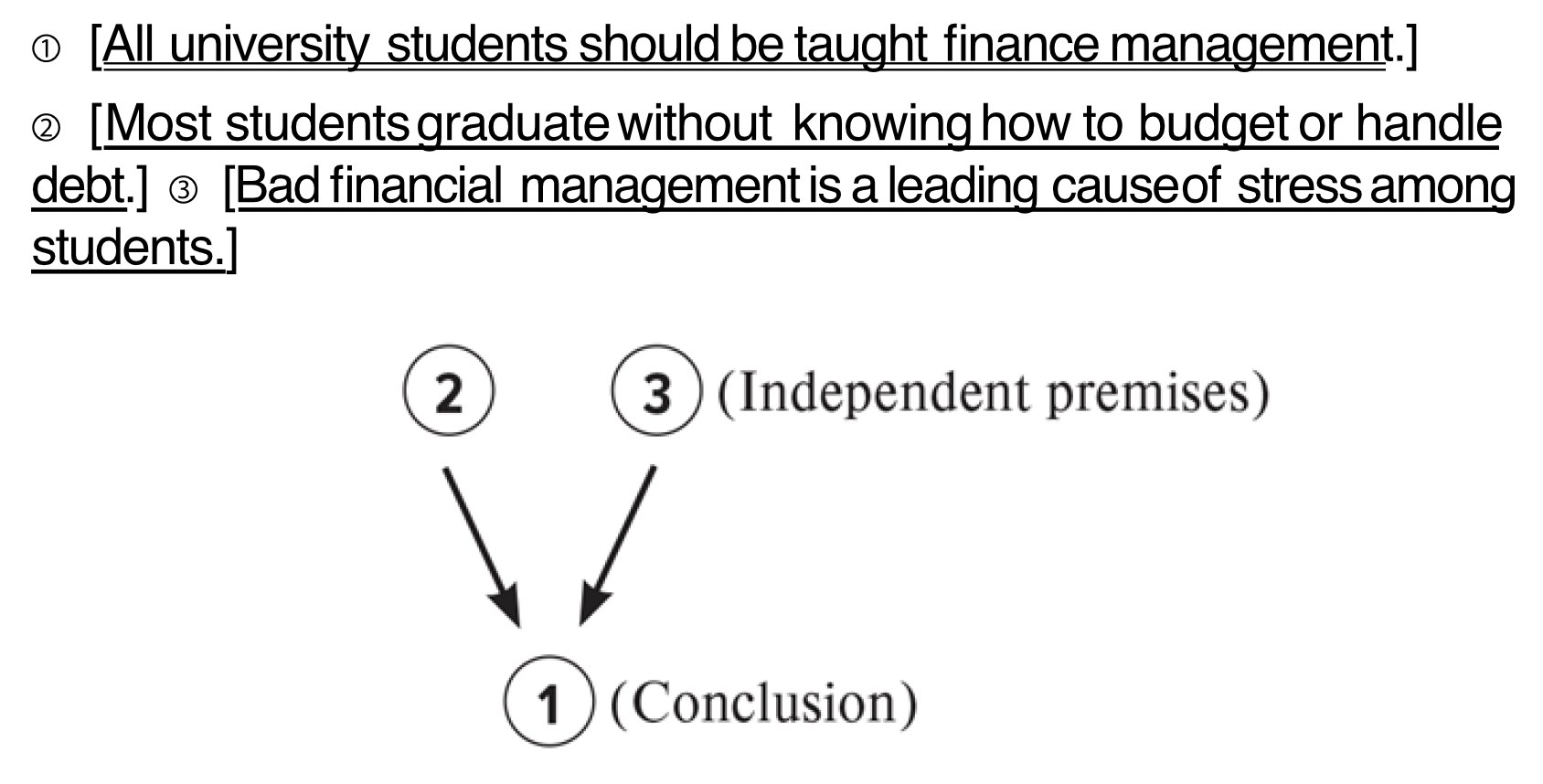
- Circled number: Used to indicate a proposition and where it appears in the argument
- Broken circle: Used to indicate an unstated premise or conclusion
- Arrow: Used to indicate the relationship between an independent premise and the conclusion, with the conclusion appearing below the arrow
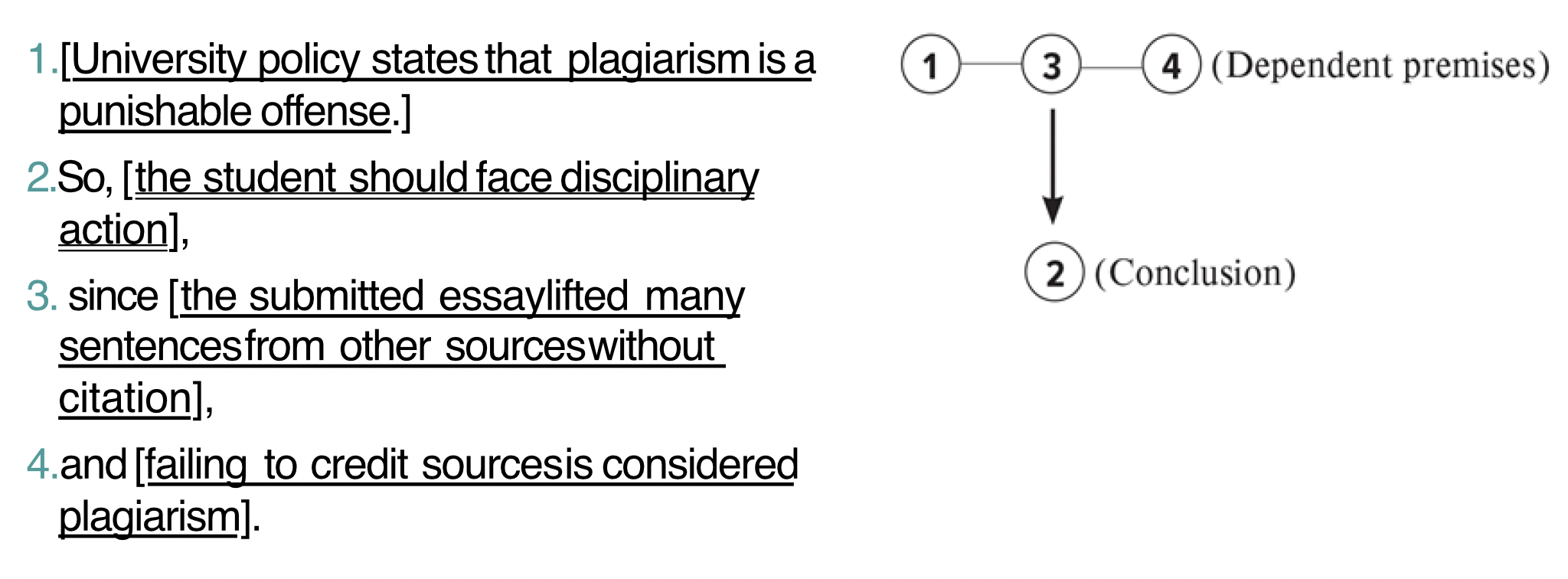
- Line: Used to connect dependent premises
- Line with an arrow below it: Used to indicate the relationship between dependent premises and the conclusion
Argument Examples
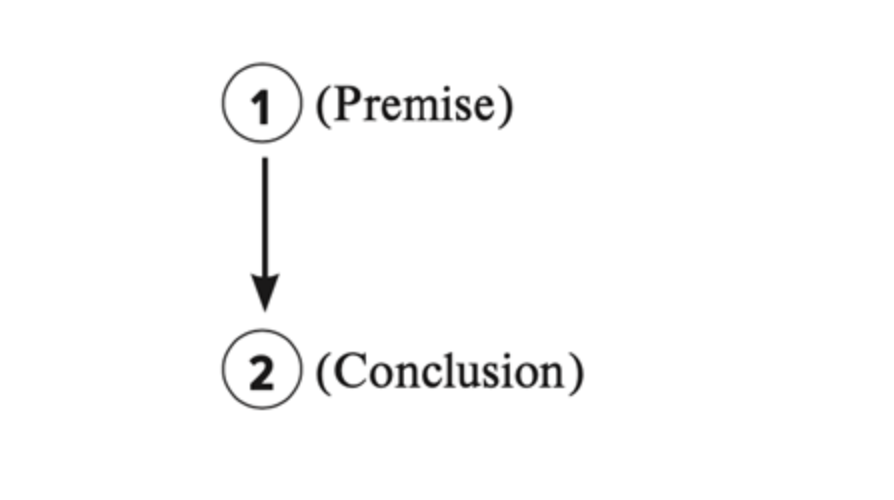
Arguments with One Premise

Argument with Independent Premises
Example: "All university students should be taught finance management. Most students graduate without knowing how to budget or handle debt. Bad financial management is a leading cause of stress among students."
Argument with Dependent Premises
Example: "University policy states that plagiarism is a punishable offense. So, the student should face disciplinary action, since the submitted essay lifted many sentences from other sources without citation, and failing to credit sources is considered plagiarism."
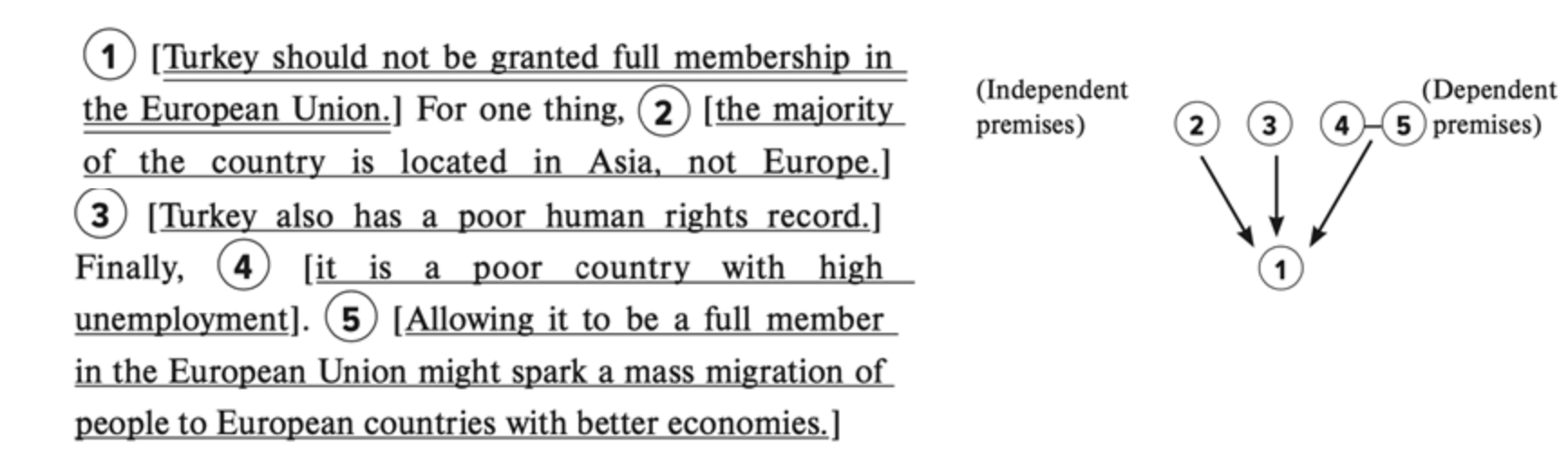
Arguments with Independent and Dependent Premises
Example: "Turkey should not be granted full membership in the European Union. For one thing, the majority of the country is located in Asia, not in Europe. Turkey has a poor human rights record. Finally, it is a poor country with high unemployment. Allowing it to be a full member in the European Union might spark a mass migration of people to European countries with better economies."
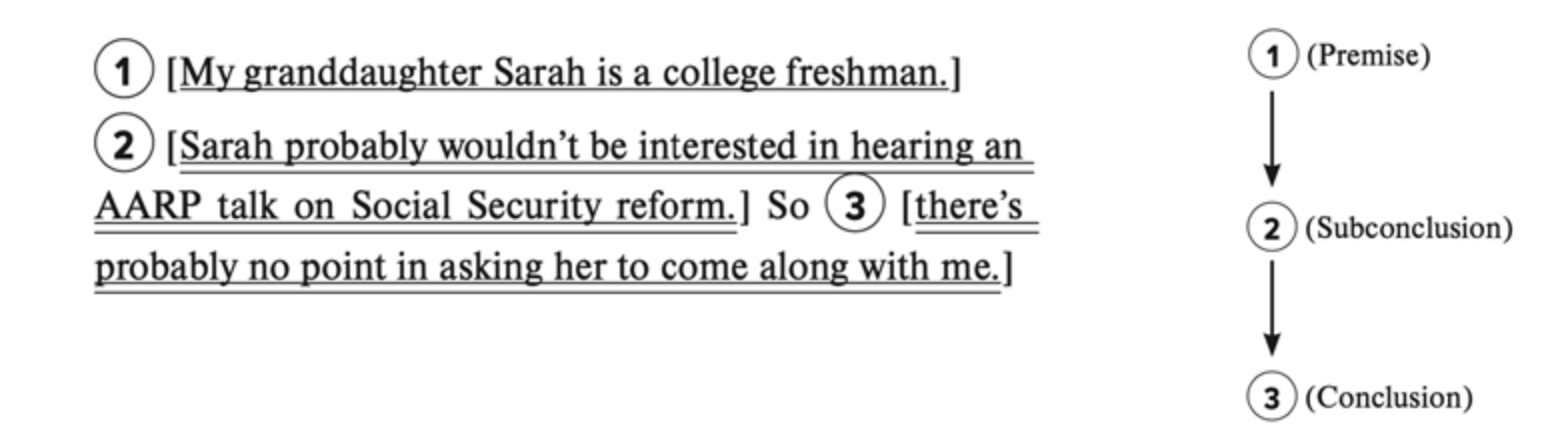
Arguments with a Subconclusion
Example: "My granddaughter Sarah is a college freshman. Therefore Sara wouldn't be interested in hearing an AARP talk on Social Security. So, there's no point in asking her to come along with me."
Arguments with an Unstated Premise
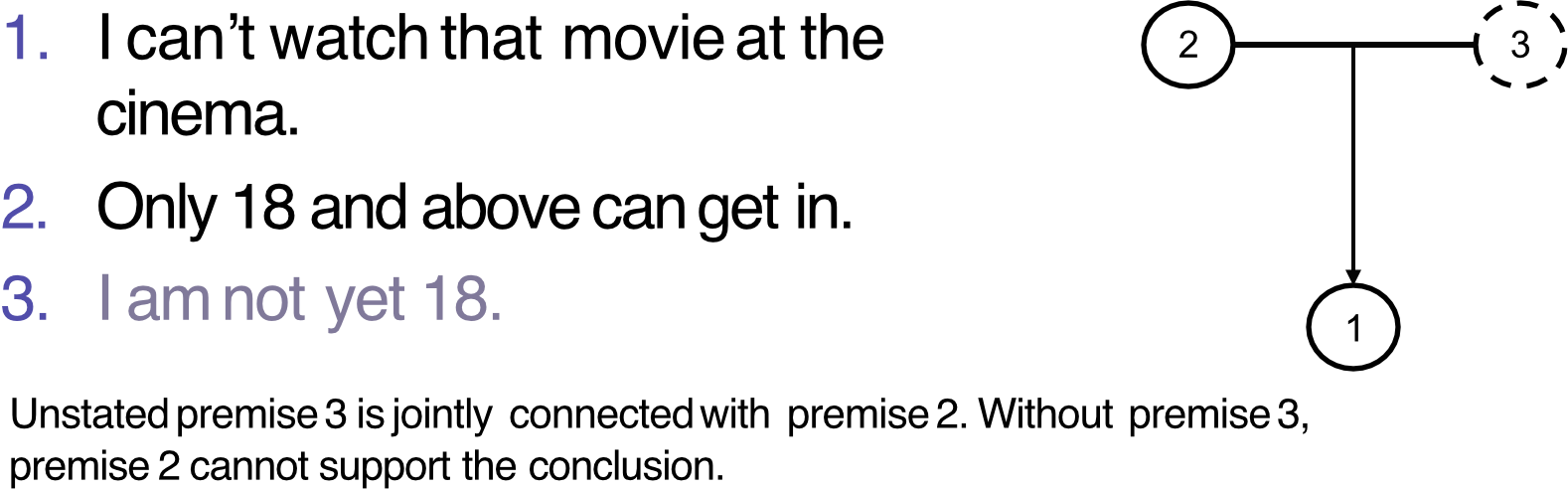
Example: "I can't watch that movie at the cinema. Only 18 and above can get in."
- Unstated premise: "I am not yet 18"
Argument with an Unstated Conclusion
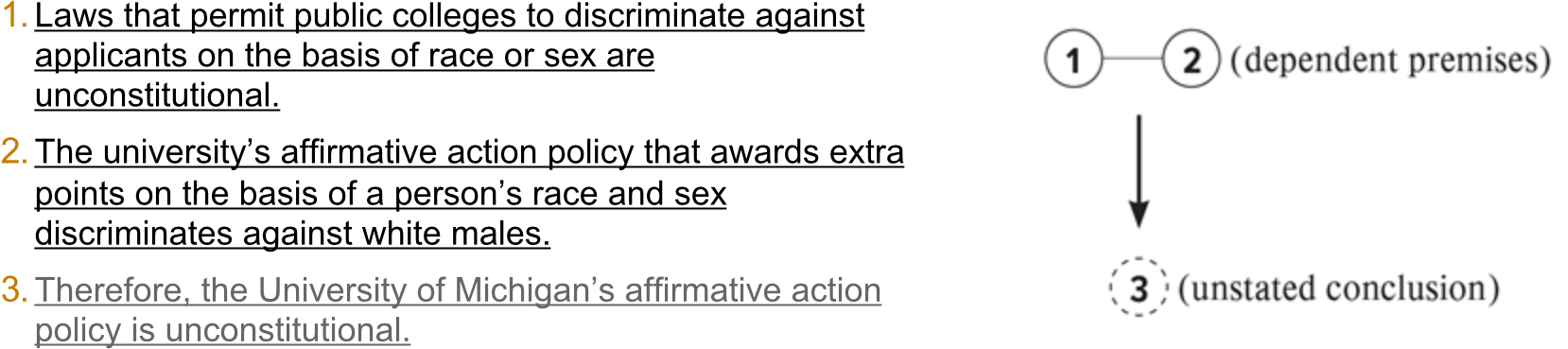
Example: "Laws that permit public colleges to discriminate against applicants on the basis of race or sex are unconstitutional. The university's affirmative action policy that awards extra points on the basis of a person's race and sex discriminates against white males."
- Unstated conclusion: "Therefore, the University of Michigan's affirmative action policy is unconstitutional"
Important Distinctions
When do we know that there is a subconclusion?
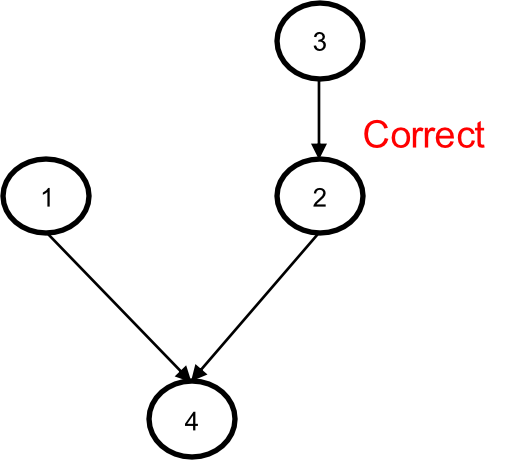
- A good argument should have only reasons that support its conclusion
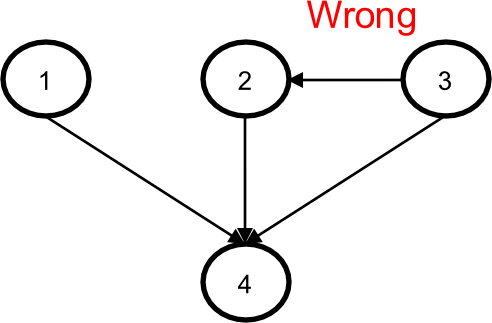
- If a premise supports another premise before proving the main point, then we should place this premise above the other premise it supports, indicating a subconclusion
Difference between independent and dependent premises
- Dependent premises:
- Incomplete without each other
- If you delete one, the other cannot support the conclusion by itself
- Independent premise:
- Stands on its own
- When another premise supports it, it becomes even stronger, but it can prove the conclusion with or without another premise
Learning Task 6.1: Breaking Down Arguments
Read each passage. For each passage:
- Bracket and number propositions
- Double underline the conclusion and underline the premise
- Circle any conclusion or premise indicator
- Make a diagram using the same symbols to illustrate the argument in each passage
Example A
"Everything is going digital nowadays. Soon, we will no longer need libraries since most journals and news sources are available online. In addition, books are being made available in electronic format."
Example B
"It is not the best decision to drive your own car to school. First, you spend more effort and energy driving yourself than being a sitting passenger. Second, cars are expensive to maintain. Gas and oil are expensive. You have to pay for parking as well. You should take the bus to school."
Critical Thinking & Analysis of Arguments
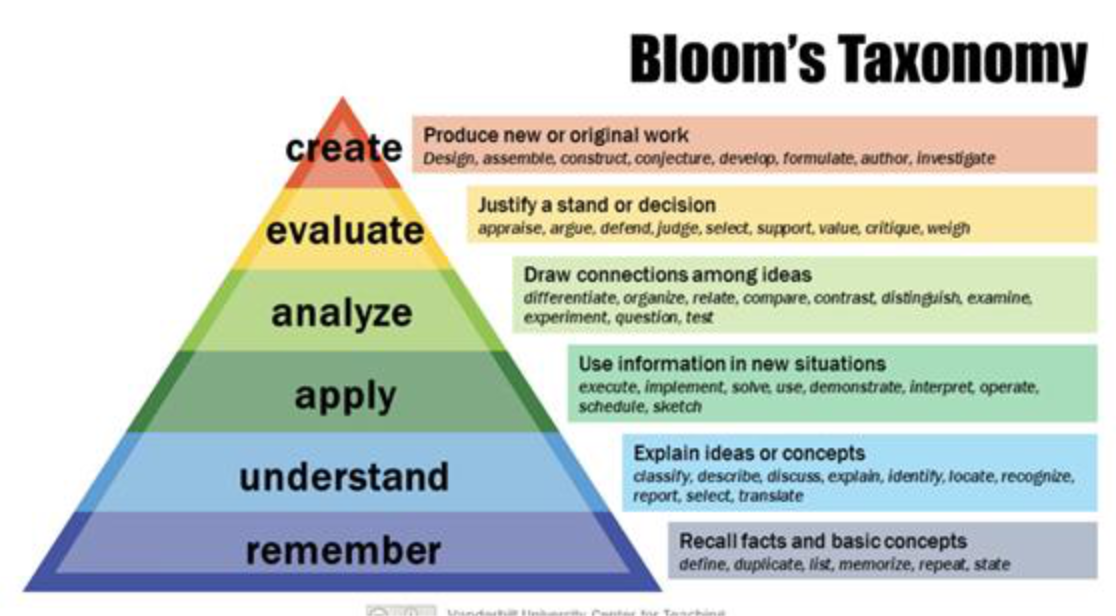
- Today, we tried out ways how to analyze arguments
- Critical thinking is about knowing how to think rather than what to think
- Arguments help us make better decisions in real life
- Critical thinkers use them not to stir conflict, but to understand and resolve it
- They don't rush to judgment
- Instead, they explore all sides of an issue—and only take a stand when they've truly seen the whole picture