Reason: have evidence and draw conclusion from that
Rationalization: have decided, find excuse for that decision
Acting without thinking is called Impulsive
Agenda
1. What is Reason?
Definition of Reason
- Reason is the way we support a belief or conclusion using evidence
- It means thinking carefully and using clear steps to solve problems
Understanding Reasoning Challenges
Two problem types that demonstrate how familiarity affects reasoning:
Problem 1: Drinking Age Rule
- Rule: Only 21 and up can drink alcohol
- Question: Who should you check to see if the rule is followed?

Problem 2: Card Logic Rule
- Rule: A card with a vowel must have a card with an even number on the other side
- Cards shown: E, K, 7, 4

- Question: Which card(s) would you turn over?
Key Insight
- People—especially those without formal training in critical thinking—find it easier to reason through problems when the situation is familiar
- The drinking age problem is more intuitive than the abstract card problem, even though they follow the same logical structure
Traditional Views of Reason
Historical Progression
- Plato's view of the human soul
- Thomas Aquinas view on God & rationality among humans
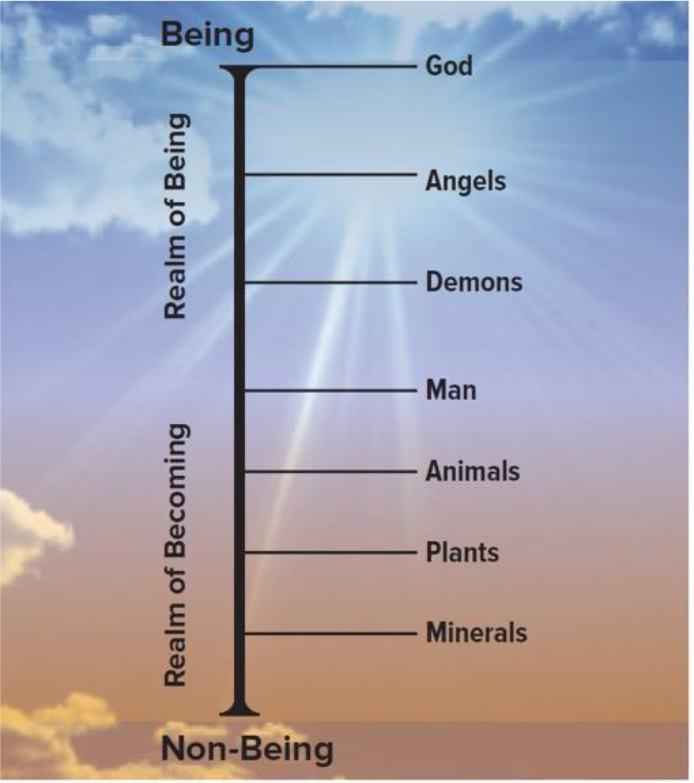
- Charles Darwin's rejection of ordered Chain of Being
The "Divine Spark" Concept
- For centuries, Western scholars believed that humans were specially created and given a "divine spark" of reason
- The Chain of Being hierarchy (from highest to lowest):
- God
- Angels
- Demons
- Man
- Animals
- Plants
- Minerals
Modern Scientific Understanding
- Today most scientists agree that rather than being driven by instinct alone, many other animals are capable of abstract thought and reason
- This challenges the traditional view of humans as uniquely rational beings
Reason and Science Paradox
- In the 20th century, reason became closely linked with science
- But ironically, science itself rests on a basic belief—that the external world exists—a belief we can't fully prove through reason
- This shows that some of our most important beliefs can't be proven, but are still considered reasonable
Components of Reason
Reason contains important components and strategies:
- Abstract thinking
- Behavioral modification
Reason involves embracing different cognitive strategies:
- Deduction
- Generalization
- Imagination
Gender, Age, & Reason
Historical Biases in Western Thought
Old Western Thought
- Reason has been traditionally linked with males in Western thought
- Aristotle's views
- The Judeo-Christian perspective of women
Sexist Stereotypes
- Women have often been seen mainly as child-bearers and considered less capable
- These stereotypes shape expectations about what work women should do
- The idea that women are "too emotional" has also kept many from leadership roles
Feminist Perspectives
Feminist Ideas
- Feminist thinkers argue that men and women have the same ability to reason
- The gap in roles and power comes from discrimination and men not wanting to give up their advantages
- Even if women are seen as more emotional, that doesn't mean they are less logical or less capable of reasoning
Additional Harm of Sexism
- Gender stereotypes also hurt men—for example, by looking down on those who choose to stay home or work in caring jobs like nursing or teaching
Critical Thinking Application
- To think critically, we need to question our assumptions about gender and age
- If we don't examine them, these assumptions can lead to unfair views and hurt both others and ourselves
Dreams & Problem Solving
Unconscious Function
- Reasoning has long been seen as a conscious activity
- Recent brain research shows that much of it happens unconsciously and automatically
Dreams and Reasoning
- Studies of brain function indicate that dreams involve cerebral activity related to reason and problem-solving
Breakthroughs
- Many important knowledge breakthroughs, such as the creation of the periodic table by Russian chemist Dmitri Mendeleyev, occurred through dream-inspired guidance
Key Insight
- Reason can operate at both conscious & unconscious levels
2. The Role of Emotion in Critical Thinking
Definition of Emotion
- Emotion is a state of consciousness in which feelings such as joy, anger, love, hate, and fear are experienced
- In Western culture, emotion has traditionally been set in opposition to reason and has been regarded as the culprit in sloppy reasoning and irrational life choices
Cultural Attitudes toward Emotion
Different Cultural Approaches
Chinese Confucianism
- Emphasizes the cultivation of relationships & emotions like compassion & loyalty as key to the good life
Traditional African
- Focuses on personal & historical experiences in critical thinkers
Buddhism
- Compassion & love is the foundation of good critical thinking
Educational Differences
- North Americans teach critical thinking as a rational and analytic process
- Japanese teachers place more emphasis on the emotional domain of critical thinking
Critical Question
- Should critical thinking take into account emotions, or is reason better off without the "corrupting" influence of emotion?
Balanced Perspective
- As critical thinkers, we must pay attention not just to the world around us, but also to our own emotions
- Feelings can sometimes block clear thinking, but they can also help us think more deeply and make wiser choices
Emotional Intelligence & Positive Effects of Emotion
Definition of Emotional Intelligence
The ability to perceive accurately, appraise and express emotion
Key Components:
- ✓ Access and/or generate feelings when they facilitate thought
- ✓ Understand emotion & emotional knowledge
- ✓ Regulate emotions to promote emotional & intellectual growth
How Emotions Help Critical Thinking
- Emotions can help us think more clearly by guiding us toward better decisions
Examples of Positive Emotional Impact:
- Empathy: Understanding how others feel—can help us see injustice and build stronger relationships
- Moral indignation: Rosa Parks' anger at unfair treatment moved her to act
- Love: Motivates compassion and care
- Happiness: Promotes positive thinking
- Guilt: Can guide moral behavior
Warning from Al Gore
- Exposure to war, disaster, and government failure—and the way media spin these events—can dull our emotional sensitivity
- This leaves us numb to violence, injustice, and neglect
Negative Effects of Emotion
When Emotions Hinder Critical Thinking
- Critical thinking can break down when our emotions are shaped by stereotypes or old emotional wounds
- When we act only on feeling—without thinking—we're more likely to make poor choices
Integrating Reason & Emotion
The Power of Integration
- When we combine feeling and reason, we have a stronger tool for critical thinking
Two Key Functions of Emotion:
- ✓ Emotion alerts us to what matters
- ✓ Emotion motivates us to act
Path to Balanced Thinking
- To grow as balanced thinkers, we need to recognize our feelings and use them alongside reason to make better decisions
3. Artificial Intelligence, Reason, & Emotion
Philosophical Questions about AI
- Reason helps us analyze and decide, but emotion isn't just raw feeling—it's shaped by what we sense around us and what we carry inside
- It helps us respond, often faster than reason
- Critical question: If something doesn't feel—because it doesn't process the world like we do—can it truly think for itself?
Definition of Artificial Intelligence
- The study of the computations that make it possible for machines to perceive, reason, & react
- It draws from cognitive psychology, philosophy, and computer science
- Goals include:
- The enhancement of human reasoning
- The creation of intelligent machines
- The development of sociable, intelligent machines that can cooperate with people
AI & Personhood Quote
"This issue matters, because technology is getting better all the time, and we need to figure out how we're going to treat potential new persons, if we end up creating beings that we decide meet the threshold of personhood."
Competing Perspectives on AI Consciousness
Roger Penrose's View (Skeptical)
- Human consciousness goes beyond quantum physics
- Computers will never be able to develop human-like thinking & consciousness
Herbert A. Simon's View (Supportive)
- The belief that intelligent computers are not thinking and conscious is based on prejudice against AI
- Consciousness is an activity of the brain, organic or inorganic
Moving Forward with AI
- Given recent advances in these endeavors, as critical thinkers, we need to move beyond questioning whether AI is capable of reasoning and emotion
- We should not hold AI to higher standards of proof than we apply to humanity
- AI possesses enormous potential to enhance our critical thinking abilities
4. Faith & Reason
Definition of Faith
- Belief & trust in a religious deity
- For those who have faith, the whole world and their whole life are focused on (a supreme being)
Fideism: Faith Transcends Reason
Definition
- Fideism is the belief that truth about the divine comes through faith, not through reason
- Some Christian and Islamic traditions hold this view when it comes to the existence of God
Weaknesses of Fideism
- Conviction does not mean truth
- Which faith is correct?
- Not allowing the use of reasons to examine belief systems & internal contradictions
Rationalism: Beliefs & Reason
Definition
- Rationalism is the view that religious beliefs should align with reason and evidence
- This means believing something is true because there are good reasons—either from reliable sources or personal experience—to support it
Types of Rationalist Positions
Religious Rationalist
- The (natural world) as a premise to the conclusion that God exists
- Failure of science against faith when they are in conflict with one another
Agnostic
- A person who believes that the existence of God is ultimately unknowable
Atheist
- A person who does not believe in the existence of God
Critical Rationalism: Faith & Reason are Compatible
Definition
- Critical rationalism is the belief that faith comes from God's revelation, but it should not conflict with reason
- If a faith-based claim contradicts logic or evidence, it can be challenged and even disproven
Example: Abraham & Isaac
- Critical rationalists interpret the story of Abraham & Isaac as a conflict between blind obedience & the moral law
Criticism of Critical Rationalism
- Critical rationalists believe that faith is based on revelation or the direct knowledge of God
- However, not all have "direct knowledge" of the existence of God
Religion, Spirituality, & Real-Life Decisions
Research Findings
- Studies have found that religious people are not more likely to act with moral courage or kindness than non-religious people
Definition of Spirituality
- Spirituality is a personal sense of respect for what is sacred—in yourself, in others, and in life
- It doesn't depend on belonging to a religion or believing in a personal God
- It's often linked to compassion, seeking justice, and staying strong through hardship
Conclusions
Key Takeaways
- Effective critical thinking requires the exercise of both reason and emotion in order to be most effective
- Faith is not immune from reason