Switching Networks - Core Concepts
Basic Definitions
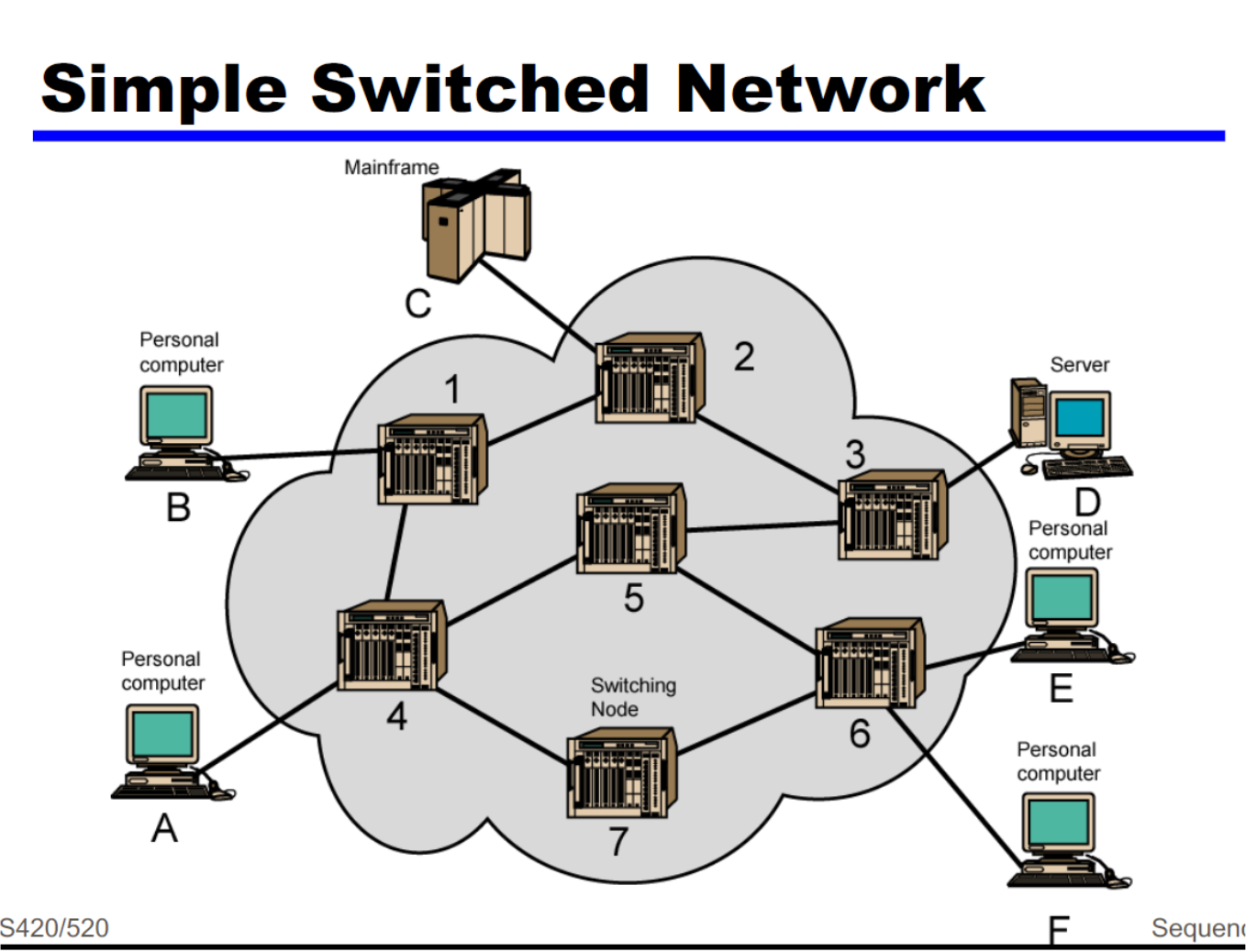
- Switching nodes: Provide a switching facility that moves data between nodes
- Stations: Devices attached to the network
- Communications network: Collection of nodes
- Switched communication network: Data entering the network from a station are routed to the destination by being switched from node to node
Network Node Characteristics
Node Properties
- Nodes may connect to:
- Other nodes only, OR
- Stations and other nodes
- Node-to-node links: Usually multiplexed
- Network topology: Usually partially connected
- Some redundant connections are desirable for reliability
Two Main Switching Technologies
จะมาเรียนสองแบบนี้ในวันนี้เลยล่ะ ต่างกันยังไง ทำงานแบบไหน ข้อดีข้อเสียเป็นยังไง
- Circuit switching
- Packet switching
Circuit Switching
ให้นึกถึงโทรศัพท์บ้านสมัยก่อนเลย ก่อนจะคุยได้ต้องมีเสียงต่อสายก่อน
Definition and Phases
- Dedicated communication path between two stations
- Connection must be established before data transmission begins
Three Phases of Circuit Switching
- Establish - Set up the connection (สร้างการเชื่อมต่อ)
- Transfer - Transmit data (ส่งข้อมูล ตอนคุยกัน)
- Disconnect - Tear down the connection (ยกเลิกการเชื่อมต่อ วางสาย)
Requirements
จะทำแบบนี้ได้คือตัว เครือข่ายต้องพร้อม แล้วก็ต้องมีระบบควบคุมคอยหาเส้นทางให้ด้วย
- Must have switching capacity and channel capacity to establish connection
- Must have intelligence to work out routing
Key Characteristics
- End-to-end resources reserved for "call"
- Link bandwidth
- Switch capacity
เหมือนได้ถนนส่วนตัวเลย
- Dedicated resources: No sharing
- Circuit-like (guaranteed) performance
- Call setup required
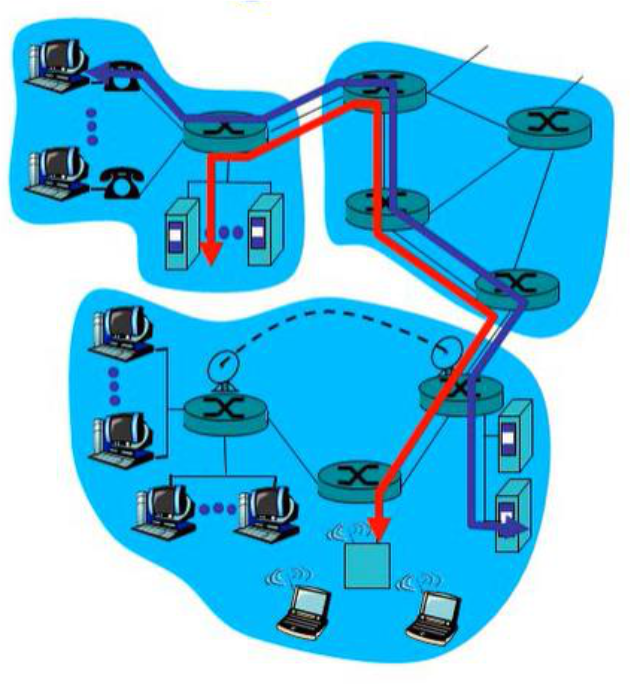
Analogy: Circuit switching is like making a traditional phone call - you dial, wait for connection, talk continuously on a dedicated line, then hang up. The entire path is reserved just for your conversation.
Circuit Switching: Multiplexing Techniques
แล้วถ้ามีคนใช้เยอะ ๆ ก็มี Technique ที่เรียกว่า Multiplexing — ให้สายสัญญาณเส้น ๆ เดียวเนี่ย รองรับหลายคู่สายพร้อม ๆ กัน
Resource Division
Network resources (e.g., bandwidth) are divided into "pieces":
- Pieces allocated to calls
- Resource piece idle if not used by owning call (no sharing)
Two Methods of Division
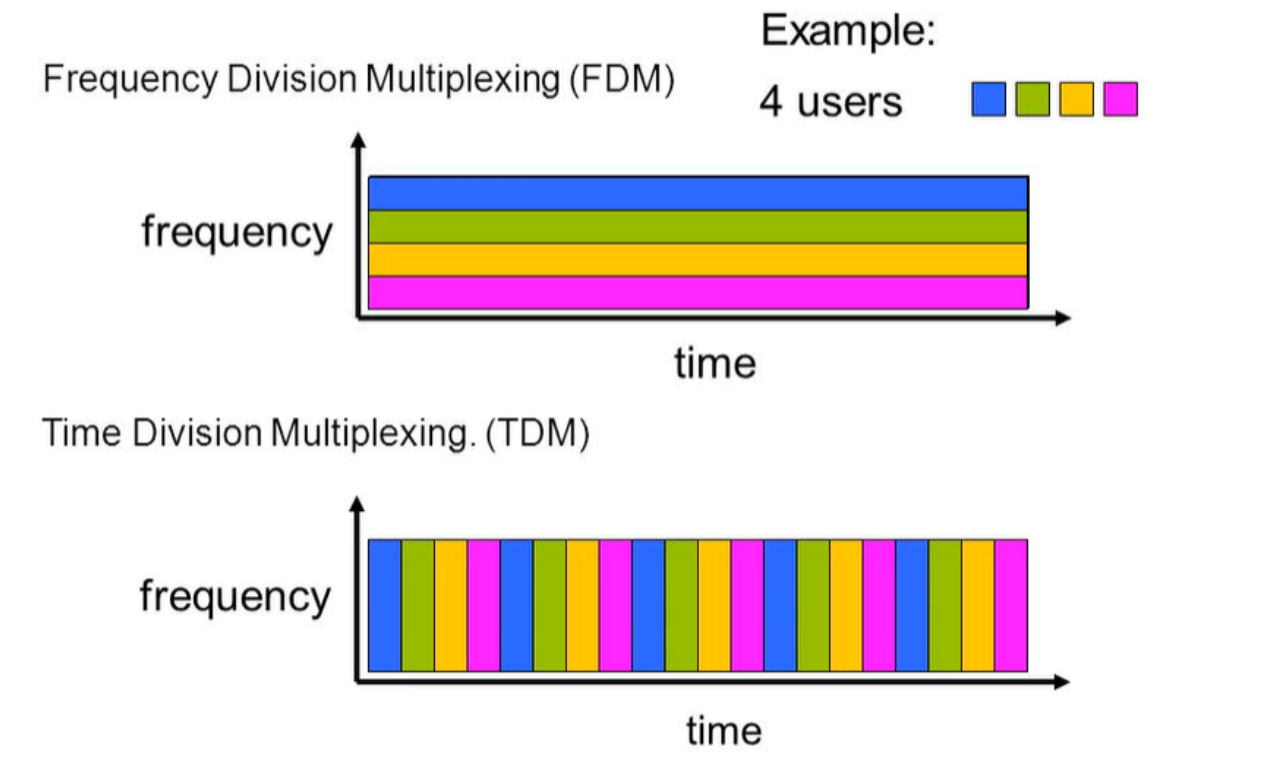
- Frequency Division Multiplexing (FDM) — แบ่งตามคลื่นความถี่ คล้าย ๆ กับช่องวิทยุ
- Time Division Multiplexing (TDM) — แบ่งตามช่วงเวลา สลับกันใช้ช่วงเซี่ยววินาที
Example Calculation
Problem: How long does it take to send a file of 640,000 bits from host A to host B over a circuit-switched network?
Given:
- Link transmission rate = 1.536 Mbps
- Each link uses TDM with 24 slots/sec
- 500 msec to establish end-to-end circuit
Solution:
Public Circuit Switched Network
ส่วนประกอบในเครือข่ายจริง ๆ ที่ทำให้เกิดกระบวนการนี้ได้
Network Components
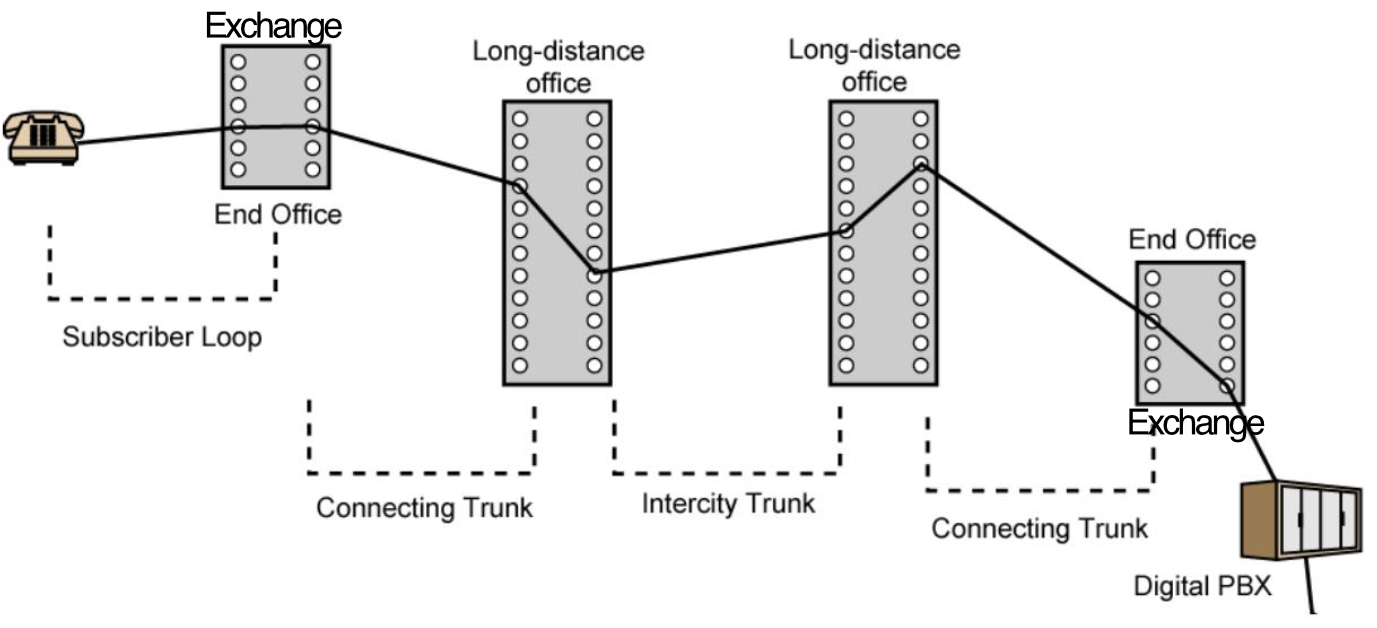
- Subscriber (ผู้ใช้บริการ พวกโทรศัพท์ คอมพิวเตอร์)
- Devices attached to network
- Subscriber line
- Local Loop - สายที่ลากจากบ้านเราไปชุมสายโทรศัพท์
- Subscriber loop
- Connection to network
- Few km up to few tens of km
- Exchange (ชุมสาย)
- Switching centers
- End office - supports subscribers
- Trunks (สายสัญญาณขนาดใหญ่ เชื่อมระหว่างชุมสายต่าง ๆ)
- Branches between exchanges
- Multiplexed (ก็ทำ Multiplexing บน Trunk นี่แหละ)
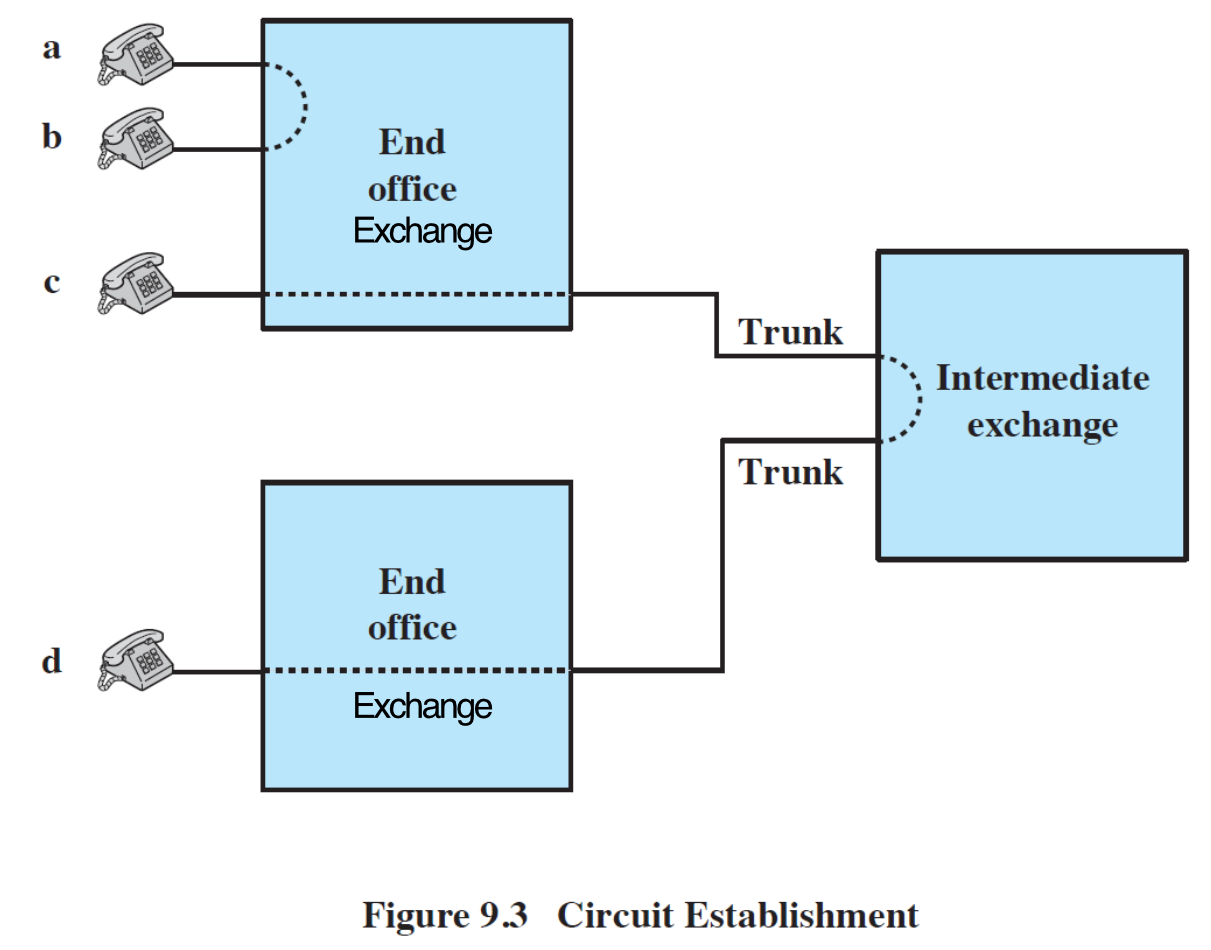
Circuit-Switching Technology
Design Considerations
- Driven by applications that handle voice traffic
- Key requirement: No transmission delay and no variation in delay
- Efficient for analog transmission of voice signals
- Inefficient for digital transmission
- Transparent
- Once a circuit is established, it appears as a direct connection
- No special logic is needed
ต้องบอกว่าไอ่ Circuit Switching เนี่ยมันเหมาะกับ Voice จริง ๆ (Analog) คือทำมาเพื่อการนั้นเลย แต่ว่าพอมาเป็นยุค Digital เนี่ย มันก็อาจจะไม่ได้เหมาะ เพราะการส่งจริง อาจจะมีหยุดบ้าง ก็เลยเริ่มไม่มีประสิทธิภาพซักเท่าไหร่
Types of Switches
Switch Categories
- Analog switches: Can pass or isolate both analog and digital signals
- Digital switches: Can only pass or isolate digital signal lines
Usage
- Both are used instead of mechanical switches for:
- Convenience
- Reliability
- Small size compared to mechanical switches
Digital Switch Components
A pin or input line that takes input from many users.
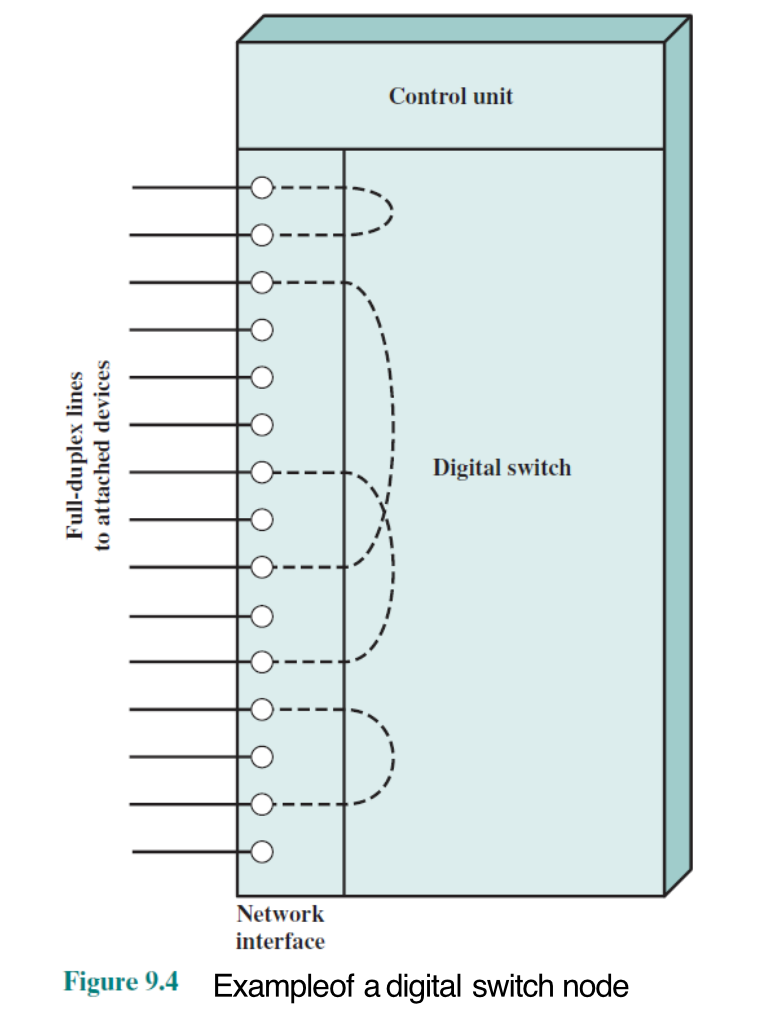
Main Components
- Digital Switch
- Provide transparent signal path between devices
- Network Interface
- Functions and hardware needed to connect digital devices
- Control Unit
- Establish connections
- Generally on demand
- Handle and acknowledge requests
- Determine if destination is free
- Construct path
- Maintain connection
- Disconnect
- Establish connections
Circuit-Switching Concepts
Three Key Components
1. Digital switch
- Provides a transparent signal path
- Must allow full-duplex transmission
2. Network interface
- Functions and hardware needed to connect digital devices
3. Control unit
- Establishes, maintains, and tears down the connection
Digital Switch: Blocking vs Non-Blocking
คุณสมบัติสำคัญของ Digital Switch เลยนะอันนี้อะ Blocking vs Non-Blocking
- Blocking: อาจจะมีบางสถานการณ์ที่เราไม่สามารถต่อสายได้ แม้ว่าเครื่องเราก็ว่าง ปลายทางก็ว่าง เพราะว่าเส้นทางข้างในตัว Switch เอง อาจจะใช้เต็มหมดแล้ว
- Non-blocking: ก็ตรงข้ามเลย Guarantee ว่า ตราบใดที่ปลายทางว่าง คุณสามารถสร้างการเชื่อมต่อได้ 100% เลย (ฟังดูดี แพงกว่าด้วยแหละ)
Blocking
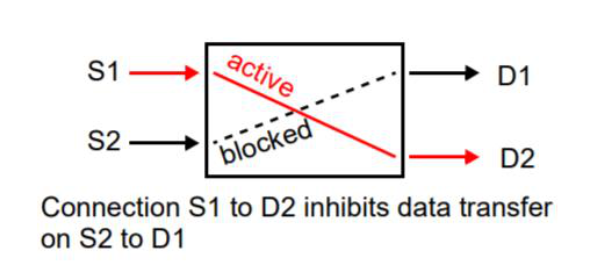
- a switching pattern is blocking if the data cannot flow on all connections simultaneously
- use on voice systems
- short duration calls
Non-blocking
A switch is said to be non-blocking if the switching fabric is capable of handling the theoretical total of all ports, such that any routing request to any free output port can be established successfully without interfering other traffics.
Switching Techniques
- Space-Division Switching: a dedicated path is established between the calling and the called subscribers for the entire duration of the call.
- Time-Division Switching: sampled values of signals are transferred at fixed intervals.
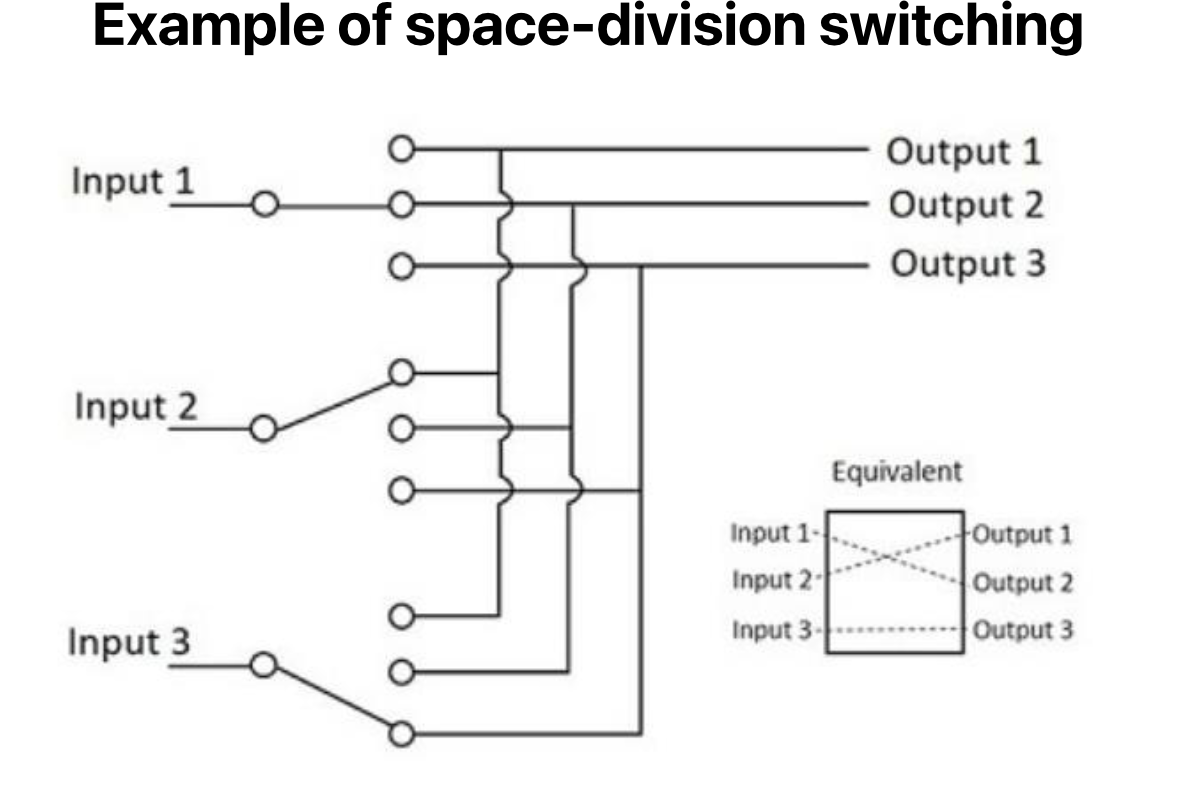
Space-Division Switching
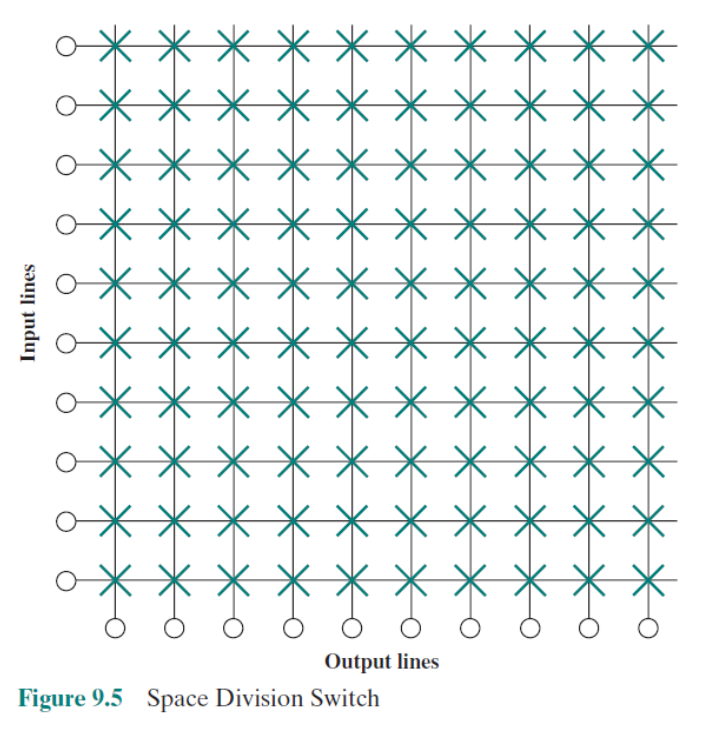
Characteristics
- Separate physical paths
- Example: Crossbar switch
Crossbar Switch Operation
- When a request comes in from an incoming line for an outgoing line, the corresponding crosspoint is closed to enable information to flow from the input to the output
- Complexity: Measured by the number of crosspoints () ข้อเสียเลยล่ะ
- Non-blocking switch: Can always establish a connection if both endpoints are free
Analogy: Think of a crossbar switch like a grid of streets where any north-south street can connect to any east-west street at their intersection points. (เหมือนสร้างถนนตัดกันทุกแยกเลย เปลืองมาก ๆ) ก็เลยมีความคิดเรื่องของ Multistage Switch
Limitations of Crossbar Switch
Three Main Limitations
- The number of crosspoints grows with the square of the number of attached stations
- This is costly for a large switch
- The loss of a crosspoint prevents connection between the two devices whose lines intersect at that crosspoint
- The crosspoints are inefficiently utilized
- Even when all attached devices are active, only a small fraction of the crosspoints are engaged
Solution
To overcome these limitations, multiple-stage switches are employed.
Multistage Switch
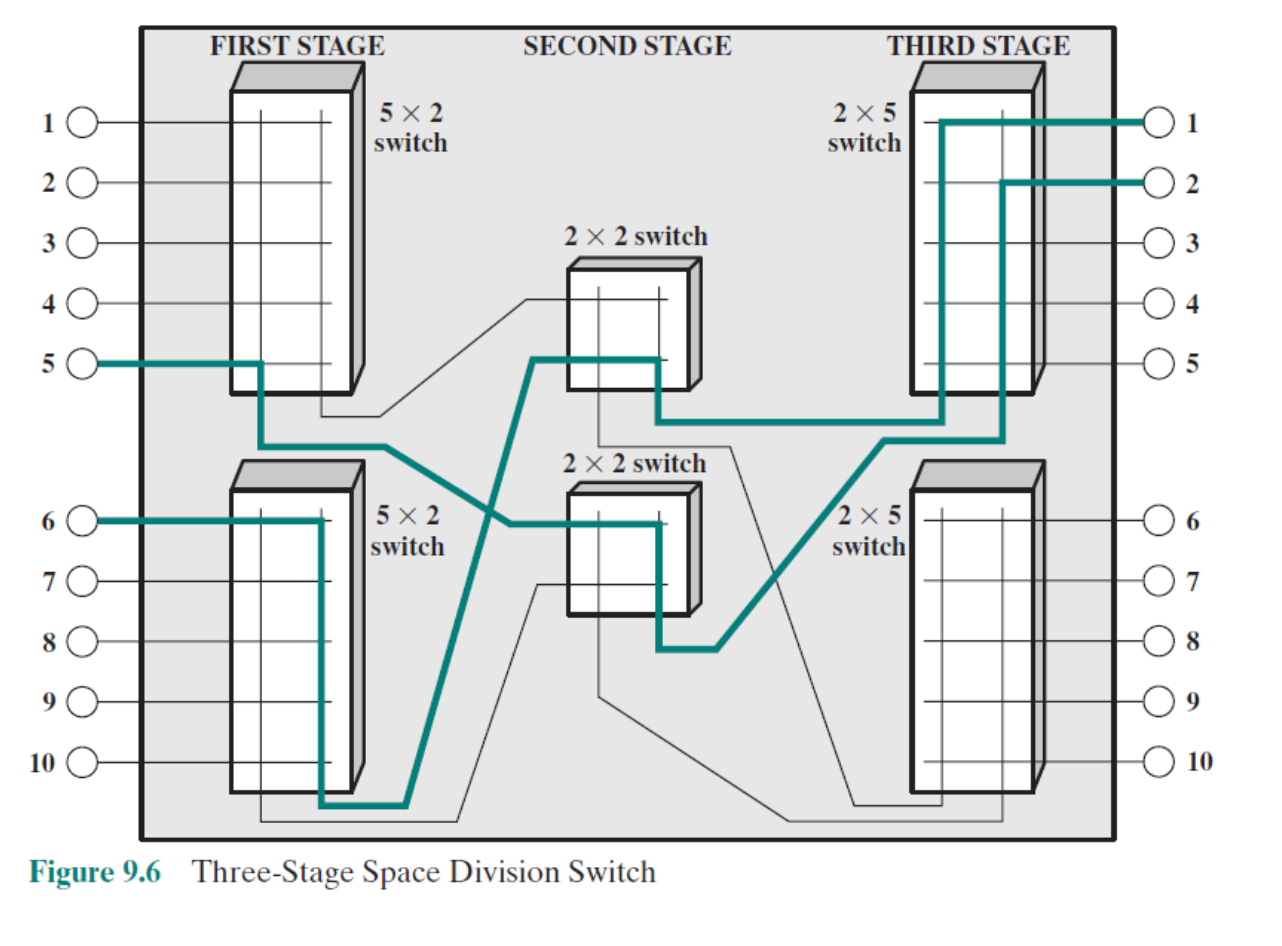
แทนที่จะใช้ Switch Crossbar ใหญ่ ๆ ตัวเดียว ก็ใช้ Switch เล็ก ๆ หลาย ๆ ตัวมาต่อซ้อนกันเป็นชั้น ๆ หลายระดับ เพื่ออะไร? ก็เพื่อลดจำนวนจุดตัดรวมลง ทำให้ประหยัดลง
แต่ก็มีข้อเสียคือ การควบคุมก็จะซับซ้อนมากขึ้น ถ้าออกแบบไม่ดีก็อาจจะกลายเป็น Blocking ได้
Advantages
- Reduced number of cross-points
- More than one path through network
- Increased reliability
- More complex control
- May be blocking
Making Non-Blocking
- A multiple-stage switch can be made non-blocking by increasing the number or size of the intermediate switches
- But this increases the cost
Time-Division Switching
ต่างจาก Space-Division ตรงที่หลักการเลยล่ะ (ไม่ได้สร้างเส้นทางกายภาพที่แยกกันอย่างถาวรแล้วนะ) แต่เป็นการจัดสรรเวลาให้ชิ้นส่วนข้อมูล (Time slot) วิ่งไปบนราง (bus ความเร็วสูง) ที่ใช้ร่วมกัน
นึกถึงเวลามีคนส่งข้อมูลพร้อม ๆ กันหลายคนใน Digital แต่ละข้อมูลของทุกคนจะถูกแบ่งเป็น Slot ย่อย ๆ, Time slot จะทำหน้าที่เหมือนตำรวจจราจร คอยจัดคิว สลับลำดับ ให้วิ่งไปออกปลายทางที่ถูกต้อง
Overview
- With the advent of digitized voice and synchronous TDM techniques, both voice and data can be transmitted via digital signals
- Led to fundamental change in design and technology of switching systems
- Modern digital systems rely on intelligent control of space and time-division elements
Characteristics
- Virtually all modern circuit switches use digital time-division techniques
- Time-division switching involves partitioning a lower-speed bit stream into pieces that share a higher-speed stream with other bit streams
- Individual pieces (slots) are manipulated by control logic to route data from input to output
Time-Division Switching Methods
Two Popular Methods
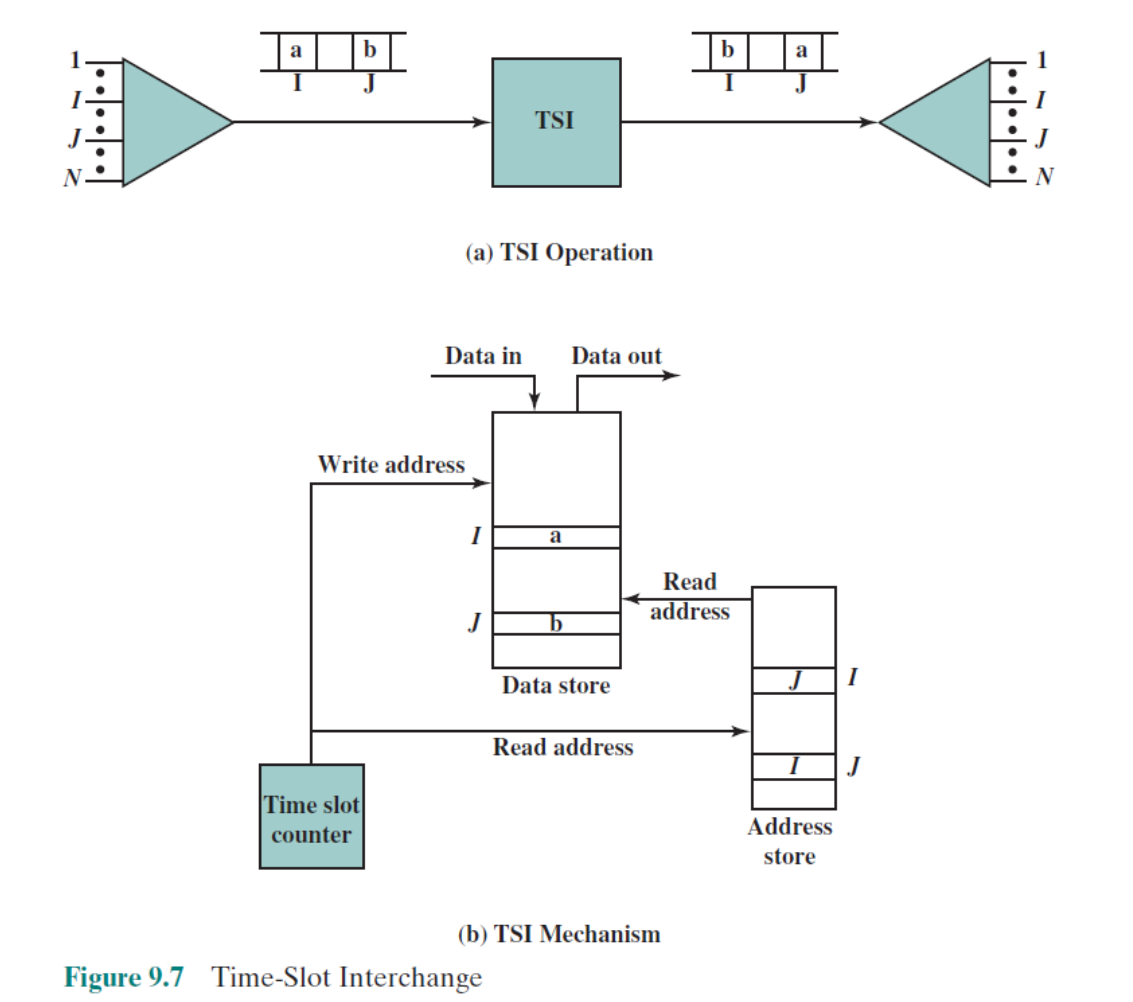
1. TSI (Time Slot Interchange)
- Data sent is changed according to the ordering of slots based on desired connections
- Consists of RAM with several memory locations (input, output locations) and control unit
2. TDM Bus
- Utilizes multiplexing to place all signals on a common transmission path
- Bus must have higher data rate than individual I/O lines
Advantages
- No need for crosspoints
Disadvantages
- Processing each connection creates delay (latency problem)
- Each time slot must be stored by RAM, then retrieved, then passed on
Time-Multiplexed Switching (TMS)
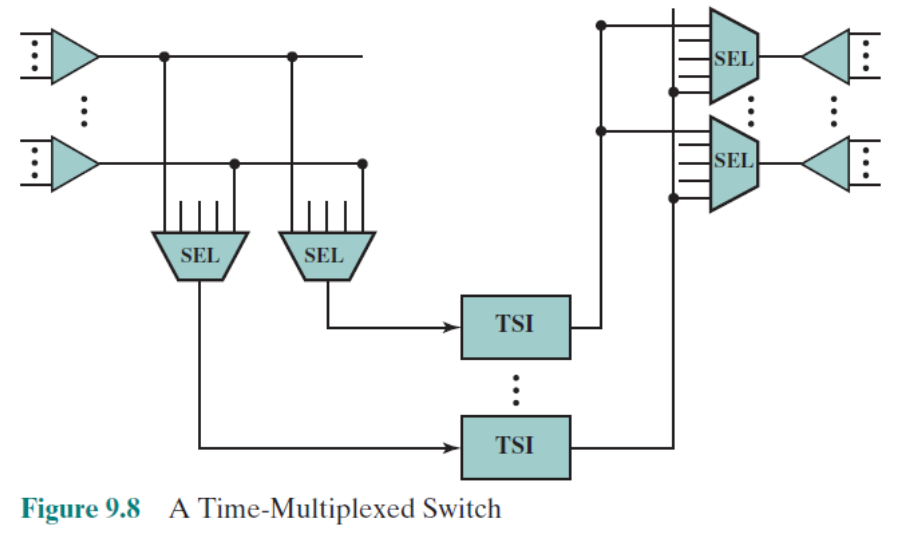
แนวคิดเพิ่มเติมของ Time-Division Switching เอาหลาย ๆ เทคนิคมาทำงานร่วมกัน เช่น เอา TSI หลาย ๆ ตัวมาขนานกัน ไรงี้…
Purpose
To overcome the latency problems of TSI, contemporary time-division switches use multiple TSI units, each carrying a portion of the total traffic.
Implementation
- To connect two channels entering a single TSI unit to a channel on another TSI unit, some form of space division switching is needed
- Requires the crosspoints to be manipulated at each time slot
- TMS switch is implemented using digital selectors (SEL)
- Device that selects an input line based on a channel assignment from a store controlled by a time-slot counter
Blocking Reduction
To reduce or eliminate blocking, multiple stage networks can be built by TMS (S) and TSI (T) stages.
Softswitch
การใช้ Software ที่รันบน Computer หรือ Server ทั่ว ๆ ไป ทำหน้าที่เป็นชุมสาย แทนที่จะใช้ Hardware แพง ๆ เหมือนตะก่อน
Definition
- Latest trend in circuit-switching technology
- General-purpose computer running specialized software that turns it into a smart phone switch
Advantages
ราคาถูกกว่ามาก ยืดหยุ่นสูง อยากเพิ่มฟีเจอร์อะไรก็แค่พัฒนา Software ไม่ต้องเปลี่ยน Hardware ยกแผง
- Cost significantly less than traditional circuit switches
- Can provide more functionality in addition to handling traditional circuit-switching functions
- Can convert digitized voice bits into packets
- Opens up options for transmission, including voice over IP (VoIP)
- นี่แหละ ๆ สามารถแปลงเสียง Digital ให้กลายเป็น Packet ข้อมูลได้ นี่แหละ ๆ ที่มาของ VoIP ที่เราใช้คุยผ่าน Internet กันได้ เริ่ด
Architecture Components
- Media Gateway (MG): Performs the physical-switching function
- Media Gateway Controller (MGC): Contains the call processing logic
Traditional Circuit Switching vs Softswitch
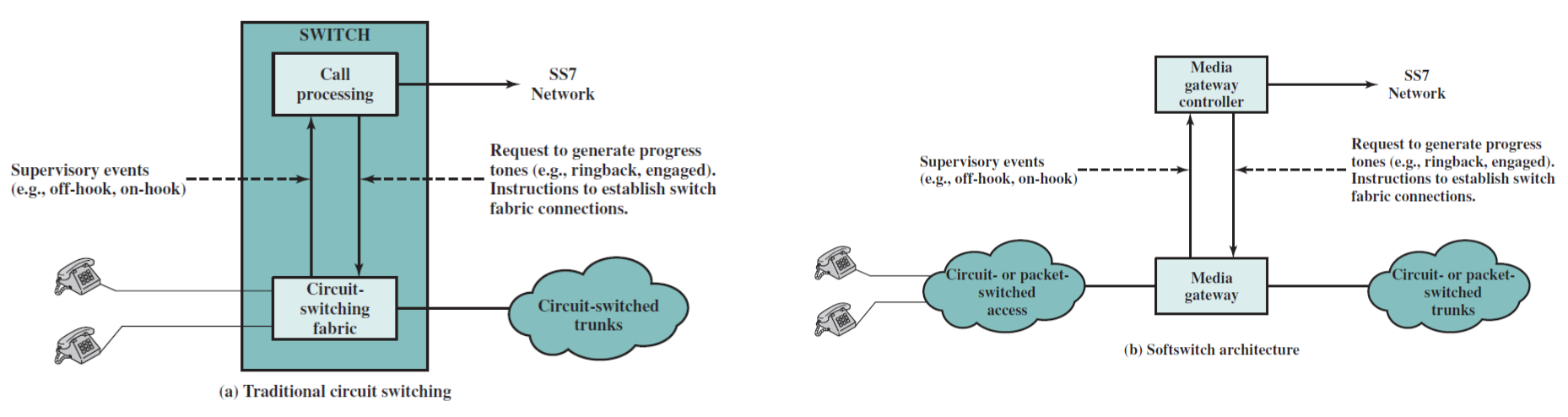
Traditional Circuit Switching
- Integrated switch with call processing and circuit-switching fabric
- Direct connection to circuit-switched trunks
- Supervisory events handled internally
Softswitch Architecture
- Separated components:
- Media gateway controller (call processing)
- Media gateway (physical switching)
- Connection to circuit or packet-switched trunks
- Supervisory events handled separately
Analogy: Traditional switching is like an all-in-one printer, while softswitch is like having separate scanner, printer, and computer that work together - more flexible and upgradeable.
Circuit Switching Summary
Best for analog transmission, especially voice!
Key Characteristics
- Designed for voice
- Resources dedicated to a particular call
- Much of the time a data connection is idle - พอเจอข้อมูลที่ส่งไม่ค่อยต่อเนื่อง ก็เลยใช้ทรัพยากรไม่คุ้มเท่าไหร่
- Data rate is fixed
- Both ends must operate at the same rate
Packet Switching
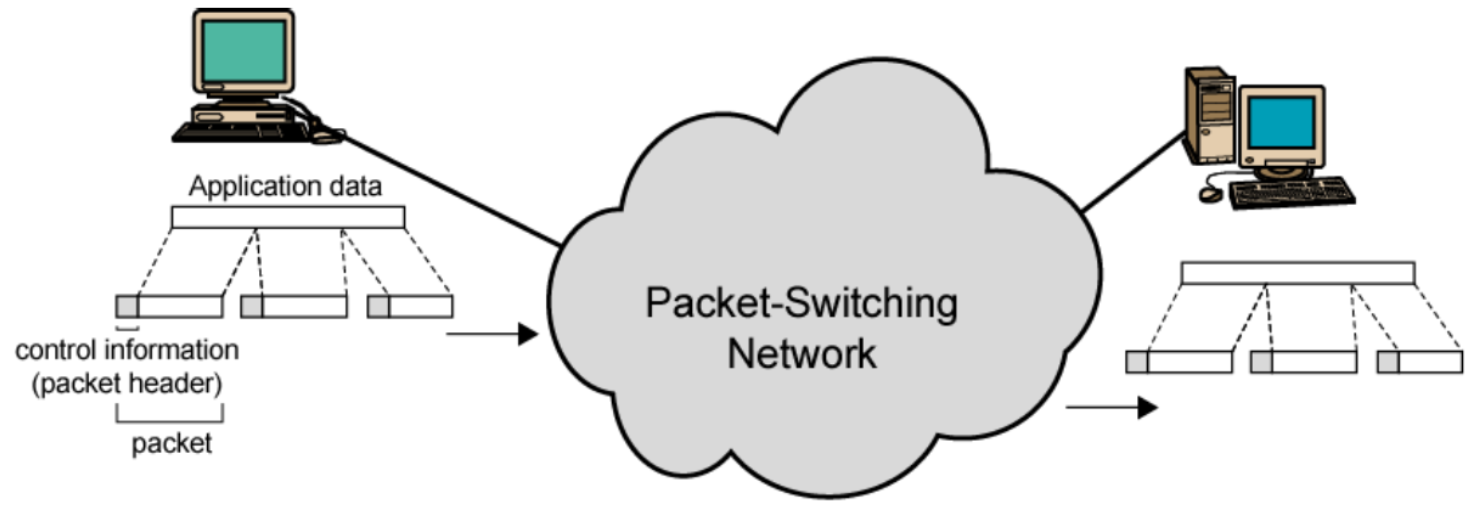
เกิดมาเพื่อข้อมูล (Data) โดยเฉพาะเลยล่ะ — แนวคิดหลักคือ หั่นข้อมูลยาว ๆ ออกเป็นชิ้นเล็ก ๆ ที่เรียกว่า Packet
ข้อมูลเล็ก ๆ แต่ละอัน จะมีข้อมูลควบคุม (Header) ติดไว้ด้วย เหมือนเป็นการจ่าหน้าซองบอกว่า Packet นี้ มาจากไหน จะส่งไปที่ไหน
Core Concepts
- Designed for data
- Data transmitted in small packets
- Typically 1000 octets
- Longer messages split into series of packets
- Each packet contains a portion of user data plus some control info
Control Information
- Routing (addressing) information
Operation
- Packets are received, stored briefly (buffered), and passed on to the next node
- ==Store and forward==
คือไม่ได้เป็นการจองเส้นทางแล้วนะ แต่ใช้วิธีการ Store and forward แทน — แต่ละเครื่องเวลาได้ข้อมูลมาแล้วมันจะเก็บไว้ในหน่วยความจำแปปนึงก่อน เก็บไว้เพื่ออ่าน Header ว่าจะส่งไปไหนต่อดี เหมือนส่งต่อไปเรื่อย ๆ เลยอะ (นึกภาพเหมือนไปรษณีย์เลย ส่งต่อไปเรื่อย ๆ)
ซึ่ง ๆ แต่ละ Packet ก็อาจจะไม่ได้ถึงพร้อมกัน หรือแม้แต่ไปคนละเส้นทางด้วยซ้ำ ขึ้นอยู่กับการจราจรตอนนั้น
Advantages of Packet Switching
1. Line Efficiency
สายสัญญาณเส้นเดียว รับจบหมดเลยเนอะ ไม่ต้องใช้หลายสายเลยล่ะ มาเข้าคิวรอส่งกันไป ใช้ Bandwidth คุ้มค่า โดยเฉพาะกับข้อมูลส่ง ๆ หยุด ๆ
- Single node-to-node link can be shared by many packets over time
- Packets queued and transmitted as fast as possible
2. Data Rate Conversion
อุปกรณ์ต้นทาง/ปลายทาง ไม่จำเป็นต้องมีความเร็วเท่ากันก็ได้ ตัว Buffer จะปรับความเร็วให้เข้ากันได้
- Each station connects to the local node at its own speed
- Nodes buffer data if required to equalize rates
3. Network Resilience
เครือข่ายมีความหนาแน่นมาก ๆ ก็ยังพยายามส่งไปให้ได้ แค่อาจจะช้าลง ไม่ได้ล่มไปเลยทันทีเหมือน Circuit Switching ที่เส้นทางขาดคือจบ!
- Packets are accepted even when network is busy
- Delivery may slow down
4. Priorities
- Priorities can be used to manage traffic flow
Analogy: Packet switching is like a postal system - your letter (data) is broken into pages (packets), each addressed, sent through various post offices (nodes), possibly taking different routes, and reassembled at the destination.
Switching Techniques: Datagram vs Virtual Circuit
ใน Packet Switching เองก็มี Style การส่งย่อย ๆ อีก
Datagram Approach
- Each packet is treated independently with no reference to previous packets
- Packets sent one at a time to the network
Virtual Circuit Approach
- A preplanned route is established before any packets are sent
- All packets follow the same logical path
Datagram Characteristics
สุดยอดของความเป็นอิสระ คนไทยแปลว่าอิสระ — แต่ละ Packet เป็นอิสระต่อกัน เครือข่ายจะไม่จำเลยว่า Packet นี้เกี่ยวข้องอะไรกับตัวก่อนหน้ามั้ยนะ จะดูว่าต้องไปไหน ก็แค่ดู Header ทำให้เดินทางสะดวก ขึ้นอยู่กับการตัดสินใจของแต่ละ Node เวลานั้น ๆ
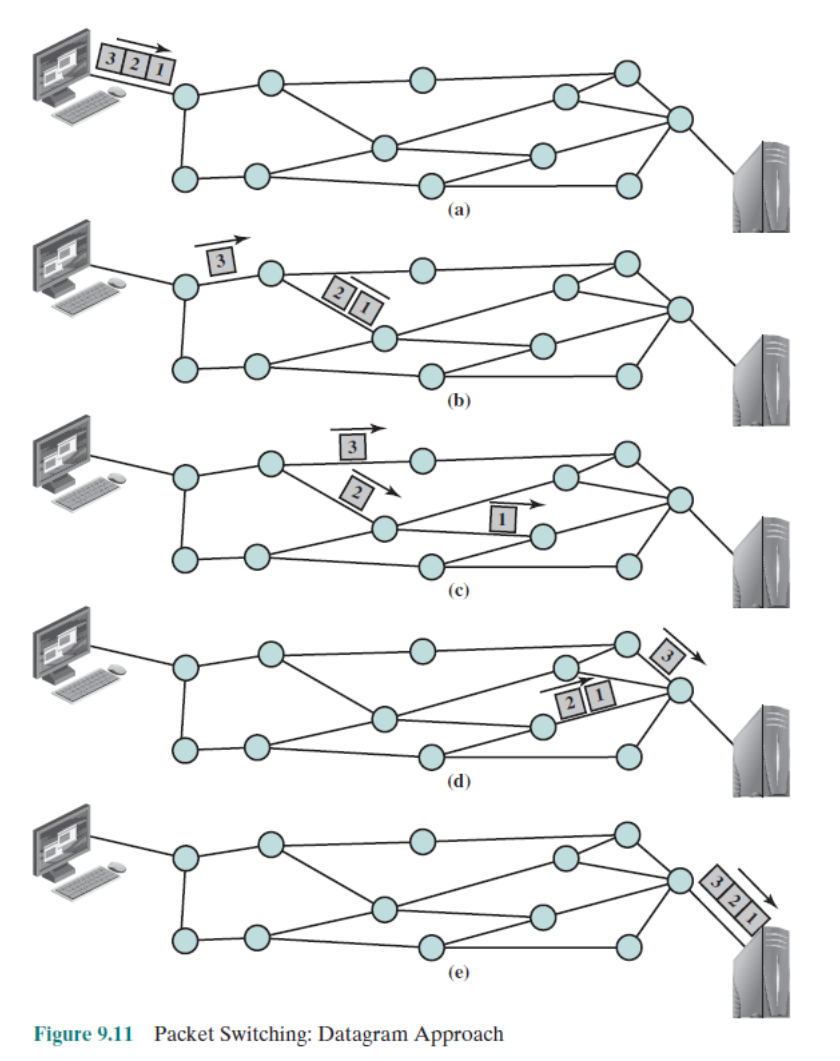
Key Features
- Each packet treated independently
- Packets can take any practical route
- Packets may arrive out of order
- Packets may go missing
- อาจจะไปถึงแบบไม่เรียง หรือหายไปเลยก็ได้ ก็เป็นหน้าที่ของผู้รับ ที่จะต้องจัดเรียงให้ถูกต้อง ตรวจสอบว่ามีอันไหนหายไปมั้ย (ถ้าหาย?) ก็ขอให้ส่งใหม่
- Up to receiver to re-order packets and recover from missing packets
Handling
- Network does not maintain state information about the connection
- Each node makes independent routing decisions
- More flexible routing possible
เน้นความง่าย ไม่ต้องเก็บสถานะอะไรเลย เหมือนส่งพัสดุแต่ละชิ้นแยกกันไปเลย ไม่มีการการันตีอะไรทั้งนั้น
Virtual Circuit Characteristics
แอบคล้าย Circuit Switching (ในแง่ของ concept) ก่อนจะเริ่มส่งข้อมูลจริง ๆ ต้องมีการสร้างเส้นทางกันก่อนนะ แต่เป็นเส้นทางแบบ Logical (เส้นทางเสมือน) ไม่ได้จองทรัพยากรจริง ๆ โดยมีการ Handshake มีการส่ง call request ปลายทางตอบรับด้วย call accept กลับมา
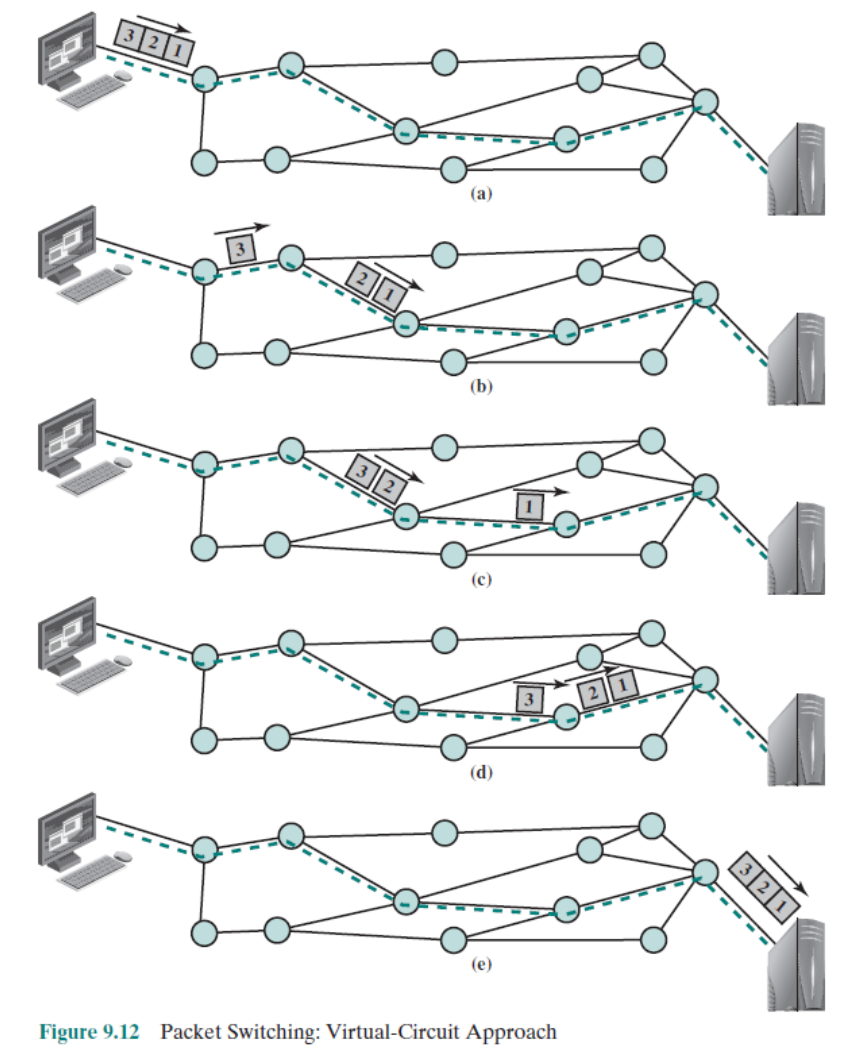
Key Features
- Preplanned route established before any packets sent
- Call request and call accept packets establish connection (handshake)
- Each packet contains a virtual circuit identifier instead of destination address
- No routing decisions required for each packet
- Clear request to drop circuit
- Not a dedicated path
เวลาส่งข้อมูลจะติด Header แค่พวก VCID (ที่ได้จากกระบวนการ Handshake) แล้วไปทางเส้นทางที่ตกลงกันไว้ ไม่วิ่งสะเปะสะปะแบบ Datagram
Advantages
- Network can provide sequencing and error control
- ==Packets are forwarded more quickly==
- No routing decisions to make
- Less reliable
- Loss of a node looses all circuits through that node
- ถ้ามี Node ใด Node นึงพังอะนะ ใช้งานไม่ได้เลย ต้องเริ่มการ Handshake ใหม่
Virtual Circuits vs. Datagram
Virtual Circuits
- Network can provide sequencing and error control
- Packets forwarded more quickly
- No routing decisions to make
- Less reliable
- Loss of a node looses all circuits through that node
Datagram
- No call setup phase
- Better if few packets
- More flexible
- Routing can be used to avoid congested parts of the network
Effect of Packet Size on Transmission Time
Image showing comparison of transmission with different packet sizes
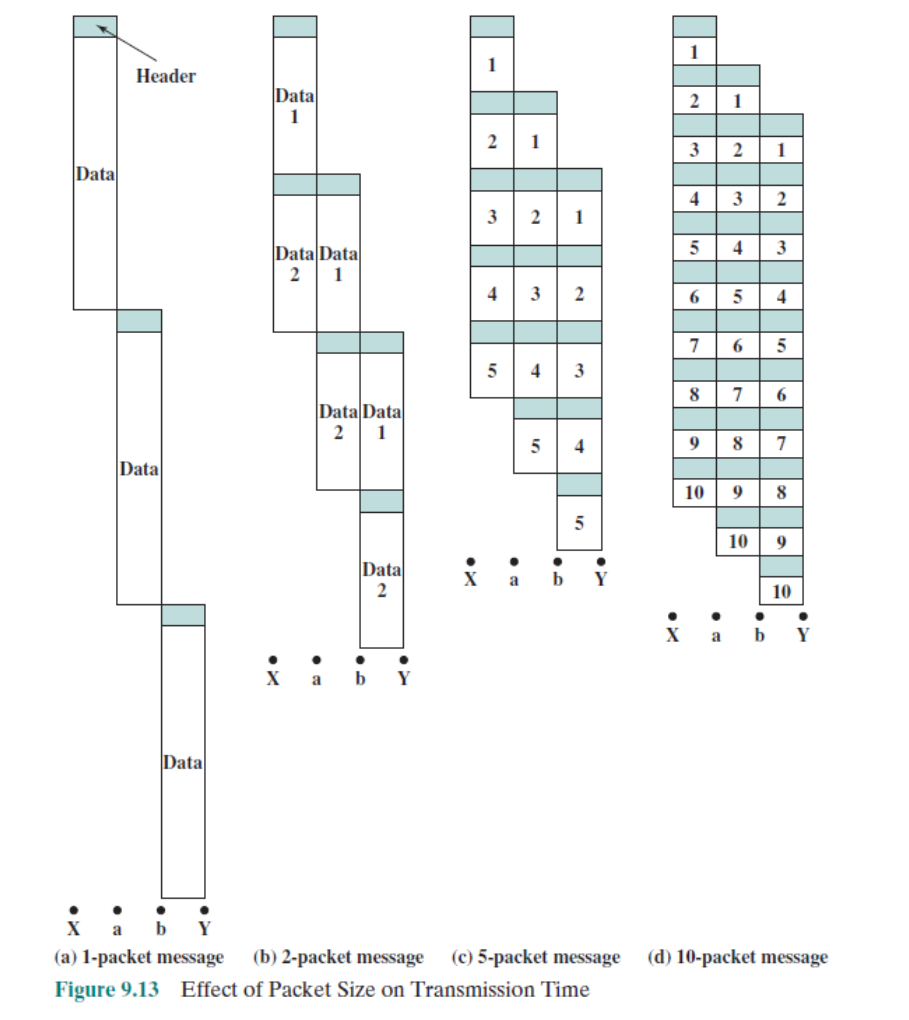
Key Observation: Smaller packets allow for more parallelism in transmission but add more overhead. The optimal packet size is a trade-off.
Circuit vs Packet Switching Performance
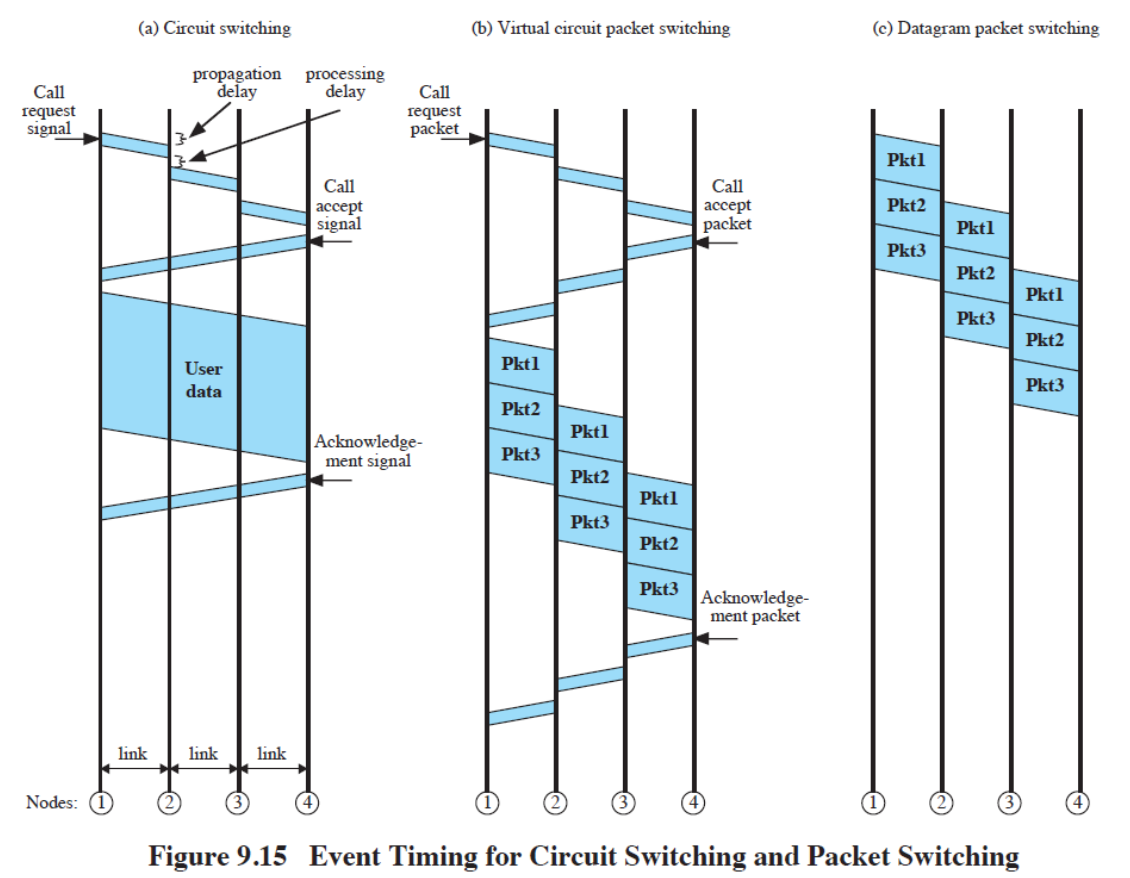
Performance Components
Three types of delay in the figure:
- Propagation delay: Time for signal to travel through the medium
- Transmission time: Time to push all bits onto the link
- Node delay: Processing time at each switching node
Comparison
Circuit Switching
- Call request signal propagates through network
- Processing delay at switches
- Call accept signal returns
- User data transmitted continuously
- Acknowledgment signal returns
Virtual Circuit Packet Switching
- Call request packet sent
- Call accept packet returns
- Data packets transmitted with packet transmission delay at each node
- Acknowledgment packet returns
Datagram Packet Switching
- Each packet individually transmitted
- Packets may take different routes
- Higher per-packet overhead but more flexible
Comparison of Communication Switching Techniques
| Feature | Circuit Switching | Datagram Packet Switching | Virtual Circuit Packet Switching |
|---|---|---|---|
| Path | Dedicated transmission path (Reserved จองไว้) | No dedicated path | No dedicated path |
| Transmission | Continuous transmission of data | Transmission of packets | Transmission of packets |
| Speed | Fast enough for interactive | Fast enough for interactive | Fast enough for interactive |
| Storage | Messages are not stored | Packets may be stored until delivered | Packets stored until delivered |
| Path Establishment | Path established for entire conversation | Route established for each packet | Route established for entire conversation |
| Delay | Call setup delay; negligible transmission delay | Packet transmission delay | Call setup delay; packet transmission delay |
| Busy Handling | Busy signal if called party busy | Sender may be notified if packet not delivered | Sender notified of connection denial |
| Overload | Overload may block call setup; no delay for established calls | Overload increases packet delay | Overload may block call setup; increases packet delay |
| Switching Nodes | Electromechanical or computerized switching nodes | Small switching nodes | Small switching nodes |
| Error Protection | User responsible for message loss protection | Network may be responsible for individual packets | Network may be responsible for packet sequences |
| Speed/Code Conversion | Usually no speed or code conversion | Speed and code conversion | Speed and code conversion |
| Bandwidth | Fixed bandwidth | Dynamic use of bandwidth | Dynamic use of bandwidth |
| Overhead | No overhead bits after call setup | Overhead bits in each packet | Overhead bits in each packet |
Asynchronous Transfer Mode (ATM)
- เดี๋ยวไปพูดเพิ่มใน Lecture 11 - Asynchronous Transfer Mode (ATM)
Circuit จองไปเลย ได้ความนิ่ง Packet คือแชร์กันไป ได้ความยืดหยุ่น
ซึ่ง ATM ก็คือ Technology ที่พยายามเอาข้อดีของทั้งสองอย่างมาร่วมกัน
Definition
A switching and multiplexing technology that employs small, fixed-length packets called cells
Key Features
หัวใจ: ใช้ Packet ที่มีขนาดเล็ก คงที่ (แหมม ไม่เรียก Packet ด้วยซ้ำ แต่เรียกว่า Cell โดยมีขนาดแค่ 53 byte เท่านั้นเอง) → ทำให้การประมวลผลทำได้ด้วย Hardware ล้วน ๆ (ความเร็วสูง)
ทำให้ Latency มันต่ำมาก ๆ Jitter ก็น้อยลงตามไปด้วย
- Fixed-size packet ensures function could be carried out efficiently with little delay variation
- Small cell size supports delay-intolerant interactive voice service with a small packetization delay
- Designed to provide:
- Performance of a circuit-switching network
- Flexibility and efficiency of a packet-switching network
- Standardization effort was to provide powerful tools for:
- Supporting a rich QoS capability
- Powerful traffic management capability
ATM Usage
ยังมีการใช้อยู่เยอะ พวกเครือค่าย WAN (of course) ไรงี้
Common Applications
- Commonly used by telecommunications providers to implement wide area networks
- Used by many DSL implementations
- Used as a backbone network technology in numerous IP networks
ATM Protocol Architecture
Layer Structure
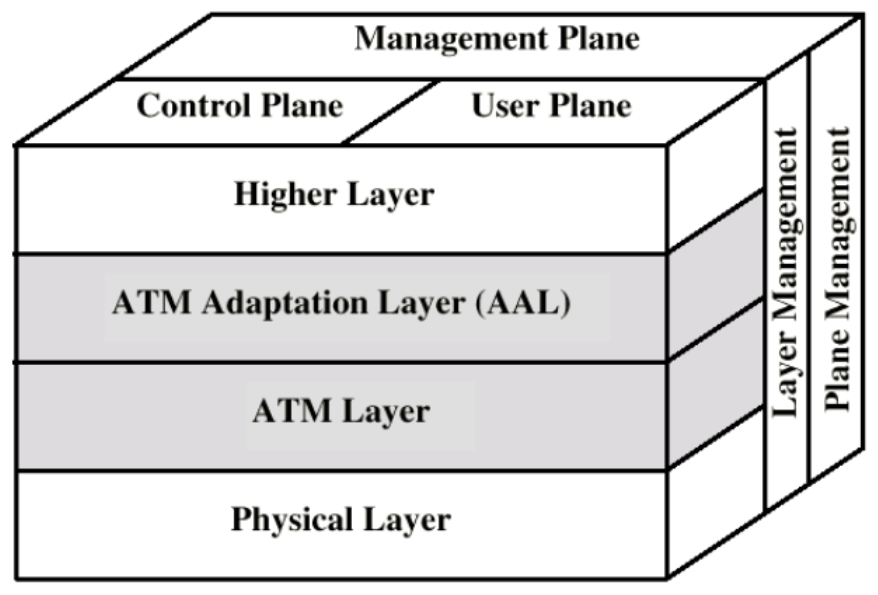
Three Planes
- User Plane: Carries user data
- Control Plane: Handles connection control signaling
- Management Plane:
- Layer Management: Layer-specific management
- Plane Management: Management of entire system
มีแนวคิดเรื่องการเชื่อมต่อเชิงตรรกะ (Logical Connection) ที่สำคัญ
Virtual Channel Connection (VCC)
Definition
- Logical connection in ATM
- Analogous to a virtual circuit
- Basic unit of switching in an ATM network
Characteristics
- Set up between two end users through the network
- A variable-rate, full duplex flow of fixed-size cells is exchanged over the connection
- Also used for user-network exchange and network-network exchange
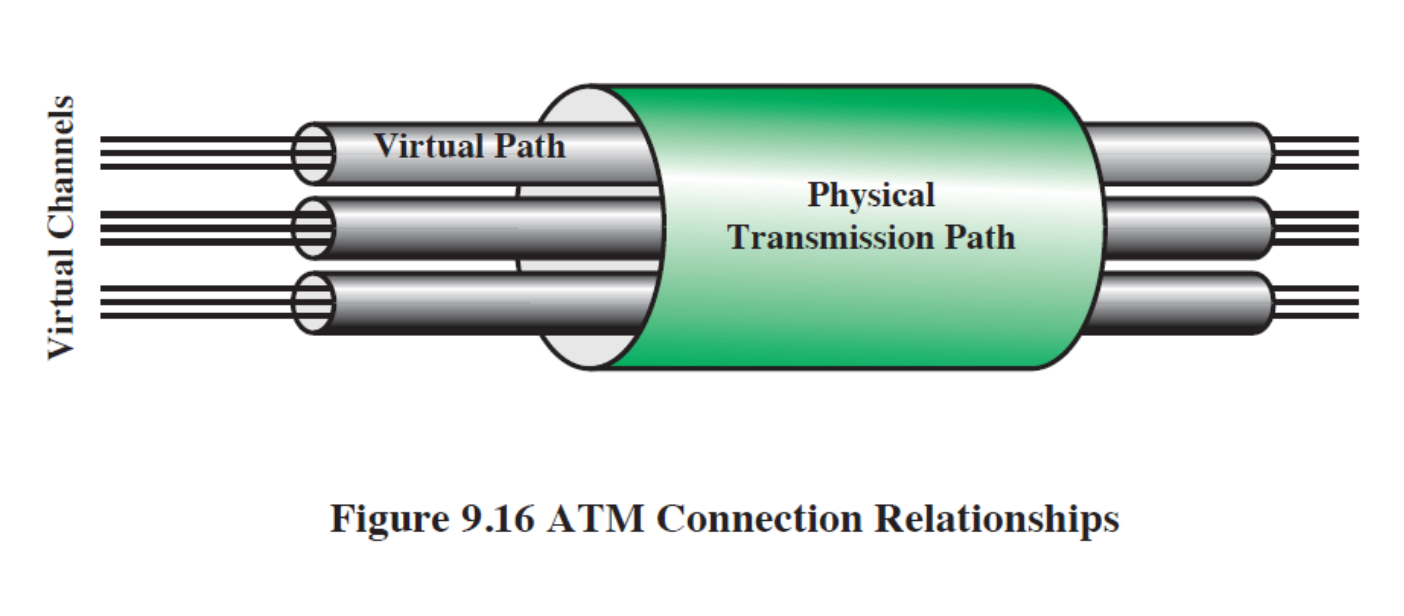
Virtual Path Characteristics
จัดกลุ่มรวม VCC หลาย ๆ เส้น ที่มีเส้นทางวิ่งคล้าย ๆ กัน ให้เป็นท่อส่งขนาดใหญ่ (Path เดียวกัน) → การจัดการเครือข่ายง่ายขึ้น มีประสิทธิภาพมากขึ้น
ITU-T Recommendation I.150 lists the following characteristics of VPCs:
1. Quality of Service (QoS)
- Specified by parameters such as cell loss ratio and cell delay variation
2. Switched and Semipermanent VPCs
- Switched VPC: On-demand connection which requires call control signaling for setup and tearing down
- Semipermanent VPC: One that is of long duration and is set up by configuration or network management action
3. Cell Sequence Integrity
- The sequence of transmitted cells within a VPC is preserved
4. Traffic Parameter Negotiation and Usage Monitoring
- Traffic parameters can be negotiated between a user and the network for each VPC
- The network monitors the input of cells to ensure that the negotiated parameters are not violated
5. Virtual Channel Identifier Restriction within a VPC
- One or more virtual channel identifiers, or numbers, may not be available to the user of the VPC but may be reserved for network use
Virtual Path Advantages
1. Simplified Network Architecture
- Network transport functions can be separated into:
- Functions related to an individual logical connection (virtual channel)
- Functions related to a group of logical connections (virtual path)
2. Increased Network Performance and Reliability
- The network deals with fewer, aggregated entities
3. Reduced Processing and Short Connection Setup Time
- Much of the work is done when the virtual path is set up
- By reserving capacity on a virtual path connection in anticipation of later call arrivals:
- New virtual channel connections can be established by executing simple control functions at the endpoints
- No call processing required at transit nodes
- Addition of new virtual channels to an existing virtual path involves minimal processing
4. Enhanced Network Services
- The virtual path is used internal to the network but is also visible to the end user
- Thus, the user may define:
- Closed user groups
- Closed networks of virtual channel bundles
ATM Cell Format
User-Network Interface (UNI) & Network-Network Interface (NNI)
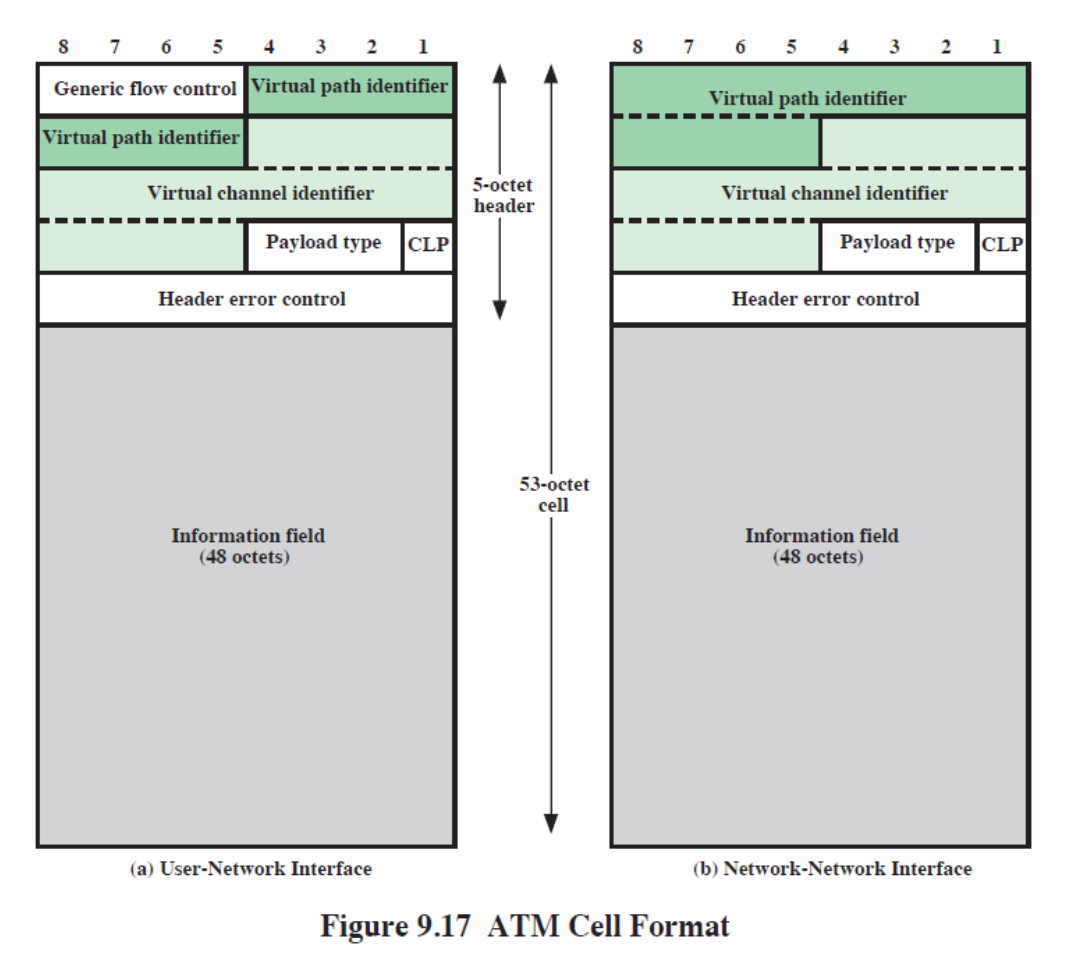
Header Fields
- GFC (Generic Flow Control): 4 bits (UNI only) - flow control
- VPI (Virtual Path Identifier): 8 bits (UNI) or 12 bits (NNI)
- VCI (Virtual Channel Identifier): 16 bits
- PT (Payload Type): 3 bits - indicates type of data
- CLP (Cell Loss Priority): 1 bit - priority indicator
- HEC (Header Error Control): 8 bits - error checking
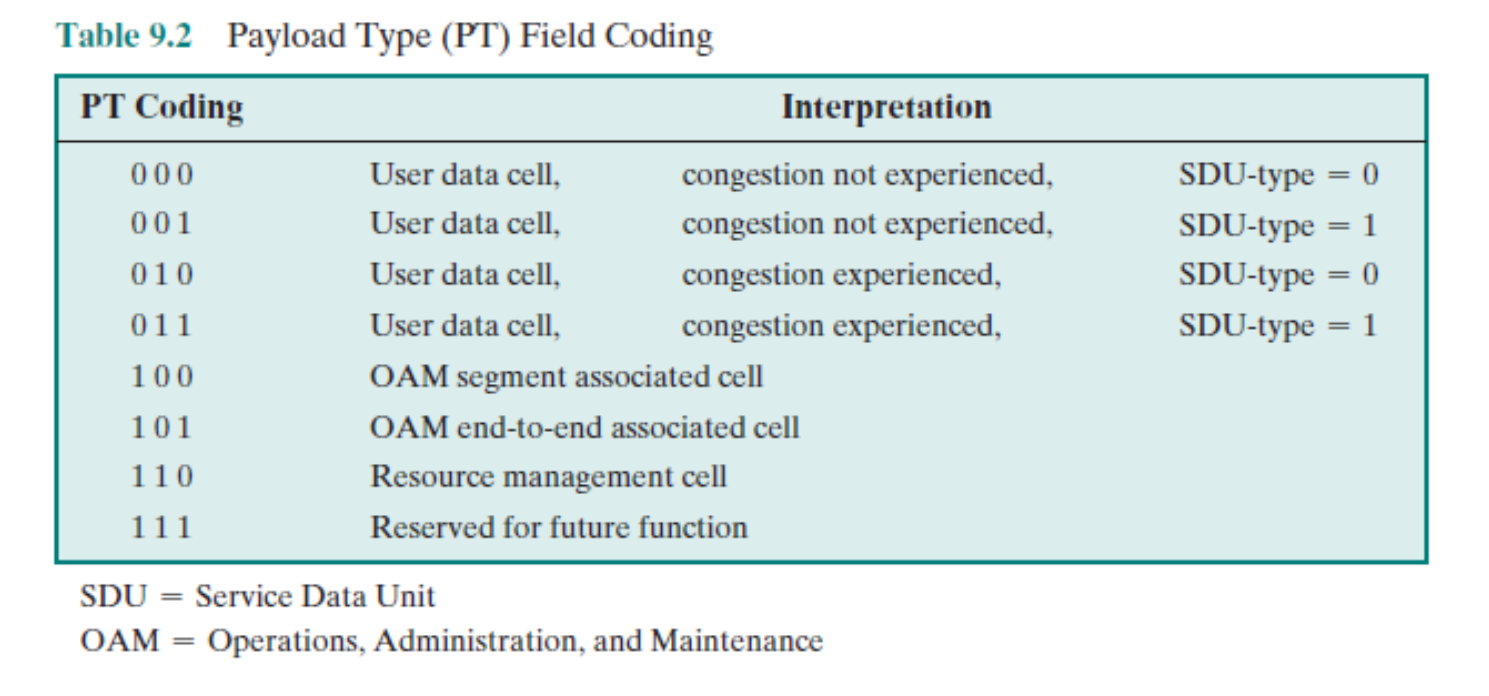
Payload Type (PT) Field Coding
| PT Coding | Interpretation |
|---|---|
| 000 | User data cell, congestion not experienced, SDU-type = 0 |
| 001 | User data cell, congestion not experienced, SDU-type = 1 |
| 010 | User data cell, congestion experienced, SDU-type = 0 |
| 011 | User data cell, congestion experienced, SDU-type = 1 |
| 100 | OAM segment associated cell |
| 101 | OAM end-to-end associated cell |
| 110 | Resource management cell |
| 111 | Reserved for future function |
Legend:
- SDU = Service Data Unit
- OAM = Operations, Administration, and Maintenance
Summary
Key Topics Covered
Switched Communications Networks
- Fundamental concepts and architecture
Circuit-Switching Networks
ทางใครทางมัน เหมาะกับเสียง ได้เท่าไหร่ก็เท่านั้น (Fixed bandwidth) ตลอดการเชื่อมต่อ
- Dedicated path establishment
- Resource reservation
Circuit-Switching Concepts
- Space division switching
- Time-division switching
Softswitch Architecture
- Modern software-based switching approach
Packet-Switching Principles
ทางเดียวกัน ช่วยกันใช้ (shared path) เหมาะกับ Data, bandwidth ใช้ตามจริง, ข้อมูลควบคุม (overhead) ติดไปกับทุกชิ้น
- Switching technique (datagram vs virtual circuit)
- Packet size considerations
- External network interface
- Comparison of circuit switching and packet switching
Asynchronous Transfer Mode (ATM)
- ATM logical connections (VCC and VPC)
- ATM cells (fixed-size packets)
Final Analogy: Think of network switching like a postal system. Circuit switching is like hiring a private courier for the entire day (dedicated), while packet switching is like sending letters through the regular mail (shared resources, store-and-forward). ATM is like using standardized envelopes that can be processed very quickly and predictably through the postal system.