Proposition = Premises แล้วแต่ว่าวางในประโยครึเปล่า
1. Proposition & Word Meaning
Proposition = ประพจน์
Propositions & Real-Life Arguments
- When we engage in reasoning, the units of thought are propositions
- Understanding propositions is a vital skill in reasoning
What is a Proposition?
Examples:
- Most cars have four wheels.
- The Empire State Building is over 1,000 feet tall.
- Jack is from SIIT.
- The theory of relativity in physics has been well confirmed by experiments.
Key Characteristics:
- All are sentences
- Each expresses a complete thought
- Each may be true or false upon further investigation
Definition of Proposition
Proposition ไม่ใช่แค่ “Ice Cream” ไรงี้ มันเป็นแค่ Topic นะ แบบนี้ — “I like ice cream” นี่แหละ complete idea
- Proposition is a complete thought:
- Normally expressed in a complete statement
- Making a statement that is either true or false
Example Analysis:
- Prop. 1: "Most cars have four wheels."
- Uses the concept CAR
- Says something about cars
- Could be true or false
หรือแบบ กรุงเทพเป็นเมืองหลวงของประเทศไทย อันนี้ก็ใช่เช่นกัน
Subject and Predicate
การที่จะใช้ Proposition สมบูรณ์นั้น ต้องมี 2 อย่างนี้ (ถ้าขาดอย่างใดอย่างนึงก็ไม่เหมือนพูดไม่จบ ใครทำอะไร หรือ ทำอะไรแล้วใครทำ)
Propositions (and the sentences that express them) must have:
- Subject: The things or class being discussed
- Predicate: Says what the subject is or what it does
| # | Subject | Predicate |
|---|---|---|
| 1 | Most cars | have four wheels. |
| 2 | The Empire State Building | is over 1,000 feet tall. |
| 3 | Jack | is a Baptist. |
| 4 | The theory of relativity in physics | has been well confirmed by experiments. |
| 5 | Baby | is the MEDDEST person on earth. |
Important: A subject without a predicate is incomplete. A predicate without a subject is incomplete.
Same Propositions, Different Words
ถ้าใช้คำต่างกัน แต่ความหมายยังเหมือนกัน มันจะยังเป็น Proposition เดียวกันมั้ยนะ?
Example Set A (Same Proposition):
- A1. Jack is a lawyer.
- A2. Jack is an attorney.
- Analysis: Different words but the same concept; the same proposition is asserted
Example Set B (Different Propositions):
- B1. Jack is tall.
- B2. Jack is married.
- Analysis: Different words and different concepts; different propositions asserted
Example Set C (Related but Different):
- C1. Jack is an SIIT student.
- C2. Jack is a Thammasat U. student.
- Analysis: Related words but not identical
- If C1 is true, then C2 must be true
- But TU is broader than SIIT
- They express/assert different propositions
Connotations
หรือพูดง่าย ๆ ก็คือความหมายโดยนัยที่มันติดมากับคำ ซึ่งมันอาจจะมาจาก ประสบการณ์ส่วนตัว หรือ วัฒนธรรมก็ได้
Understanding Connotative Meaning
Definition: The meaning of a word or phrase based on personal experience or personal associations
Two words that express the same concept are usually synonyms, but:
- Some words expressing the same concepts have different connotations
- They convey different:
- Images
- Feelings
- They elicit different associations in the mind
Connotation Examples
Example 1:
- "Mary has a firm command of the subject matter."
- "Mary has a thorough understanding of the subject matter."
Analysis:
- The sentences assert the same propositions
- The italicized phrases express the same concept
- Although the connotations are different
More Connotation Examples
Set C:
- C1. Bob is a policeman.
- C2. Bob is a cop.
Set D:
- D1. Alex is a shrink.
- D2. Alex is a psychotherapist.
Set E:
- E1. Luke is a sanitary engineer.
- E2. Luke is a garbage collector.
Key Point: Different connotations do NOT lead to different propositions being asserted, even when there may be positive and negative connotations.
Connotations Can Hide Different Meanings
Be Careful! Words that differ in connotation may also differ in literal meaning; they may not express the same concept.
Example:
- "Jack and Ennis are living together."
- "Jack and Ennis are living in sin."
These express different propositions despite referring to the same situation.
Exercise: Different Words × Literal Meanings
Determine whether the pairs express the same propositions:
- Pair 1:
- A. You have a lovely view from your window.
- B. You have a beautiful view from your window.
- Pair 2:
- A. Wendy is a journalist.
- B. Wendy works for a newspaper.
- Pair 3:
- A. Jake is a mellow individual.
- B. Jake is an unmotivated slob.
Metaphors
Understanding Metaphors
Definition: A particular figure of speech in which a thing is equated with another to bring out some point of similarity
Examples:
- Simile: "Life is like a box of chocolates."
- Metaphor: "Life is a cabaret."
In Critical Thinking: We consider any nonliteral use of language as metaphor
Why Find Literal Meanings?
We need to translate metaphors because:
- We are concerned with logical relationships among propositions
- To know how a proposition is related to others, we need to know what it does say or does not say
Example to Translate:
- "It is a Band-Aid solution."
- Literal meaning: It is a temporary solution that doesn't address the root problem
Figurative vs Literal Language
Figurative Language
- A way of expressing oneself that does not use a word's strict or realistic meaning
- Common in comparisons and exaggerations
- Usually used to add creative flourish or explain a complicated idea
- Example: "Learning organic chemistry is like moving a mountain."
Literal Language
- Means what it says
- Uses words the way they are defined
- Example: "Learning organic chemistry is difficult."
Uncovering Literal Meaning
Example 1: "Time is gold."
Process:
- Time has qualities like gold
- Gold has value and should not be wasted
- Literal meaning: Time is valuable
Example 2: "Your ghosting turned my food into stone."
Process:
- Your ghosting has made my food have the same qualities as stones
- Stones are hard and should not be eaten
- Literal meaning: Your ghosting made my food impossible to eat
Strategy for Propositions & Premises
Three-Step Process:
Step
- Use technique of classification and definition to identify the concepts that the word expresses
- ระบุให้ชัดก่อนว่า Concept ที่เขาต้องการสื่อคืออะไรกันแน่
- Ignore difference in connotations
- ให้มองข้ามความต่างของ Connotation ไปก่อน
- ถ้า Literal Meaning เหมือนกัน → Proposition เดียวกัน
- แต่ แต่ แต่ ระวังเวลา Connotation มันแรงจนไปเปลี่ยน Literal Meaning ได้เหมือนกัน
- Find a literal interpretation
- พยายามหาความหมายที่แท้จริง แบบตรงตัว เช่นเวลาเจอพวก Metaphor หรืออะไรที่ไม่ตรงตัว
2. Proposition & Grammar
Sentence Structures, Connectives, Restrictive & Nonrestrictive Clauses, Noun Clauses
Propositions and Sentence Structures
Key Principle 1: Grammar Serves Clarity
ช่วยความชัดเจน
- Most grammatical rules and structures serve the purpose of maintaining clarity in thought and speech
- Words cannot be put together randomly
- The rules of grammar tell us how to put words together
- A mastery of grammar allows us to formulate thoughts clearly no matter how complex or subtle they are
Key Principle 2: Grammatical Equivalence
Two different grammatical structures can be equivalent, just as two words can be synonymous.
Grammar Structure ต่างกันก็อาจจะแปลได้ว่ามันประโยคมัน Equivalent ก็ได้นะ
Example Set 1 (Active vs Passive):
- 1A. The Mets beat the Red Sox.
- 1B. The Red Sox was beaten by the Mets.
Example Set 2 (Comparative):
- 2A. Jane did better than Tom.
- 2B. Tom did worse than Jane.
Quick Review: Proposition & Grammar
Determine whether the pairs assert the same proposition:
- Pair 1:
- A. The couch is in front of the window.
- B. The window is behind the couch.
- Pair 2:
- A. I spilled the coffee.
- B. The coffee was spilled. (by who??)
- Pair 3:
- A. The man who painted my house is the brother of my best friend.
- B. My best friend's brother painted my house.
Key Principle 3: Multiple Propositions in One Sentence
A single sentence can assert more than a single proposition. - ประโยคเดียวก็สามารถมีหลาย Proposition ซ้อนอยู่ได้
Example 3: "We live in a red house near the lake."
Component Propositions:
- 3A. We live in a house.
- 3B. The house is red.
- 3C. The house is near the lake.
Important: Each of these propositions is asserted by the sentence, and the speaker is saying that the proposition is true (but it could turn out false later).
ต้องให้แต่ละประโยคเป็นจริง ทั้งประโยคโดยรวมถึงจะเป็นจริง ถ้าบ้านเป็นสีเขียวขึ้นมา ทั้งประโยค "We live in a red house near the lake." พังหมด
Complex Sentence Example
Statement A: "Samuel Morse, who invented the telegraph and made a fortune from it, was also a painter whose work is highly regarded and exhibited."
Component Propositions:
- A1. Samuel Morse invented the telegraph.
- A2. Samuel Morse made a fortune from telegraph.
- A3. Samuel Morse was a painter.
- A4. Samuel Morse's painting was highly regarded.
- A5. Samuel Morse's painting is often exhibited.
Key Point: For statement A to be true, A1 to A5 must be true. The original sentence is shorter and easier to say, but it is logically equal to all of its component propositions.
How to Identify Component Propositions
When we encounter a complex sentence, ask:
=="What needs to be true so that the whole statement is true?"== อะไรในนี้บ้างที่ต้องเป็นจริง ประโยคนั้นถึงจะเป็นจริง
Quick Review: Component Propositions
List the component propositions:
- "He arrived in time but out of breath."
- P1: He arrived in time. (Must be true, we need to accept that)
- P2: He was out of breath.
- "The ice on the river is thick enough to hold our weight."
- P1: There is ice on the river. (Must be true, we need to accept that)
- P2: The ice is thick enough to hold our weight.
- "Pisitpol, who is a student from SIIT, made an app that could be the next ChatGPT."
- P1: Pisitpol is a student from SIIT. (Must be true, we need to accept that)
- P2: Pisitpol made an app.
- P3: That app could be the next ChatGPT.
Key Principle 4: Asserted vs Unasserted
A sentence does not always assert every proposition it expresses.
Asserted propostion ก็คือ ผู้พูดยืนยันใช้ประโยคนั้น ๆ ยืนยันว่าเป็นเรื่องจริง / Unasserted ก็ตรงกันข้ามกัน ผู้พูดไม่ได้ยืนยันว่ามันเป็นเรื่องจริง
Definition of Terms:
- Asserted: When we use a sentence to make a definite statement, we are asserting the proposition
- Unasserted: When we make statements about possibilities that may or may not be real, we are asserting the thought of these statements but not every proposition in these statements
Examples:
- Asserted: "The exam is canceled."
- Conditional (Unasserted components): "The cancelation of the exam depends on whether SIIT campus is totally flooded."
Understanding Conditional Statements
Statement: "The cancellation of the exam depends on whether SIIT is totally flooded."
What is being asserted:
- ✓ I believe that/It is true that: The cancellation of the exam depends on whether SIIT is totally flooded.
What is NOT being asserted:
- ✗ I do not believe that SIIT is totally flooded.
- ✗ I do not believe that the exam is canceled.
Quick Review: Asserted vs Unasserted
Determine if the italicized proposition in each sentence is asserted or unasserted:
- I don't care whether it rains.
- unasserted
- I could fly if I had wings.
- unasserted
- The lawyer said the butler committed the murder, but in fact, the butler was out playing Bingo that night.
- asserted
- The abandoned wooden church, gray and dusty looked as if it was built a hundred years ago
- unasserted
- He ran away from her as if she were the next pandemic.
- unasserted (check all)
Connectives
ไอ่พวก Connectives เนี่ยแหละที่จะเอามาเชื่อม Proposition เข้าด้วยกัน → กลายเป็น Proposition ใหม่ที่ซับซ้อนมากขึ้น — แล้วเราเอาประโยคมาวางต่อกันเฉย ๆ ไม่ได้หรอ - ไม่ได้! เพราะว่าการที่มี Connectives เนี่ยแหละ มันให้ความหมายมากขึ้นกว่า sum of all parts
Understanding Connectives
- Definition: Words that are used to make a compound sentence
- In logic: "and" is a conjunction
Types of Connectives
Examples of Compound Sentences:
- [Nothing works any more] but [nobody cares].
- [I went to the kitchen] because [I was hungry].
- [He ran from the scene] for [he was afraid].
- After [the storm passed], the temperature dropped.
Connective Patterns:
- prop p and prop q
- prop p but prop q
- prop p because prop q
- prop p, for prop q
- after prop p, prop q
Result: A compound proposition that is treated as a distinct proposition
Key Point: Compound propositions are treated distinctly because they say something more than the sum of their parts.
What Connectives Assert
Example: "[I went to the kitchen] because [I was hungry]."
Three Things are Asserted:
- Assertion 1: I went to the kitchen.
- Assertion 2: I was hungry.
- Assertion 3: There is a relationship between the 2 assertions.
Important: The relationship between component propositions is an additional information we get through the connective.
Categories of Connectives
Connectives Asserting Relationship of Dependence
- because
- since
- therefore
- so that
Connectives Asserting Relationship of Time or Place
- after
- before
- when
- while
- where
In all cases: The conjunction combines the component propositions into a statement in which ALL are being asserted as true.
How Relationships Change
The relationship between component propositions changes depending on the connective. This relationship is asserted as well.
Example 1: "I went to the store while I was hungry."
- ✓ It is true that I went to the store.
- ✓ It is true that I was hungry.
- ✓ It is true that there is a connection between prop A and prop B (That they happened at the same time)
Example 2: "I went to the store so I was hungry."
- ✓ It is true that I went to the store.
- ✓ It is true that I was hungry.
- ✓ It is true that there is a connection between prop A and prop B (That A caused B to happen)
Connectives with Unasserted Components
Special Connectives:
- if... then
- either... or
- unless
Examples:
- If [my cat could talk], [I'd be ruined].
- Either [my car is talking] or [I am hearing things].
- Unless [it rains today], [we will play basketball outside].
Key Point: A statement using one of these connectives asserts that a certain relationship exists between the component propositions, but it does NOT assert the components themselves.
Analyzing Unasserted Connectives
Example 7: "If [my cat could talk], [I'd be ruined]."
- ✗ Does NOT assert that the cat could talk
- ✗ Does NOT assert that I am ruined
- ✓ DOES assert: IF my cat could talk, THEN I'd be ruined
Example 8: "Either [my car is talking] or [I am hearing things]."
- ✗ Does NOT assert that the cat is talking
- ✗ Does NOT assert that I am hearing things
- ✓ DOES assert: One of the two could be true
Example 9: "Unless [it rains today], [we will play basketball outside]."
- ✗ Does NOT assert that it rains today
- ✗ Does NOT assert that we will play basketball outside for sure
- ✓ DOES assert: It is possible that we won't play basketball outside
Visual Summary
Example 7: "If [my cat could talk], [I'd be ruined]."
What I'm asserting:
- I am not asserting that my cat could talk.
- I am not asserting that I'd be ruined.
- I assert that if my cat could talk, then I'd be ruined.
Example 8: "Either [my car is talking] or [I am hearing things]."
What I'm asserting:
- I am not asserting that my cat is talking.
- I am not asserting that I am hearing things.
- I assert that one of the two could be true.
Example 9: "Unless [it rains today], [we will play basketball outside]."
What I'm asserting:
- I am not asserting that it rains today.
- I am not asserting that we will play basketball outside for sure.
- I assert that it is possible that we won't play basketball outside.
Restrictive and Nonrestrictive Clauses
น่าสนใจ ต่างกันแค่ เครื่องหมาย Comma
Understanding the Difference
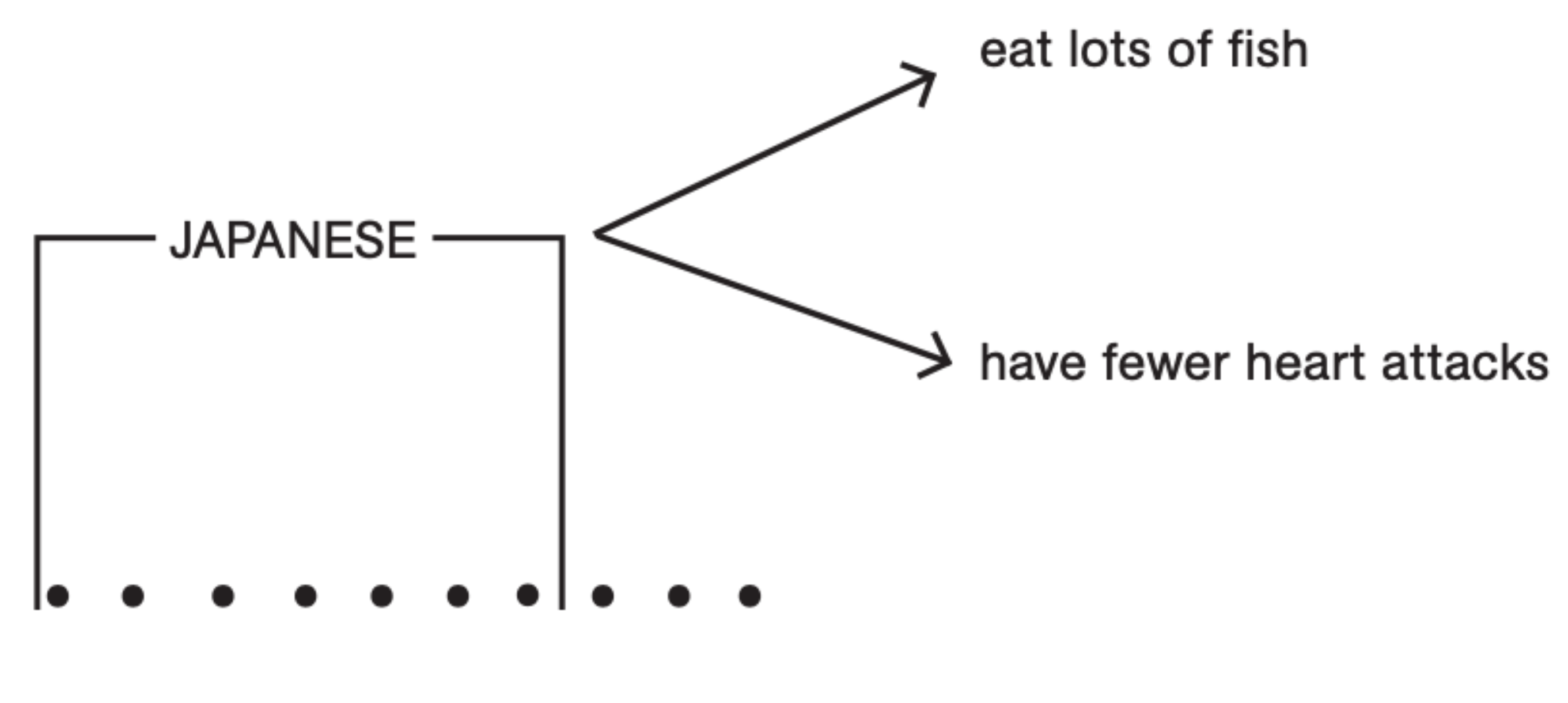
Example 10 (Nonrestrictive): "The Japanese, who eats lots of fish, have fewer heart attacks."
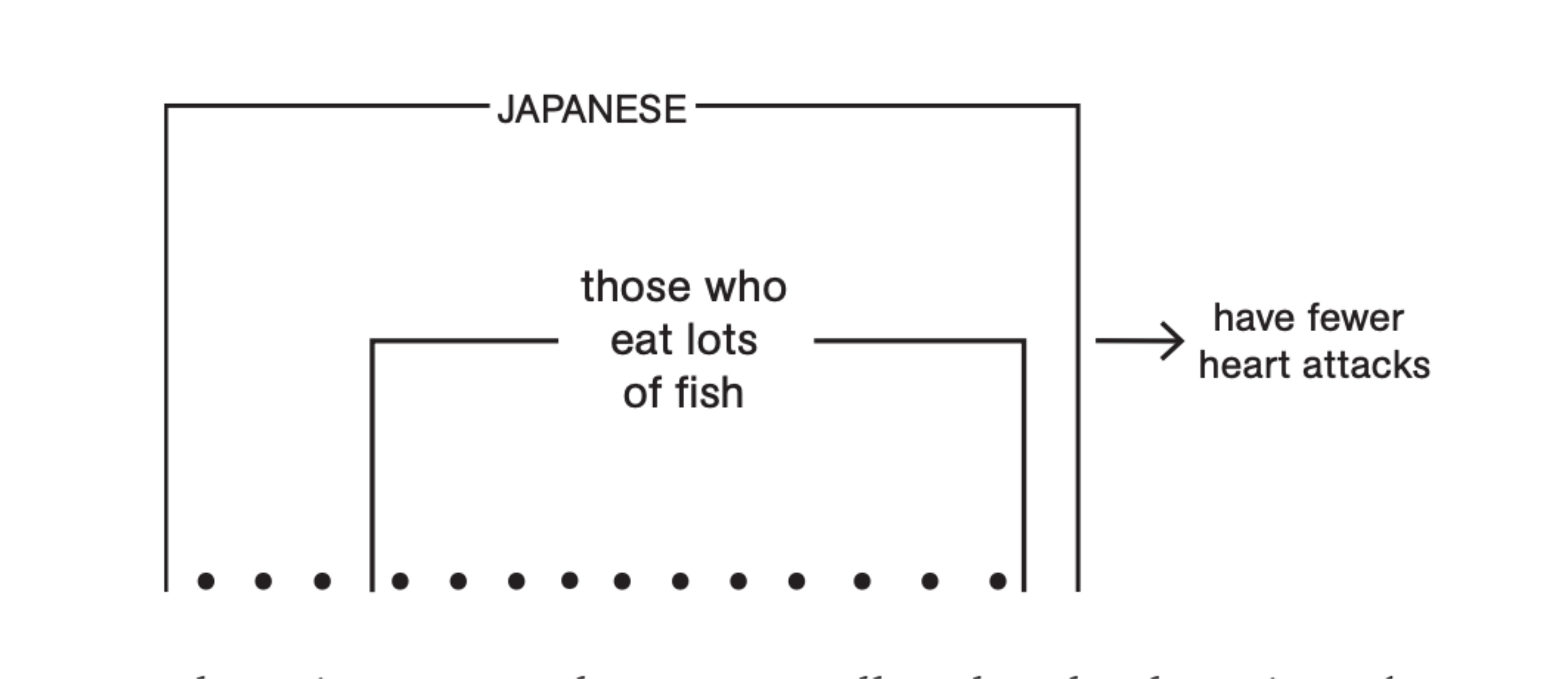
Example 11 (Restrictive): "The Japanese who eats lots of fish have fewer heart attacks."
Nonrestrictive Clauses (with commas)
Example 10: "The Japanese, who eats lots of fish, have fewer heart attacks."
Analysis:
- The commas tell us that the clause introduces a separate point
- Does NOT restrict the reference of the subject term
- Makes two statements:
- The Japanese (as a whole) have fewer heart attacks
- The Japanese (as a whole, again) eat lots of fish
Visual:
Restrictive Clauses (no commas)
Example 11: "The Japanese who eats lots of fish have fewer heart attacks."
Analysis:
- The relative clause restricts the reference of the term "Japanese"
- Refers to a certain subclass of the Japanese people: those who eat lots of fish
- Makes a single statement about that subclass
- NOT making any statement about the Japanese people as a whole
Visual:
Summary Table
| Sentence | Relative Clause | Asserted Propositions |
|---|---|---|
| 14. The Japanese, who eat lots of fish, have fewer heart attacks. | Nonrestrictive | 14a. The Japanese have fewer heart attacks. 14b. The Japanese eat lots of fish. 14c. The Japanese eat lots of fish and the Japanese have fewer heart attacks. |
| 15. The Japanese who eat lots of fish have fewer heart attacks. | Restrictive | 15. The Japanese who eat lots of fish have fewer heart attacks. |
Summary
Key Takeaways
What We Learned:
- We looked closer at the basic unit of arguments: the proposition
- We learned that propositions could assert the same idea even if they use different words or different grammatical structures
- We took a closer look at propositions that are asserted and unasserted
Next Meeting:
- We will understand what categorical propositions are and how to use them
Strategy Summary
Working with Propositions & Premises
Three-Step Process:
- Use technique of classification and definition to identify the concepts that words express
- Ignore differences in connotations
- Find a literal interpretation
Key Terms to Remember
- Proposition: A complete thought that can be true or false
- Subject: The things or class being discussed
- Predicate: What the subject is or does
- Connotation: Personal associations with words
- Metaphor: Nonliteral use of language
- Connectives: Words that combine propositions
- Asserted: Claimed to be true
- Unasserted: Expressed but not claimed to be true
- Restrictive Clause: Limits the meaning (no commas)
- Nonrestrictive Clause: Adds separate information (with commas)