Remember
Inductive = maybe/likely/probably true [cogent]
deductive = 100% true [valid] (if premises are true)
Agenda
- Arguments and Deductive and Inductive Reasoning
- The 3rd Type of Inductive Reasoning: Causal Argument
- Necessary and Sufficient Conditions
- Misuse of Inductive Reasoning
1. Review: Deductive and Inductive Reasoning
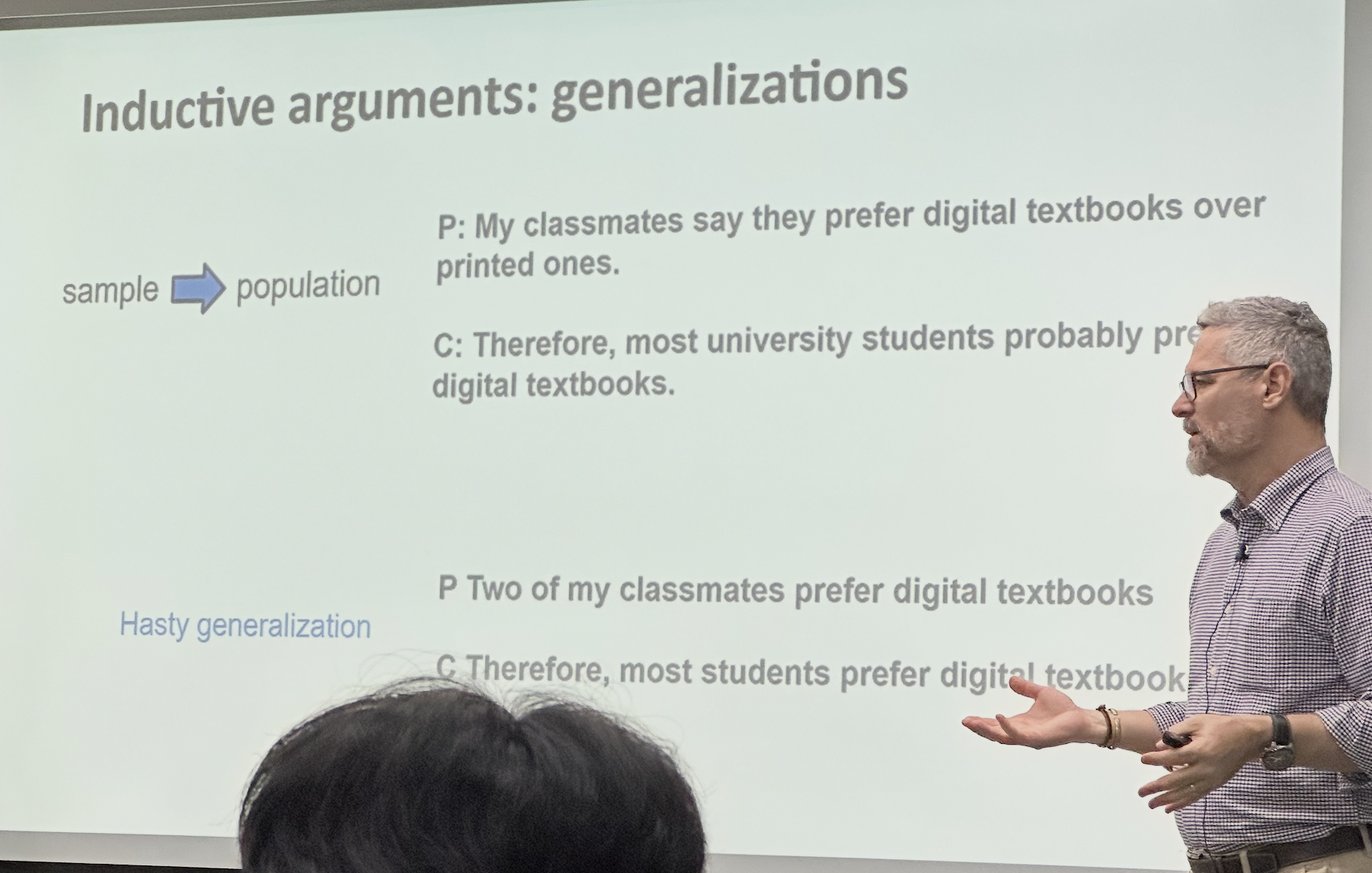
How do the two types of reasoning fit into our concept of an argument?
Example Arguments Comparison
Argument A (Deductive):
- Mr. Chad receives a 70,000.00 per month salary from Alpha Corp
- His wife, who also works at Alpha Corp, has a monthly salary of 50,000.00
- Conclusion: It follows that the couple's monthly income from Alpha Corp is 120,000.00
Argument B (Inductive):
- Mr. Chad receives a 70,000.00 per month salary from Alpha Corp
- His wife, who also works at Alpha Corp, has a monthly salary of 50,000.00
- Conclusion: We can, therefore, assume that Mr. Chad has a higher position than his wife at Alpha Corp
- Hidden Premise: Employees in higher positions usually have higher salaries
Key Differences
Deductive Argument (A):
- ✓ The conclusion cannot be false if the premises are true
- ✓ The conclusion necessarily follows the premises
- ✓ The conclusion only spells out a fact that is implicit in the premises
- ✓ This is not new information - we also know who contributes more to the combined salary
Inductive Argument (B):
- ✓ The conclusion only probably follows the premises
- ✓ The conclusion still has room to be false, even when its premises are true
- ✓ The conclusion introduces information not directly stated by the premises
- ✓ The conclusion gives us new information
Summary Quote
"The difference between the two arguments is that a deductive argument's conclusion necessarily follows its premise(s), while an inductive argument only probably follows. A valid deductive conclusion cannot be false if its premises are true."
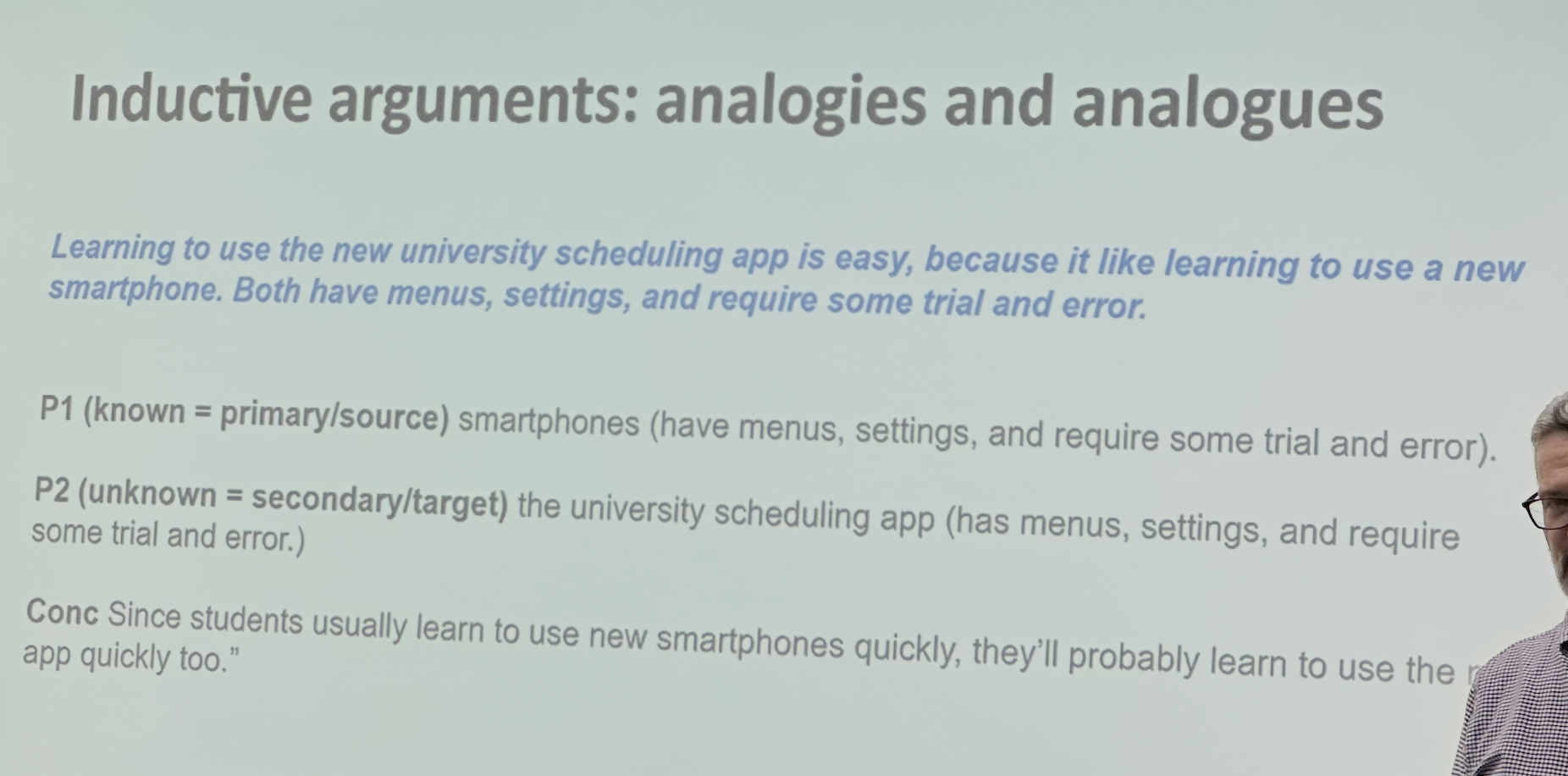
- He is like lion (analogy)
- He is lion (metaphor)
2. Causal Arguments & Conditions
What is a Cause?
Definition: An event that brings about a change or produces an effect
Causal Arguments Explained
- In causal arguments, it is claimed that something is (or is not) the cause of something else
Example:
- P1: You're eating too many French fries and
- P2: You don't exercise
- P3: You're going to gain weight if you don't change your ways
- มันก็ไม่ได้ Guarantee ซะหน่อย มันไม่เหมือน 1+1=2 ซะหน่อย
Analysis:
- The speaker asserts that consuming excessive French fries and failing to exercise will lead to weight gain
- Like other inductive arguments, the conclusion is never 100% certain
- You may not gain weight due to factors like a metabolic disorder or a tapeworm
Ambiguity in the Word "Cause"
When the word "cause" is used, it is seriously affected by ambiguity.
- Conveys something that must be present for an effect (necessary)
- Is something that guarantees an effect (sufficient)
- Is both necessary and sufficient.
Example 1: Necessary Condition
Statement: "Sprinkling water on flowers will cause them to grow"
- We mean that water is required for growth
- We do NOT mean that water alone can do the job
Example 2: Sufficient Condition
Statement: "Going for a swim will cause us to cool off"
- We mean that the swim itself will do the job
- But we also understand that taking a cold shower or staying in an air-conditioned room would work as well
Solution
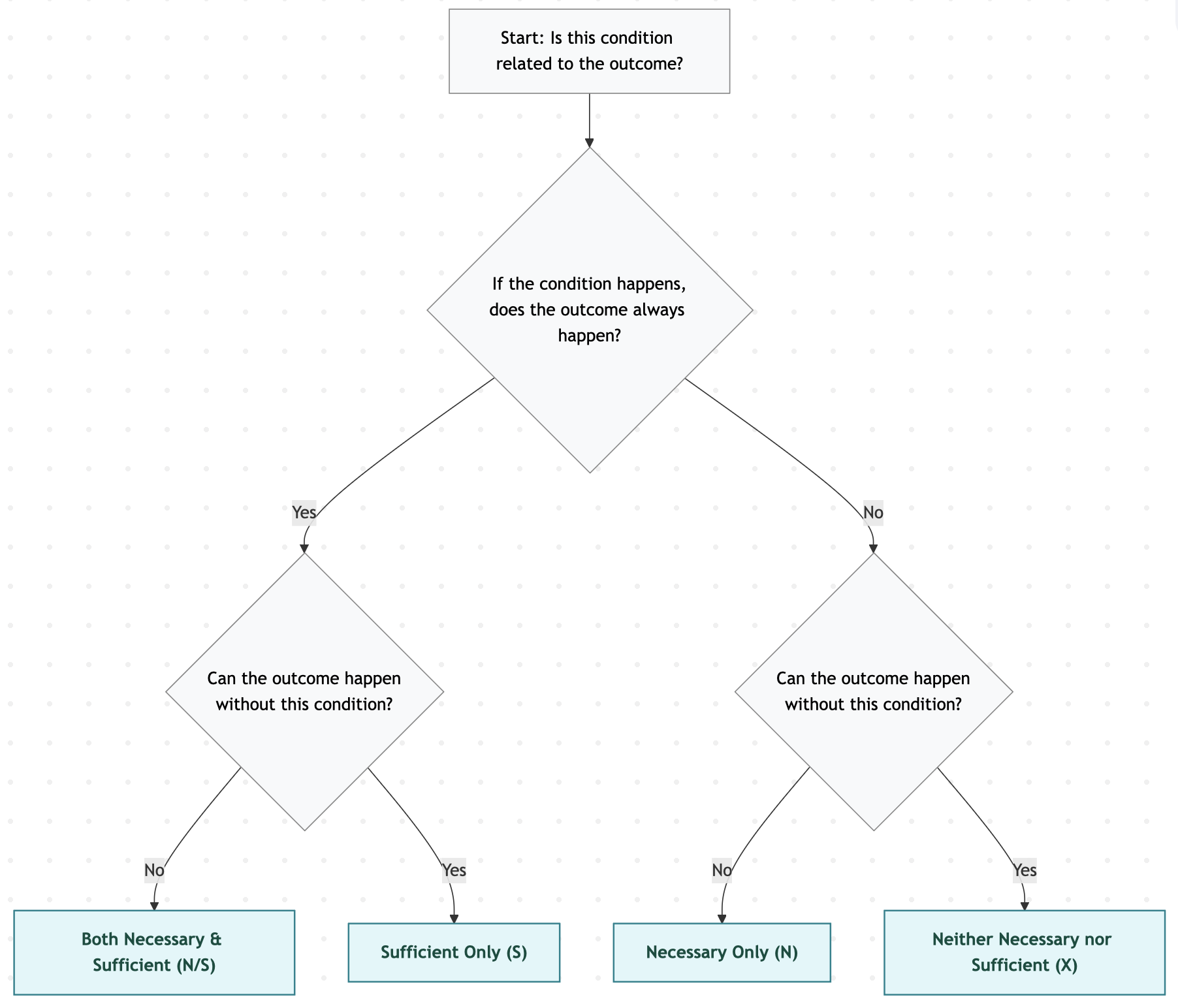
Using the terms 'necessary' and 'sufficient' conditions will be useful in clarifying this ambiguity.
Necessary Condition
A condition that must be present for an effect to occur (although it may not be enough to cause the effect on its own.)
เช่นพวกแบบ Oxygen is needed to cause a fire.
Definition
- It is what the name suggests
- It is a causal factor in which the effect cannot happen without it
Formula
"Without this, then not that..."
How Necessary Statements Are Expressed
- "If this doesn't happen, then that won't occur"
- "If this isn't true, then that isn't true either"
- "If this isn't present, then that won't be present"
- "If it doesn't have (A), then it can't be (B)"
- "If it doesn't do (A), then (B) won't be the result"
Example
"If you did not book your Grab ride, then it won't show up at your door"
More Examples of Necessary Conditions
- "If the SARS-CoV-2 virus hasn't infected you, then you are not sick with COVID-19"
- The virus infection is necessary for COVID-19
- "If the polio vaccine does not prevent polio, then the near-zero cases of polio after vaccination are a coincidence"
- The vaccine's effectiveness is necessary for the reduction in cases
- "If it doesn't have wings, it cannot be a bird"
- Wings are necessary for being a bird
- "If your only CPU won't turn on, you cannot finish your coding task"
- A functioning CPU is necessary for completing the task
Sufficient Condition
A condition that, if present, guarantees the effect — it’s enough to cause the effect.
Example: Striking a match in the presence of oxygen and fuel is a sufficient condition for starting a fire, assuming normal/typical conditions.
Definition
- Necessary and sufficient conditions are different
- Even if the necessary condition is met, this might not be enough to ensure that the effect will happen
- Sufficient conditions are the total conditions that must be met to ensure that the effect happens
Formula
"If this, then that..."
How Sufficient Statements Are Expressed
- "If this is true, then that will always be true"
- "If A is present, then that proves B"
- "If this is true, then that will always follow"
- "If A is present, then B must be true"
Key Point
Having the lottery ticket doesn't mean you will win the prize
Examples of Sufficient Conditions
- "You are in Rangsit, so you are in Thailand"
- Being in Rangsit is sufficient to prove you're in Thailand
- "If the figure has 3 straight sides, then it is a triangle"
- Having 3 straight sides is sufficient to identify a triangle
- "If today is Friday, then tomorrow is Saturday"
- Friday is sufficient to guarantee Saturday follows
- "If the scan shows no brain activity, then the patient is clinically dead"
- Absence of brain activity is sufficient for clinical death
Necessary vs Sufficient Conditions
Necessary
- Whenever a factor is essential, mandatory, or required for the effect to be realized
Sufficient
- Whenever an event or a factor ensures that the effect is realized
Practice: Necessary and Sufficient Conditions
Evaluate the argument. The conclusion is underlined. Identify if the premises meet the necessary or sufficient conditions.
- N = necessary
- S = sufficient
- X = neither necessary nor sufficient
Questions
- Ben is an SIIT student. Therefore, Ben is a math expert. X
- Ben's dorm is 10 minutes from SIIT, and he left his dorm for SIIT 15 minutes ago. Ben is at SIIT now. N
- Ben is an SIIT student. Ben is a Thammasat University student. S
- Ben is in the LAS101 class. Ben is an intelligent student. X
- N คือถามว่า Ben ต้องอยู่ใน LAS101 class มั้ยเพื่อที่จะเป็น intelligent student
- S ถามว่า Guarantee มั้ย
- Ben started his thesis 3 semesters ago. So, Ben has been working on his thesis for 3 semesters now. N
Exercises Causal conditions, Mill’s method
- Eating too much food will cause weight-gain. X
- Throwing a brick through a window will cause the window to break. S
- Releasing the shutter of a camera causes an image to appear on the film. N
- Pulling the trigger of a gun causes it to fire. X
- Pouring water on a wood fire will cause it to be extinguished. S
- Eating contaminated food will cause one to become ill. X
- Flipping the wall switch to the “up” position causes the overhead lights to go on. X
- Getting a degree requires a minimum GPA of 2, and minimum 145 credits in a combination of major and minor subjects. N/S
If there are no oxygen, human cannot live. S
Because Chiang Mai is located in the north, there’s a lot of pollution. X
If someone coughs, they have a sore throat. X
หน้าตาดี จะต้องมีแฟนได้ X
Key Understanding
"Knowing the necessary and sufficient conditions for a claim helps us determine if there is a cause-and-effect relationship. If that factor is a necessary condition, it only allows the possibility of the effect. Factors that are sufficient conditions guarantee that the effect will happen."
3. Causal Arguments & Mill's Methods
Are there other ways to prove cause and effect relationships?
Can we use observation and experience to prove causality?
John Stuart Mill's Methods
Introduction
- John Stuart Mill proposed a useful way for scientists to show that one thing causes another
- In his book A System of Logic, Mill suggested several methods for asking questions in experiments
Examples of Mill's Method of Experimental Inquiry
-
Method of Agreement
- What things were the same when the effect happened?
-
Method of Difference
- What things were missing when the effect did not happen?
-
Joint Method of Agreement & Difference
- What things were the same when the effect happened?
- What things were the same when the effect did NOT happen?
Method of Agreement
Definition
The method of agreement looks at two or more instances of an event to see what they have in common.
Example: Restaurant Food Poisoning
Scenario:
- Four people eat at a restaurant
- Only three get food poisoning
- The method of agreement tells us to investigate what the three instances have in common
Analysis Table:
| Instances of the Effect | Fish | Spaghetti | Ham | Bread | Appetizer | Soda | Beer | Wine |
|---|---|---|---|---|---|---|---|---|
| John: Food poisoning | ✅ | ✅ | ✅ | ✅ | ||||
| Robert: Food poisoning | ✅ | ✅ | ✅ | |||||
| Christina: Food poisoning | ✅ | ✅ | ✅ | ✅ |
Result:
- In all three instances of the effect, the appetizer was the one thing in common
- Therefore, the appetizer is the cause
Method of Difference
Definition
We look at two cases—one where the event happens and one where it doesn't. If everything is the same except for one difference, that difference is probably the cause.
Example: Different Meal Analysis
Scenario:
- Examine the same diners at a different meal
- Look for the difference between the three who got food poisoning and the one who did not
Analysis Table:
| Instances of the Effect | Hamburger | French Fries | Tea | Pie |
|---|---|---|---|---|
| John: Food poisoning | ✅ | ✅ | ✅ | ✅ |
| Robert: Food poisoning | ✅ | ✅ | ✅ | ✅ |
| Christina: Food poisoning | ✅ | ✅ | ✅ | ✅ |
| Kristin: No food poisoning | ✅ | ✅ | ✅ |
Result:
- Kristin is different from the three - she didn't get food poisoning
- We see that Kristin didn't eat fries
- Therefore, the fries are the cause
Joint Method of Agreement and Difference
Definition
The joint method of agreement and difference combines the first two approaches. Adding the results of the two methods into one analysis strengthens our claim.
Analysis
Combined Table:
| Instances of the Effect | Fish | Spaghetti | Ham | Bread | Appetizer | Soda | Beer | Wine |
|---|---|---|---|---|---|---|---|---|
| John: Food poisoning | ✅ | ✅ | ✅ | ✅ | ||||
| Robert: Food poisoning | ✅ | ✅ | ✅ | |||||
| Christina: Food poisoning | ✅ | ✅ | ✅ | ✅ | ||||
| Kristin: No food poisoning (Shaded) | ✅ | ✅ | ✅ |
- The 3 white rows show the results of agreement
- The shaded row shows the result of the method of disagreement
Key Rules
- The effect must always be present when the cause is present
- The effect must always be absent when the cause is absent
Conclusion
The joint method allows us to assert that the appetizer is a sufficient condition for their food poisoning.
Applying Mill’s Methods
“Why did some students fail in the midterm exams?”
- Create a joint method chart with:
- At least 4 instances of the effect
- At least 3 possible causes
| Instance | Missed ≥ 30% of lectures | Crammed | Slept < 5 hours the night before |
|---|---|---|---|
| I1 Fail | ✓ | ✓ | ✓ |
| I2 Fail | ✗ | ✓ | ✓ |
| I3 Fail | ✓ | ✓ | ✗ |
| I4 Fail | ✗ | ✓ | ✗ |
| I5 Pass | ✓ | ✗ | ✓ |
| I6 Pass | ✗ | ✗ | ✓ |
| I7 Pass | ✗ | ✗ | ✗ |
Construct a table that supports this conclusion.
Which one of Mill’s methods did the doctor use?
A man developed an allergic reaction to an unknown food. His doctor asked him
about foods that often cause allergic reactions, and the man replied that he had
eaten coconut, chocolate, nuts, milk products, shellfish, peppers, eggs, and wheat
products prior to suffering the reaction. The doctor told him to eliminate all of these
foods from his diet; when he had done so, the reaction disappeared. The doctor then
told him to introduce each of these foods back into his diet, one at a time. The man
did so, and the reaction reappeared only when he ate milk products. The doctor
concluded that milk products caused the allergic reaction.
| Trial | Coconut | Chocolate | Nuts | Milk Products | Shellfish | Peppers | Eggs | Wheat | Allergic Reaction? |
|---|---|---|---|---|---|---|---|---|---|
| T0 – Before elimination | ✓ | ✓ | ✓ | ✓ | ✓ | ✓ | ✓ | ✓ | Yes |
| T1 – All foods removed | ✗ | ✗ | ✗ | ✗ | ✗ | ✗ | ✗ | ✗ | No |
| T2 – Coconut only | ✓ | ✗ | ✗ | ✗ | ✗ | ✗ | ✗ | ✗ | No |
| T3 – Chocolate only | ✗ | ✓ | ✗ | ✗ | ✗ | ✗ | ✗ | ✗ | No |
| T4 – Nuts only | ✗ | ✗ | ✓ | ✗ | ✗ | ✗ | ✗ | ✗ | No |
| T5 – Milk products only | ✗ | ✗ | ✗ | ✓ | ✗ | ✗ | ✗ | ✗ | Yes |
| T6 – Shellfish only | ✗ | ✗ | ✗ | ✗ | ✓ | ✗ | ✗ | ✗ | No |
| T7 – Peppers only | ✗ | ✗ | ✗ | ✗ | ✗ | ✓ | ✗ | ✗ | No |
| T8 – Eggs only | ✗ | ✗ | ✗ | ✗ | ✗ | ✗ | ✓ | ✗ | No |
| T9 – Wheat only | ✗ | ✗ | ✗ | ✗ | ✗ | ✗ | ✗ | ✓ | No |
| T10 – Remove milk again | ✗ | ✗ | ✗ | ✗ | ✗ | ✗ | ✗ | ✗ | No |
Construct a table that supports this conclusion.
Which one of Mill’s methods did Mrs Wilkins use?
Mrs. Wilkins sometimes has trouble sleeping. In order to determine the cause, she
decided to take note of her pre-bedtime behavior over the course of a week. On
Monday she drank camomile tea, had a late dinner, took a hot bath, read from a
book, took a walk, and slept well. On Tuesday she had a late dinner, read from a
book, and slept poorly. On Wednesday she drank a glass of wine, got a massage,
took a walk, and slept poorly. On Thursday she had a late dinner, drank a glass of
wine, read from a book, took a hot bath, got a massage, and slept well. On Friday
she read from a book, drank camomile tea, got a massage, had a late dinner, took a
walk, and slept well. On Saturday she drank a glass of wine, got a massage, took a
walk, drank camomile tea, took a hot bath, and slept well. On Sunday she read from
a book, took a hot bath, drank camomile tea, and slept poorly. What can Mrs. Wilkins
conclude is the cause of sleeping well?
| Day | Camomile Tea | Late Dinner | Hot Bath | Read Book | Walk | Glass of Wine | Massage | Slept Well? |
|---|---|---|---|---|---|---|---|---|
| Mon | ✓ | ✓ | ✓ | ✓ | ✓ | ✗ | ✗ | Yes |
| Tue | ✗ | ✓ | ✗ | ✓ | ✗ | ✗ | ✗ | No |
| Wed | ✗ | ✗ | ✗ | ✗ | ✓ | ✓ | ✓ | No |
| Thu | ✗ | ✓ | ✓ | ✓ | ✗ | ✓ | ✓ | Yes |
| Fri | ✓ | ✓ | ✗ | ✓ | ✓ | ✗ | ✓ | Yes |
| Sat | ✓ | ✗ | ✓ | ✗ | ✓ | ✓ | ✓ | Yes |
| Sun | ✓ | ✗ | ✓ | ✓ | ✗ | ✗ | ✗ | No |
4. Misuse of Inductive Reasoning
How do people misuse inductive argument?
Common Fallacies in Inductive Reasoning
Every day, we encounter arguments that misuse inductive reasoning. These may concern pregnancy, poverty, violence, or even achieving a fit and firm body. Such arguments commit mistakes through various fallacies:
- Chicken and Egg Fallacy
- Post hoc, ergo propter hoc (False Cause)
Chicken and Egg Fallacy
General Form
Structure:
- A and B regularly occur together
- Therefore, A is the cause of B
What Goes Wrong
- There is no common cause that brings about A and B
- An assumption is made that one event must cause another just because the events occur together
- The assumption is based on inadequate justification
- There is not enough evidence to draw a causal conclusion
Chicken and Egg Fallacy - Example
The Problem Illustrated
Argument A:
- The people who often have violent behaviors are the people who play violent video games
- Therefore, playing violent video games is the cause of violent behavior
Argument B:
- People who are violent play violent video games
- Therefore, violent video games are created for people with violent behaviors
Analysis
- Argument A says: A happens with B often, therefore A is the cause
- Argument B says: B happens with A often, therefore B is the cause
- Both commit the chicken and egg fallacy - we can't determine which came first or which causes which
Chicken and Egg Practice
Which is a Chicken and Egg Fallacy?
Argument A:
- Johnny Cash was famous
- He was also on television frequently
- Therefore, Johnny Cash was famous because he was on television frequently
- ❌ This IS a chicken and egg fallacy (maybe he was on TV because he was famous!)
Argument B:
- I didn't wash dishes all week
- My dirty dishes started to grow mold
- If I don't want mold growing on my dishes, I should wash them
- ✓ This is NOT a fallacy (there's a clear causal relationship)
Post Hoc, Ergo Propter Hoc
Definition
This fallacy, sometimes referred to as false cause, looks like this:
Structure:
- Event A precedes event B
- Therefore, Event A caused event B
Example
- Ahmed tries to open a video program on his computer, but it crashes
- He concludes that the program is causing the computer to crash
Why It's a Problem
- The fact that the opening of one program always precedes the crash is a good possibility for cause
- But it cannot be maintained as the one and only cause until a stronger link is made
Post Hoc Practice
Which is NOT an example of a post hoc fallacy?
a. I thought my team would lose the game, and they did. If I want them to win next time, I need to think more positively.
- ❌ This IS post hoc (thinking negatively doesn't cause losing)
b. Shari wanted to make a great meal for her guests, so she picked out a delicious looking recipe and followed it exactly. Her guests loved it.
- ✓ This is NOT post hoc (following a recipe has a legitimate causal relationship with the result)
c. Jason did not have time to brush his teeth before his dentist appointment. But the dentist told him he had no cavities. So, Jason has decided he does not need to brush his teeth anymore.
- ❌ This IS post hoc (one instance doesn't prove causation)
LAS101 Roadmap
Course Structure
- Introduction
- Definitions
- Concepts on Proof and Belief
- Limits of Human Thinking and Errors
- Arguments
- Propositions and Inductive Argument ← We are here
- Formal Deduction ← Next target
Key Takeaways
- Deductive reasoning provides certainty (if premises are true, conclusion must be true)
- Inductive reasoning provides probability (conclusion likely but not certain)
- Causal arguments claim something causes something else
- Necessary conditions are required for an effect (without X, no Y)
- Sufficient conditions guarantee an effect (if X, then definitely Y)
- Mill's Methods help establish causation through observation
- Chicken and Egg Fallacy assumes causation from correlation
- Post Hoc Fallacy assumes causation from temporal sequence
False cause fallacies in contemporary issues
Can you analyze necessary and sufficient conditions for these causal arguments?
- Claim: Autism rates increased after the introduction of certain vaccines, so vaccines must cause autism.
- Claim: A government passes new economic legislation, and unemployment drops shortly after-therefore, the policy caused the drop.
- Claim: Mental health issues among teens increased after social media became popular, so social media is the cause.
- Claim: A company introduces Al automation, and job losses follow-therefore, automation caused unemployment.