Nodal Analysis
- Nodal analysis, also known as the node-voltage method provides a general procedure for analyzing circuits using node voltages as the circuit variables. It is based on a systematic application of Kirchhoff’s current law (KCL) + Ohm’s Law
Nodal Analysis without Voltage Sources
- Given a circuit with nodes without voltage sources, the nodal analysis of the circuit involves the following steps.
The Nodal Analysis Steps
- Determine the number of nodes.
- Select a node as a reference node (assume as ground where ).
- Assign voltage variables () to the remaining nodes.
- These voltages are referenced with respect to the reference node.
- Assign current variables (, and so on) at each node where voltage is unknown. (สมมติกระแสที่ไหลในแต่ละเส้นของวงจร)
- เนื่องจากอันนี้ยังไม่มี Voltage Sources ดังนั้นทุกอันที่เป็น non-reference nodes จะเป็น unknown หมด
- Note that, in a resistor, current flows from a higher potential to a lower potential.
Nodal Analysis with Voltage Sources
- อันนี้จะใช้ในกรณีไหนบ้าง มาดูกัน
- ถ้าแหล่งจ่ายแรงดันต่อเชื่อมระหว่าง Reference Node
The voltage at the non-reference node is equal to the voltage of the voltage source
- ถ้าแหล่งจ่ายแรงดันต่อเชื่อมระหว่าง Node กับ Node (โดยที่ทั้ง 2 Node ไม่ใช่ Reference Node) → จะ Form Supernode!
- สามารถใช้ KVL ในการคิดหาอีกสมการนึงได้
- ถ้าแหล่งจ่ายแรงดันต่อเชื่อมระหว่าง Reference Node
- แต่วิธีการคิดก็เหมือน Step ข้างบน แค่ Step 4 ต่างนิดหน่อย, คำนึงถึง Supernode ด้วย
Mesh Analysis
- Mesh analysis provides a general procedure for analyzing circuits using mesh currents as the circuit variables. It is based on a systematic application of Kirchhoff’s voltage law (KVL).
- Recall: A mesh is a loop that does not contain any other loop within it.
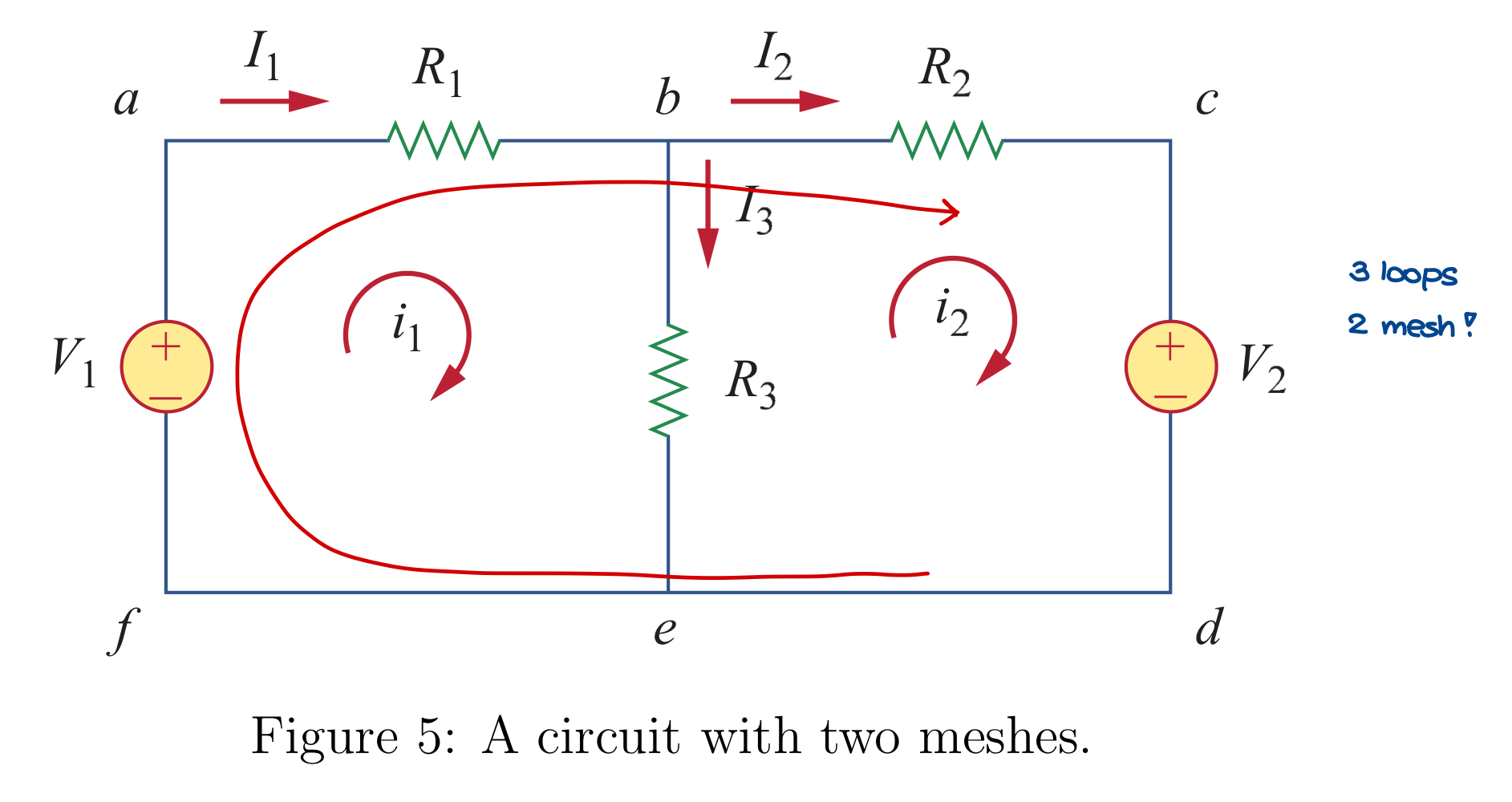
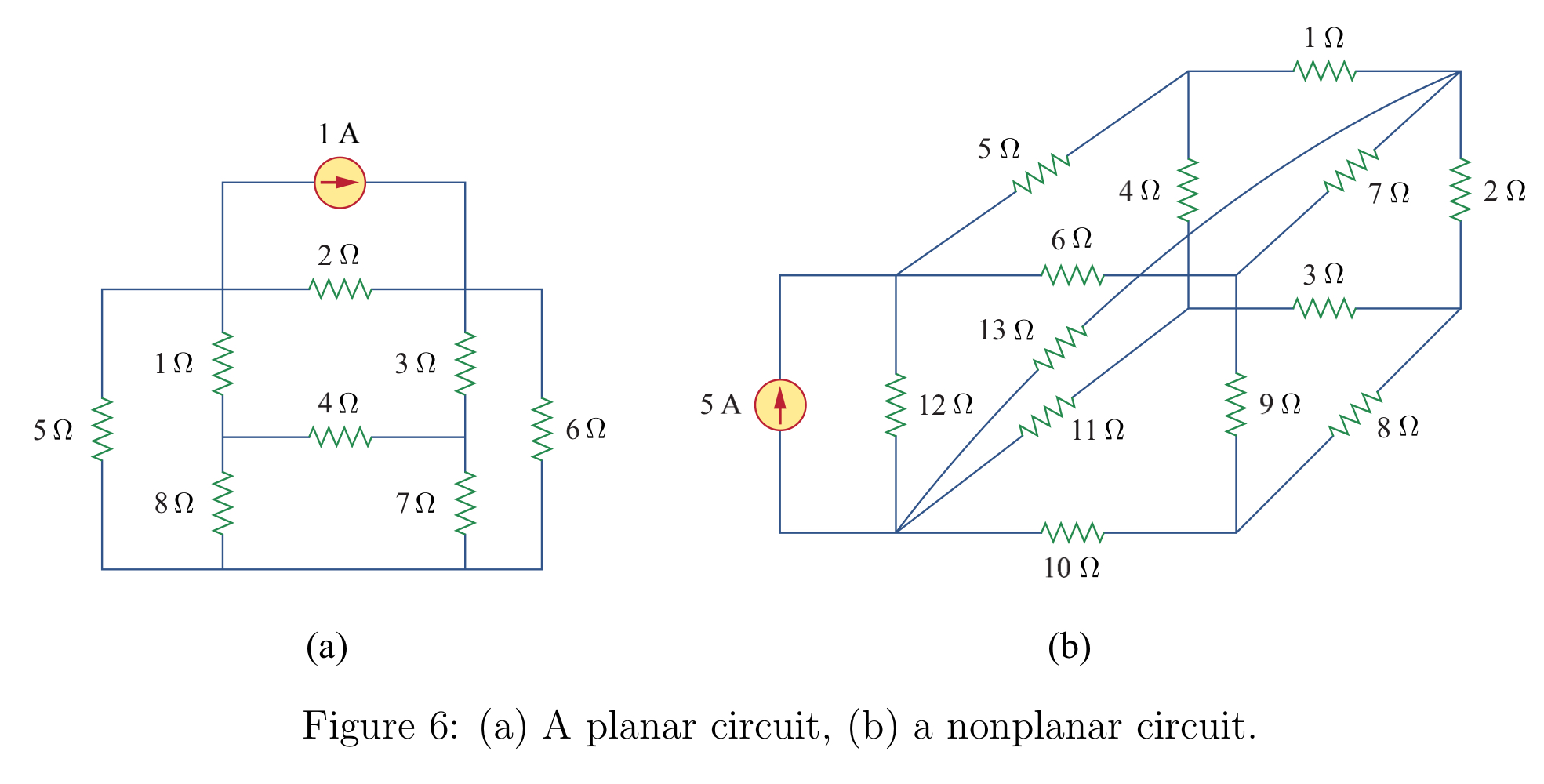
- Mesh analysis only applicable to a circuit that is planar. A planar circuit is a circuit that can be drawn in a plane with no branches crossing one another.
Mesh Analysis without Current Sources
The Mesh Analysis Steps
- กำหนดตัวแปร Current Mesh ในทุก Mesh ()
- ควรกำหนดให้กระแสไหลในทางเดียวกัน (Clockwise Direction ง่ายสุด)
- Define the voltage drop polarities.
- เขียนสมการ Mesh ต่าง ๆ โดยใช้ KVL ร่วมกับ Ohm’s Law
- แก้สมการ (อาจจะต้องใช้ Cramer’s rule)
Mesh Analysis with Current Sources
- จะมี 2 กรณีเช่นกัน
- ถ้าแหล่งจ่ายกระแสอยู่ใน Mesh เดียว
ค่าของกระแสใน Mesh นั้นก็จะมีค่าเท่ากับค่าของแหล่งจ่ายกระแสตัวนั้นเลย
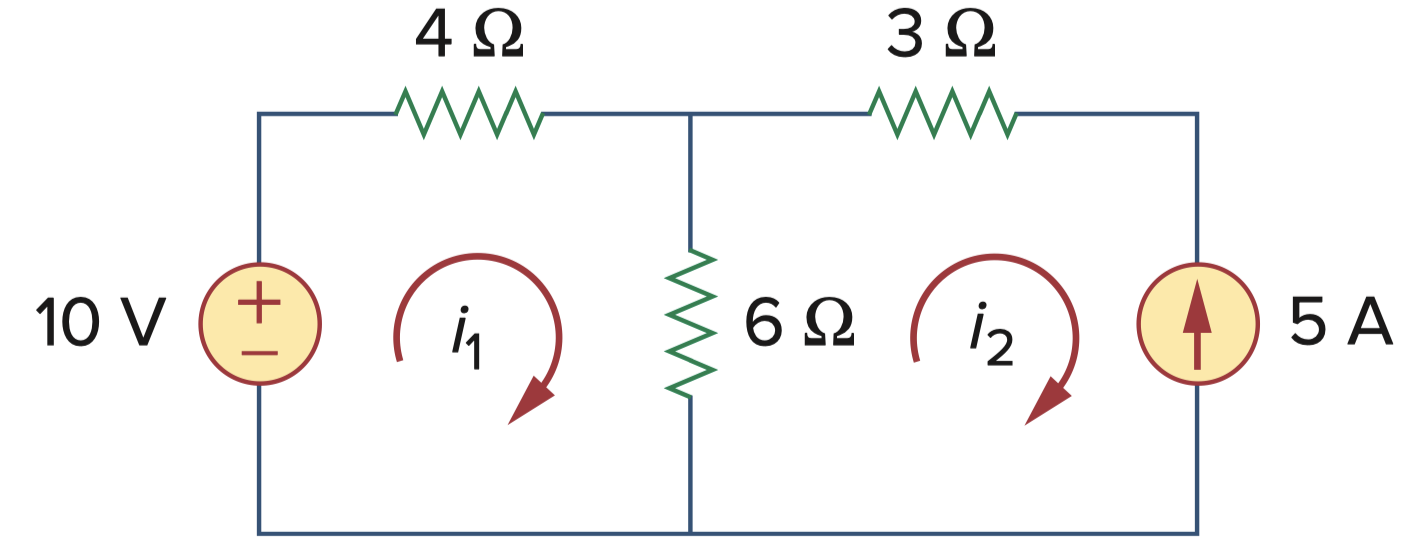
- อย่างข้อนี้คือเป็น Case 1 เลย ดังนั้นเวลาหา Mesh ของ ก็จะหาได้ง่าย ๆ เลย
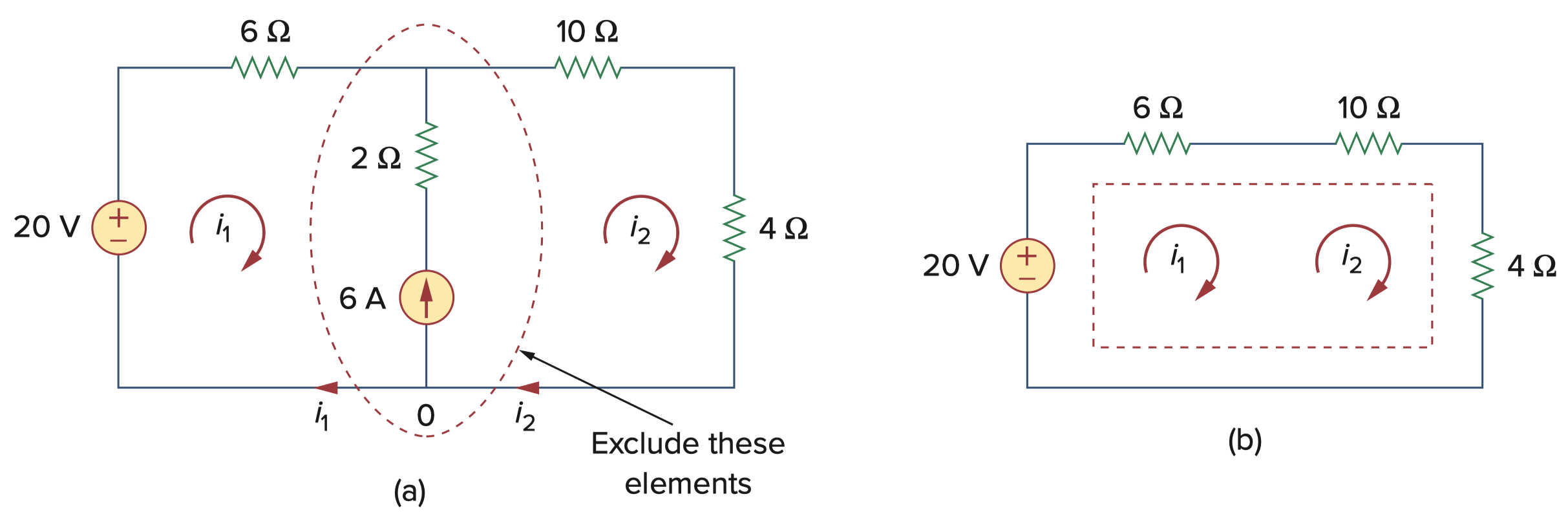
- ถ้าแหล่งจ่ายกระแสอยู่ระหว่าง Mesh สอง Mesh (ดูยังไง ก็ดูกระแสที่ผ่านมันก็ได้ว่ามี 2 ตัวรึเปล่า) → Supermesh
- A supermesh results when two meshes have a (dependent or independent) current source in common. (ดูคนละแบบกับ Node Analysis)
- สามารถ Exclude, Supermesh ไปได้เลย
- อีกสมการก็สามารถหาจากการมอง Supermesh เปล่า ๆ
- ถ้าแหล่งจ่ายกระแสอยู่ใน Mesh เดียว